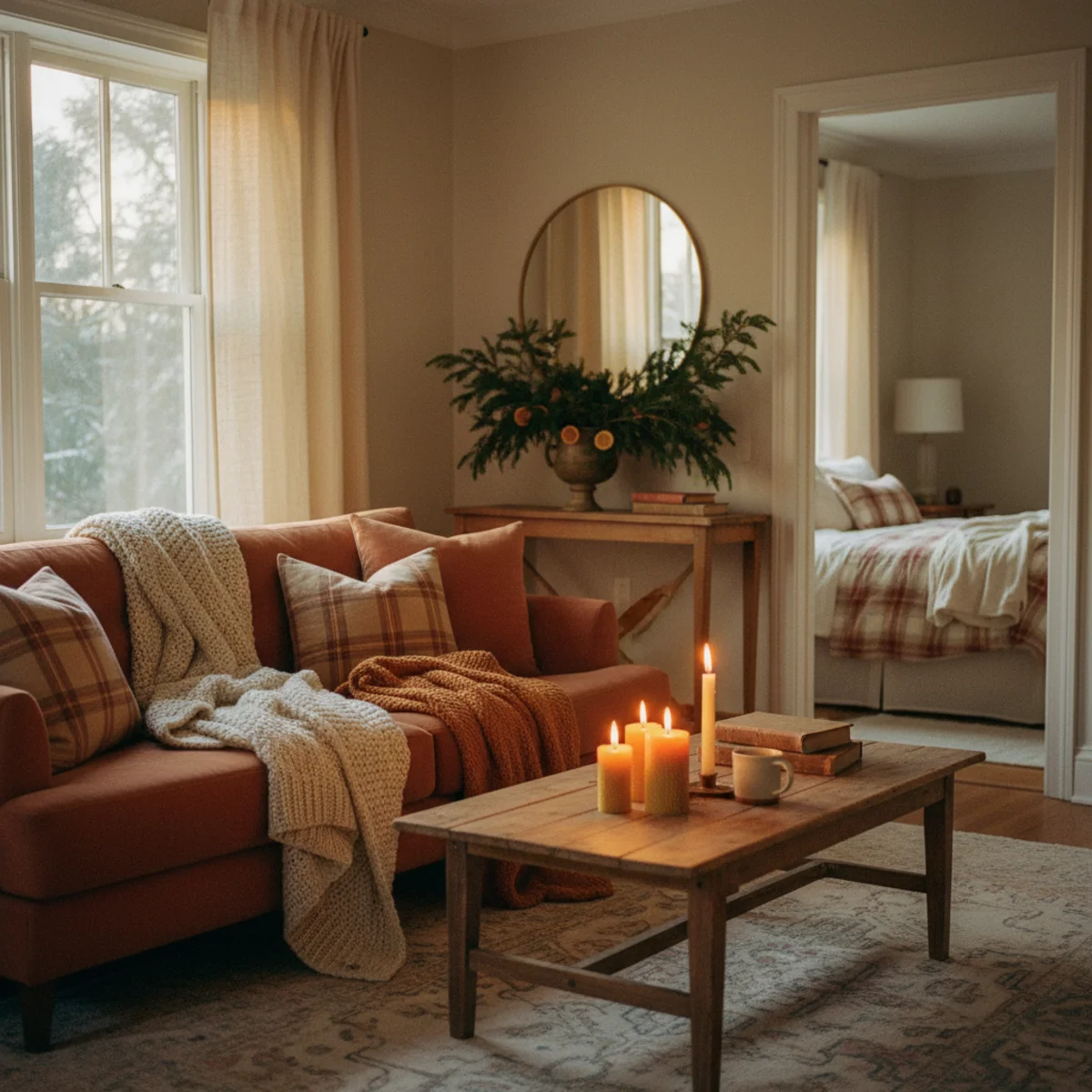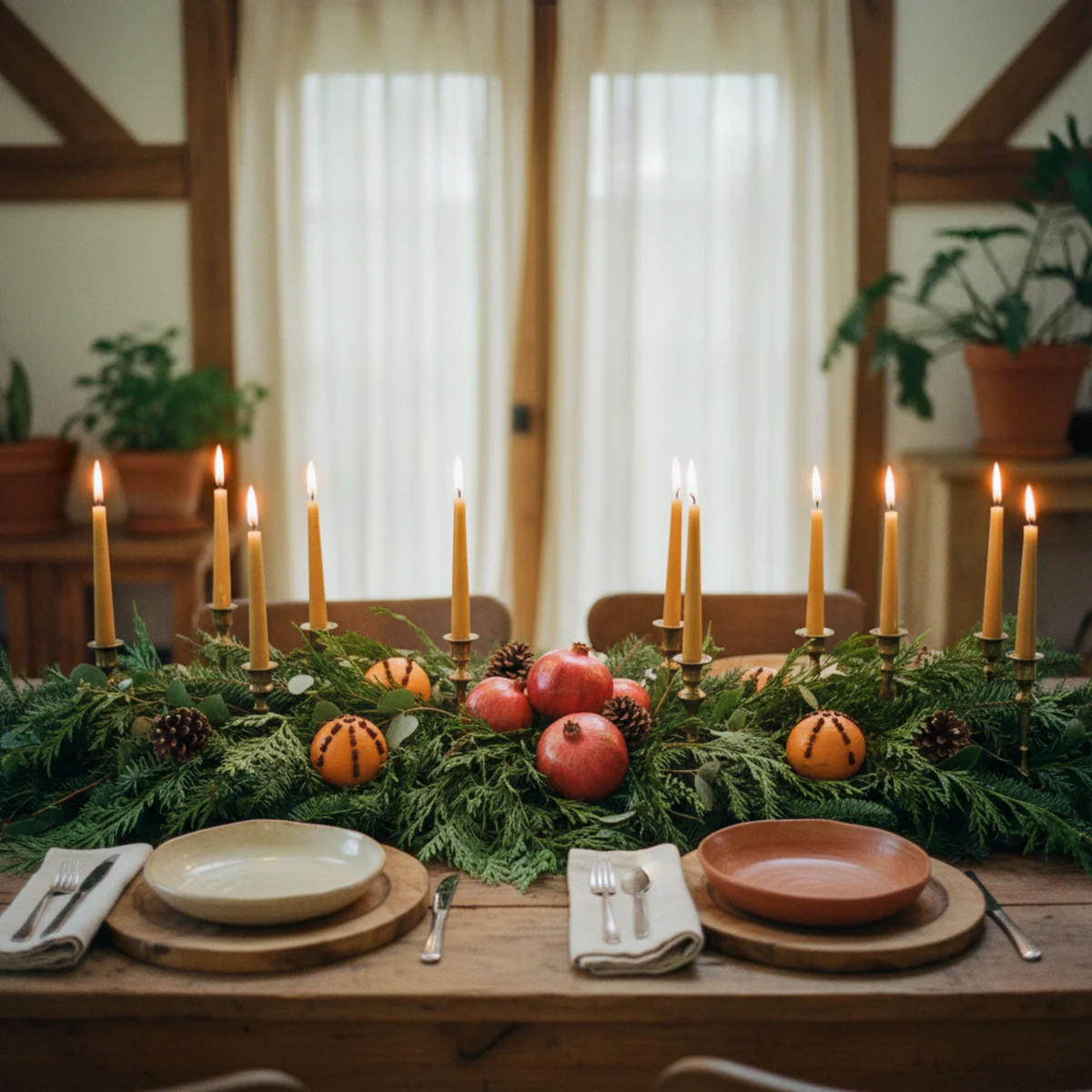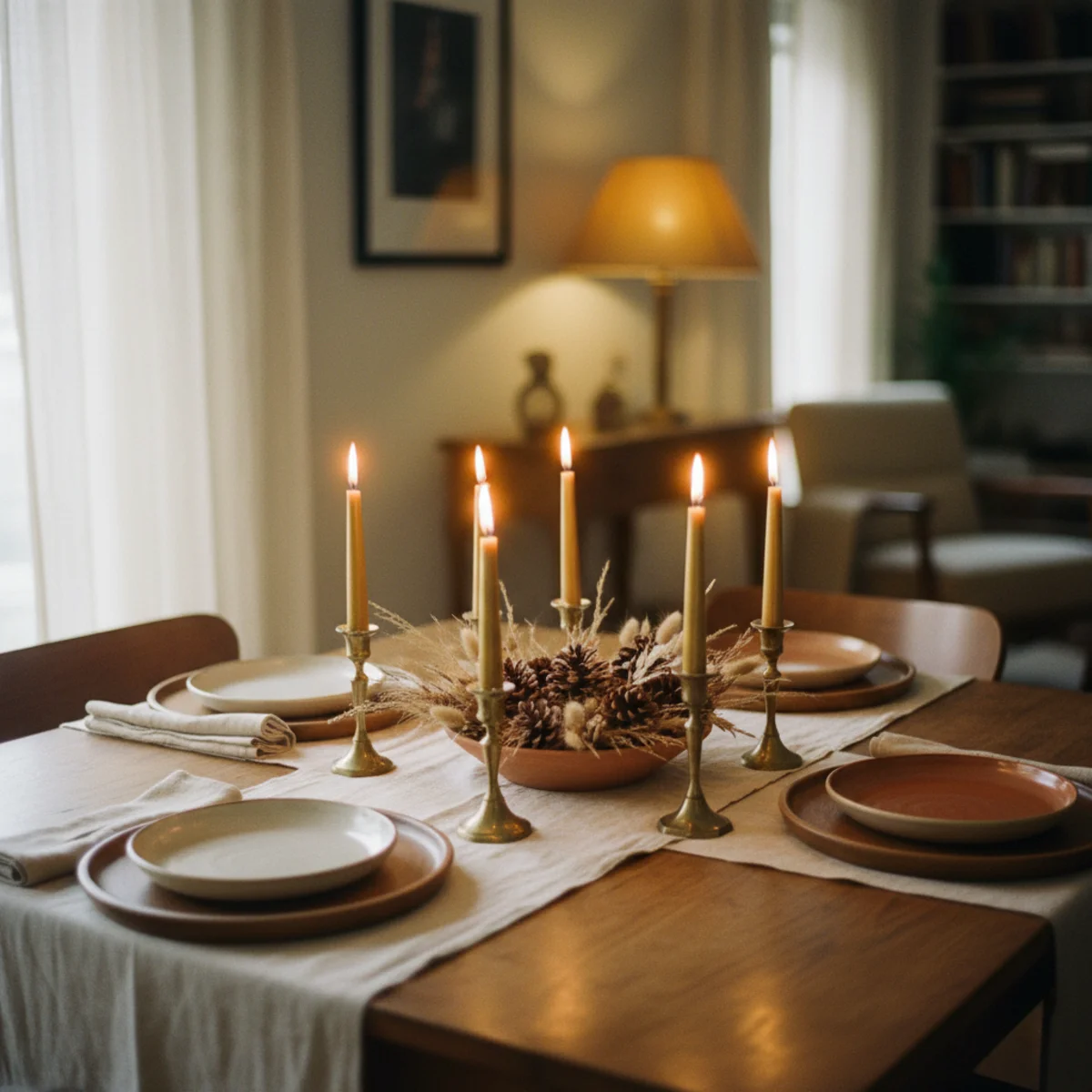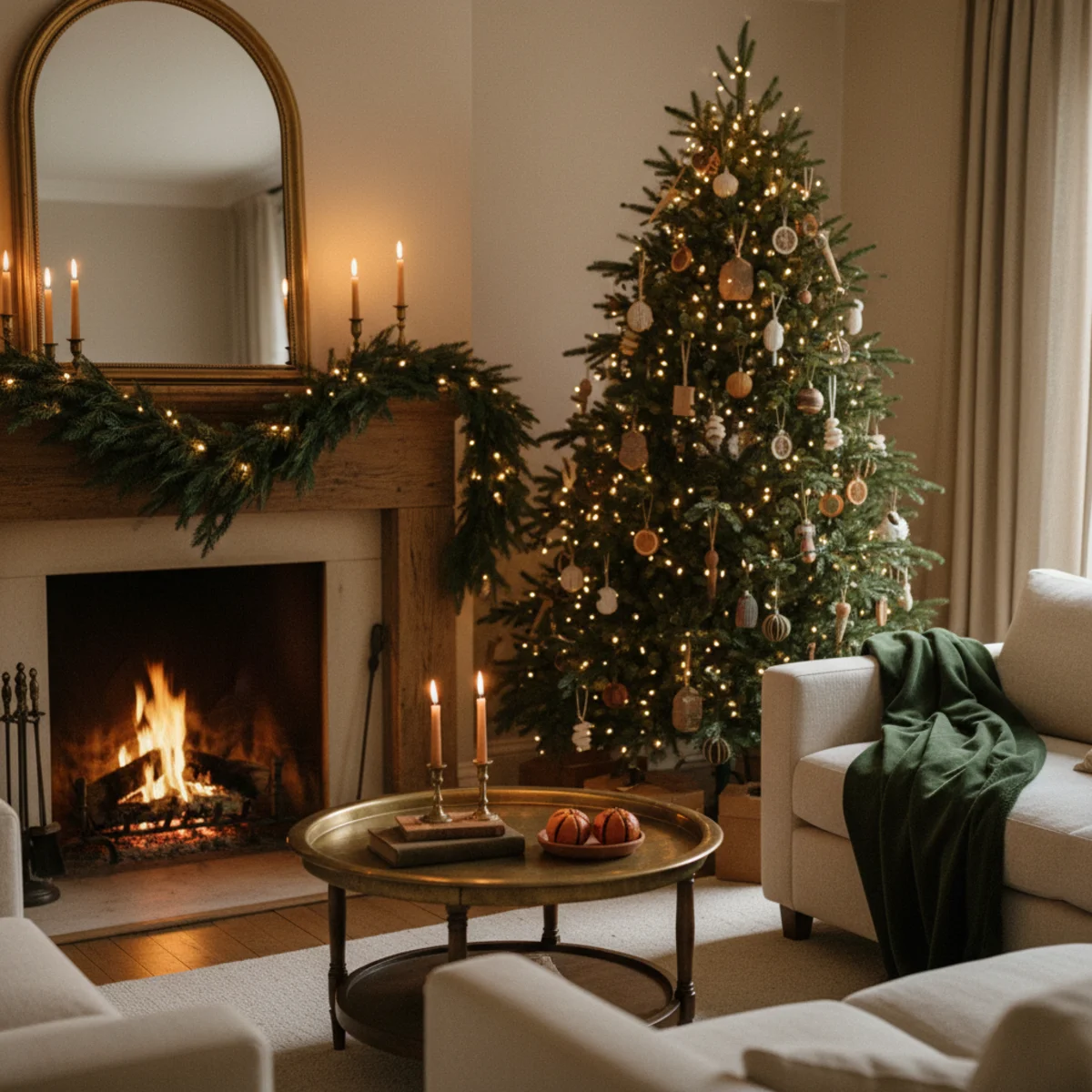
These twelve cozy Christmas decor ideas are tested across actual cozy homes during real holiday seasons — small apartments handling tight gathering space, family homes hosting multiple meals, rental units doing limited-investment seasonal decor. Each move below pulls Christmas back from commercial bright-and-busy toward the warm muted natural aesthetic that genuinely reads cozy: fresh garland, beeswax candles, warm string lights, natural ornaments, a restrained palette. The result is Christmas that feels rooted in warm tradition rather than in retail.
Commercial Christmas decor failed when retailers manufactured the holiday aesthetic at scale — bright red, primary green, plastic everything, generic 'farmhouse Christmas' signs, blue and silver themes that have nothing to do with the season's actual cultural origins. The fix is the opposite direction: muted natural materials, beeswax and wax candles, fresh greenery, hand-thrown ceramics, natural-fiber stockings, restrained palettes that emphasize one or two colors rather than the full retail rainbow.
By the end of this guide, you'll know exactly which moves transform Christmas decor from commercial-bright to genuinely cozy — fresh garland with no plastic, beeswax candles, warm string lights, natural ornaments, the muted palette discipline, and the seven other specific moves that make the holiday season warm rather than busy.
WHAT'S INSIDE
- Why fresh garland (real pine, cedar, eucalyptus) outperforms any plastic garland every time
- The beeswax candle versus paraffin distinction that transforms Christmas atmospheric quality
- The 2700K warm-white string light spec that beats every multicolor option
- The muted palette discipline (one accent color plus natural materials) that defines real cozy Christmas
The most magical holiday rooms are the simplest — real greenery, candlelight, and a few things that mean something. The tinsel is just noise.
— House Beautiful [citation needed — verify before publish]
What is cozy Christmas decor?
Cozy Christmas decor is a warm, natural, restrained take on holiday decorating — real or realistic greenery, warm candlelight, a muted earthy-and-traditional palette, and a few meaningful pieces rather than an overwhelming display of plastic and flashing lights. It carries the warm-home aesthetic into the holidays rather than abandoning it for tinsel.
The defining qualities are real materials and restraint. Fresh garland and a real or realistic tree, beeswax candles and warm string lights instead of cold flashing ones, ornaments in muted tones and natural materials, and a palette that leans on greenery, warm metallics, and deep traditional reds and greens used sparingly. It's the difference between a holiday room that feels like a warm gathering and one that feels like a store display — and it's usually cheaper, since greenery and candlelight cost less than a haul of plastic.
More in Seasonal you may love
See allWhy cozy Christmas decor is everywhere in 2026
As the warm, natural home took over the rest of the year, people wanted their holidays to match — Pinterest's cozy Christmas and natural Christmas decor searches climb every November, away from the bright plastic maximalism of past decades and toward greenery, candlelight, and muted tones.
The honest appeal is warmth and a little restraint. After a year of cozy, natural rooms, the flashing-lights-and-tinsel version feels jarring, while a holiday home of fresh garland, warm candlelight, and a few meaningful ornaments feels like an extension of the warmth people already live in. It's also kinder to the budget and the senses — real greenery and candlelight beat a cart of plastic for both cost and feeling.
28 cozy Christmas decor ideas
01Hang Fresh Garland
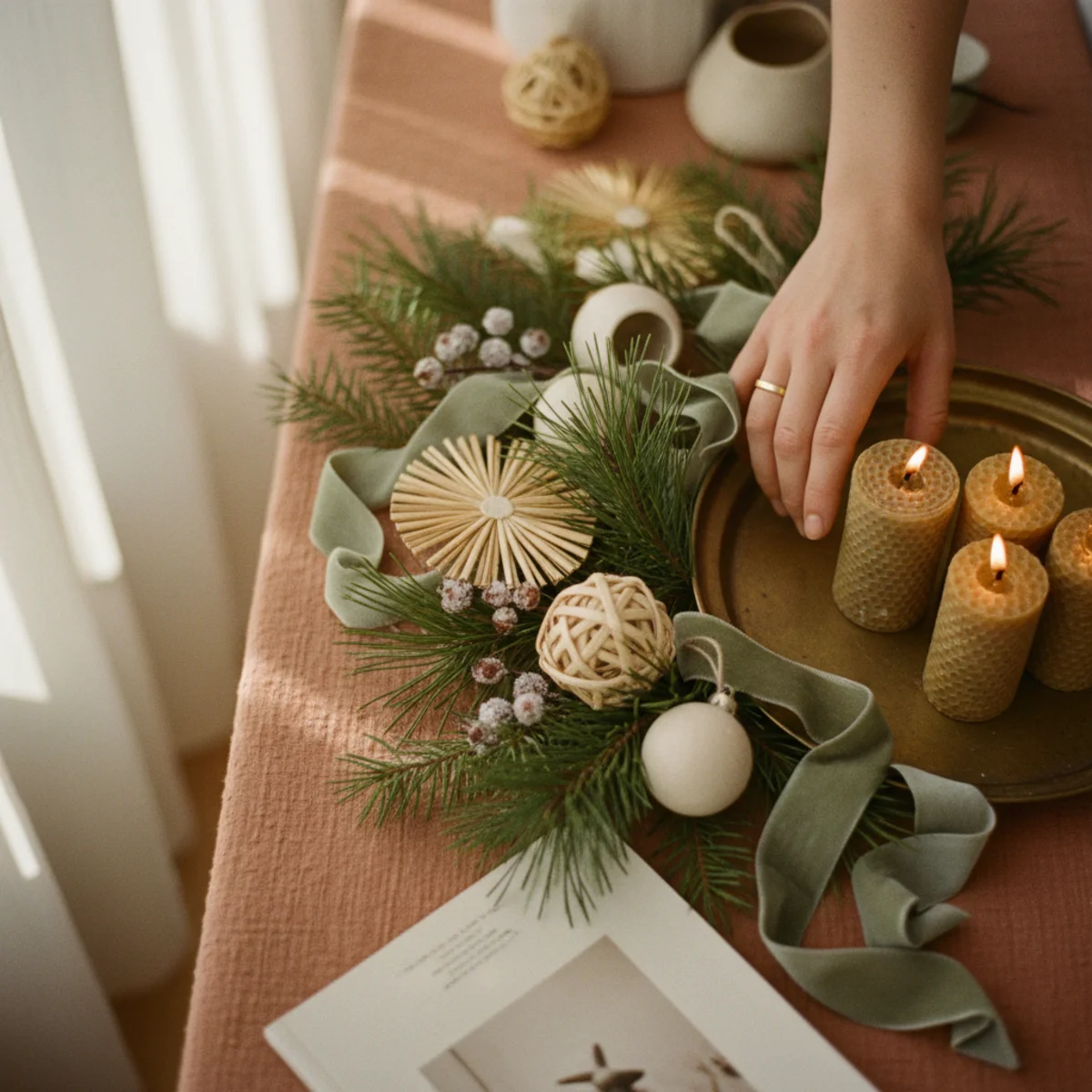
The single most-defining cozy Christmas decor move is fresh garland — real pine, cedar, fir, or mixed evergreen draped along mantels, staircases, doorways, and entry tables. The fragrance alone signals authentic Christmas the way no plastic substitute can; the visible needles and natural irregularity read genuine where uniform plastic reads commercial. Cost: $25 to $80 for the whole house in fresh garland; lasts 2 to 4 weeks indoors.
Best fresh garland sources: TREE LOTS at $5 to $15 per 6-foot strand of mixed evergreen, FARMERS MARKETS during December at $8 to $20 per strand for premium mixed greens, GROCERY STORE FLORAL DEPARTMENTS at $10 to $25 per strand (sometimes lower quality), or DIY garland from your own yard trees plus craft store wire ($3 in supplies). Best species mix: pine (deep green, classic Christmas), cedar (lighter green, fragrant), eucalyptus (silver-tone variation), magnolia (warm tan undersides). Hang on mantels (drape with 6 to 12 inches of overhang on each side), wrap staircase banisters, drape over doorways, layer along entry table or sideboard. Refresh water if attached to wreaths or vases; mist the garland every 3 to 4 days to extend freshness. Cumulative seasonal cost: $25 to $80 for typical 2-3 garland-zone house.
AFFILIATE SLOTGREENERYFresh pine/cedar/fir garland at $5-25 per strand from tree lots; mist every 3-4 days; lasts 2-4 weeksAdd affiliate URL when configuredWhy it works
Because the fragrance is the irreplaceable signal — fresh pine and cedar release scent into the room that is the strongest single olfactory cue of authentic Christmas. Plastic garland has zero fragrance and reads commercial-fake to anyone familiar with the difference. The visual case is similar: fresh garland has irregular needle distribution, varied shade across branches, and the slight droop of real plant material; plastic garland has uniform spacing, single-tone color, and rigid posture that reads manufactured. The compound signals (scent plus visual irregularity) are what make fresh garland genuinely cozy where plastic falls flat.
Pro tip — Combine garland with battery-operated fairy lights woven through the branches — $8 to $15 per 20-foot fairy light strand on copper wire (no plug needed, runs 8 to 12 hours per battery set). The combined fresh garland plus warm fairy lights is the iconic cozy Christmas decor element and works on mantels, staircases, and doorways.
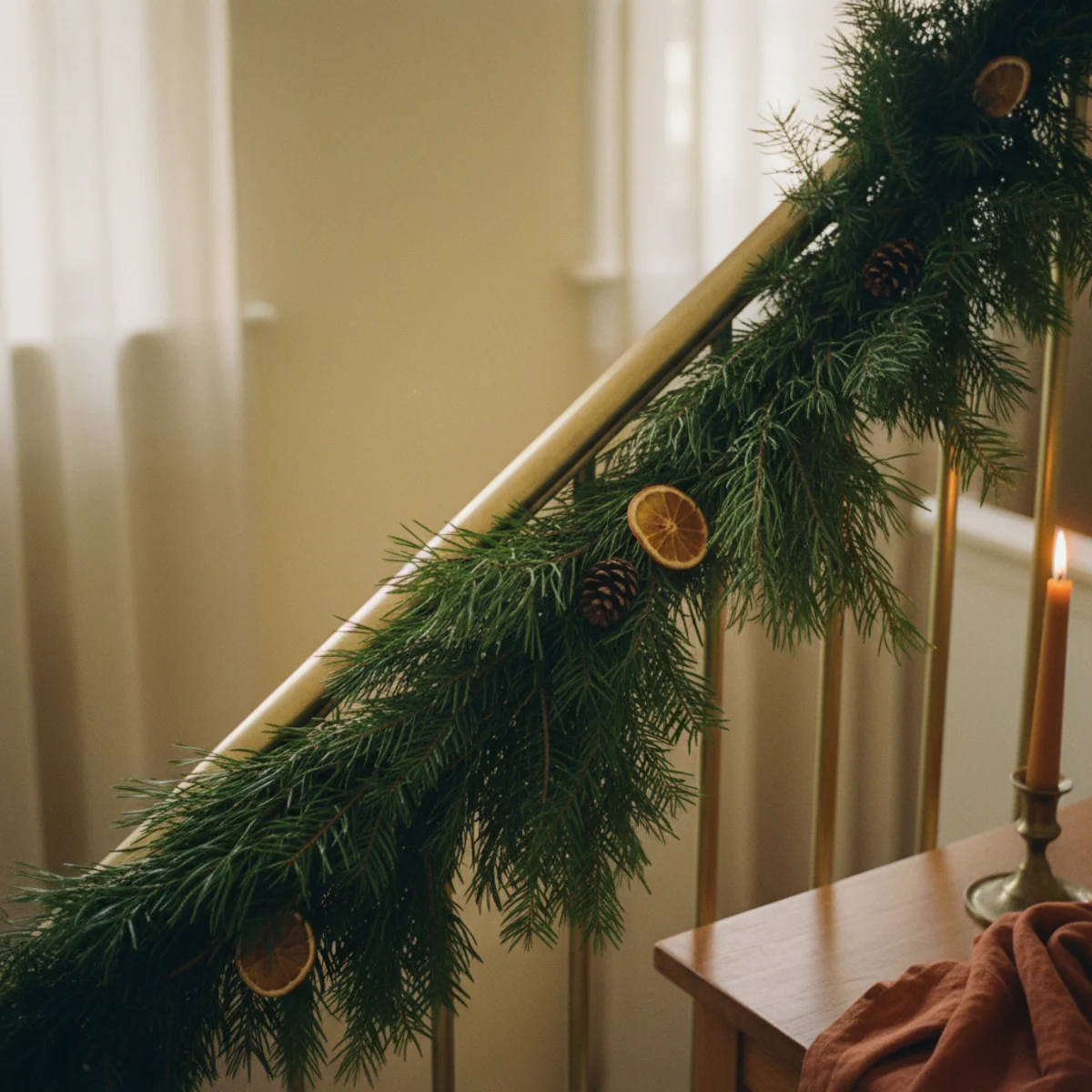
Fresh pine and cedar with fairy lights woven through — the cozy Christmas signal commercial plastic cannot replicate. See also: DIY garland
02Light Beeswax Candles
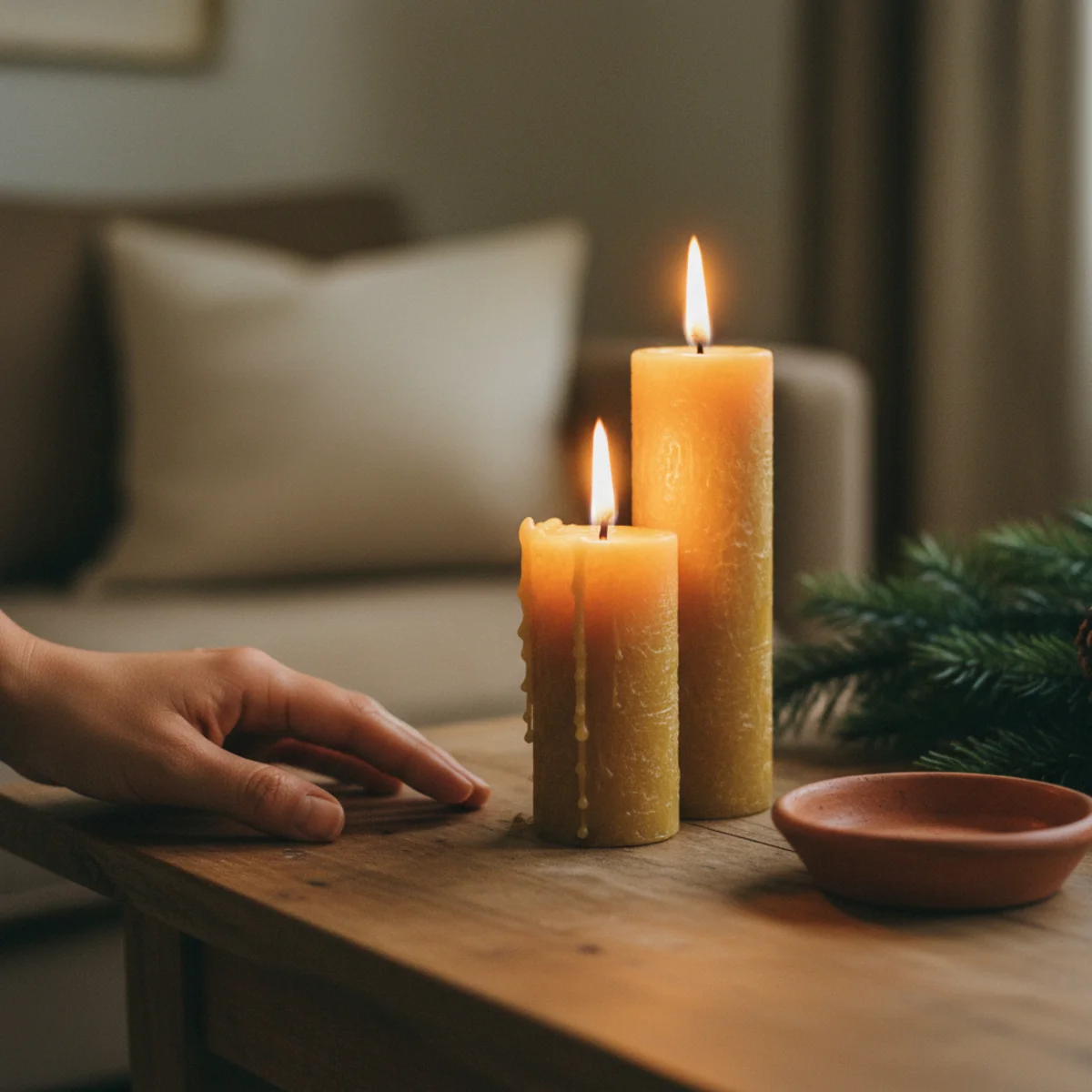
Beeswax candles transform Christmas atmosphere in ways paraffin candles cannot match — natural honey scent (no synthetic fragrance needed), warmer-toned flame, longer burn time, and visual signal of premium quality. The cost premium ($8 to $25 per beeswax candle versus $1 to $5 for paraffin) is offset by longer burn time and dramatically better atmospheric impact across the holiday season.
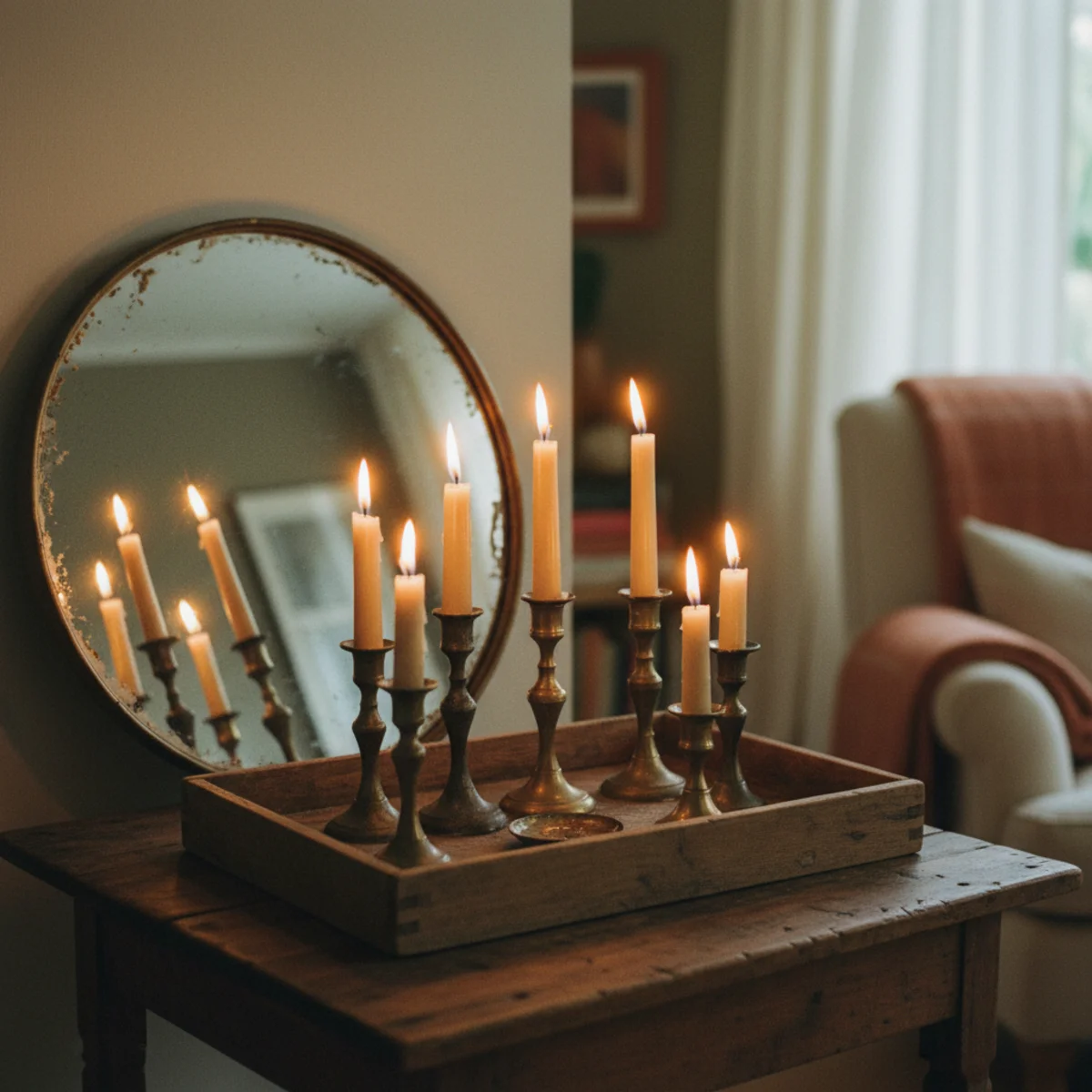
Beeswax candle sources: ETSY ARTISAN MAKERS at $6 to $15 per taper, $15 to $40 per pillar (search 'pure beeswax candles' for highest quality), BEEHIVE COLLECTION at $12 to $20 per taper from independent beekeepers, KNORR BEESWAX TAPERS at $8 to $12 per taper from Whole Foods or natural grocers, LOCAL BEEKEEPERS at $5 to $10 per taper at farmers markets. Look for 100% pure beeswax (not 'beeswax blend' which often means majority paraffin). The natural honey scent fills rooms during burn; the slight yellow tint of the wax adds to warm aesthetic; the burn time is roughly 2x paraffin per ounce. Use in vintage brass holders for the warmest classic Christmas combination ($10 to $30 per holder from estate sales). Light 6 to 12 beeswax candles during evening hours across the holiday season.
AFFILIATE SLOTLIGHT100% pure beeswax tapers and pillars at $6-40 each from Etsy, Beehive Collection, or local beekeepersAdd affiliate URL when configuredWhy it works
Because beeswax candles produce a warmer-toned flame, release natural honey-and-wax scent without any synthetic fragrance, and burn cleaner (no soot or chemical fumes). The combined sensory impact — warm flame plus natural scent — is what makes beeswax candles authentically cozy rather than just decoratively lit. Paraffin candles produce more uniform brighter flames that read as commercial-modern, and any scent has to be artificially added (which often competes with food smells and other ambient scents). The beeswax difference is small per candle but compounds across 60+ holiday evenings into significant atmospheric improvement.
Pro tip — Stock a year-round supply of beeswax tapers in 4 to 6 colors (cream, natural honey, terracotta, deep green) — you'll use them across multiple seasons (Christmas, winter, fall mantels, year-round dinners) and the bulk pricing reduces per-candle cost. Order 24 tapers at $4 to $6 each in fall for the whole-season supply.
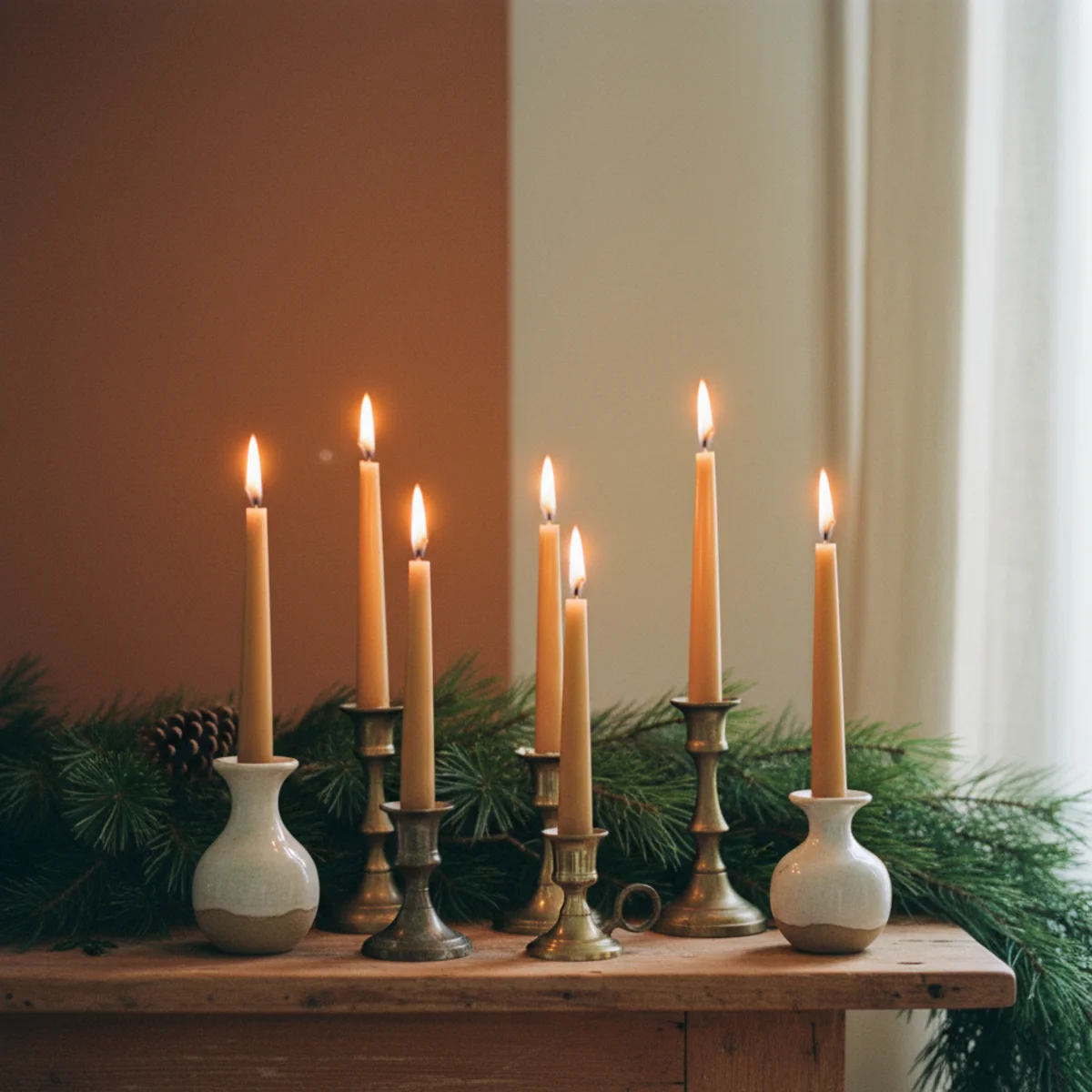
Six beeswax tapers in vintage brass holders — warmer flame and natural honey scent across the holiday. See also: vintage brass holders
03Choose Warm String Lights
Christmas string lights make or break the holiday lighting aesthetic — and the difference between cozy and commercial comes down to one specification: 2700K warm-white. Skip multicolor (commercial), cool white (clinical), blue (cold), red and green alternating (too busy). Pure warm-white at 2700K reads as candlelight at distance and is the only spec that genuinely works for cozy Christmas.
String light specs: LED at 2700K warm-white (not 3000K, not 5000K), in clear glass bulbs or small fairy lights. Best types: VINTAGE-STYLE EDISON BULB STRING ($30 to $80 per 50-foot strand from Brightech, Costco, or Amazon) — large filament bulbs for outdoor or covered porch use, COPPER WIRE FAIRY LIGHTS ($8 to $20 per 20-foot strand) — small lights woven through garland and around trees, MINI WARM-WHITE BULB STRING ($15 to $40 per 50-foot strand) — interior string lights for trees and mantels. Avoid: any multicolor strands, any 'blue/white' or 'cool white' strands, novelty shapes (snowflakes, stars, candy canes), and especially the dollar-store strands that look cheap because they are. Total cost for whole-house warm-white string lighting: $80 to $250 depending on coverage; lights last 8 to 15 holiday seasons.
AFFILIATE SLOTLIGHT2700K warm-white LED string lights only; Brightech Edison-style, copper wire fairy, or warm mini-bulb strandsAdd affiliate URL when configuredWhy it works
Because Christmas atmosphere depends on warm light that approximates candle flame, and 2700K is the temperature that achieves this approximation while LED string lights at 3000K or above read as too bright and slightly clinical. The single specification (2700K, not 3000K, not 4000K) determines whether your tree lights and garland fairy lights read as 'warm Christmas' or as 'commercial holiday display.' Most retail Christmas string lights default to higher temperatures (3500K or 4000K) for higher visible brightness, which produces the harsh blue-tinted Christmas-tree light that fights cozy aesthetic.
Pro tip — Test one strand of any string light brand before committing to whole-house coverage — Kelvin specifications on packaging are sometimes inaccurate, and the actual color reads slightly different across brands. One $15 test strand prevents the much-worse mistake of buying 8 strands of slightly-cool-toned lights.
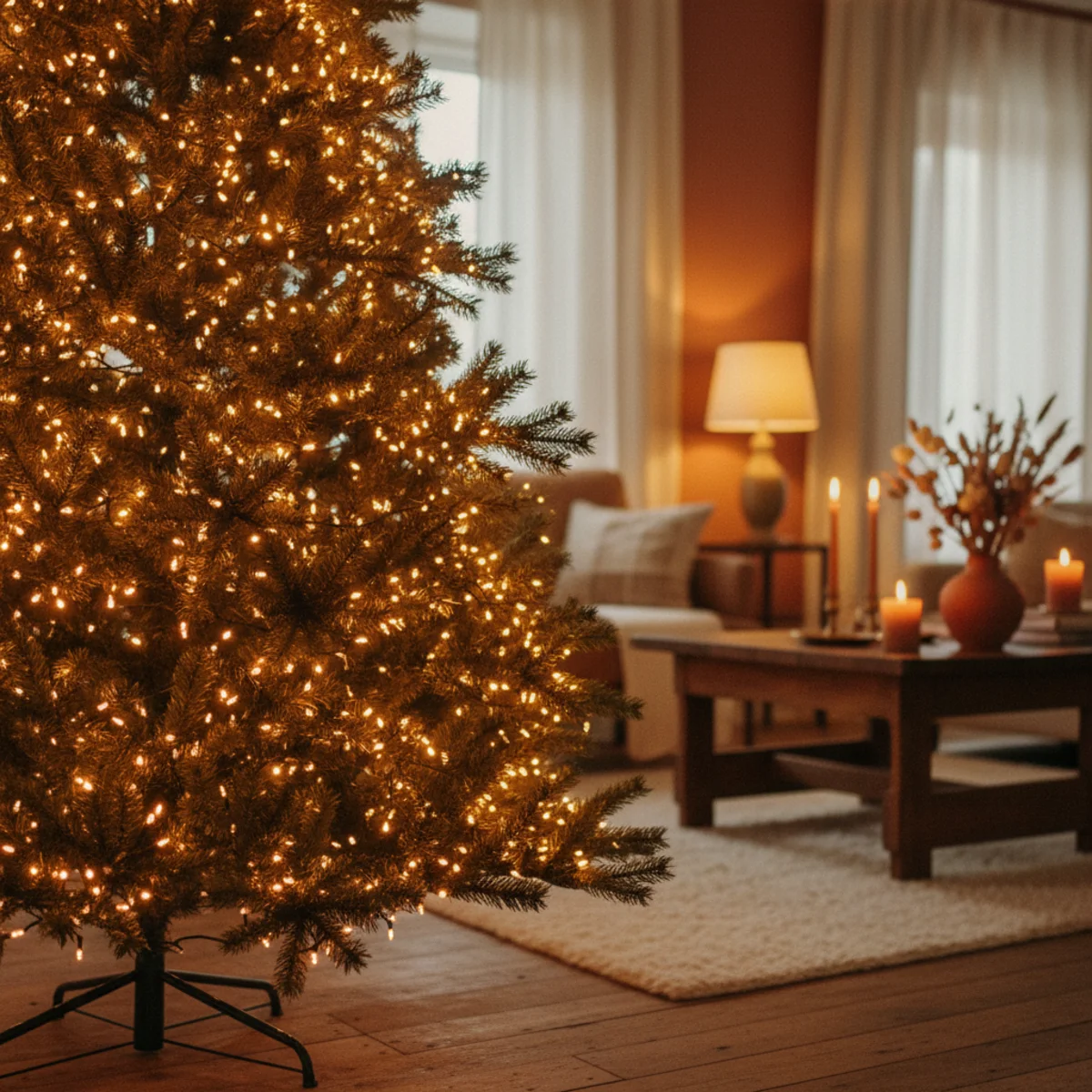
2700K warm-white string lights and copper fairy lights — the spec that turns commercial bright into candlelight glow. See also: Brightech
04Keep a Muted Palette
Commercial Christmas defaults to a full retail rainbow — bright red, primary green, gold, silver, blue, often all in one room. The cozy alternative is restraint: one or two accent colors plus natural materials (wood, brass, wax, evergreen). The discipline keeps the holiday from reading as a Christmas store and lets the natural materials do the seasonal work.
Cozy Christmas palette options: NATURAL + ONE COLOR — natural greens (fresh evergreen, dried foliage) + warm brass + cream + ONE accent of muted terracotta, deep rust, or dusty sage. NATURAL + WHITE — fresh evergreens + cream/oat textiles + warm brass + light wood + minimal pops of muted color. CLASSIC RESTRAINED — deep forest green + cream + warm brass + small amounts of muted red (cranberry, dusty russet, not bright primary red) + natural wood. RUSTIC NATURAL — natural wood + jute + linen + brass + small amounts of dried red berries or dried pomegranates. The restriction: pick ONE palette option and commit, rather than mixing 3 to 4 accent colors. The discipline is what creates the cozy-restrained feel rather than the commercial-busy alternative.
AFFILIATE SLOTPALETTENatural materials + ONE accent color (terracotta, deep rust, dusty sage, muted cranberry); skip the full rainbowAdd affiliate URL when configuredWhy it works
Because the eye reads color volume as visual busy-ness — multiple bright accent colors signal 'commercial holiday display' regardless of how good each individual piece is. The muted-palette discipline allows the natural materials (fresh evergreen, wood, brass, wax) to provide the visual interest, with one accent color adding seasonal punctuation without overwhelming. Restraint is what distinguishes 'warm collected Christmas' from 'every-decoration-from-the-storage-bin-is-out-at-once Christmas.' The reduction in color count compounds across every decor decision.
Pro tip — Audit your Christmas decor storage and donate or store away anything in colors outside your chosen palette — the 5-minute decluttering of mismatched ornaments and bright commercial pieces is the highest-leverage single move toward cozy palette discipline. Without the storage cleanup, the mismatched pieces tempt you back into the commercial palette every December.
Fresh evergreen, warm brass, cream textiles, muted terracotta accent — the restrained palette that reads collected. See also: warm brass
05Add Natural Ornaments
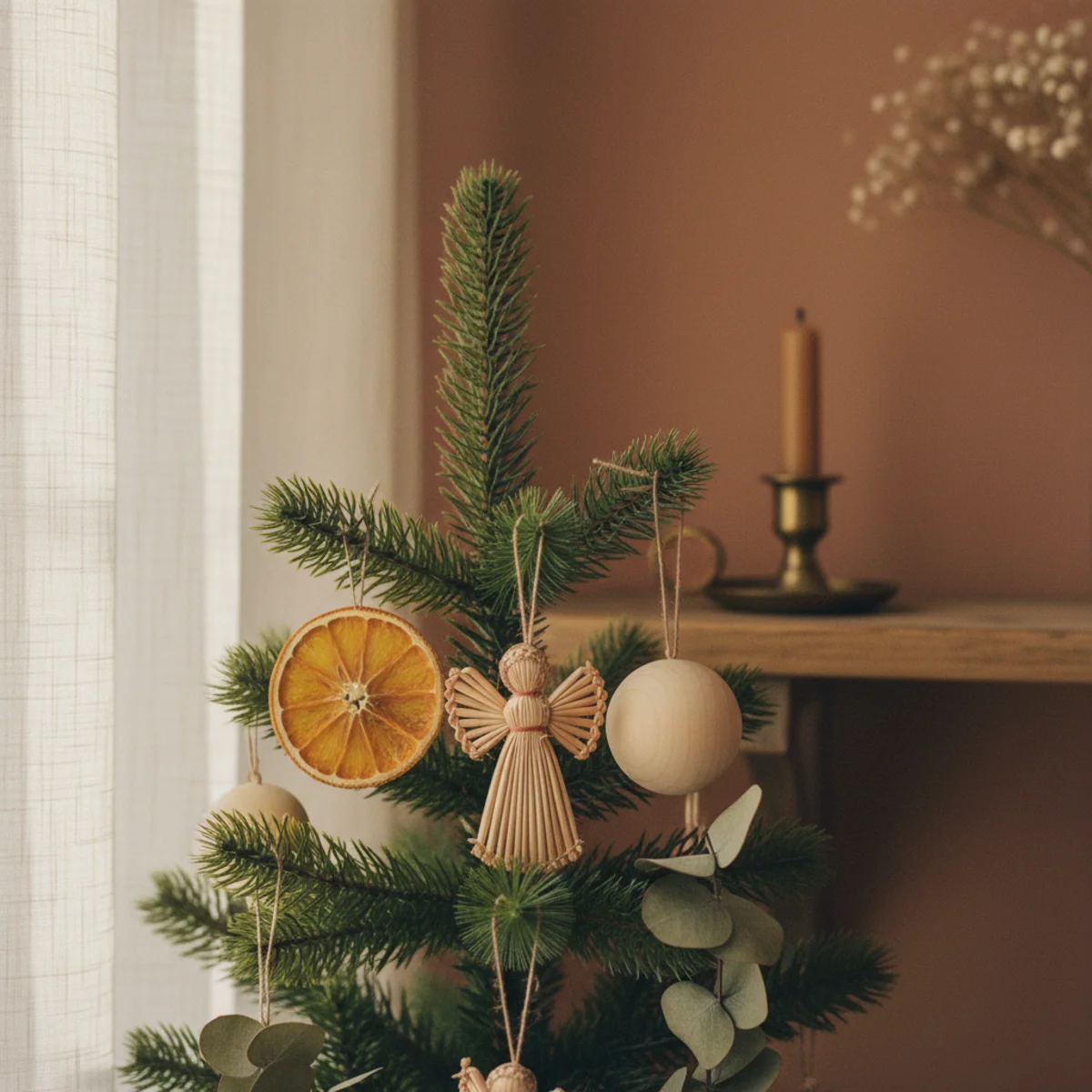
Christmas tree ornaments tell the story — and the difference between cozy and commercial comes down to ornament material. Wood, glass, paper, dried fruit, natural fiber, hand-thrown ceramic, vintage thrifted pieces. Skip plastic ornaments, primary-color mass-produced pieces, and anything purchased as part of a 'set.' Real ornaments tell a real story.
Natural ornament categories: WOODEN ORNAMENTS — hand-turned wood balls, wooden stars and snowflakes ($3 to $15 each from Etsy or local craft fairs), HAND-BLOWN GLASS — clear or warm-toned glass balls, vintage German or Polish glass at $10 to $40 per ornament (Etsy or estate sales), PAPER ORNAMENTS — folded star ornaments, vintage paper birds, fabric and paper combinations ($5 to $25 each), DRIED FRUIT — dried orange slices, dried apple slices, dried pomegranate, threaded on twine or wire ($3 to $10 per garland or as individual ornaments, can be DIY for under $1 each), NATURAL FIBER — pinecones (plain or lightly dusted with white), straw stars, woven jute ornaments ($2 to $15 each), HAND-THROWN CERAMIC — small ceramic ornaments by independent makers ($8 to $25 each from Etsy). Build the tree across years rather than buying complete ornament sets — the collected unevenness reads as 'family Christmas across decades' rather than 'tree purchased this December at Target.'
AFFILIATE SLOTORNAMENTSWood + glass + paper + dried fruit + natural fiber + ceramic; build collection across years not single purchasesAdd affiliate URL when configuredWhy it works
Because tree ornaments are the most-visible Christmas element — what people focus on when entering the room. Plastic ornaments signal commercial mass production; natural materials (wood, glass, paper, dried fruit, fiber, ceramic) signal craft, tradition, and accumulated family history. The visual difference is significant; the emotional difference compounds across years as families layer in ornaments from gifts, travel, milestones, and hand-made projects. The tree becomes a memory ornament rather than a styled display object.
Pro tip — Add one or two new handmade or thrifted ornaments per year rather than buying complete ornament sets — the slow accumulation builds the collection meaningfully across decades, with each ornament carrying some specific origin or memory. Pinterest-style 'shop the whole tree set' approaches read as commercial-display Christmas; slowly accumulated trees read as family Christmas.
Wood, glass, paper, dried fruit, pinecones — the natural ornament mix that reads as collected family history. See also: dried fruit
06Decorate the Mantel With Greenery
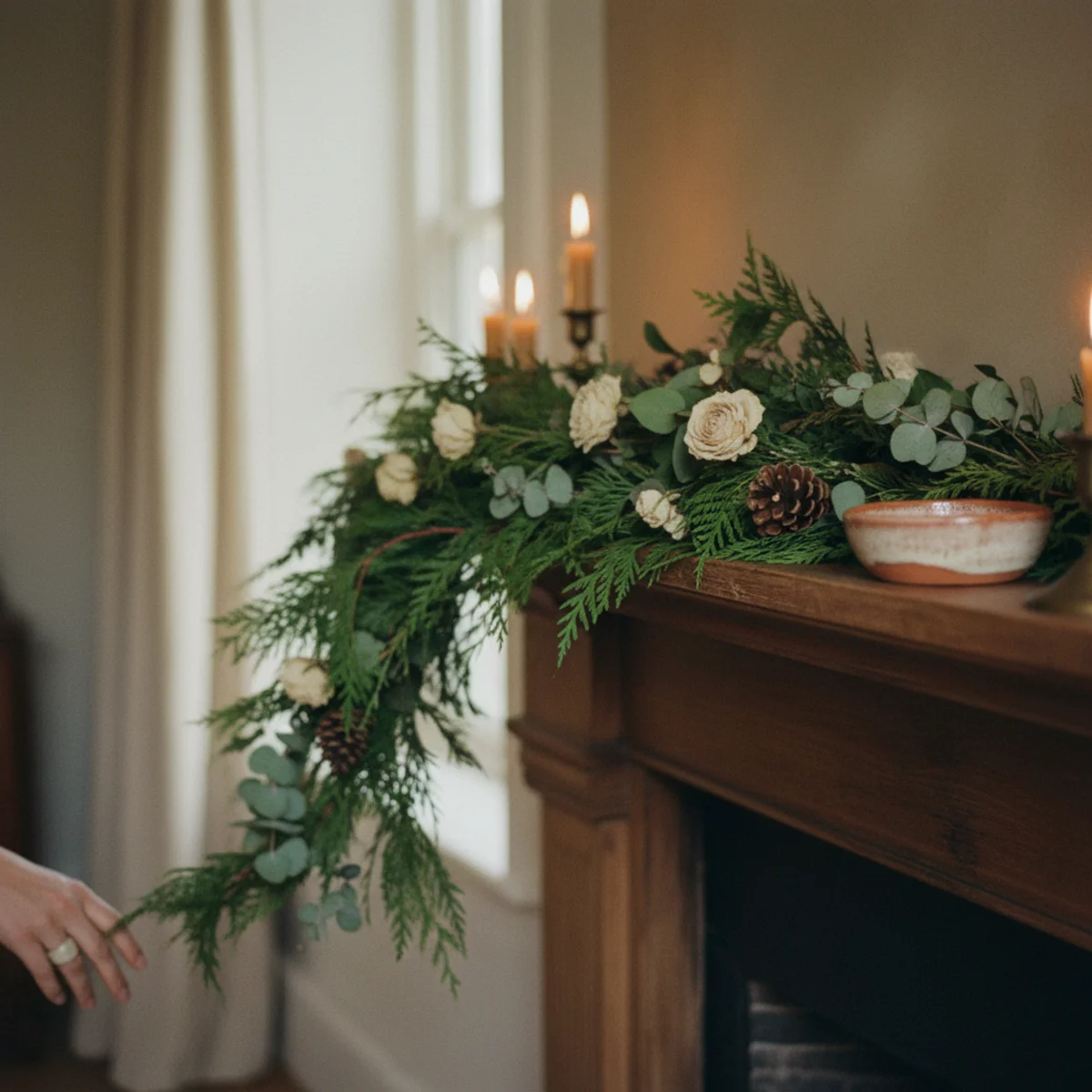
The Christmas mantel is the single most-photographed seasonal vignette — and the cozy version comes down to greenery first, everything else second. Lay a thick base of fresh evergreen garland along the mantel with significant overhang, then add layered elements (beeswax candles in vintage holders, dried fruit garland, framed art) that complement rather than compete with the greenery.
Cozy mantel build sequence: (1) BASE LAYER — fresh garland of pine, cedar, and eucaltyptus mixed, with 8 to 14 inches of overhang on each end and slight drape between candleholders. (2) ANCHOR ELEMENTS — 3 to 5 vintage brass candleholders with beeswax tapers, spaced across the mantel. (3) ACCENT ELEMENTS — small wood or ceramic ornaments tucked into the garland, dried orange slices on twine threaded through the garland, small pinecones in clusters. (4) LIGHTING — copper wire fairy lights woven through the garland (battery-operated, 8 to 12 hour runtime per battery set). (5) BACK ART — single framed botanical print, vintage map, or natural-tone artwork leaned against the wall behind the mantel, height 18 to 36 inches. Keep the mantel visually horizontal — the eye should travel left to right across the layered greenery rather than concentrating on any single point. Total cost for full mantel build: $40 to $120 in materials.
AFFILIATE SLOTMANTELBase fresh garland + 3-5 brass candleholders with beeswax + tucked ornaments + copper fairy lights + leaned artAdd affiliate URL when configuredWhy it works
Because mantel decor with greenery as base layer reads as 'styled around the natural Christmas plant material' (organic, intentional, warm), while mantel decor with greenery as accent reads as 'stuff arranged with some greenery sprinkled in' (chaotic, commercial, busy). The base-first approach makes every additional element read as supporting the greenery rather than competing with it. Mantels are the holiday equivalent of a coffee table styling — the base needs to anchor the composition before any accent elements add detail.
Pro tip — Photograph the mantel from your normal seated position in the room (sofa or main chair) rather than from standing — the mantel will be viewed from that angle for the majority of the season, and styling for that viewing height matters. Many mantels look great from standing but reveal styling problems from seated viewing.
Fresh garland base, brass and beeswax, dried orange, fairy lights, leaned art — every element supporting the greenery. See also: single framed botanical print
07Bring In a Bowl of Citrus and Cloves
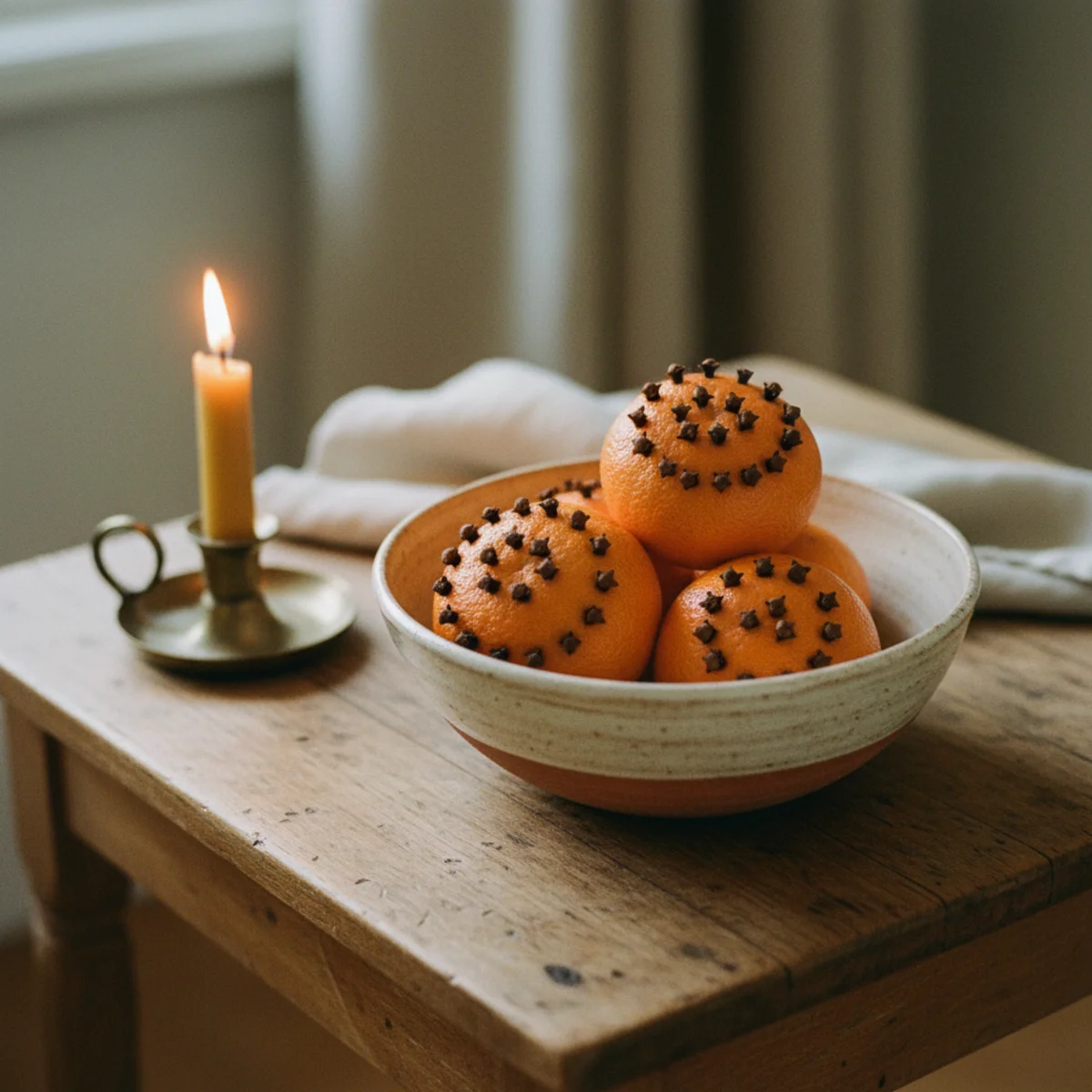
A bowl of fresh citrus studded with whole cloves is the simplest cozy Christmas still life — and it doubles as a natural air freshener. Oranges, lemons, and clementines pressed full of whole cloves release warm spiced scent for 2 to 3 weeks, while the visible composition (bright orange against deep brown cloves) reads as the iconic warm-Christmas color palette in miniature.
Recipe: 5 TO 8 ORANGES, 3 TO 4 LEMONS, optional clementines for size variation. WHOLE CLOVES ($3 to $8 per ounce from spice aisle or bulk bins, about $5 worth makes 8 to 12 fruits). Press cloves into citrus skin in random patterns or concentric rings — 30 to 60 cloves per fruit. The fruits release warm clove scent for 2 to 3 weeks, gradually drying out into pomanders. Arrange in a wooden, ceramic, or brass bowl 10 to 14 inches across, pile slightly with a few pieces standing tall. Position on the dining table, the kitchen island, or the coffee table for daily visual impact. The clove-studded citrus is a 1500-year-old Christmas tradition (the original 'pomander' for scenting medieval homes); the cultural depth reinforces the warm-traditional cozy aesthetic.
AFFILIATE SLOTSCENT5-8 oranges + 3-4 lemons + cloves in wooden/ceramic/brass bowl; press cloves into skin; refresh weeklyAdd affiliate URL when configuredWhy it works
Because it combines three cozy elements in one $10 setup: warm color (bright orange against natural wood or ceramic bowl), authentic Christmas scent (cloves are the dominant traditional Christmas spice), and visible craft (the studded pattern reads as deliberate hand-work rather than purchased decor). The fact that it's also functional (eat the fruit later as it dries; it serves as natural air freshener) reinforces the warm-collected ethos. The whole composition cost $10 and reads as significant cozy holiday detail.
Pro tip — Press the cloves into citrus 1 to 2 hours before guests arrive for maximum scent release — the freshly-pressed cloves release the strongest aroma initially, with declining intensity over 2 to 3 weeks. For ongoing fresh scent across the season, refresh the bowl with new clove-studded citrus every 7 to 10 days.
Oranges and lemons studded with cloves in a wooden bowl — 1500-year-old tradition for $10 in materials. See also: wooden
08Use Velvet and Wool Textiles
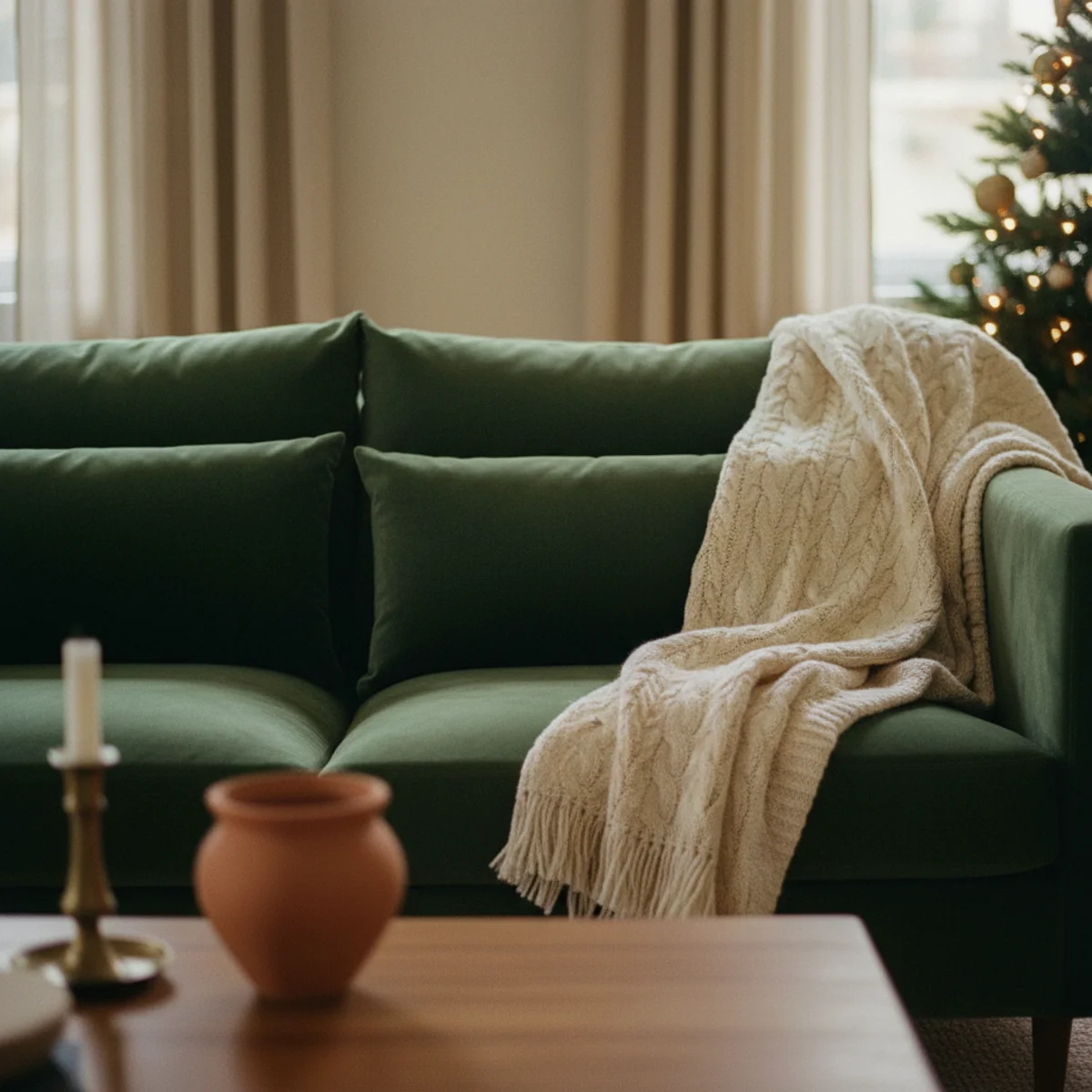
Christmas textiles do a lot of seasonal work — and the cozy version means leaning into velvet, wool, and heavier weights rather than the lightweight cotton or summery linen used the rest of the year. Velvet cushions, wool tree skirts, wool stockings, wool or velvet throws all add the sheen and texture that catches Christmas lamp light and beeswax candlelight as warm reflective glow.
Christmas textile swap: SOFA CUSHIONS — swap in 2 to 3 velvet cushions in deep terracotta, olive, or muted cranberry ($40 to $120 per cover) among the year-round linen and boucle ones. TREE SKIRT — wool tree skirt in natural cream, oat, or deep green ($40 to $150 from Etsy artisans or Pottery Barn, $20 to $40 thrifted from estate sales). STOCKINGS — wool, linen, or velvet stockings in natural fabrics ($20 to $80 each from Etsy or specialty shops; see rule 11). THROW BLANKETS — add 1 to 2 wool throws in cream or muted accent colors specifically for the holiday season ($40 to $120 each, possibly thrifted from estate sales). TABLE LINENS — wool runners or heavy washed linen tablecloths instead of summer-weight cotton. The combined textile shift signals 'this is now the warm holiday season' visually and physically.
AFFILIATE SLOTTEXTILESVelvet cushions + wool tree skirt + wool/linen/velvet stockings + extra wool throws + heavier table linensAdd affiliate URL when configuredWhy it works
Because both materials have visual depth and tactile warmth that lighter textiles cannot match — velvet's directional nap catches light and reflects warm glow, wool's natural texture and weight reads as winter-appropriate and substantial. The combination of velvet's light-reflective sheen and wool's textile weight creates the layered material richness that cozy Christmas needs. Cotton and lightweight linen are summer-textile language; velvet and wool are winter-and-holiday language.
Pro tip — Buy velvet pieces in deep saturated colors (terracotta, olive, deep cranberry, muted rust) rather than pure red or bright green — the saturated colors read cozy where pure primary colors read commercial-Christmas. The slight desaturation is what distinguishes velvet from 'Christmas velvet sold at retail.'
Velvet cushions, wool tree skirt, wool throws — textile weight that catches lamp and candle light as warm glow. See also: throw-blanket-layering
09Run a Simmer Pot
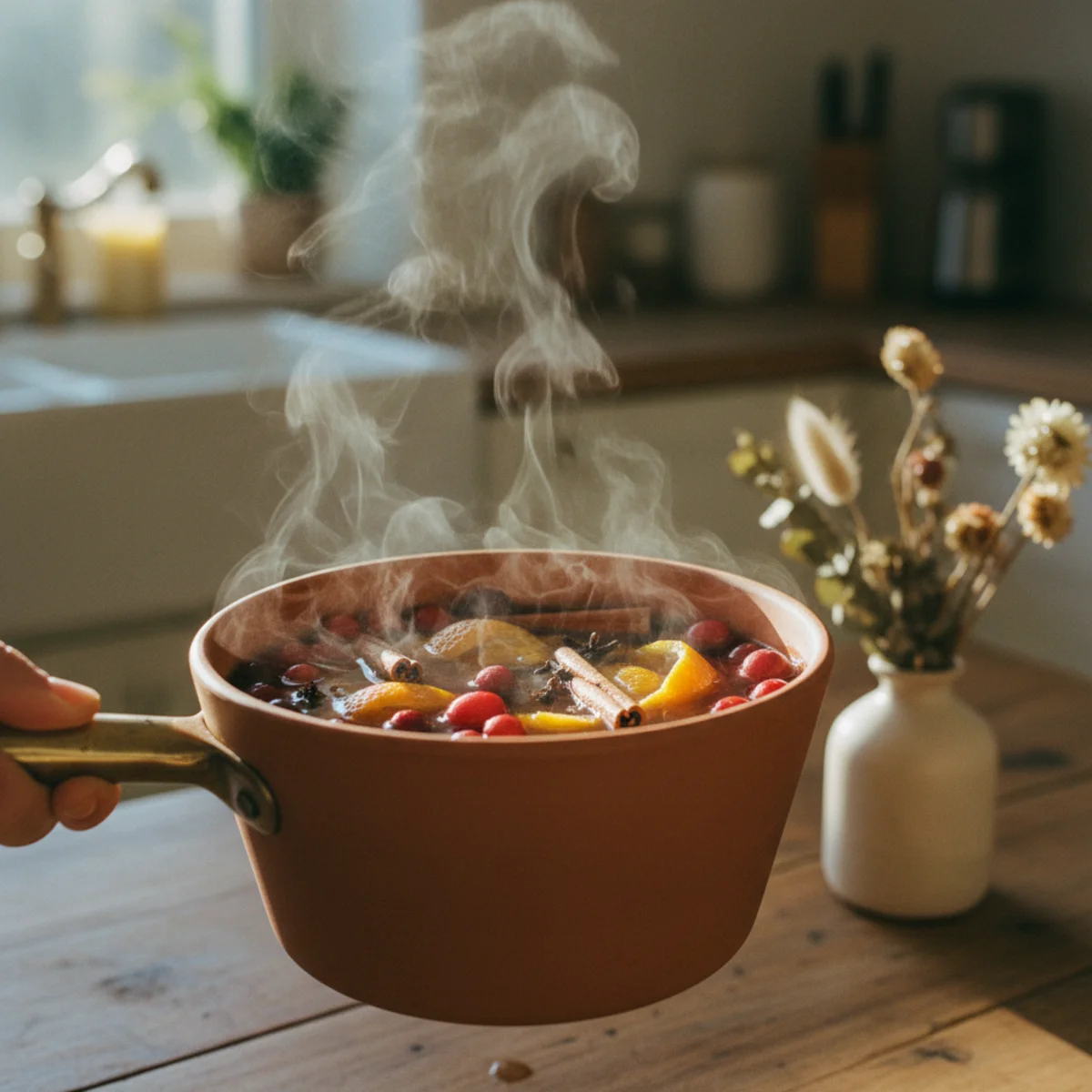
The Christmas simmer pot is the same recipe as the winter version (per the winter-decor guide) but with seasonal twists — apple cider replacing some water, more cinnamon and clove, sometimes adding cranberries or pine sprigs. The result is a whole-house Christmas scent for $3 to $8 in ingredients, running 1 to 3 hours on stovetop or 6 to 8 hours in a slow cooker.
Christmas simmer pot recipes: CLASSIC — water + apple cider 1:1 + peels from 2 oranges + 3 cinnamon sticks + 6 to 8 whole cloves + 3 to 4 star anise + sliced apple + fresh cranberries (handful) + vanilla extract. WINTER FOREST — water + pine sprigs + cedar sprigs + 3 cinnamon sticks + 6 whole cloves + small piece of fresh ginger. SPICED ORANGE — water + peels from 3 oranges + 4 cinnamon sticks + 8 whole cloves + small piece of fresh ginger + 1 tablespoon allspice. Simmer on low 1 to 3 hours on stovetop (supervised) or 6 to 8 hours in slow cooker (unattended). Total cost per pot: $3 to $8 in ingredients (mostly food waste plus cheap pantry spices). Run 2 to 4 times per week across the holiday season for ongoing house-warm scent.
AFFILIATE SLOTSCENTApple cider + water + orange peels + cinnamon + cloves + star anise + cranberries; 1-3 hours stovetop or 6-8 slow cookerAdd affiliate URL when configuredWhy it works
Because Christmas already has so many olfactory signals (fresh evergreens, beeswax candles, cooking food, mulled wine, baking) that synthetic scented products often compete unsuccessfully with the natural ones. The simmer pot uses ingredients that ARE the Christmas scents (cinnamon, clove, apple, orange) at the right concentrations to enhance rather than fight the other natural scents. The result is whole-house Christmas atmosphere built from natural ingredients that cost almost nothing and integrate with food and other seasonal smells.
Pro tip — Pre-bag simmer-pot kits for gifts and easy daily use — small mason jars or muslin bags filled with cinnamon sticks, dried orange peels, cloves, star anise, and dried cranberries make excellent host gifts ($3 to $5 in materials per kit) and provide convenient quick-pot ingredients for your own use across the holiday season.
Apple cider, orange peels, cinnamon, cloves, cranberries simmering — Christmas whole-house scent for $5. See also: winter-decor
10Choose a Real or Realistic Tree
The Christmas tree itself defines half the holiday decor — and the cozy version means committing to either a real tree (with all the fresh fragrance and natural irregularity) or a very high-quality realistic artificial tree if real isn't feasible. Skip the bargain-bin obviously-fake trees and the pre-lit trees with built-in cool-white lights that fight cozy aesthetic.
Real tree options: FRESH-CUT TREE from local tree farm at $40 to $120 for 6 to 8 foot trees, or LIVING POTTED TREE (Norfolk pine, small spruce in pot) for $30 to $80 — can replant after Christmas. Most real-tree households use fresh-cut for the genuine pine fragrance. Realistic artificial alternatives: BALSAM HILL trees at $300 to $1,500 (premium realistic with separated lights or unlit options), CRATE & BARREL realistic trees at $200 to $700, KING OF CHRISTMAS at $300 to $900 (best quality-to-price ratio for realistic artificial). Critical specs for artificial: PE/PVC blend with separated tip styles (not uniform PVC), choose UNLIT trees so you control the warm-white string lights yourself rather than living with whatever cool-toned lights come pre-installed. Total cost: $40 to $120 annual for real trees, or $300 to $1,500 one-time for quality artificial that lasts 10 to 15 years.
AFFILIATE SLOTTREEReal fresh-cut $40-120 or quality realistic artificial $300-1,500; unlit so you control warm-white lightsAdd affiliate URL when configuredWhy it works
Because the tree is the visual anchor of most Christmas living rooms — its character (real or fake, realistic or obviously plastic, pre-lit cool or unlit warm) dominates the room aesthetic for 4 to 6 weeks. Bargain artificial trees with built-in cool-white lights fight cozy at every viewing; real trees or premium realistic ones (with warm-white lights you control) support cozy at every viewing. The tree investment compounds across all decor adjacent to it — same ornaments and decor look different against different tree quality.
Pro tip — If buying real, get the tree on December 1 to maximize freshness through Christmas — earlier-purchased trees dry out by the holiday itself. Cut another inch off the trunk and place immediately in water with tree preservative ($5 per bottle); refill water daily for first week, then every 2 to 3 days.
Real fresh-cut tree with warm-white lights you control and natural ornaments — the cozy Christmas anchor. See also: Balsam Hill
11Add Stockings in Natural Fabric
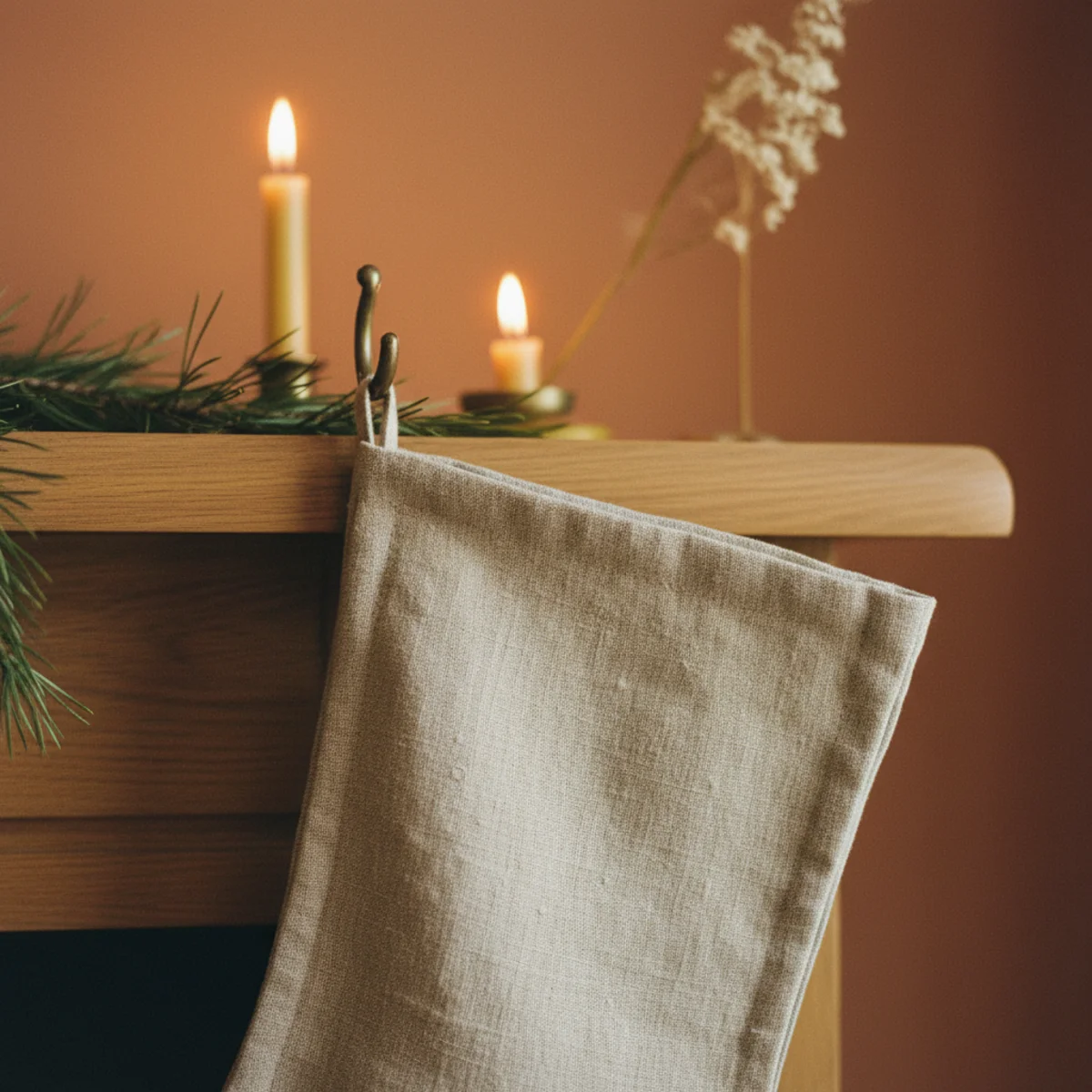
Stockings round out cozy Christmas decor — and the natural-fabric version (wool, linen, velvet, knit) outperforms commercial mass-produced stockings significantly. Hand-made or thrifted natural-fiber stockings tell the family story rather than reading as 'matching set purchased at Target.' Cost: $20 to $80 each for natural-fiber stockings; $5 to $20 for thrifted vintage; build collection across years.
Best natural-fabric stocking sources: ETSY ARTISANS for hand-knit, hand-quilted, or hand-stitched stockings at $30 to $80 each (search 'wool Christmas stocking' or 'linen Christmas stocking'), VINTAGE THRIFT at $5 to $20 each from estate sales — often gorgeous hand-quilted or hand-knit pieces from earlier decades, POTTERY BARN HOLIDAY for wool felt and embroidered linen at $25 to $70 each, SUNDANCE for higher-end hand-stitched at $80 to $150 each. Materials to prioritize: WOOL (knit, felted, or boucle), LINEN (washed, slightly textured), VELVET (deep warm tones), MIXED NATURAL FABRIC (combinations of wool and linen). Hang from mantel hooks ($10 to $30 each, vintage brass or simple hammered metal) or from a fireplace screen if no mantel. Build the collection across years — one new stocking per year as needed, possibly hand-made or hand-decorated as a yearly tradition.
AFFILIATE SLOTSTOCKINGSWool, linen, velvet, or knit natural fabric; one per family member; hand-embroider initialsAdd affiliate URL when configuredWhy it works
Because stockings are the most-personal Christmas decor element — they represent specific family members and accumulate emotional weight across years of holiday seasons. Mass-produced matching commercial stockings (plastic-feel velour, synthetic 'felt') signal 'purchased this year' rather than 'family tradition built over time.' Natural-fabric stockings with visible craft (knit stitches, quilted patches, embroidery, age patina) signal the opposite — heritage, intention, and family identity. The material choice does most of the emotional work.
Pro tip — Embroider or stitch each family member's initial onto their stocking ($3 in supplies per stocking, 30 minutes of work per piece) — the personalization adds meaning that mass-produced 'name printed in commercial font' stockings can't match. Even amateurish hand-embroidery reads warmer than professional commercial print.
Hand-knit wool and natural linen stockings — material that signals family heritage rather than retail set. See also: Sundance
12Keep It Restrained
The final cozy Christmas discipline is the editing principle — knowing when to stop. Cozy Christmas rooms have less stuff than commercial Christmas rooms, not more. Three styled vignettes with depth and intention outperform 15 scattered surface decorations every time. Restraint is what creates the warm-collected feel rather than the busy-overwhelmed alternative.
Restraint principles: ONE TO TWO MAJOR DECOR ZONES per room — mantel and tree in living room (not also coffee table heavily styled and console heavily styled and side tables heavily styled), dining table centerpiece (not also sideboard heavy and hutch heavy). 30% RULE — surfaces should remain 30 to 40 percent empty during Christmas; if every surface is covered, you've gone too far. ONE PALETTE COMMITMENT — pick your accent color from rule 4 and stick to it; the discipline prevents creeping addition of other colors as Christmas approaches. STOP BUYING — after Thanksgiving weekend, no new Christmas decor purchases. The discipline forces working with what you have rather than continuing to accumulate. POST-HOLIDAY DONATIONS — every January, donate or discard any Christmas decor that didn't earn its place this year. The restraint compounds across years into truly curated rather than accumulated holiday decor.
AFFILIATE SLOTDISCIPLINE1-2 major decor zones per room; 30-40% surface empty; one accent color commitment; stop buying after ThanksgivingAdd affiliate URL when configuredWhy it works
Because Christmas pulls toward 'more is festive' as a default mental model — and unchecked, that default creates visually overwhelming rooms with no breathing space, no focal points, and no sense of intentional curation. Cozy Christmas inverts this default: less is more festive, when the less is genuinely well-chosen and well-placed. The discipline isn't about doing less work; it's about doing better work and stopping at the right point. The best-loved cozy Christmas rooms have three excellent vignettes; the busy commercial alternatives have 15 mediocre ones.
Pro tip — Photograph your Christmas decor on December 5 — by that date you've usually finished setting up but not yet added the 'maybe one more thing' accumulation that happens across December. Use that photo as the reference for next year's setup; resist additions that creep in after that point.
Two major decor zones, 35% surface empty, single accent color — restraint that creates warm collected Christmas. See also: intentional curation

How to do cozy Christmas decor step by step
Real materials, warm light, and restraint. Build it in this order.
- 1Start with greenery
Hang fresh or realistic garland on the mantel, stair, and doorway. Greenery is the warm, natural foundation of the whole look.
- 2Get the light warm
Use warm-white, non-flashing string lights and cluster beeswax candles. Warm steady light is the coziest holiday move.
- 3Choose natural ornaments and a muted palette
Decorate with wood, glass, brass, and dried citrus in a restrained palette, using deep red and green sparingly.
- 4Add scent and texture, then edit
Run a simmer pot, add velvet and wool textiles, and then pare back — a few meaningful pieces beat every surface covered.
Quick tips
- Always choose warm-white, non-flashing lights; cool or flashing lights read cheap.
- Mist real garland every few days so it doesn't dry out and drop needles.
- Decorate with natural materials — wood, brass, glass, dried citrus — over plastic.
- Run a simmer pot of orange, cinnamon, and clove for holiday scent.
- Keep a muted palette and use bright red sparingly as an accent.
- Edit hard — a few meaningful pieces beat every surface covered in plastic.
Cozy Christmas by room
A real tree with warm lights and natural ornaments, garland on the mantel, velvet cushions, and clustered candles.
Fresh garland, brass candlesticks, a few muted ornaments, and stockings in natural fabric.
A greenery runner, beeswax tapers, and clove-studded oranges; see our tablescape guide.
A small real tree or a few branches, warm lights, garland, and candlelight — restraint suits small rooms.
The coziest holiday rooms are the simplest — real greenery, warm candlelight, and a few things that mean something.
Frequently asked questions
What makes Christmas decor 'cozy' versus commercial?+
What kind of string lights should I use for cozy Christmas?+
Should I get a real or artificial Christmas tree?+
What palette works for cozy Christmas?+
How do I make a Christmas mantel cozy?+
What scent should I use for Christmas?+
Cozy Christmas decor is the warm, natural take on the holidays — real greenery, warm candlelight, natural ornaments, and a muted palette, all held with restraint. We'd swap multicolor flashing lights for warm-white and trade half the plastic for dried citrus and brass before anything else; it turns a house from 'holiday store' to 'warm gathering' in an afternoon. Lead with greenery and candlelight, edit hard, and the holidays feel like an extension of the warm home you already live in rather than a clearance aisle.