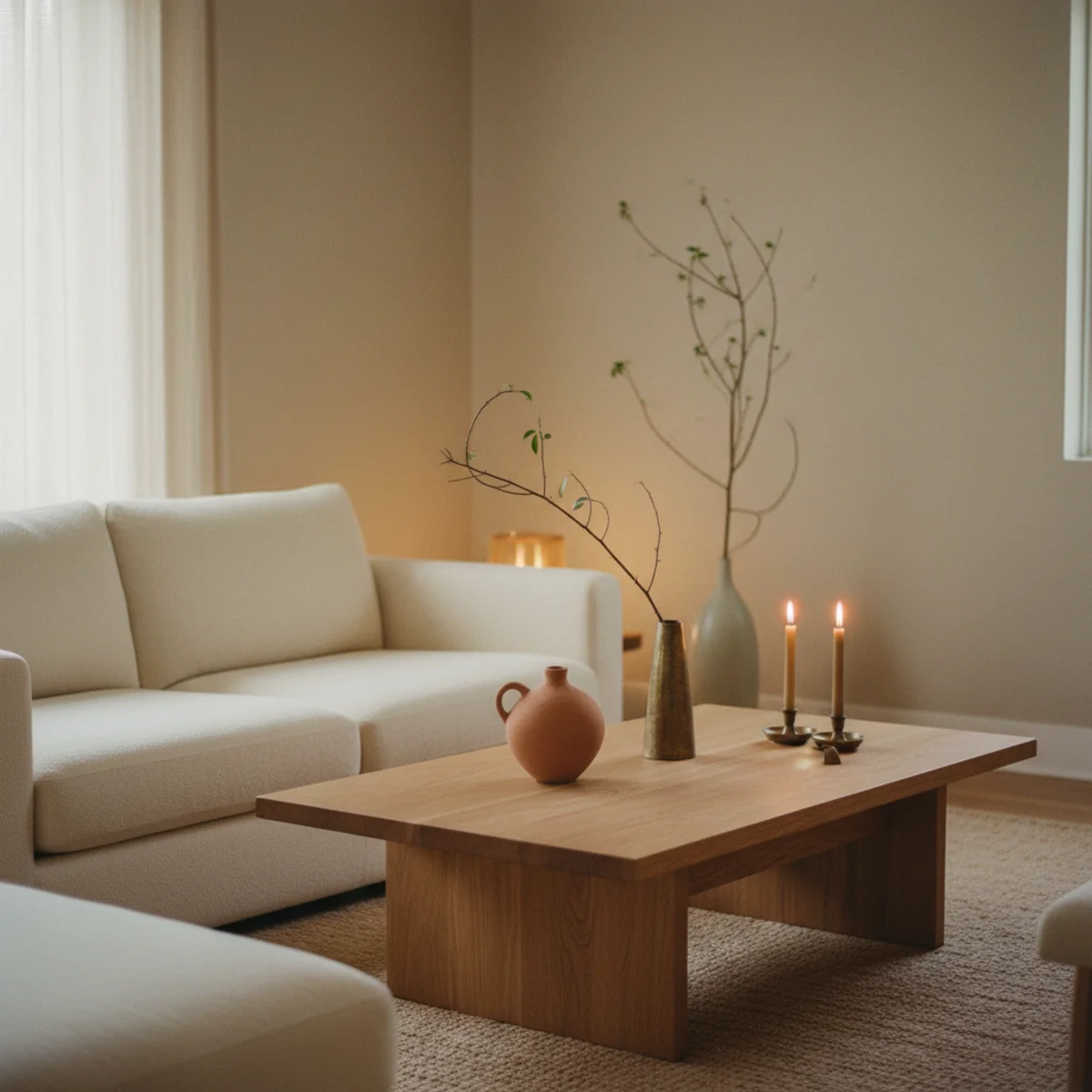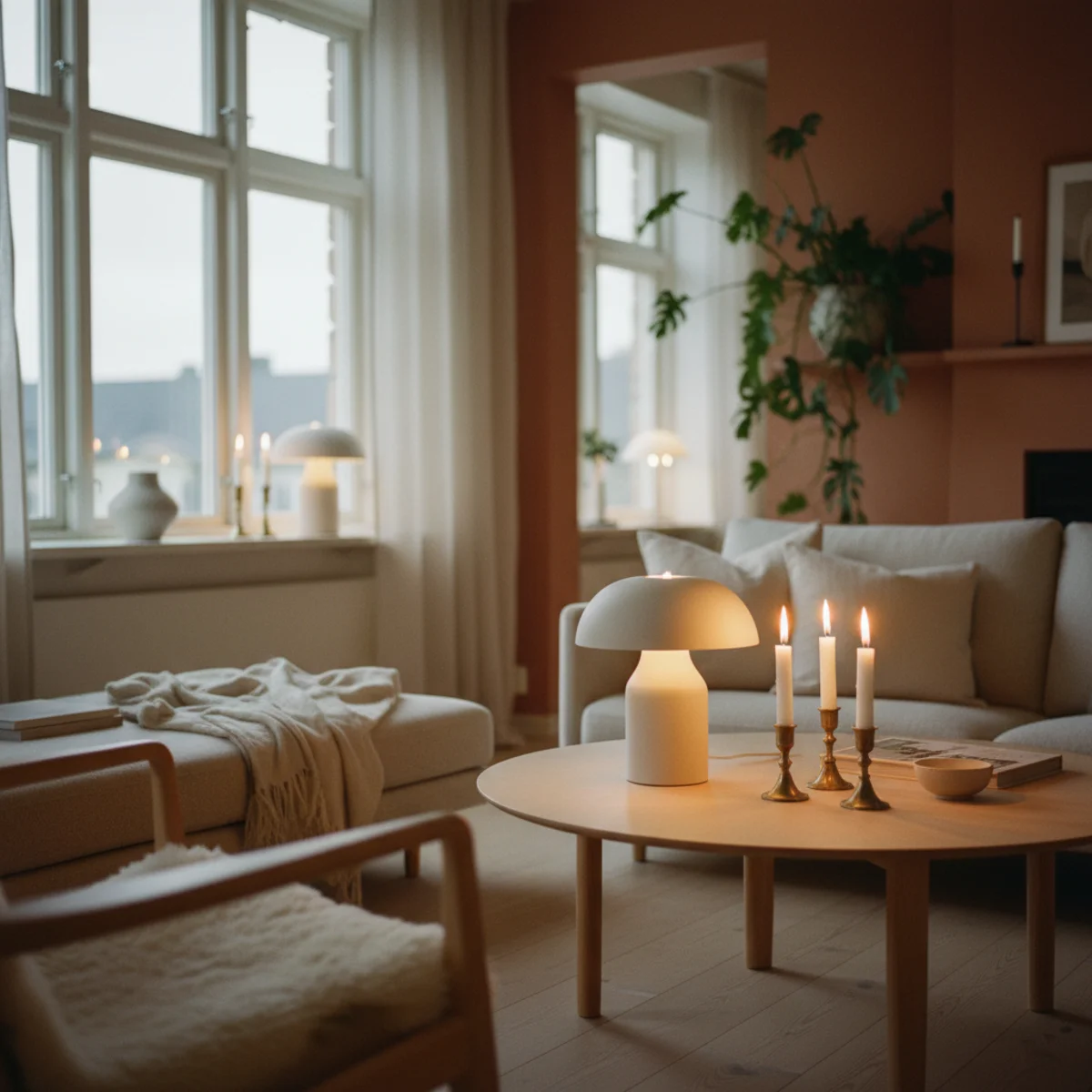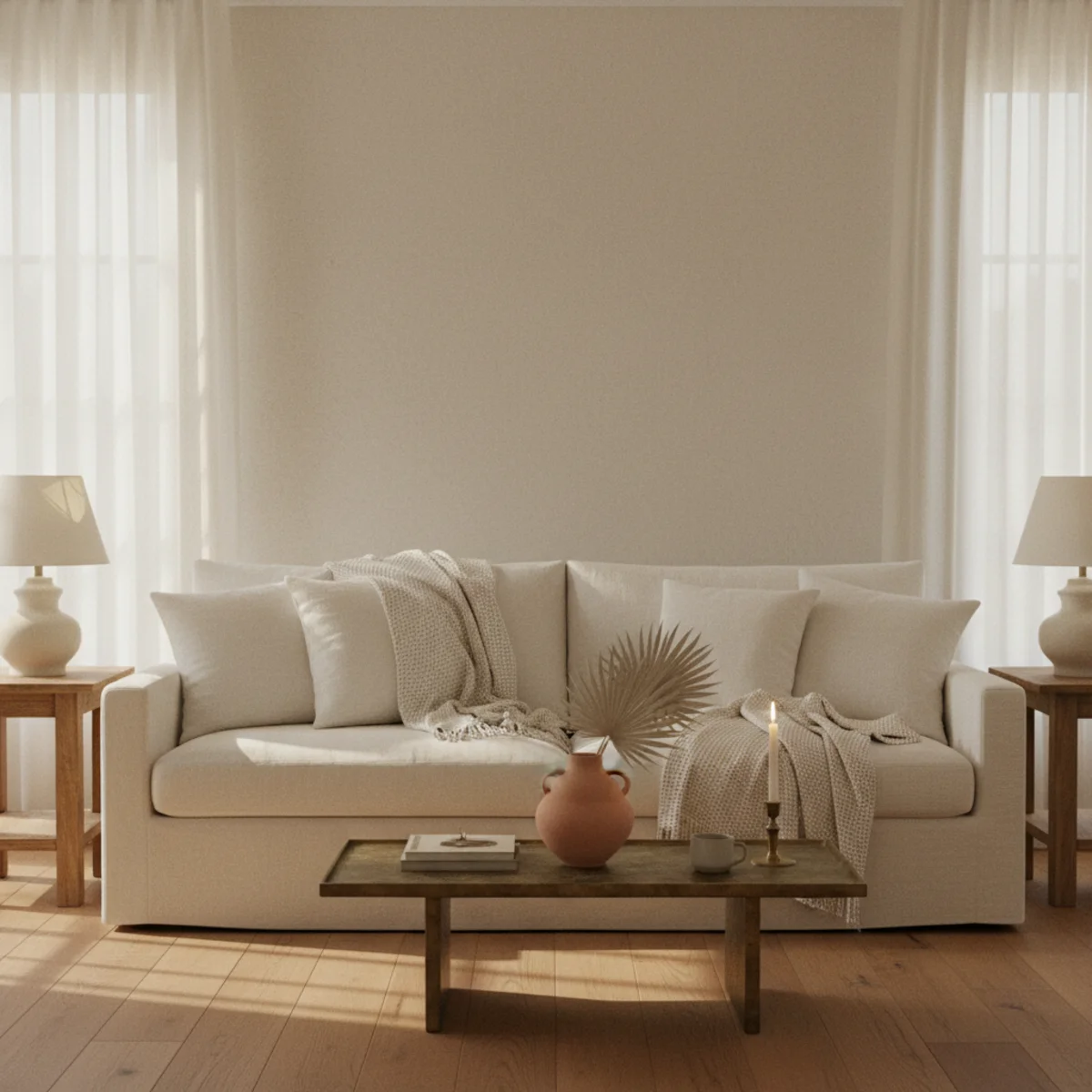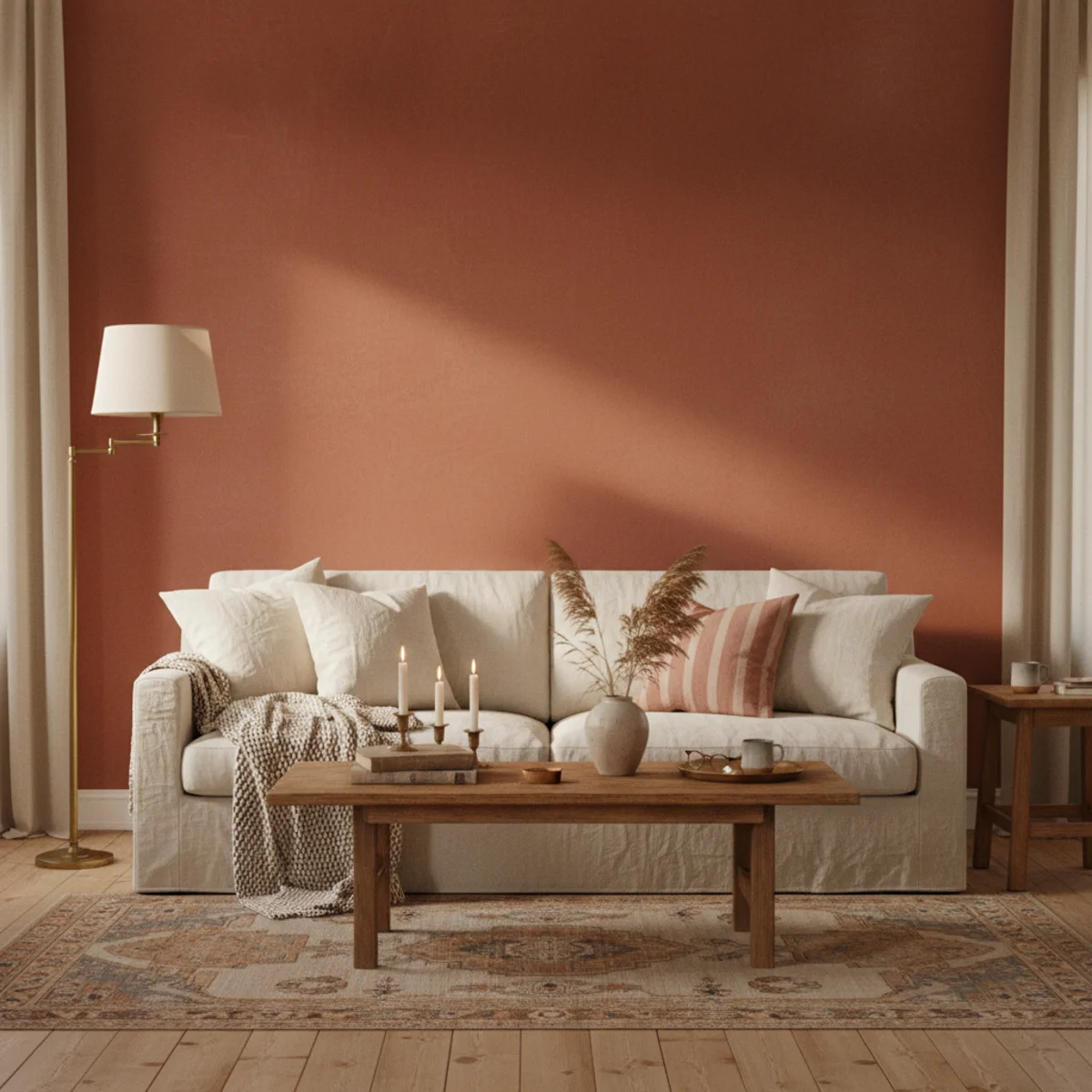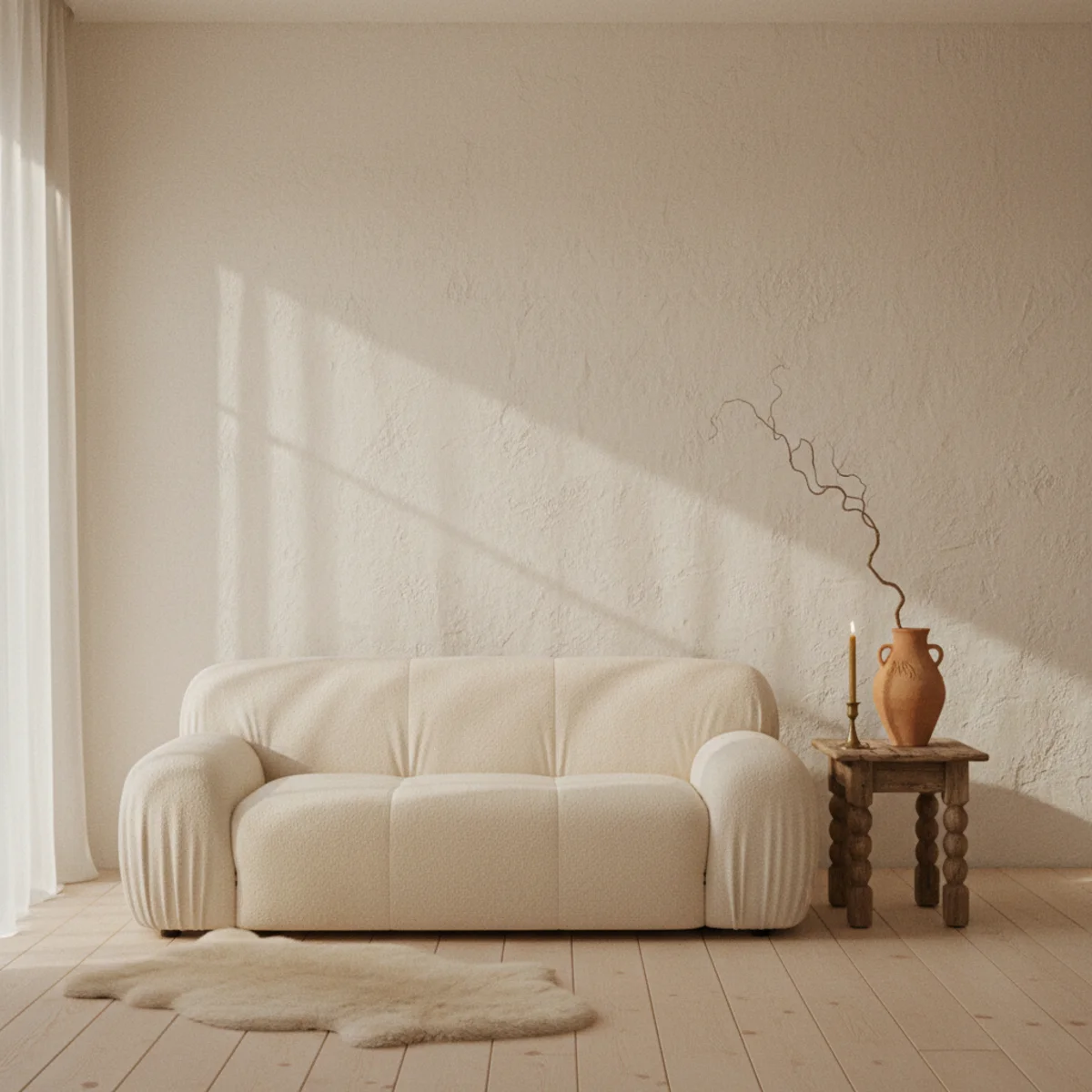
These twelve warm minimalism principles cover the exact balance between editing and adding that makes a minimalist room feel warm rather than sparse. Cold minimalism left rooms empty; warm minimalism keeps them visually quiet while adding the texture, tone, and natural materials that make the emptiness feel deliberate rather than incomplete. The difference is small but visible — and applicable to any room of any size.
Every principle below assumes you already love the warm-minimalist aesthetic and want to make it work in your actual home. The codes name the exact paint colors, fabric weights, wood tones, and material choices that consistently deliver. Cost ranges are honest — most warm-minimalist rooms can be built for under $1,500 in furniture and styling, far less if thrifted.
By the end of this guide, you'll know exactly which earthy off-white to choose, how to add texture without color, which one saturated moment to include, and the editing pass that separates warm minimalism from cold minimalism.
WHAT'S INSIDE
- Why the off-white paint matters more than the furniture (and which three tones work in 95% of rooms)
- The one saturated accent that stops a warm minimalist room from going flat
- Why texture beats pattern in this aesthetic — and which combinations are reliable
- The editing rule that prevents the dreaded empty room effect
Minimalism doesn't have to mean cold. The warmth comes from material and light, not from adding more things.
— Kinfolk Home [citation needed — verify before publish]
What is warm minimalism?
Warm minimalism is a pared-back design approach that keeps minimalism's restraint — few objects, clean lines, calm surfaces — but swaps its cold palette and hard materials for earthy color and natural texture. Instead of gallery white and chrome, it's limewashed clay walls, oiled oak, chunky wool, and a single saturated accent.
The defining move is texture over stuff. A warm minimalist room has very few objects, but the ones it has are tactile: a bouclé chair, a nubby rug, a plaster wall that catches afternoon light. Restraint in quantity, abundance in feel. Warm minimalism isn't beige-on-beige — it's the difference between an empty room and a calm one.
More in Color Stories you may love
See allWhy warm minimalism is everywhere in 2026
The cold minimalist room of the 2010s — white walls, gray sofa, chrome legs — started to feel like a dentist's office, and the backlash arrived as warmth. People still wanted calm and uncluttered, but they wanted it to feel like a home. Warm minimalism gave them both.
The aesthetic dovetails with everything else trending: slow living, secondhand, the move toward natural material. Designers from Studio McGee to the Kinfolk crowd built the look's vocabulary, and Pinterest's "warm minimalism" and "quiet luxury home" searches climb every season. It photographs beautifully and, crucially, it forgives — fewer objects means less to keep tidy.
12 ways to get the warm minimalist look
01Build on an Earthy Off-White Foundation
Cold minimalism uses bright white walls and concrete or polished floors; warm minimalism replaces both with earthy off-whites — soft warm whites, sandy creams, oat tones, limewashed clay. The foundation determines whether the minimalism reads as cold gallery or warm sanctuary. Get the off-white right and most other decisions become easier; get it wrong (bright white, gray-undertone) and no amount of warming additions can rescue the room.
Choose an earthy off-white with documented warm undertones: Benjamin Moore Soft Chamois OC-13, Farrow & Ball Setting Plaster 231, Sherwin-Williams Natural Choice SW7011, or BM Cinnamon Slate (for slightly deeper warmth). Apply to walls, trim, and ceiling all in the same tone (or trim in slight eggshell sheen versus matte walls). Test 12-by-12-inch swatches on multiple walls before committing. Pair with limewash on one feature wall for added texture. The foundation off-white is the warm-minimalist canvas; every other decision builds on it. Skip pure whites and gray-leaning whites — both fight warm minimalism instantly.
AFFILIATE SLOTPAINTEarthy off-white with warm undertones (BM Soft Chamois, F&B Setting Plaster, SW Natural Choice)Add affiliate URL when configuredWhy it works
Because warm minimalism reduces the number of decorative elements in a room, which makes the wall color responsible for far more of the visual mood than in maximalist rooms. A wrong-undertone off-white in a maximalist room is forgiven by all the other colors and patterns; the same wrong off-white in a minimalist room reads cold and dominant because there's nothing else to balance it. Foundation tone is the warm-minimalist make-or-break.
Pro tip — Photograph the swatch on the wall under your actual 2700K lamps, then compare to the same swatch under daylight. The wider the warmth gap between the two photos, the less reliable the paint will be. Pick the off-white that reads warm in both lighting conditions, not just one.
Earthy off-white walls — the foundation that determines whether minimalism reads warm or cold. See also: 12-by-12-inch swatches
02Add One Saturated Moment Per Room
Warm minimalist rooms benefit from a single saturated color moment — a single rust cushion, a sage ceramic vessel, a deep navy artwork, a mustard chair — placed strategically to prevent the room from going flat. The principle: one saturated moment per room, used across one to two objects maximum. The saturated piece anchors the otherwise neutral palette and gives the eye somewhere to land amid the tonal quiet.
Pick one saturated color per room: rust, terracotta, deep mustard, sage green, dusty navy, or burgundy. Use it across one or two small objects: a single throw cushion (22-inch square at $15 to $40), one ceramic vessel (8 to 12 inches tall at $15 to $80), or one piece of art on the wall (16x20 inches at $20 to $200). Avoid bright primaries and neon — they fight the warm-minimalist tone. The accent should occupy roughly 5 to 8 percent of the visual real estate, never more. One per room is the rule; two creates competition.
AFFILIATE SLOTSTYLINGSingle saturated accent (rust, sage, navy) across 1-2 small objectsAdd affiliate URL when configuredWhy it works
Because pure neutrals across an entire room — wall to ceiling to furniture to textiles — eventually read as a single tonal field, which the eye fatigues on. One saturated moment gives the eye a point of return, a small visual anchor amid the quiet. Without it, warm minimalism drifts toward cold minimalism. The saturated piece is the warmth made visible; without it, the warmth becomes an idea rather than an experience.
Pro tip — Pick the saturated accent color from something you already love and own — a beloved vintage rug's warmest tone, an inherited piece of art, a piece of pottery from a meaningful trip. Matching the accent to an existing piece makes the room read as collected over time rather than designed in one shopping trip.
One saturated cushion in the entire room — the moment that prevents minimalist flatness. See also: rust ceramic
03Choose Texture Over Pattern, Every Time
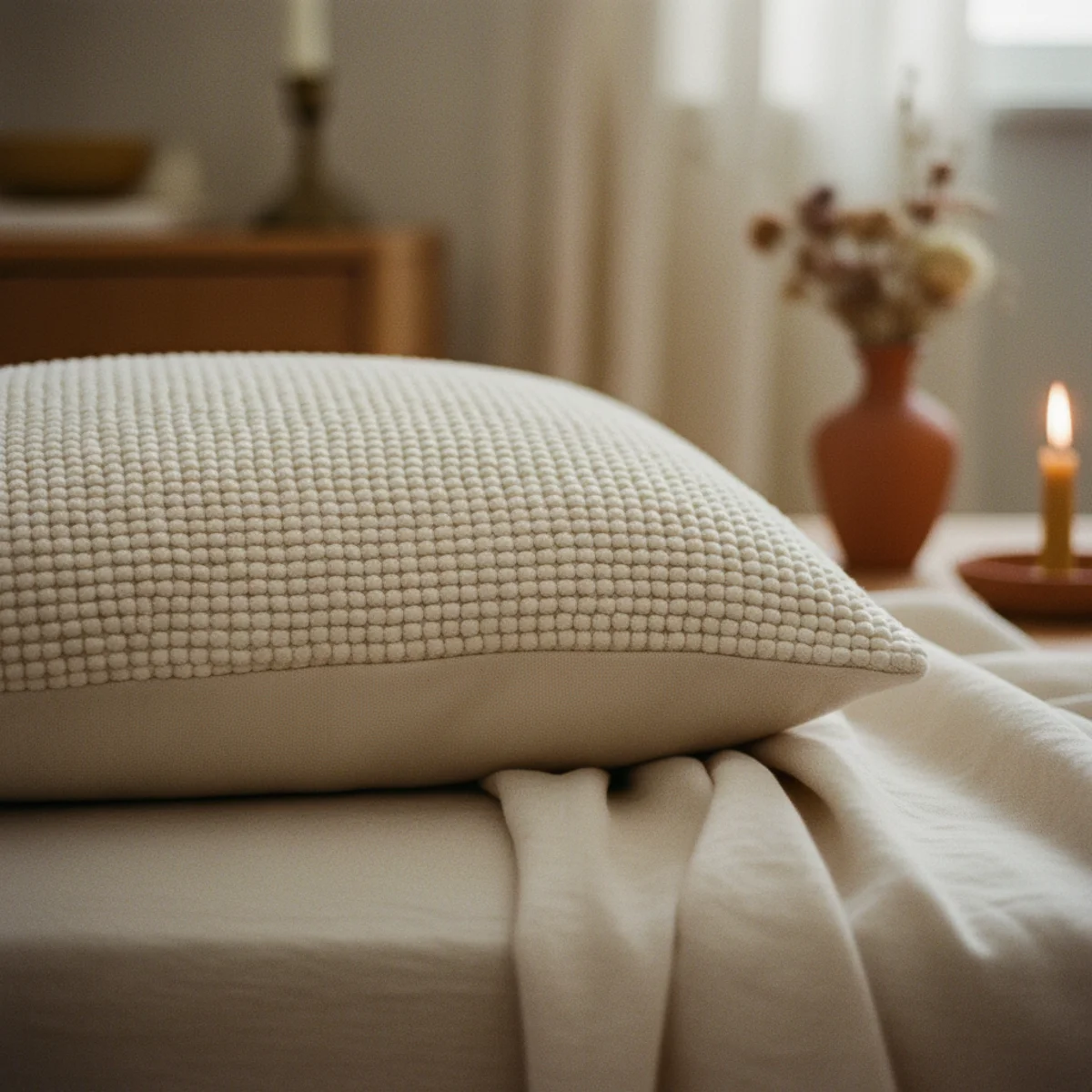
Warm minimalism uses zero pattern (or near-zero) and immense texture instead. A linen sofa, a wool boucle accent chair, a chunky knit throw, a jute rug — all in the same tonal family, all heavily textured, no printed motifs anywhere. The texture provides the visual interest that pattern would in other aesthetics, and the lack of pattern keeps the room read as quiet and considered. Pattern would break the warm-minimalist spell instantly.
Layer at least four textures in any warm-minimalist room, all in cream-to-oat tones: smooth linen (upholstery, curtains), nubby boucle or wool (accent chair, cushion), chunky knit or felted wool (throw), and a natural-fiber rug (jute, wool, or vintage flatweave). Avoid printed cushions, patterned wallpaper, geometric rugs with visible motifs, and floral or striped fabrics anywhere. If you must include a pattern, choose subtle stripes or solids with weave texture, never visible printed motifs. The texture mix replaces what pattern would do without the visual noise.
AFFILIATE SLOTTEXTILESFour texture layers in same tonal family, zero patternsAdd affiliate URL when configuredWhy it works
Because texture creates visual interest at the surface level (how light catches the weave, how the fabric drapes) without adding chromatic or graphic information for the eye to process. Pattern asks the eye to identify and follow a motif; texture only asks the eye to register a surface quality. Warm minimalism is about reducing cognitive demands, and texture delivers visual depth without demanding cognitive processing.
Pro tip — Buy fabric swatches of three different textures in the same color before committing — the warm-minimalist look depends on the texture combinations working together, and only side-by-side comparison reveals whether the linen and boucle and knit will read as collected or fight each other.
Four textures, one color family, zero patterns — texture is how warm minimalism creates interest. See also: natural-fiber rug
04Limewash a Feature Wall for Depth
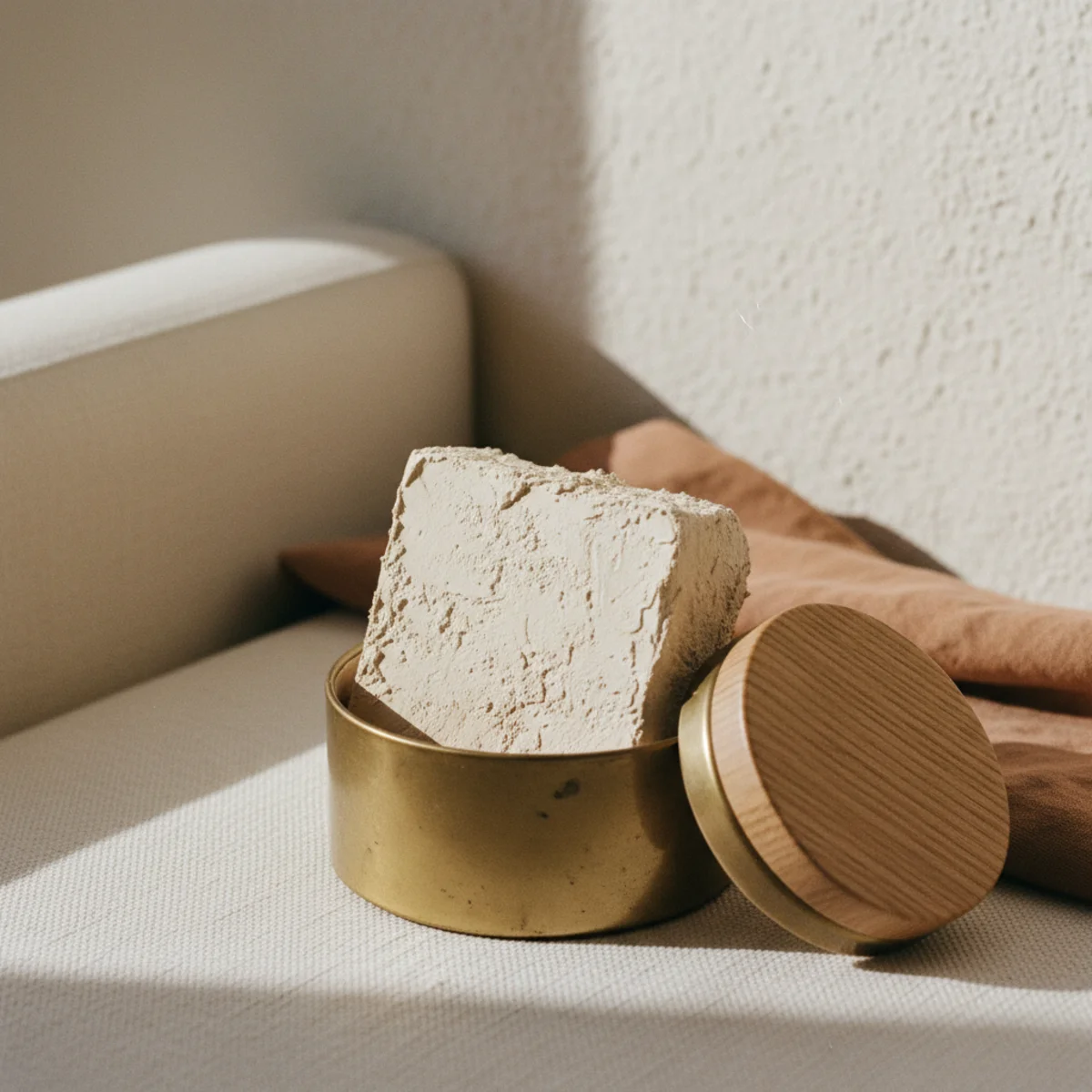
The single highest-impact warm-minimalism addition is limewashing one wall. Limewash creates microscopic texture and tone variation that flat paint cannot replicate — the wall reads as plaster, not paint, and the subtle mottled finish catches light differently throughout the day. For warm minimalism specifically, limewash works because it adds texture and depth without adding color or pattern, which is exactly what the aesthetic needs.
Buy limewash from Bauwerk Color, Romabio, or Portola Paints in a warm-undertone earthy off-white ($40 to $80 per gallon, covers 200 sq ft). Apply two coats with a 4-inch lime brush in crosshatching X-shaped strokes. The first coat looks streaky, the second blends the texture. Pick one wall: the wall behind the sofa, the bed, or a dining table is best. Skip glossy or recently latex-painted walls unless sanded lightly first. The completed limewash wall is the warm-minimalist focal point — never paint the same room limewashed on every wall (it competes with itself).
AFFILIATE SLOTPAINTLimewash one feature wall in warm earthy off-whiteAdd affiliate URL when configuredWhy it works
Because limewash adds the textural depth that warm minimalism needs without adding color, pattern, or visual noise. The mottled finish provides subtle variation that flat paint can't replicate, but the variation stays inside the same warm-white tonal family — so it doesn't interrupt the minimalist quiet. A limewashed wall in warm minimalism reads as a piece of architecture, not as decoration, which is exactly the right register.
Pro tip — Practice the X-shaped crosshatching technique on a piece of drywall scrap or inside a closet first — limewash brushing is unlike normal painting, and the first 20 minutes feel awkward before the technique clicks. Once you get the rhythm, the rest of the wall takes about 90 minutes.
One limewashed wall — the architectural depth warm minimalism specifically needs. See also: limewash from Bauwerk
05Oil the Wood, Don't Lacquer It
Warm minimalism uses wood — a lot of it — but the wrong finish kills the aesthetic. Polyurethane and lacquer finishes create shiny, plastic-looking surfaces that read commercial; oil finishes (Danish, tung, walnut) develop a soft matte patina that deepens over years. Every visible piece of wood in a warm-minimalist room should be oiled, not lacquered. The difference is immediate and irreversible.
Use Danish oil, pure tung oil, or walnut oil ($12 to $25 per pint) on all visible wood: tabletops, console tops, shelves, exposed chair frames. Apply with a clean rag in thin coats, wipe excess after 15 minutes, allow 24 hours between coats. Two to three coats give the right matte finish; more makes the surface too oily. Refresh once a year by lightly sanding (220 grit) and applying one additional coat. For wood you can't refinish (rented apartments, existing lacquered furniture), buy or thrift replacement pieces with oil finishes. Avoid stain that mimics oil; the difference shows.
AFFILIATE SLOTFINISHDanish, tung, or walnut oil on all visible wood; never polyurethane or lacquerAdd affiliate URL when configuredWhy it works
Because the surface quality of wood is one of the few visual cues in a warm-minimalist room (since pattern is absent and color is muted), and shiny lacquered wood reads cold and commercial. Oiled wood reads warm and crafted — the matte surface scatters light gently, the slight imperfections of the grain are visible, and the surface continues to develop character with use. The finish is what makes wood read as warm rather than just present.
Pro tip — Test the finish by running a fingertip across the surface — oiled wood feels silky and slightly textured; lacquered wood feels glassy and unnaturally smooth. The tactile difference is immediate, and once you notice it, you'll see the visual difference everywhere.
Oiled, never lacquered — the wood finish that lets warm minimalism read as crafted. See also: Danish oil
06Edit, Then Edit Again, Then Once More
The single most-skipped step in warm minimalism is the editing pass. People style their rooms beautifully, then leave too many objects on every surface — and the warm minimalism becomes warm maximalism by accident. The fix: edit the room once, walk away for a day, return and edit again, walk away again, edit once more. By the third pass, the room is right. Most warm-minimalist rooms have 30 to 50 percent fewer objects than their owners initially placed.
Walk the room with one specific question: does this object earn its space? Take photographs of each surface (coffee table, console, shelves, mantel) before and during editing. Anything that doesn't earn its space — that doesn't serve daily use, that doesn't carry personal meaning, that doesn't anchor a deliberate vignette — goes into a storage box for 30 days. If you don't miss it after 30 days, it leaves the house permanently. Most warm-minimalist rooms end up with 4 to 6 visible objects per major surface, not the 8 to 12 that initial styling tends to add.
AFFILIATE SLOTPROCESSThree rounds of object editing, 24-48 hours apartAdd affiliate URL when configuredWhy it works
Because the initial styling instinct is to add objects until the room looks done, but warm minimalism's quiet depends on having fewer objects than that instinct suggests. Each editing pass removes objects that initially seemed essential but reveal themselves as visual noise once seen against the simpler arrangement. The aesthetic is built on what's not there as much as what is — and that requires removing things, not adding them.
Pro tip — Photograph each major surface from your eye-level standing position, then again from where you'll actually look at it from (sofa, chair, doorway). The two photos reveal different busyness — surfaces look more crowded from sitting positions than from standing. Edit for the sitting view.
Four objects on a coffee table — the editing that warm minimalism specifically requires. See also: warm minimalism's quiet
07Layer Neutrals in Tone, Not in Color
Warm minimalism uses many neutrals, but layers them in tone rather than color — a darker oat next to a lighter cream, an aged brass against an oiled oak, a cream linen beside an oat boucle. The variation reads as deliberate without introducing color contrast. This is what separates warm minimalism from empty room with neutrals — the tonal layering does the visual work that color contrast does in other aesthetics.
Pick a primary neutral (the dominant cream or oat) and layer in three to five secondary neutrals at increasing or decreasing warmth steps: a slightly darker oat throw, a lighter cream curtain, an aged-brass lamp base, an oiled walnut console. Each step adds 5 to 15 percent more or less warmth than the primary. Sources: tonal variation comes from materials more than paint — linen reads different from wool reads different from leather reads different from brass. Combine four natural materials in the same tonal family and the layering happens automatically.
AFFILIATE SLOTPALETTEPrimary neutral + 3-5 secondary tonal variations across natural materialsAdd affiliate URL when configuredWhy it works
Because tonal layering provides visual variation without breaking the minimalist quiet — the eye reads multiple tones within the same color family as deliberate, but doesn't have to process them as separate colors. The aesthetic stays neutral while the room reads layered. Mixing different colors (a sage cushion plus a navy artwork plus a rust ceramic) tips warm minimalism into warm eclectic; tonal variation keeps it minimalist.
Pro tip — Photograph your room in black-and-white to test the tonal variation — if all the materials look the same gray, you have insufficient tonal layering. If you can clearly see distinct tones at multiple values, the layering is working. The black-and-white test ignores color entirely and reveals the underlying tone hierarchy.
Three tones, no colors — the layering that warm minimalism uses where other aesthetics use contrast. See also: tonal variation
08Add One Sculptural Object as a Quiet Focal Point
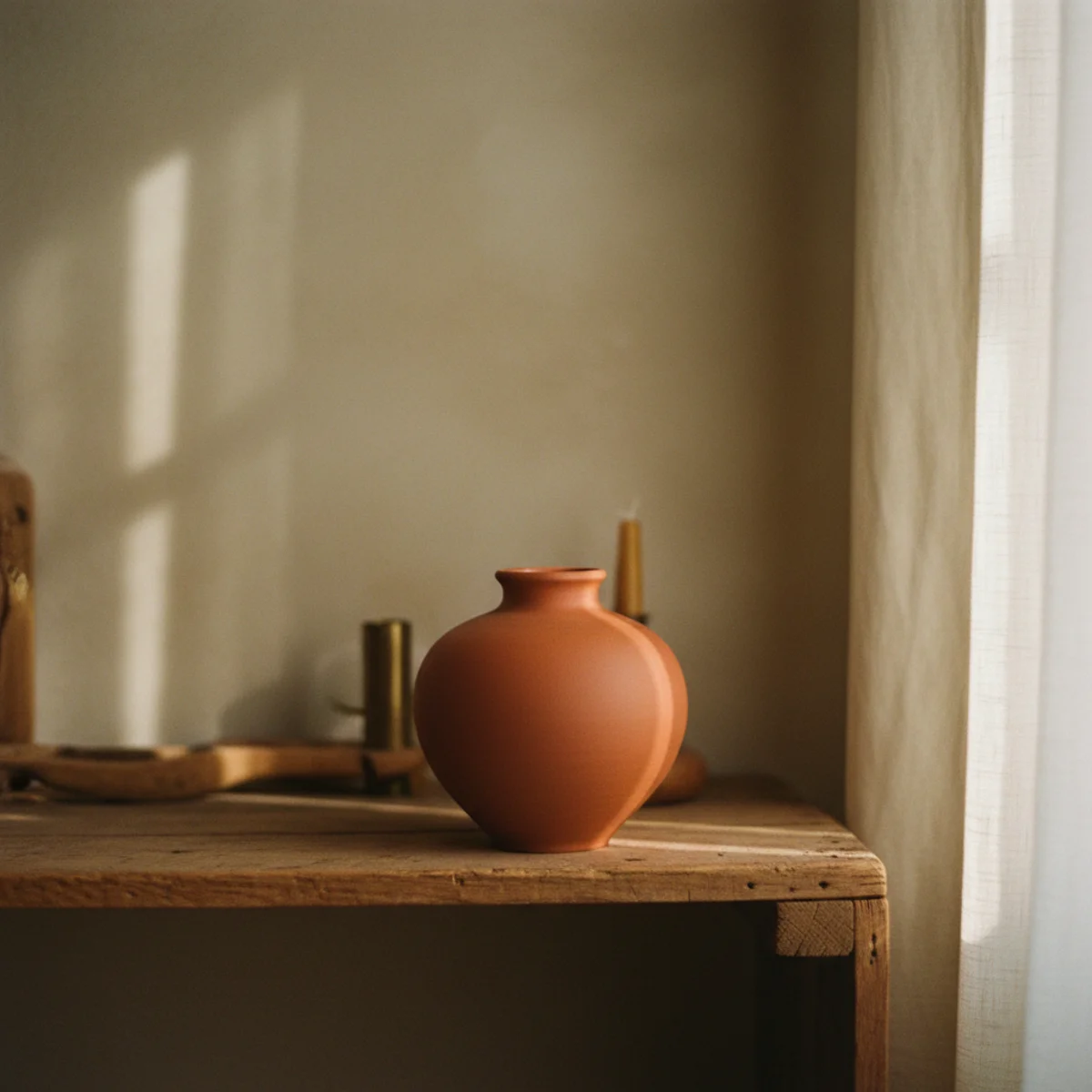
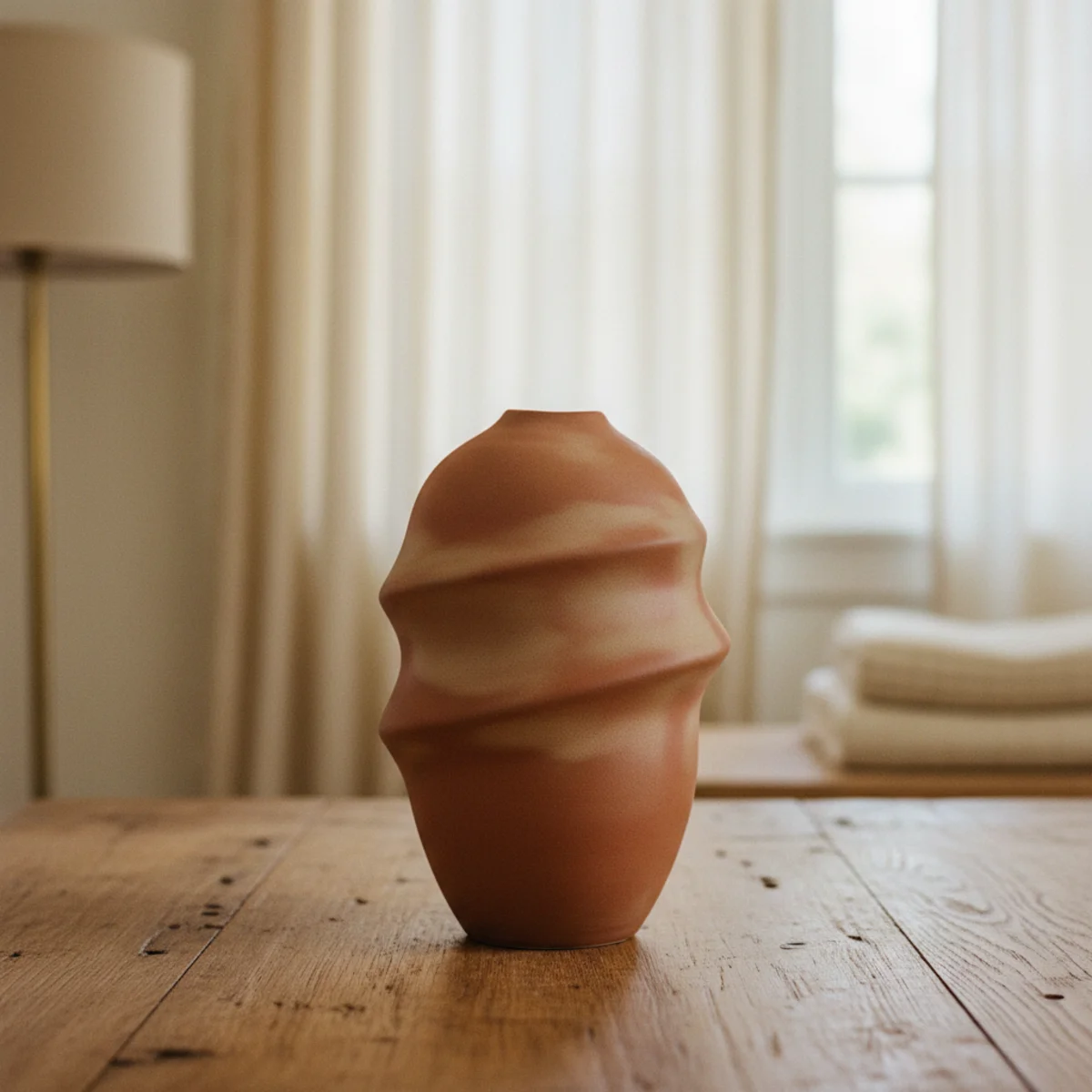
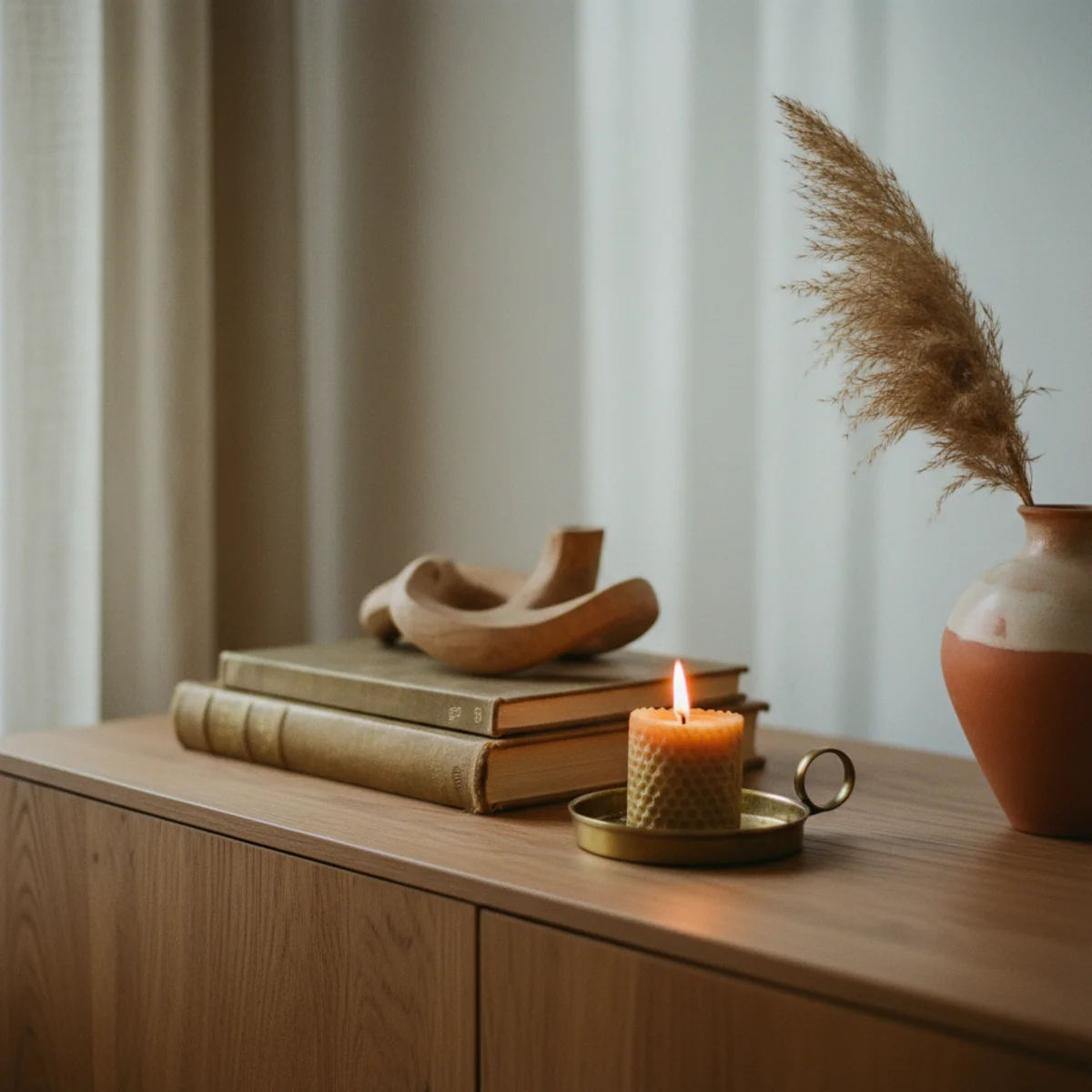
Every warm-minimalist room benefits from one sculptural object — a single piece that reads as art even if it's not formally art. A tall ceramic urn, a worn wooden bowl, a piece of weathered driftwood, a small stone sculpture, a heavy candle holder. The object becomes the room's quiet focal point, drawing the eye without demanding attention. One per room, never more.
Pick a sculptural object 8 to 24 inches tall, in stoneware, ceramic, wood, stone, or aged brass — never plastic, glass, or anything obviously commercial. Sources: thrifted hand-thrown studio pottery at $5 to $40, vintage African or Japanese carved wood at $30 to $200, hand-forged metal sculptures from artisan makers on Etsy at $40 to $300. The object should sit alone on a surface (console, coffee table, shelf) with significant negative space around it — never grouped with other objects, never holding flowers or branches (it's the sculpture, not a vase). The isolation is the point.
AFFILIATE SLOTSCULPTUREOne sculptural object 8-24 inches in stoneware, wood, stone, or brassAdd affiliate URL when configuredWhy it works
Because warm minimalism's quiet depends on each visible object commanding its own attention. One sculptural piece on a console becomes a focal point; three sculptural pieces on the same console become a vignette competing with itself. The discipline of one piece, isolated, with negative space around it, is what gives the object its weight in the room. Multiplying objects dilutes each.
Pro tip — Choose the object based on how it feels in your hand — sculptural pieces in warm minimalism work best when they have real weight and surface texture. A 6-inch ceramic that weighs 3 pounds feels significant; the same ceramic at 8 ounces feels disposable, even if visually similar. The weight is the warmth.
One stoneware vessel, alone on a console — the isolation is what gives the object its weight. See also: thrifted hand-thrown studio pottery
09Use Natural-Fiber Window Treatments
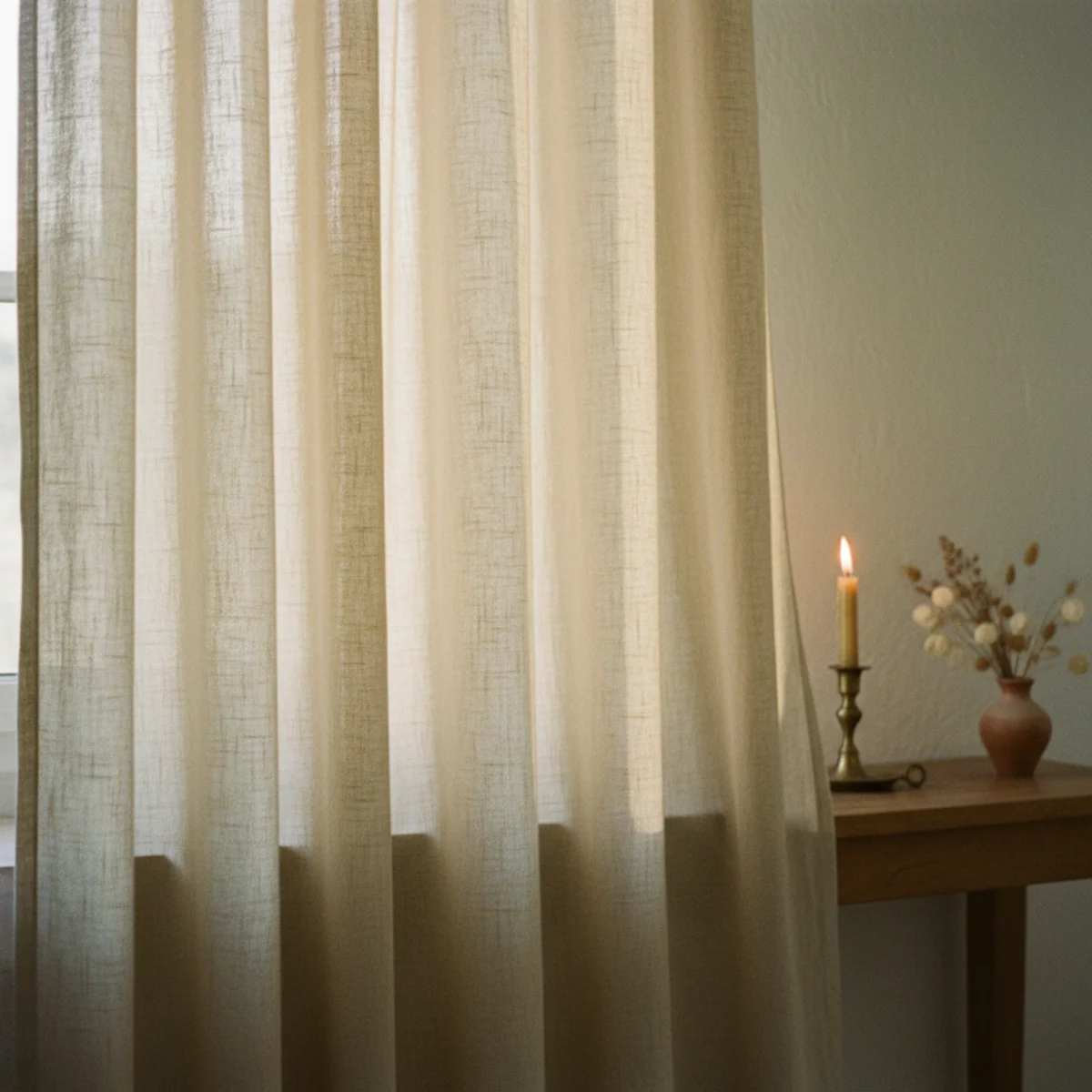
Warm minimalism's window treatments avoid the standard options — bright white curtains, blackout drapes, plastic blinds — and use natural fibers instead: linen panels, hemp curtains, woven bamboo shades, or layered cotton with wooden roman shades. The natural materials filter light beautifully and add the texture that warm minimalism specifically needs. They're also nearly always cheaper than synthetic alternatives.
Two natural-fiber approaches work best: floor-length unlined linen panels (IKEA AINA at $40 per panel, Quince at $69, Pottery Barn at $129+) hung close to the ceiling and stopping just above the floor; or woven bamboo or rattan roman shades (Home Depot at $30 to $80, Cb2 at $79 to $200) that pull down for privacy and roll up to disappear. Avoid pure white synthetic curtains, vinyl blinds, and anything labeled blackout for the main room (use blackout liners in bedrooms only). Layer linen panels over bamboo shades for full privacy with maximum texture.
AFFILIATE SLOTWINDOWFloor-length linen panels OR woven bamboo shades (or both layered)Add affiliate URL when configuredWhy it works
Because windows occupy significant visual real estate in any room, and the wrong window treatment can flatten an otherwise warm minimalist space. Synthetic white curtains read as commercial; vinyl blinds read as office. Natural-fiber linen, hemp, bamboo, and woven cotton all add texture and warmth at the window — and the way they filter light (softer, golden, diffused) adds to the warm-minimalist mood every hour of the day.
Pro tip — Hang linen curtain panels from a ceiling-mounted rod (or as close to the ceiling as possible), not from above the window frame. The ceiling-mount makes the room read taller, the curtains read more luxurious, and the warm-minimalist quality immediately becomes more architectural.
Linen panels and bamboo shades — natural fibers that filter light into warmth all day. See also: linen panels
10Add a Bouclé or Sheepskin Texture Element
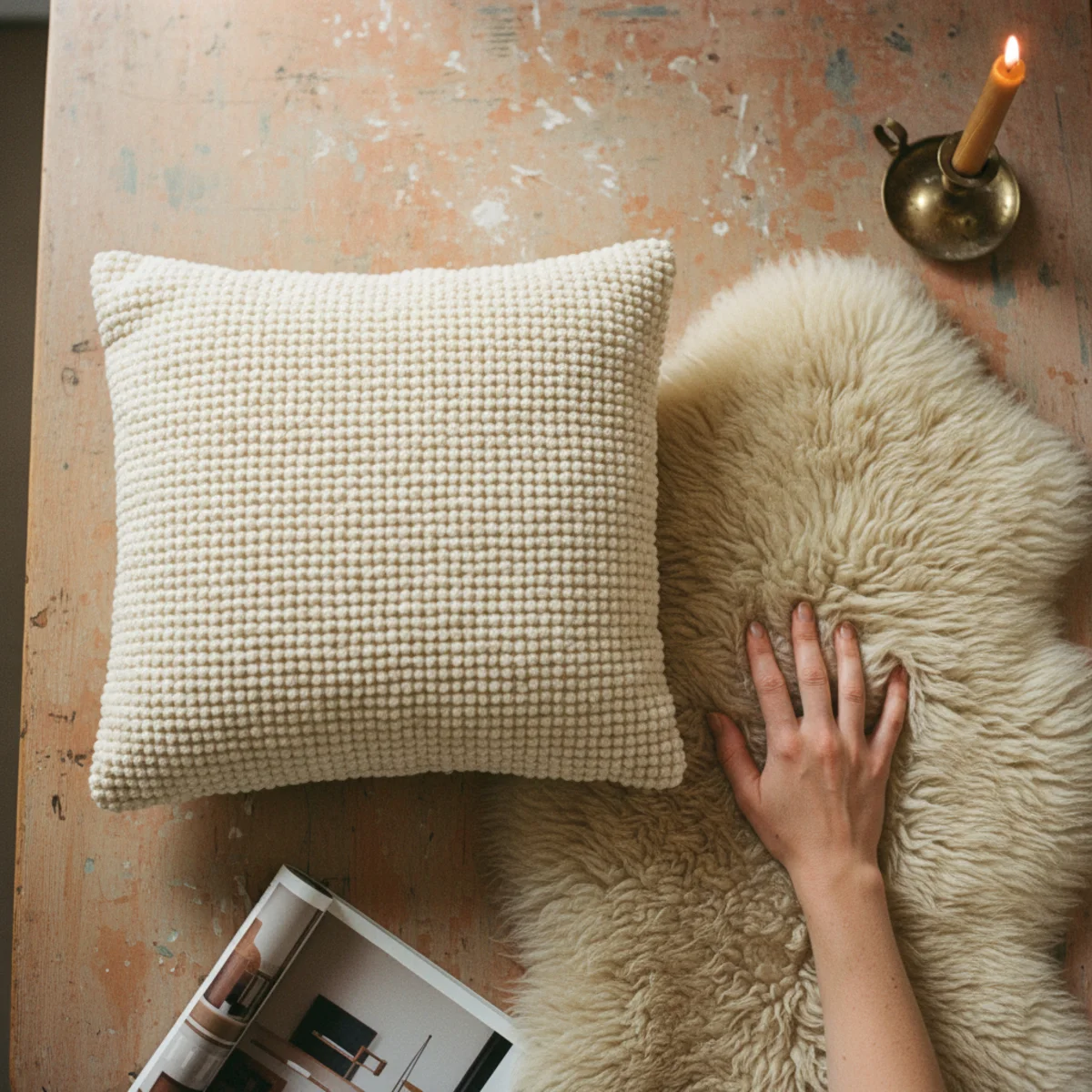
The single highest-impact texture addition for warm minimalism is one bouclé or sheepskin piece — a chair, a cushion, a throw, or a pelt draped over a wooden bench. Both materials add extreme visual depth in the same neutral tonal range, exactly what warm minimalism specifically needs. One bouclé chair or one sheepskin pelt per room is the rule; more than one creates competition. The piece becomes a quiet focal texture.
Choose one bouclé or sheepskin piece per room. Bouclé options: accent chair (Article Sven Charme at $799, West Elm Eden at $999, IKEA OREVAD at $250 as budget pick), cushion cover ($20 H&M Home, $60 West Elm), throw ($79 West Elm). Sheepskin options: pelt over chair back or bench (Costco at $40 to $60, IKEA LUDDE at $60, Pottery Barn at $150 to $250). Choose natural cream, oatmeal, or sand tones — bright white reads commercial, dark tones break the warm-minimalist palette. Position prominently (the chair or pelt should be visible from the main viewing angle).
AFFILIATE SLOTTEXTILESOne bouclé chair OR one sheepskin pelt, prominently placed, natural cream tonesAdd affiliate URL when configuredWhy it works
Because both materials are visually concentrated — the surface texture is so distinct that one piece in a room dominates the texture story by itself. Adding a second bouclé chair next to the first creates competition; the eye doesn't know which to register first. The minimalism is in the restriction to one per room, paired with the maximum impact of the chosen piece. One bouclé is the right amount; two is two too many.
Pro tip — Place the bouclé chair or sheepskin in the room's primary viewing zone (visible from the doorway, opposite the most-used seating) so it functions as both a tactile invitation and a visual anchor. Hidden in a corner, the same piece loses 70 percent of its impact.
One bouclé chair, prominently placed — the texture moment that elevates the entire warm minimalist room. See also: Article Sven Charme
11Hide the Tech and the Cords
The single fastest way to break warm minimalism is visible cords, electronics, and tech. Every cable, every charger, every visible piece of black plastic interrupts the warm calm. The solution is systematic hiding: cord raceways painted to match walls, cable trays under desks and consoles, charging stations inside drawers or cabinets, televisions either inside cabinets or behind picture-light setups. Tech invisibility is a warm-minimalist requirement, not an aesthetic preference.
Use peel-and-stick cord raceways ($8 from Amazon for 4-foot sections, paintable to wall color) along baseboards. Put all chargers in a single drawer or basket — never visible on counters. Mount TVs at the right height (eye level seated) with a flush-mount bracket so cables exit straight down behind the TV, then hide cables in a paintable raceway or inside the wall (electrician work, $200 to $400). Style around the TV with a small console below holding 3 to 4 objects, drawing the eye away from the screen. For laptops and tablets, build a small charging station inside a closed cabinet or drawer with a hidden outlet — never let charging cables be visible.
AFFILIATE SLOTORGANIZATIONCord raceways, hidden charging stations, cable management for TV and electronicsAdd affiliate URL when configuredWhy it works
Because visible tech and cords are the most disruptive elements possible in a warm minimalist room — they introduce hard plastic, sharp lines, glossy black surfaces, and chromatic interruption all at once. A single visible black charging cable across an otherwise warm minimalist room is the visual equivalent of a single dissonant chord in an otherwise melodic song. The hiding work is the maintenance of the aesthetic.
Pro tip — Audit your room once a month specifically for new visible cords and tech — they accumulate quickly as you add devices, and you'll lose track of how many small interruptions have appeared. A monthly 10-minute cord audit (consolidate, hide, paint over) keeps the warm minimalism from slowly degrading without you noticing.
No visible cords, no glossy black anywhere — warm minimalism specifically requires tech invisibility. See also: warm minimalist room
12Let Negative Space Be the Feature, Not the Filler
The final principle of warm minimalism — the one that separates it from any other aesthetic — is that empty space is treated as a deliberate design element, not as filler waiting for the next object. An empty wall, a mostly bare console, a coffee table with one tray and nothing else, the floor visible across the room. These are not absences; they are presences. Warm minimalism teaches the eye that nothing can be everything.
Designate at least one major empty zone per room: an entirely empty wall (no art, no shelves, no anything — just the wall and its paint), a console with one object on it, a coffee table with only a single tray, a floor section with no rug or furniture. Resist the urge to fill these zones — and resist them for at least three months before reconsidering. Most warm-minimalist rooms have between 25 and 40 percent of visible surfaces deliberately empty. The percentage is the discipline, and the discipline is the aesthetic.
AFFILIATE SLOTPRINCIPLE25-40% of visible surfaces deliberately empty as design featureAdd affiliate URL when configuredWhy it works
Because negative space is what gives every styled element in the room weight and breath. Without empty walls, an empty coffee table, an empty corner — every styled piece in the room competes for visual attention, and the warm minimalism collapses into warm maximalism. The discipline of leaving things empty is the aesthetic itself; warm minimalism is not the absence of styling but the deliberate use of nothing as a styled element.
Pro tip — Take a photo of your room from the doorway every two weeks and circle the empty zones. If they've shrunk since the last photo, you're adding objects. Edit aggressively to restore them — the warm minimalism only works when the emptiness is protected.
One empty wall, deliberately preserved — negative space is the feature, not the filler. See also: warm minimalism's quiet
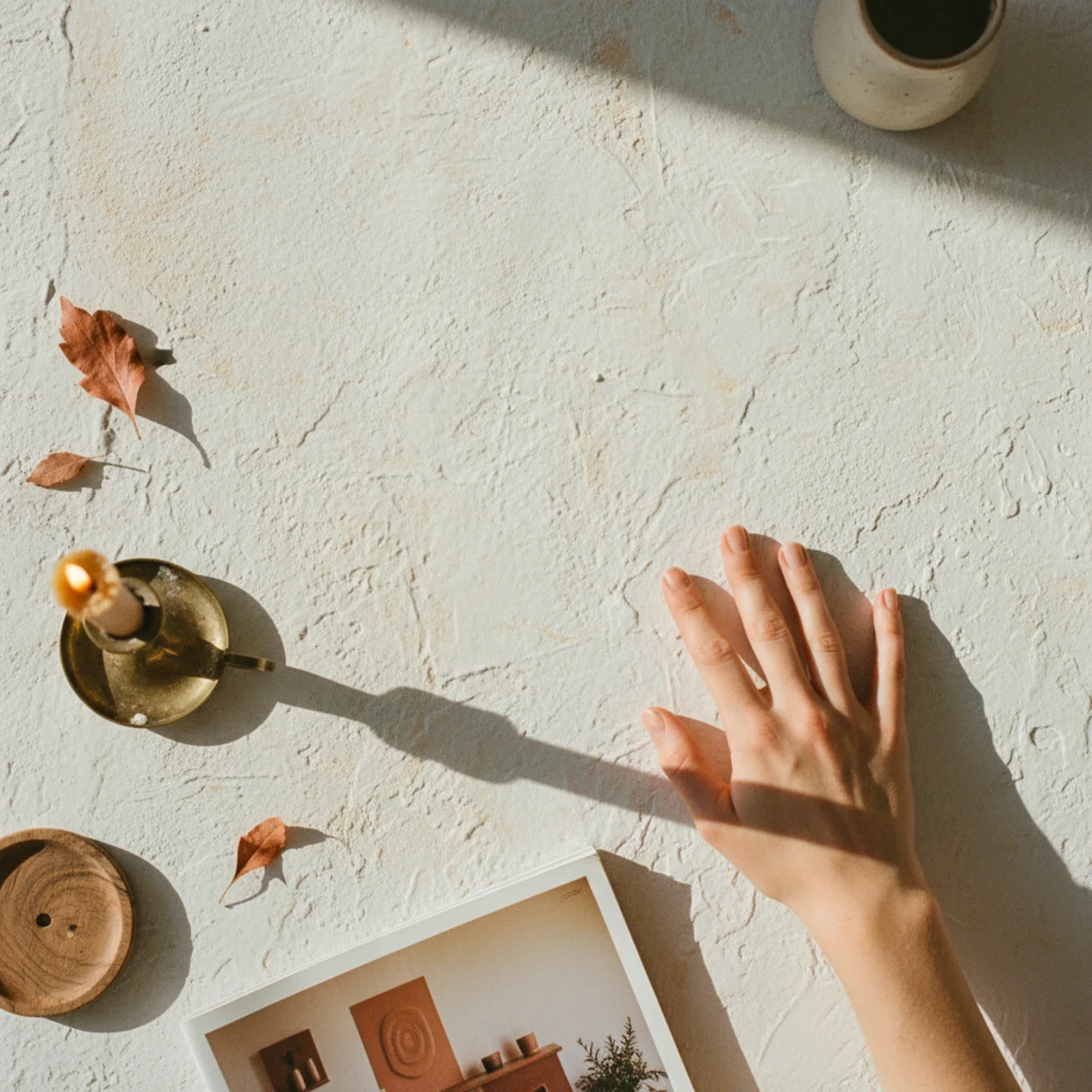
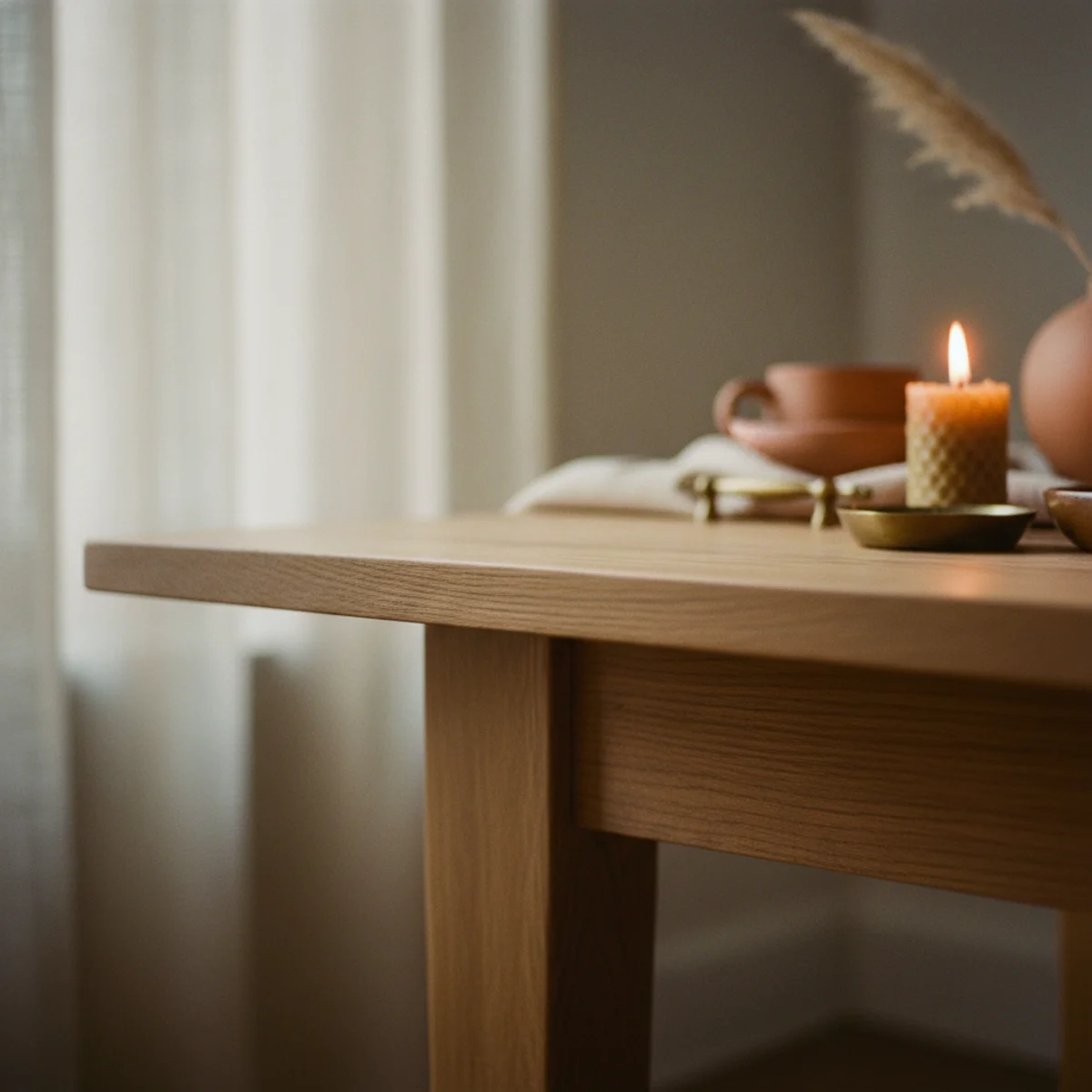
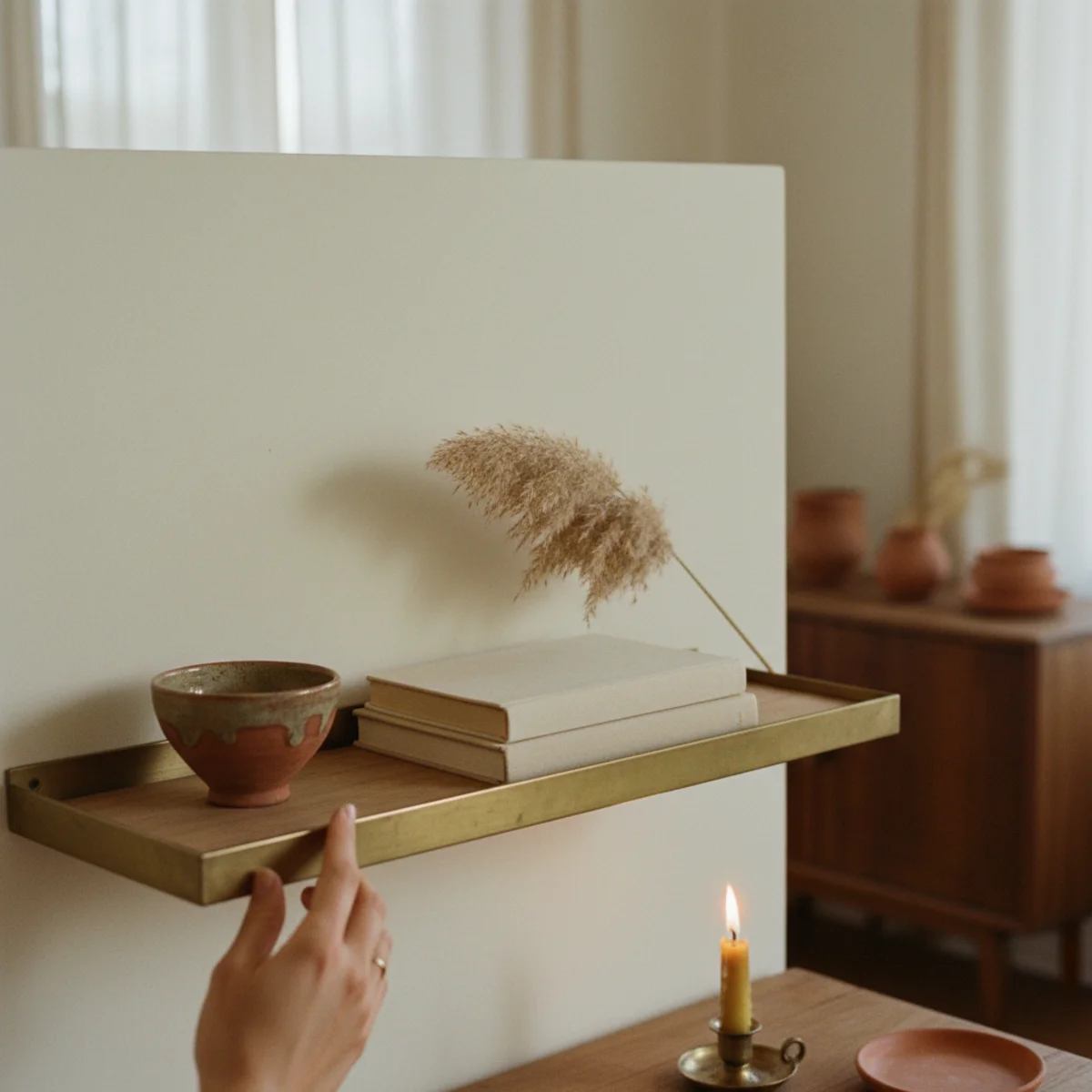
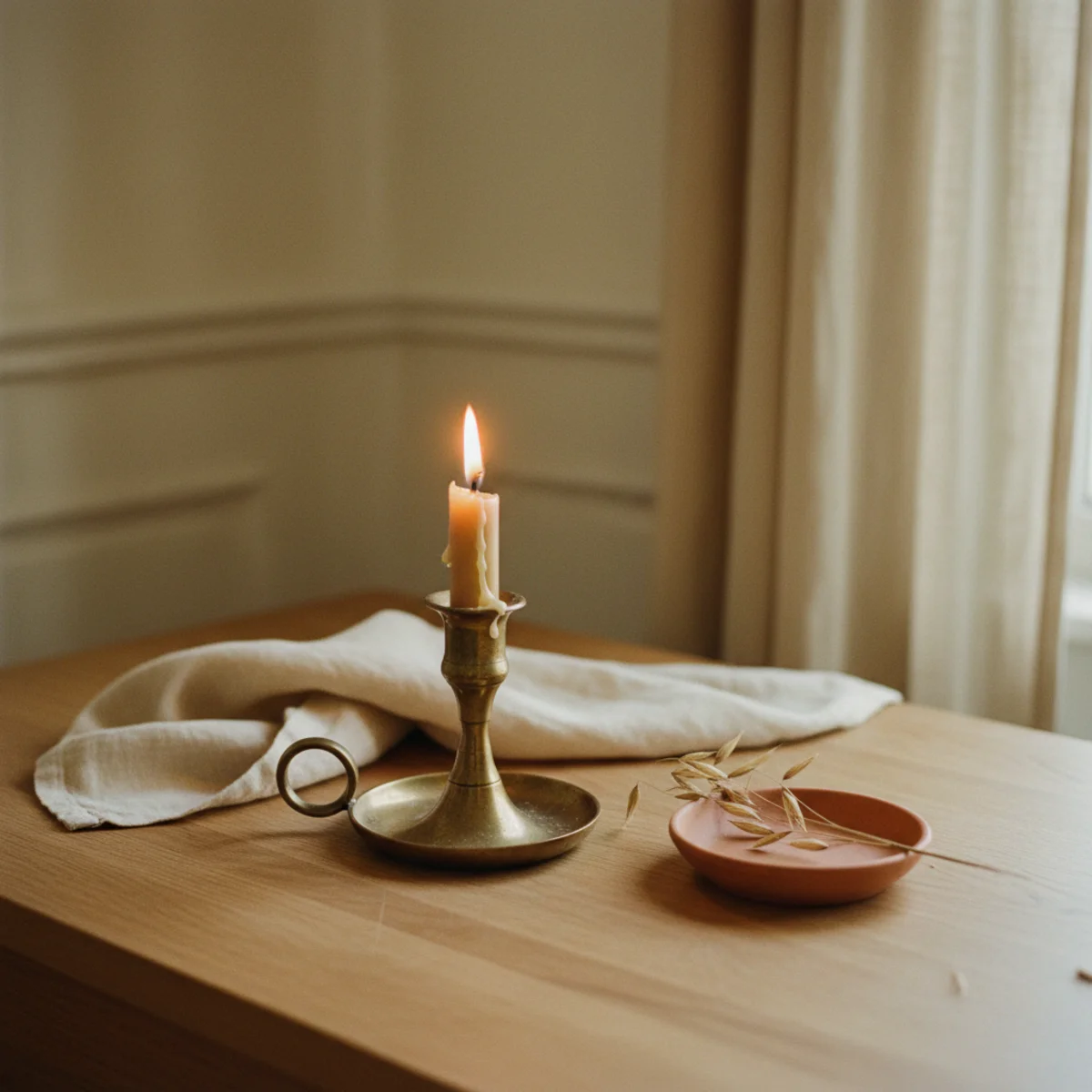
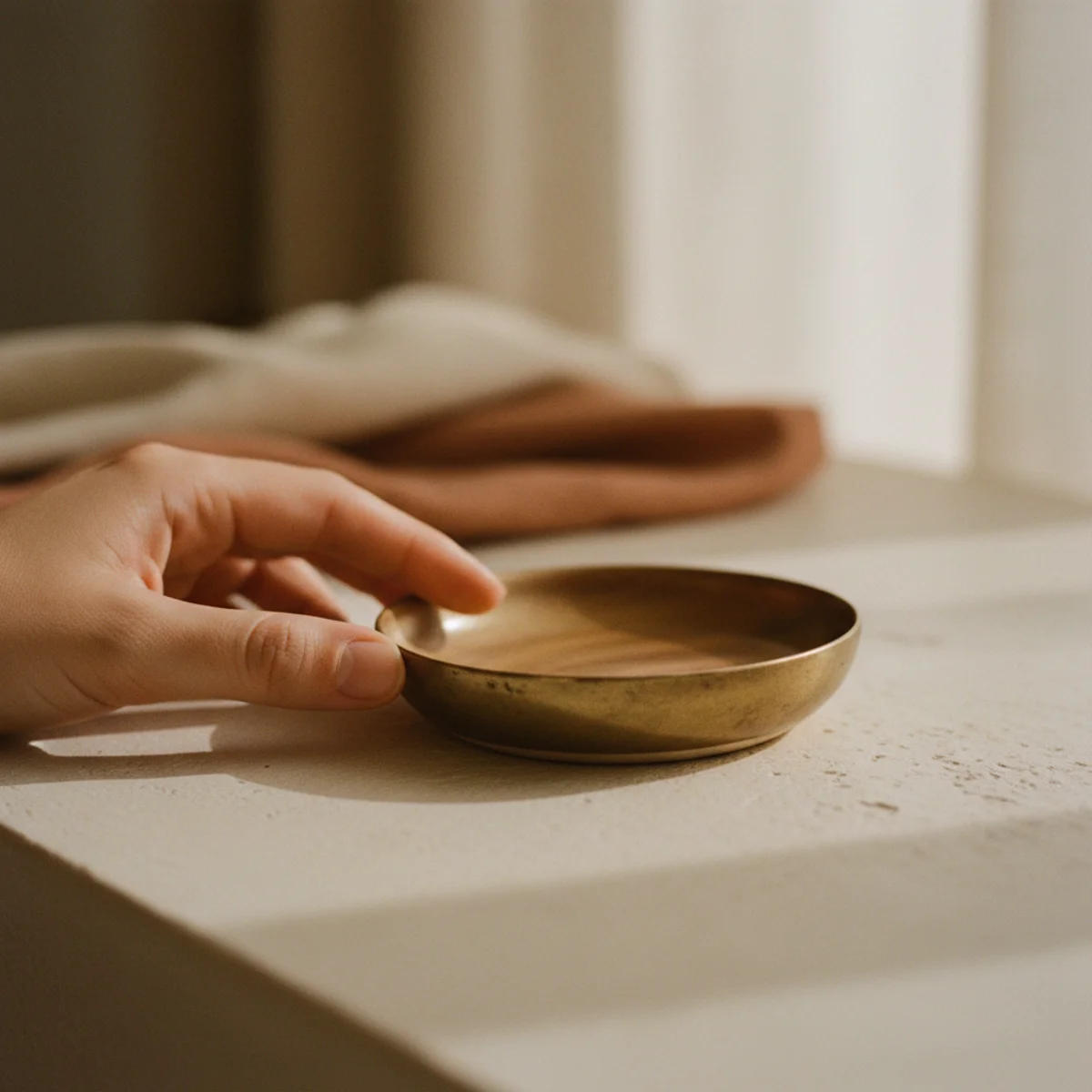
How to get the warm minimalist look
Start subtractive, then add warmth back deliberately. Work in this order.
- 1Strip back first
Remove everything from the room, then bring back only what earns its place. Most rooms come back at half their previous contents.
- 2Set the warm-neutral base
Paint walls a warm off-white or clay, and choose oiled wood and natural-fiber flooring. This is the canvas everything else sits on.
- 3Layer texture, not objects
Add a chunky rug, a bouclé chair, a linen throw — high-touch materials in low quantity. Texture does the work color and clutter used to.
- 4Place one accent and one object
A single saturated cushion or chair, and one sculptural ceramic. Then stop, before the room tips back into busy.
Quick tips
- Test every warm white at 4pm; the undertone you'll live with only appears at sunset.
- Keep the whole palette in the warm half of the color wheel — one cool gray breaks the spell.
- Choose matte and oiled finishes over gloss everywhere; gloss reads cold and shows everything.
- Buy fewer, better objects — one handmade ceramic beats five factory ones.
- Hide cords and tech; visible cables are the fastest way to break minimalist calm.
- Leave deliberate negative space and resist filling it — the emptiness is the feature.
Warm minimalism by room
A low neutral sofa, a chunky rug, one accent chair, oak floors, and a single sculptural object.
Layered linen in tonal neutrals, paired wood lamps, a limewashed wall, nothing on the nightstands but a lamp.
Handle-less cabinets in clay or oak, open shelving styled sparely, hidden small appliances.
Zellige or microcement in warm tones, a wooden stool, one stack of folded waffle towels.
Warm minimalism is restraint with the heat left on. Fewer things, but every one of them soft.
Frequently asked questions
What is warm minimalism?+
How is warm minimalism different from regular minimalism?+
What colors work in warm minimalism?+
Can warm minimalism work in small spaces?+
How do I make a warm minimalist room feel less empty?+
What's the most important warm minimalism principle?+
Strip the room back first, set a warm-neutral base in paint and oiled wood, then add warmth through texture rather than objects — a chunky rug, a bouclé chair, one sculptural ceramic. We'd test the wall color at 4pm before anything else; the undertone you live with shows up at sunset, and getting that one decision right is most of the battle. Warm minimalism is full of feeling and nearly empty of things. Hold that tension and the room takes care of itself.