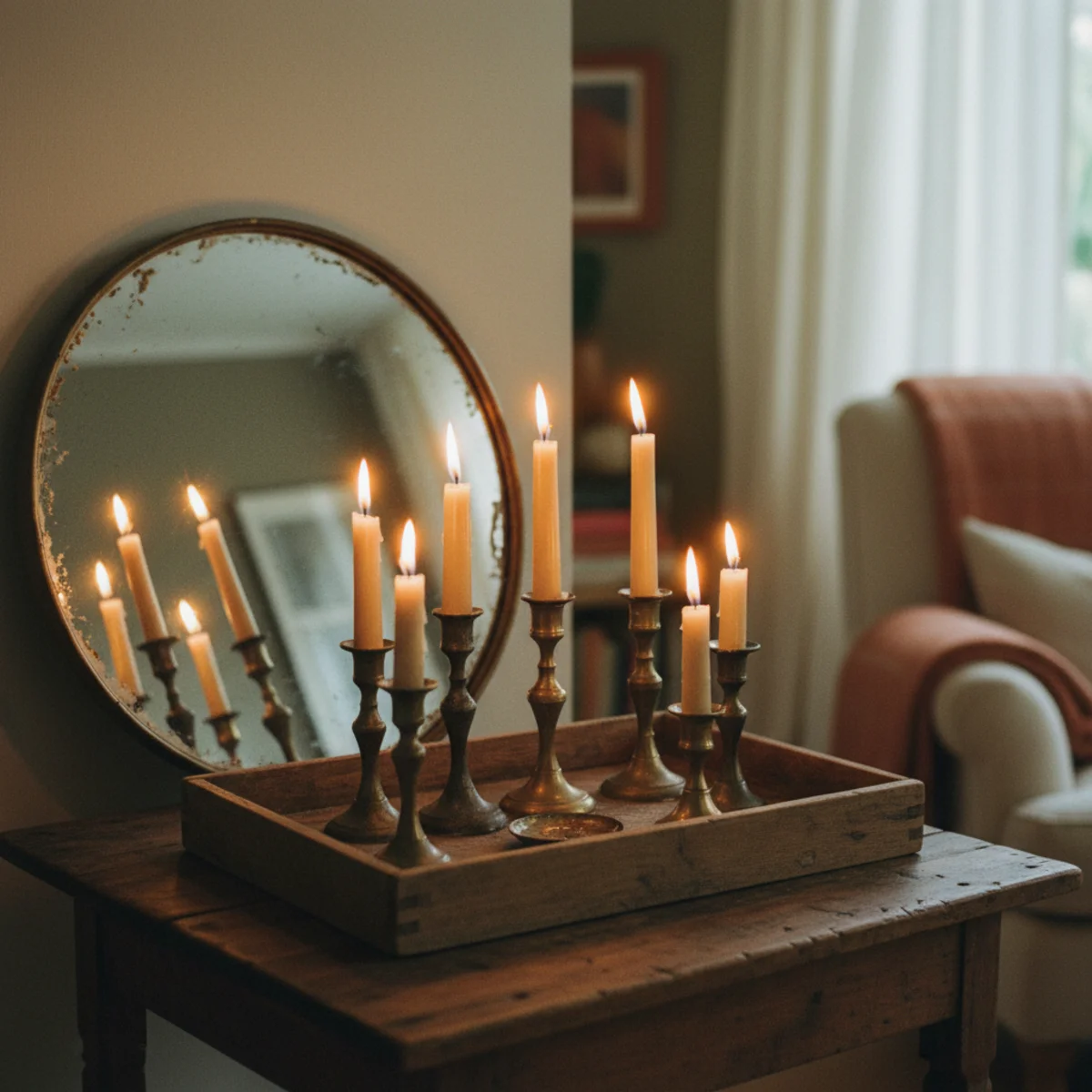
These twelve candle styling principles are tested across actual styled rooms — coffee tables that draw the eye, dining tables for romantic meals, mantels that anchor seasonal displays, bathroom counters that turn baths into rituals. Each move below names the exact arrangement rule, the candle types and heights to mix, the surface or backdrop choices that matter, and the small details (vintage brass holders, beeswax versus paraffin, mirror placement) that separate styled candle displays from random ones.
Most candle styling fails because the candles are treated as individual decor objects rather than as compositions. One candle here, one candle there, no relationship between them visually — the eye reads scattered rather than intentional. The fix is composition discipline: odd-number groupings, mixed heights on a single tray or surface, contained zones rather than distributed, and the specific styling moves that make 5 candles look better than 10 scattered ones.
By the end of this guide, you'll know exactly which styling principles transform candle displays from random to intentional — the odd-number grouping rule, the height-mixing principle, the tray containment, the beeswax preference, the eye-level placement, and the seven other moves that make any candle collection read as deliberately styled.
WHAT'S INSIDE
- Why odd-number groupings (3, 5, 7) outperform even-number arrangements every time
- The tray containment principle that turns scattered candles into intentional clusters
- Beeswax versus scented soy — when each works and why beeswax is usually the answer
- The eye-level rule (candles should sit below seated eye height) that creates atmospheric effect
Low, flickering light is the single most flattering thing in any room. Candles do more for a space than most lamps.
— Domino [citation needed — verify before publish]
What is candle styling?
Candle styling is the practice of grouping and placing candles so they add warm low light and visual texture rather than sitting as scattered afterthoughts. The core technique is clustering: odd numbers of candles at varied heights, gathered on a tray or surface so they read as one intentional vignette.
Material matters more than people think. Beeswax burns clean, lasts longer, and smells faintly of honey on its own; soy holds scent well but you don't want to layer several competing scents in one room. Tapers, pillars, and votives each play a height role — tapers for the tall plane, pillars for the mid, votives to fill in. The holder ties it together: brass, ceramic, or glass over plastic.
More in Styling you may love
See allWhy candle styling is everywhere in 2026
As the warm, hygge-influenced home took over, candlelight became a deliberate design layer rather than a special-occasion thing. Pinterest's candle styling and candle holder searches climb every fall, and the look has shifted toward clustered beeswax pillars and vintage brass over single scented jars.
The appeal is cost and atmosphere. A few candles and a thrifted tray transform a coffee table or mantel for almost nothing, and low flickering light flatters a room in a way overhead bulbs never will. It's the cheapest, most repeatable way to make a space feel intentional after dark.
20 candle styling ideas to try
01Group in Odd Numbers at Mixed Heights
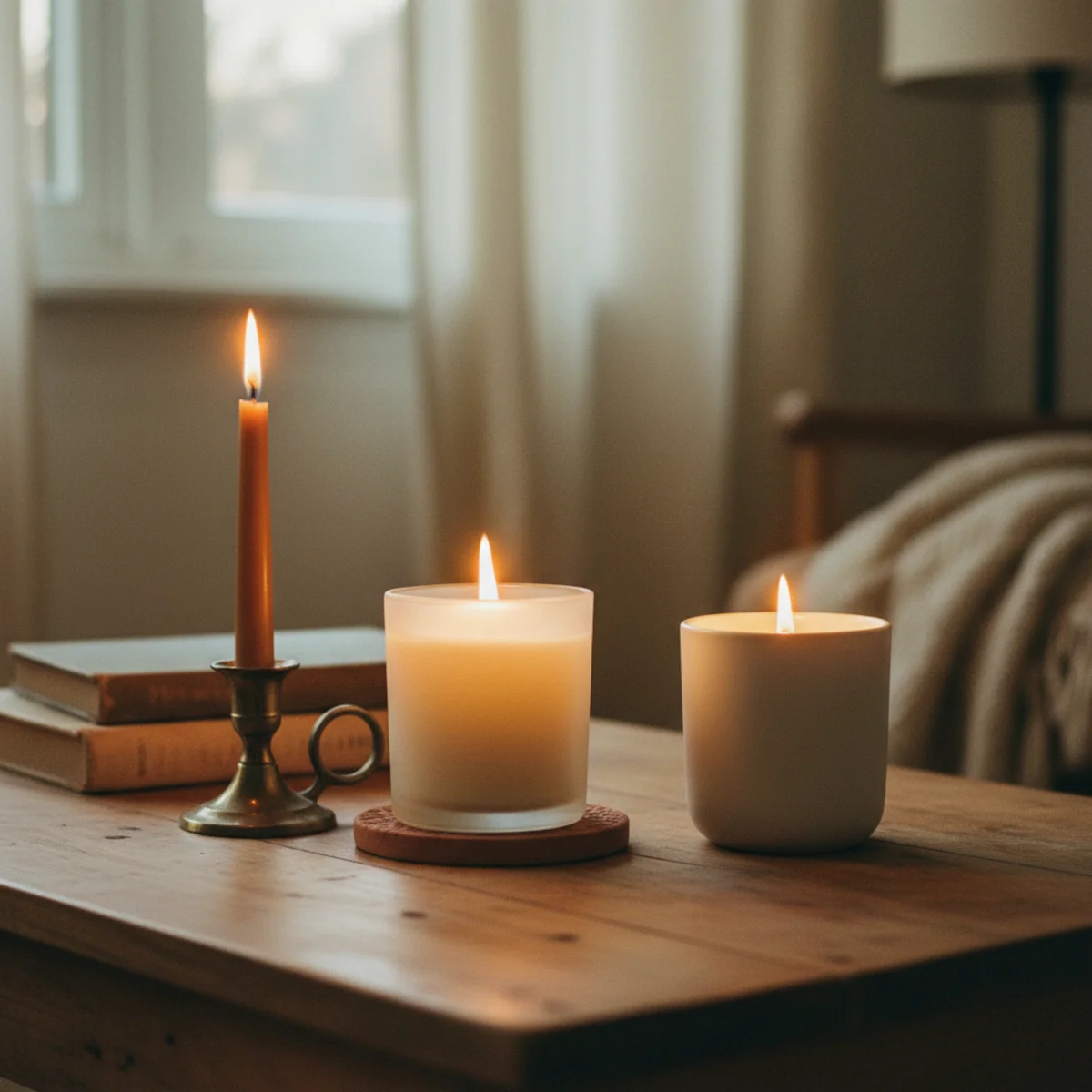
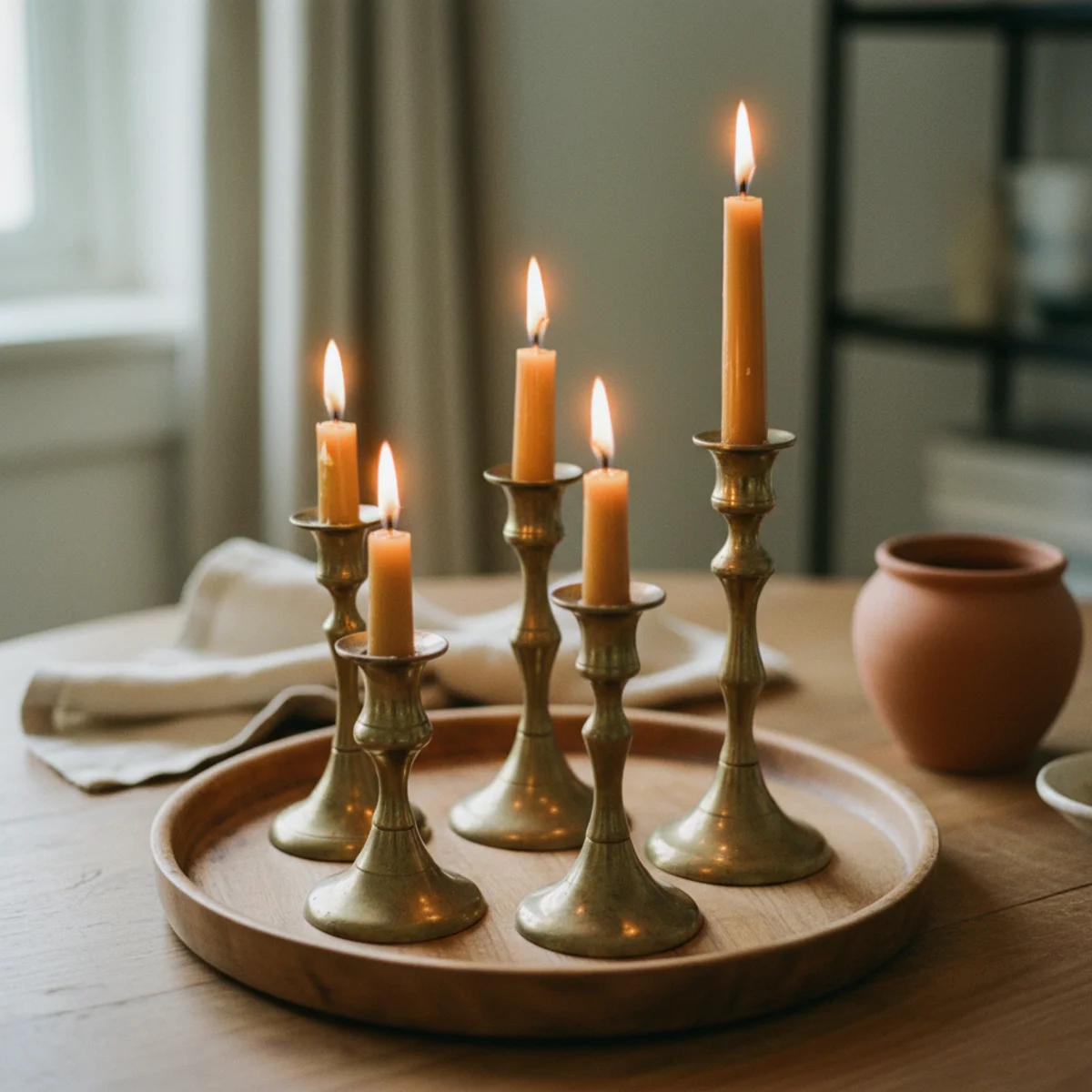
The single most-important candle styling principle is odd-number groupings at mixed heights. Groups of 3, 5, or 7 candles read as intentional composition; groups of 2, 4, or 6 read as accumulated or commercial. Within the odd-numbered group, mix heights deliberately — a tall pillar, two medium tapers, two short votives — for visual rhythm that even matched-height groupings lack.
Standard odd-number groupings: GROUP OF 3 — one tall (10 to 14 inches), one medium (5 to 8 inches), one short (2 to 4 inches). Position the tall behind, the short in front, the medium beside. GROUP OF 5 — two tall, two medium, one short. Or one tall, two medium, two short. GROUP OF 7 — three different heights with multiples at each height. Always include at least 3 different heights regardless of total count. Height sources: TAPER CANDLES (8 to 12 inches tall in 6 to 10-inch brass holders), PILLAR CANDLES (3 to 9 inches tall in various widths), VOTIVES (2 to 4 inches tall in small holders). Mix heights creates the visual rhythm that the eye reads as composed; matched heights read as either commercial display or unintentional accumulation. The combined odd-count and mixed-height discipline transforms how candle groups read instantly.
AFFILIATE SLOTPRINCIPLEAlways odd-number groupings (3, 5, 7) at 3+ different heights mixing tapers, pillars, and votivesAdd affiliate URL when configuredWhy it works
Because even-number arrangements create implicit symmetry that the eye reads as deliberate-but-rigid (or accidental, when the eye can't find the symmetry). Odd numbers create asymmetric balance that reads as intentional composition — there's no obvious pairing, so the eye must consider the whole as a single unit rather than as pairs of objects. The 3-element rule comes from classical art composition and continues to outperform even-number groupings in nearly every styling context. The same applies to candle holders, ceramic objects on shelves, vases on tables.
Pro tip — If you have 4 matching candles, use 3 and store the fourth — the discipline of working with odd counts is more important than using all your candles at once. Rotate the unused candle in occasionally to vary the display. Many candle collections fail because households commit to using everything they own rather than to styling what they own.
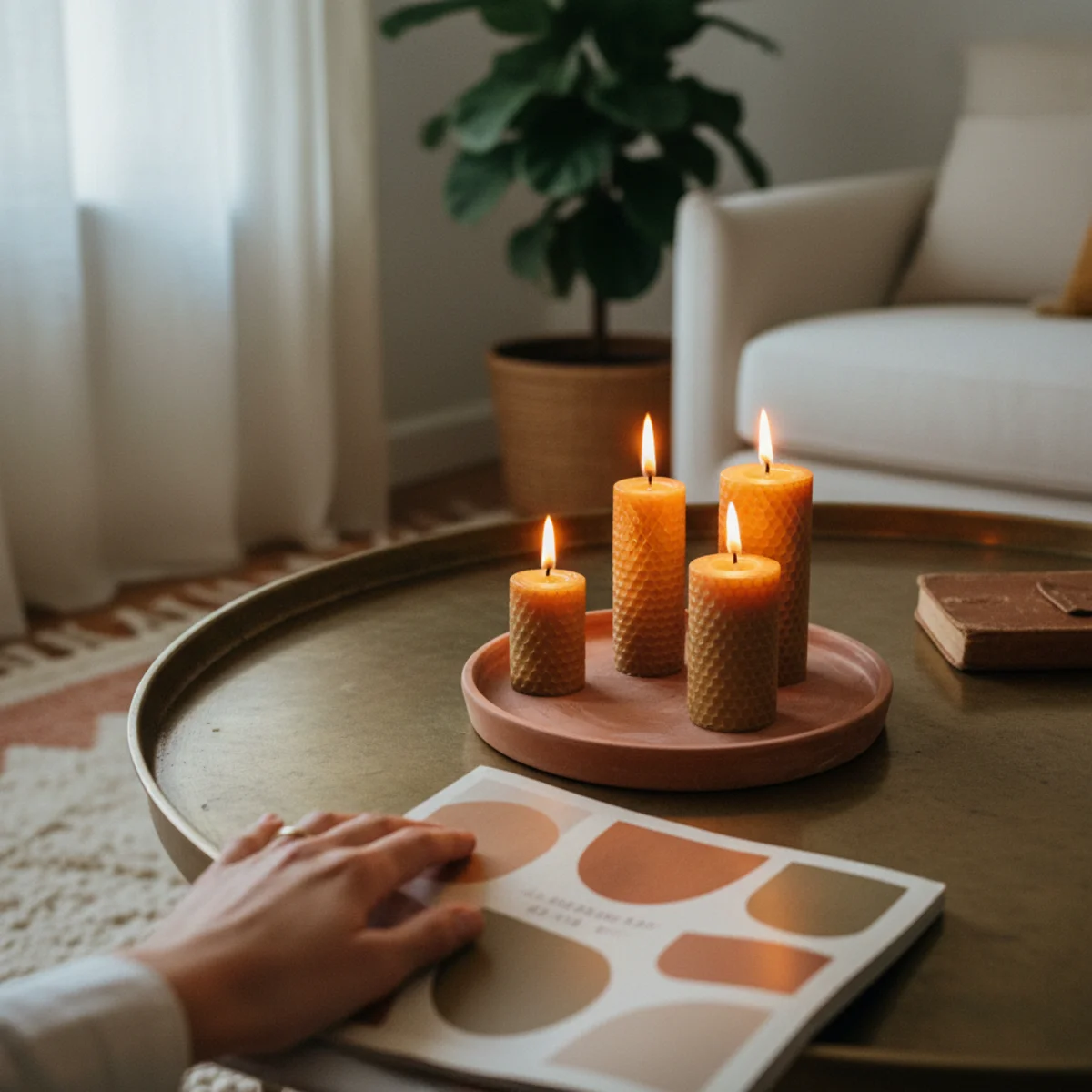
Five candles at three heights — tall pillar, medium tapers, short votives — the odd-number mixed-height composition. See also: ceramic objects on shelves
02Use a Tray to Contain the Group
A tray turns scattered candles into a composed group — the boundary defines the cluster as one styled unit rather than as multiple independent objects. The tray also catches wax drips, protects the surface underneath, and adds material variation (wood, brass, marble, stone) that contributes to the room's warm-material layering. Cost: $15 to $80 per tray; impact: significant.
Best tray options for candle styling: WOODEN TRAYS — walnut, oak, or olive wood at 12 to 18 inches across ($25 to $80, IKEA HEDERLIG at $15, vintage at $10 to $30). MARBLE OR STONE TRAYS — small to medium marble cutting boards or stone slabs at 8 to 14 inches ($30 to $120). BRASS OR METAL TRAYS — vintage brass trays or modern hammered metal at $20 to $60. WOVEN OR RATTAN TRAYS — natural-fiber trays at $20 to $50. Position the tray on coffee table, dining table, console behind sofa, or mantel. Place 3 to 7 candles ON the tray in mixed heights (rule 1), with possible additional small objects (small ceramic vessel, single pinecone, sprig of greenery) tucked between candles. The tray contains the cluster visually and protects the surface from dripping wax functionally. Size the tray to roughly match the candle group footprint — too large reads disproportionate, too small reads crowded.
AFFILIATE SLOTPRINCIPLEWooden, marble, stone, brass, or rattan tray 12-18 inches; size slightly larger than candle footprintAdd affiliate URL when configuredWhy it works
Because the tray creates a visual frame around the candle group, telling the eye 'these candles belong together as one composition' rather than 'these are independent objects that happen to be near each other.' The frame also adds material substance to the group — without the tray, candles sit directly on the surface and look slight; on a substantial wooden or marble tray, they read as anchored composition. The tray multiplies the visual weight of the candle group without requiring more candles.
Pro tip — Use a tray slightly larger than the candle footprint with 1 to 2 inches of visible tray around the cluster — the small border of visible tray around the candles is what makes the containment read as deliberate framing. Trays exactly the size of the candle footprint read as accidental; trays significantly larger read as disproportionate.
Walnut tray with five candles, ceramic vessel, and pinecone — containment that turns scattered into composed. See also: IKEA HEDERLIG
03Choose Beeswax Over Scented Soy
The candle material decision matters more than most styling choices — beeswax candles produce warmer-toned flames, release natural honey scent without synthetic fragrance, burn cleaner, and read as premium quality. Scented soy candles work for specific use cases but generally underperform beeswax for warm-home styling. The material choice affects how every styled candle display reads atmospherically.
Beeswax candle sources: ETSY ARTISAN MAKERS at $6 to $15 per taper, $15 to $40 per pillar (search 'pure beeswax candles' for 100% pure not blend), BEEHIVE COLLECTION at $12 to $20 per taper from independent beekeepers, KNORR BEESWAX TAPERS at $8 to $12 per taper from natural grocers, LOCAL BEEKEEPERS at $5 to $10 per taper at farmers markets. Look for 100% pure beeswax — 'beeswax blend' usually means majority paraffin with small beeswax additive. Scented soy candles for specific moods: BATH AND BODY WORKS (mass-market scented, $15 to $30), DIPTYQUE (premium scented, $40 to $100), AERY LIVING (UK-made warm scents, $30 to $60), OR LOCAL CANDLE MAKERS for hand-poured natural soy with essential oils. Use beeswax for the atmospheric daily candles (groupings, displays, ambiance); use scented soy occasionally for specific bath/bedroom mood moments only. The beeswax warmth versus paraffin coolness is significant for atmospheric impact.
AFFILIATE SLOTMATERIAL100% pure beeswax tapers/pillars from Etsy, Beehive Collection, or local beekeepers; scented soy only for specific moodsAdd affiliate URL when configuredWhy it works
Because beeswax candles produce a warmer-toned flame (slightly more yellow-orange where paraffin produces white-yellow), release natural honey scent without any synthetic fragrance, and burn cleaner without soot or chemical fumes. The combined sensory impact — warmer flame plus natural scent plus cleaner burn — is what makes beeswax candles authentically cozy rather than just decoratively lit. The cost premium ($8 to $25 per beeswax candle versus $1 to $5 for paraffin) is offset by longer burn time (roughly 2x per ounce) and dramatically better atmospheric impact across daily use.
Pro tip — Stock 24+ beeswax tapers at once during fall when bulk pricing is best — order $80 to $120 worth of tapers in cream, natural honey, and accent colors for the whole-season supply across Christmas, winter, and ongoing daily use. The bulk approach reduces per-candle cost significantly and ensures the supply is consistent across cold months.
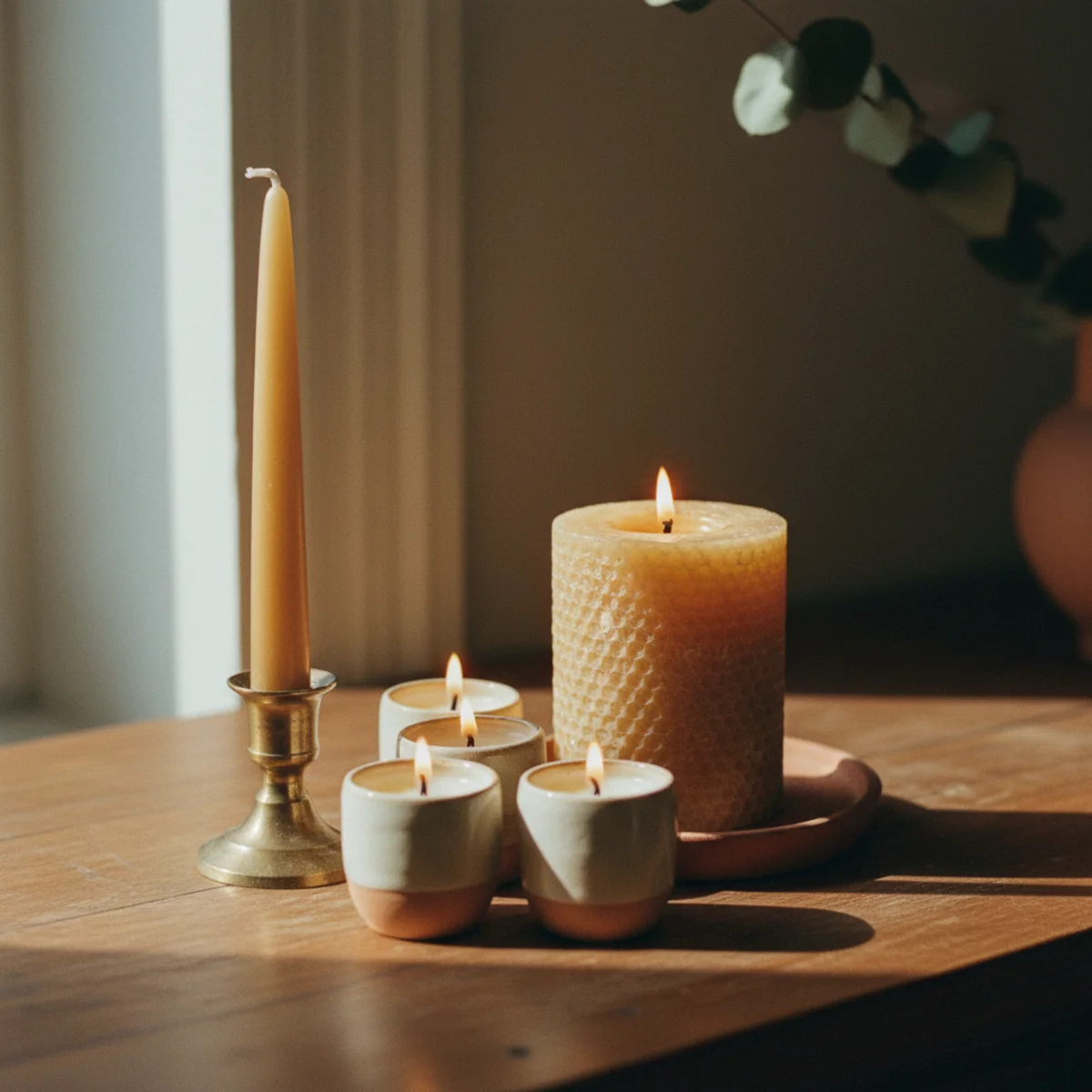
Pure beeswax tapers in vintage brass holders — natural honey color, warmer flame, cleaner burn. See also: best-candles-cozy-home
04Place Candles Below Eye Level
Candles work best when the flame sits below seated eye height (roughly 42 to 48 inches above the floor for seated viewing). Flames above eye level read as too bright and competing with seeing; flames below eye level read as atmospheric warm light pooling in the room. The eye-level rule applies to coffee tables, side tables, ottomans, dining tables — every surface where candles get placed at seated viewing height.
Eye-level placement rules: COFFEE TABLE — at 16 to 18 inches above floor, candles on the table sit at 18 to 30 inches above floor (pillars and tapers) — below seated eye level at 42 to 48 inches. Perfect atmospheric height. DINING TABLE — at 28 to 30 inches above floor, candles sit at 30 to 42 inches above floor — at or slightly below seated dining eye height. Position taller candles slightly to the side so they don't block conversation across the table. CONSOLE BEHIND SOFA — at 30 to 32 inches above floor, candles sit at 32 to 44 inches — at or slightly below seated viewing height. MANTEL — at 50 to 56 inches above floor — slightly above seated eye level but appropriate for fireplace context. AVOID: candles on high shelves (6+ feet above floor), candles on tall consoles in seating zones (eye level competing), candle chandelier or pendant arrangements above seated viewing — these all read as commercial/decorative rather than atmospheric.
AFFILIATE SLOTPLACEMENTCoffee tables, dining tables, consoles, ottomans - candles below seated eye level (42-48 inches above floor)Add affiliate URL when configuredWhy it works
Because candle flames are bright relative to ambient room lighting — and flames above the eye line shine into your eyes and compete with seeing other parts of the room, while flames below the eye line spread warm pooled light into the room without competing with vision. The physiological difference is significant: at-or-below eye level reads as atmospheric ambient warmth; above eye level reads as direct competing light source. Most badly-styled candle displays violate this rule by placing candles on high shelves or pendants where the flame distracts rather than enhances.
Pro tip — Test your candle placement from your actual seated position in the room (sofa, dining chair, armchair) — the eye level matters from where you'll actually be looking at the candles, not from your standing arranging position. Candles styled from standing often need height adjustment when viewed from seated.
Candles at 28 inches above floor on coffee table — atmospheric warm pool, not eye-competing light source. See also: coffee table styling
05Mix Tapers, Pillars, and Votives
Within any candle group, mix three different candle types — tapers (long thin candles in holders), pillars (thick freestanding candles), and votives (small candles in glass jars). The variety creates visual rhythm and provides different light qualities at different heights. Single-type groupings (only tapers, only pillars) read as commercial display; mixed groupings read as collected over time.
Standard mixed candle composition: TAPERS for vertical lines and height — 8 to 12 inches in vintage brass or hand-thrown ceramic holders, $1 to $2 per taper plus $10 to $30 per holder thrifted or new from Etsy. Use 2 to 4 per group. PILLARS for visual weight and longer burn — 3 to 9 inches tall in various widths, $5 to $15 per pillar from Pier 1 or Williams-Sonoma. Use 1 to 3 per group as the visual anchor. VOTIVES for small warm light pools and visual rhythm — 2 to 4 inches tall in glass jars or small holders, $1 to $3 per votive. Use 2 to 4 per group at the base level. The 3-type mix means the group has 5 to 11 candles total spanning visual heights from 2 inches to 14 inches, creating the layered atmospheric effect that single-type groups cannot match.
AFFILIATE SLOTCOMPOSITIONMix 2-4 tapers + 1-3 pillars + 2-4 votives in every styled group; total 5-11 candles spanning 2-14 inches heightAdd affiliate URL when configuredWhy it works
Because the 3 candle types each serve different visual functions — tapers add vertical lines and visual rhythm, pillars add weight and longer burn time, votives fill in at the base with small warm pools. The combination creates a complete vertical composition where matching candles only fill one role. Matching pillar groups read as commercial-thick; matching taper groups read as formal-dining; matching votive groups read as decorative-clustered. The mix is more visually interesting and more functionally complete.
Pro tip — Buy a starter kit of all three types together — 6 tapers + 3 pillars + 6 votives ($30 to $60 total) gives you the materials for 1 to 3 styled groups across the home. The kit-buying approach is faster than collecting individual pieces over time and ensures the visual variety from the first display.
Three tapers, two pillars, four votives — the 3-type mix that single-type groups cannot match. See also: Williams-Sonoma
06Add a Mirror Behind a Cluster
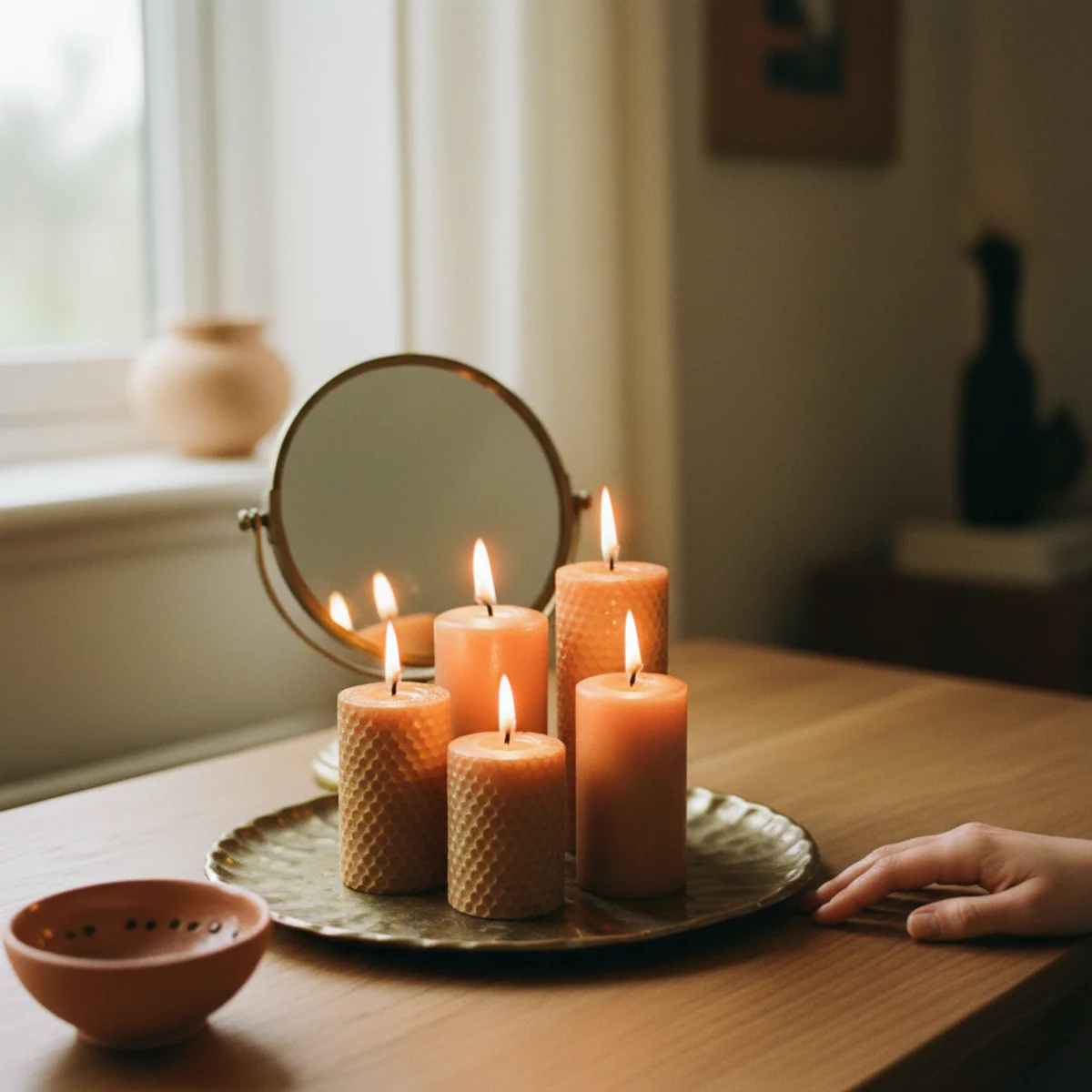
A mirror behind a candle cluster doubles the visible candle count and dramatically increases the warm-light effect. The mirror reflects each flame, the warm wax color, the surrounding ambient glow — turning a 5-candle group into the visual effect of 10 candles. Best applications: dining table with mirror on the wall behind, console with mirror above, dressing table with mirror frame.
Mirror-behind-candles applications: DINING TABLE with mirror on wall behind — 24 to 48-inch framed mirror centered on the wall behind one end of the table ($60 to $400 for the mirror). Candle cluster on the table near that wall reflects fully in the mirror; viewing from the opposite side of the table shows both real candles and reflected candles for doubled visual count. CONSOLE WITH MIRROR ABOVE — small to medium mirror (18 to 30 inches) above a console table, candle cluster on the console reflecting in the mirror. ENTRY TABLE with mirror — same principle in the entry. BATHROOM COUNTER with vanity mirror — candle cluster reflecting for spa-bath effect. POWDER ROOM SINK — candles on the counter reflect in the wall mirror for evening party lighting. The doubled visual effect costs nothing extra (the candles you already have) and depends only on positioning relative to existing mirrors.
AFFILIATE SLOTEFFECT24-48 inch mirror behind candle cluster on dining table, console, entry table, or bathroom counterAdd affiliate URL when configuredWhy it works
Because the reflection genuinely doubles the visual warm-light count — your eye sees both the actual candles and their reflected duplicates, processing the total as one richly-lit composition. The mirror also adds depth perception (the reflected candles appear to extend the space beyond the mirror), making the room feel larger and more atmospherically lit. The trick works because candle flames are bright enough relative to ambient light that the reflections register strongly even in dim rooms — where many other reflective effects are too subtle to read.
Pro tip — Position candles 6 to 12 inches in front of the mirror rather than directly against it — the small distance creates depth in the reflection and lets the reflected candles read as 'candles in another space' rather than as 'candles touching mirror.' Touching-the-mirror placement looks accidental; intentional small-distance placement looks composed.
Five candles reflected in mirror — doubled visual count and atmospheric depth at no extra candle cost. See also: framed mirror
07Run Tapers Down a Dining Table
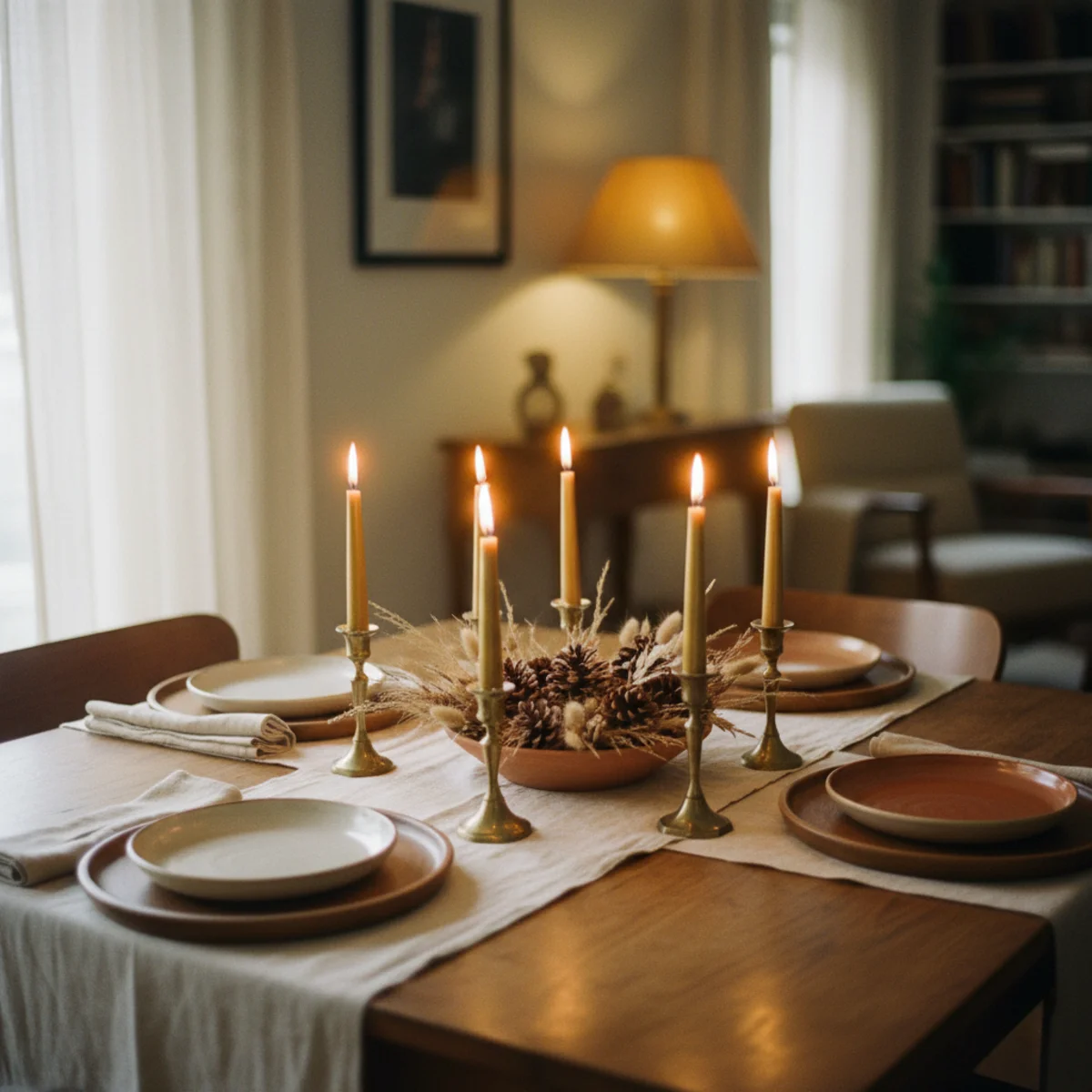
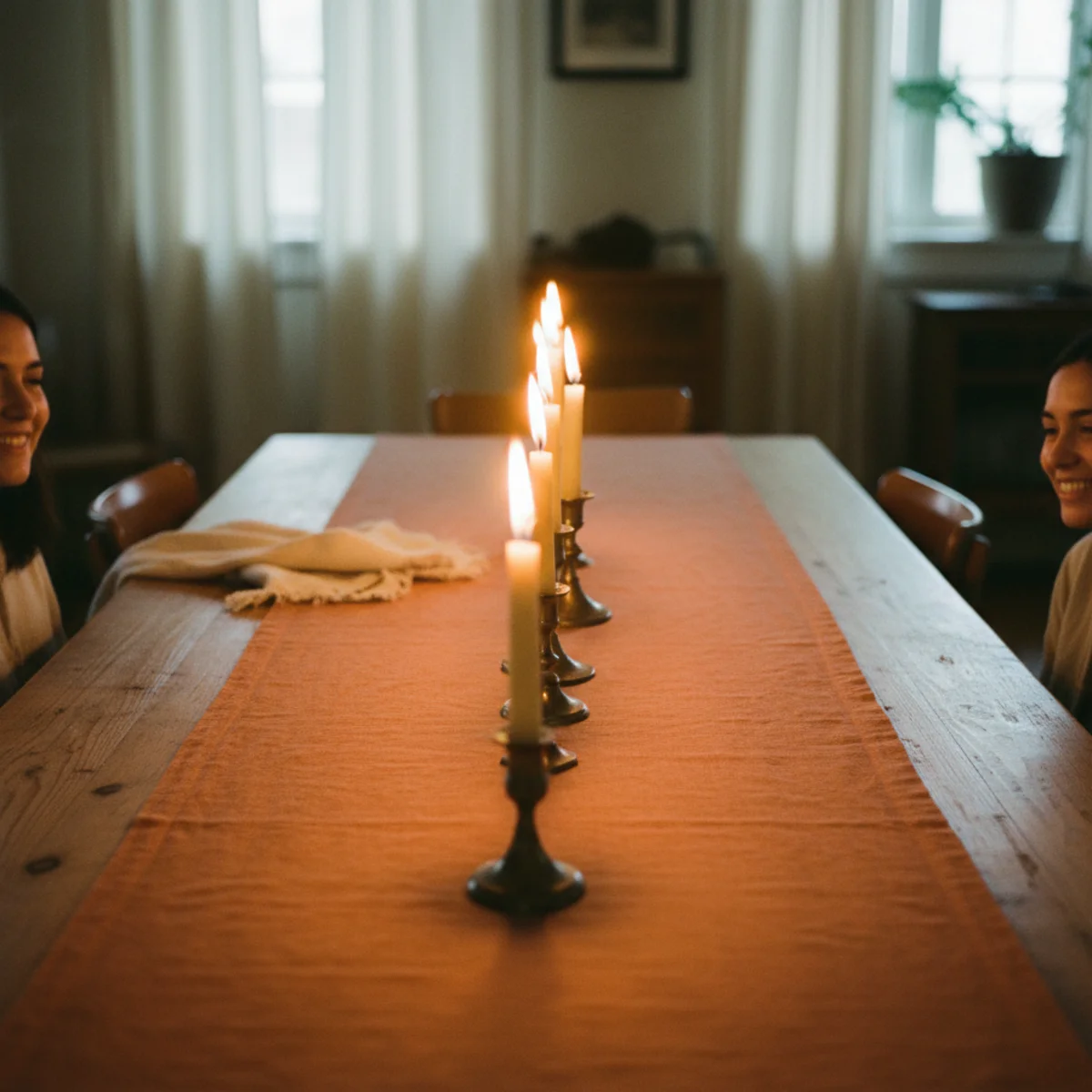
A line of taper candles down the center of a dining table is the classic dinner-party styling move — 4 to 7 tapers in matching or coordinated holders, spaced 8 to 12 inches apart, running the table length. The repeated vertical lines create rhythm and provide flattering warm light at the perfect height for dining conversation across the table.
Taper-line setup: 4 TO 7 BRASS OR CERAMIC HOLDERS spaced 8 to 12 inches apart down the table center. Holder height: 6 to 10 inches (the tapers then reach 14 to 22 inches above the table — slightly above seated eye level but not blocking sightlines across). Mix matched and coordinated holders rather than identical — three of one design + two of another design + one accent reads collected, where six identical holders read commercial. TAPER COLORS — ivory, cream, natural beeswax for neutral elegance; or warm earth tones (terracotta, deep rust, olive) for seasonal punctuation. CANDLE LIGHTING TIMING — light all candles 15 minutes before guests arrive so the cluster is fully glowing when people sit down. LOWER STYLING — between tapers, add small low elements (small ceramic vessels, sprigs of greenery, citrus on twine) that fill the spaces visually without blocking sightlines. The complete taper line transforms any dinner from casual to atmospheric meal.
AFFILIATE SLOTDINING4-7 tapers down table center spaced 8-12 inches apart in mixed coordinated brass or ceramic holdersAdd affiliate URL when configuredWhy it works
Because the repeated vertical lines of taper candles create visual rhythm down the long horizontal table — the eye reads the line as composed design rather than as scattered placement. The height of the tapers (in 6 to 10-inch holders) also positions the flame at the right level for cross-table conversation — high enough to provide light without being below sightline, low enough not to block faces. The single-line composition also reads more elegant than scattered candle groups for formal dining specifically.
Pro tip — Choose tapers that fit your holders snugly — tapers that wobble in too-large holders read as accidental, tapers that don't fit are useless. Standard taper diameters: 7/8 inch (most common), 13/16 inch (slightly thinner), 1 inch (slightly thicker). Buy holders and tapers in matching diameters; test fit before the dinner party.
Six tapers down the table center with greenery between — the classic dinner-party styling move. See also: dining-nook-ideas
08Cluster in the Window at Dusk
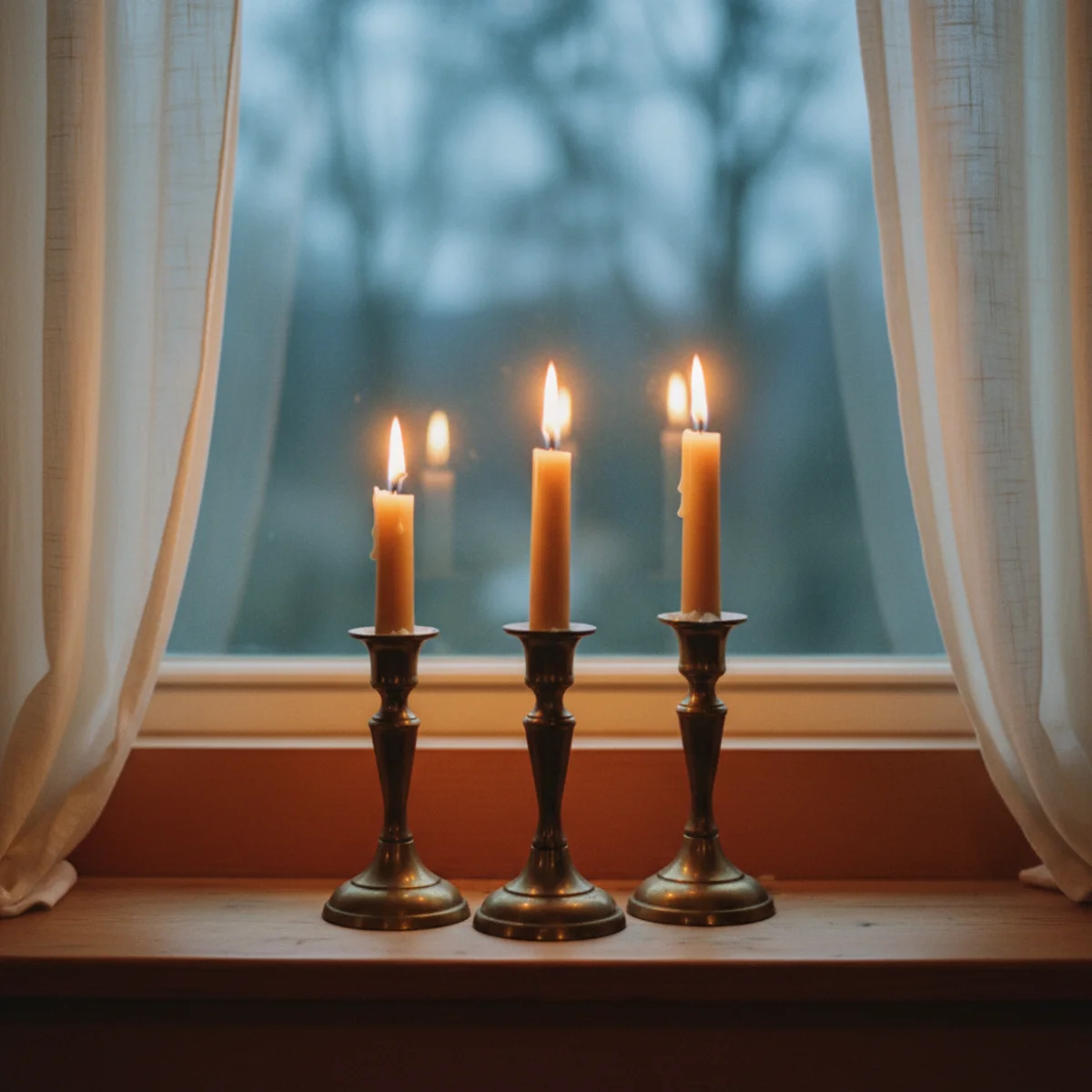
Candles in a windowsill at dusk reflect in the darkening window glass — doubling the visible candle count via reflection (rule 6) but also adding the exterior-visibility effect that signals 'warm home' from outside. The window candle cluster works especially well during winter evenings when the dark window functions as a mirror for the lit interior.
Window cluster setup: 3 to 7 candles grouped on the windowsill or on a small table directly in front of a window. Mix pillars (3 to 5 inches tall), votives in glass jars, and small tapers in vintage brass holders. Position 2 to 4 inches back from the glass to prevent heat damage and to create depth in the reflection. Best windows for clustering: living room front window facing the street (exterior visibility), dining room window beside the table (intimate dining glow), master bedroom window if visible from main living areas. LIGHT BEFORE DUSK rather than after dark — the gradual reflection effect as outside darkens creates atmospheric transition. The reflected effect in the dark window glass (during winter evenings when the window is essentially a mirror) doubles the visible candle count and creates warm glow both inside and from outside.
AFFILIATE SLOTPLACEMENT3-7 candles clustered in windowsill or in front of dark window; light before dusk for reflection effectAdd affiliate URL when configuredWhy it works
Because the reflected effect in dark window glass doubles the visible candle count and creates a glow effect that pure interior clusters cannot match. The exterior visibility also adds an emotional dimension — walking by other warm-window-lit homes during winter evenings is itself part of the season's emotional fabric, and your own home contributes to that shared experience. The candle-in-window is also a centuries-old winter symbol (originally a sign of welcome for travelers), which the design choice subtly invokes.
Pro tip — Use a metal or stone tray underneath the candle cluster on the windowsill to catch dripping wax — even careful candle-burning produces some wax drip, and a $10 tray protects the windowsill underneath. Choose a warm-toned brass or oxidized metal tray that adds to rather than detracts from the candle styling.
Five candles clustered on windowsill at dusk — reflected double-count visible inside and from outside. See also: winter-decor
09Use Vintage Brass Holders
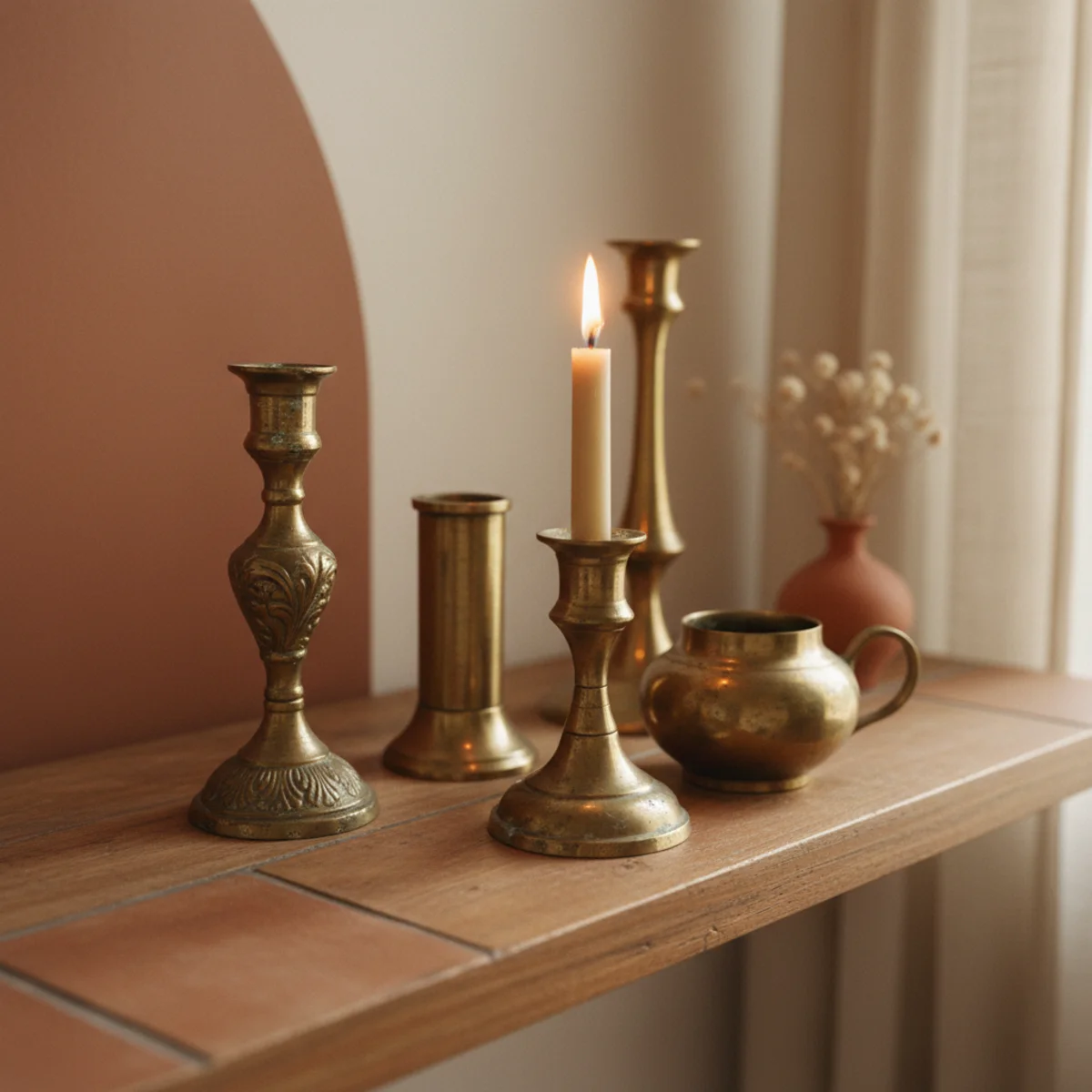
Candle holders themselves are part of the styling — and vintage brass holders consistently outperform new ceramic or modern metal alternatives for warm-home aesthetic. The aged brass patina, the irregular handmade details, the visible history of use all signal authentic warm-collected character that new mass-produced holders cannot match. Sources: estate sales, antique stores, Marketplace at $5 to $30 per holder.
Vintage brass holder sourcing: ESTATE SALES typically yield 4 to 8 brass holders at $5 to $20 each across mixed styles (single tapers, doubles, candelabra, pillar holders). Saturday morning hunting often produces full sets. ANTIQUE STORES at $10 to $40 each for vintage brass holders — selection is curated, prices higher than estate sales but quality often better. FACEBOOK MARKETPLACE at $5 to $30 each for individual brass pieces or small collections. AUCTION HOUSES (online or local) for vintage Skultuna brass, Scandinavian brass, mid-century Danish brass at $20 to $80 per piece. WARNING: 'antique-style' new brass holders from retailers ($20 to $80 each) miss the patina and irregularity that make vintage worth its lower price. The vintage difference is substantial; mass-produced reproductions can never match the aged real thing. Build the collection slowly — one or two holders per estate sale visit — across years for accumulated warm-collected character.
AFFILIATE SLOTHOLDERSVintage brass at $5-30 per holder from estate sales, antique stores, Marketplace; never polish unless severely tarnishedAdd affiliate URL when configuredWhy it works
Because aged brass has natural patina (slight darkening, irregular tone, sometimes verdigris) that develops only across decades of real use — and the patina is what reads warm and collected rather than commercial-new. New brass either looks too polished (commercial showroom) or has fake aged-patina (immediately recognizable as imitation). The handmade irregularity in older holders (slightly uneven bases, asymmetric details, weight variations) also reads as craftsmanship that mass-produced new holders cannot achieve. The cost case is striking: vintage at $5 to $30 outperforms new at $20 to $80 substantially.
Pro tip — Don't polish vintage brass holders unless they're severely tarnished — the natural patina is part of what makes them work, and over-polishing returns them to looking like new brass. If you must clean, use a soft cloth and mild soap; avoid polish that strips the aged tone.
Five vintage brass holders with natural patina — character that new reproductions cannot achieve. See also: estate sales
10Float Candles in a Shallow Bowl
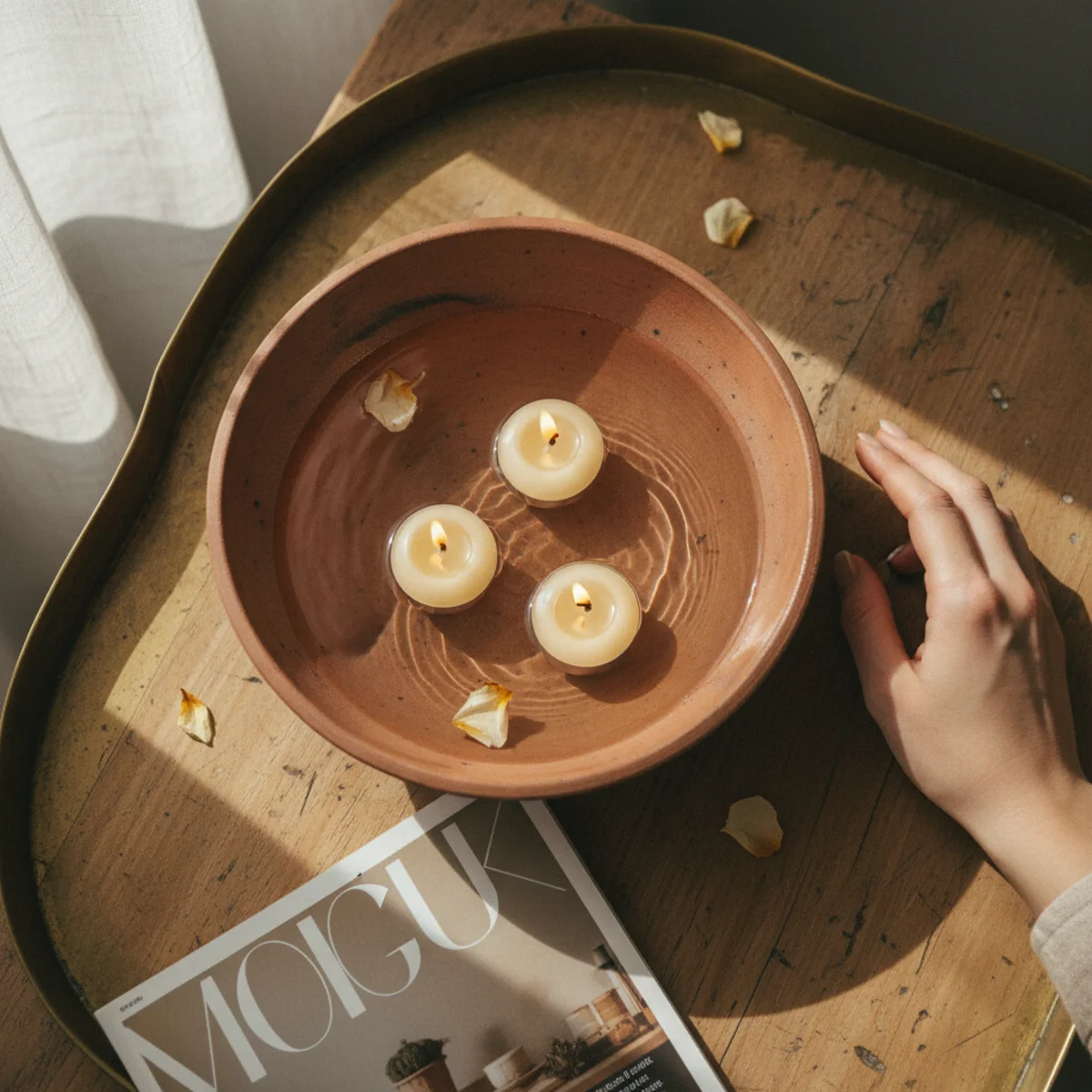
Floating candles in a shallow bowl of water create an unexpected styling effect — small lit candles floating on water surface with optional submerged elements (river stones, glass beads, dried botanicals). The technique works especially well for dining tables, low coffee tables, or as bathroom counter accent for the spa-bath ritual. Cost: $5 to $30 for floating candles and bowl; impact: striking.
Floating candle setup: SHALLOW BOWL — 8 to 14 inches across, 2 to 4 inches deep, in clear glass, ceramic, or vintage hammered metal ($15 to $80 retail, $5 to $20 thrifted). FILL with water to roughly 1 inch from rim. FLOATING CANDLES — small disc-shaped candles 1.5 to 2.5 inches across in cream, white, or natural tones ($5 to $15 for sets of 6 to 12 from Walmart, Amazon, or specialty candle shops). Position 3 to 5 floating candles on the water surface, spaced so they can float without bumping. SUBMERGED ELEMENTS — optional river stones, sea glass, glass beads, or pressed dried botanicals at the bottom of the bowl for visual layering. POSITION on dining table center as alternative to taper line, on coffee table as low ambient lighting, or on bathroom counter beside the bath for spa-bath atmosphere. The water adds reflectivity (each flame reflected in the surface) and slight movement (candles drift gently) for atmospheric effect that fixed candle holders cannot produce.
AFFILIATE SLOTTECHNIQUEShallow bowl 8-14 inches + water + 3-5 floating disc candles + optional submerged stones/beads/botanicalsAdd affiliate URL when configuredWhy it works
Because the unexpected technique catches the eye — most styled candle displays use fixed holders, so floating candles read as deliberately different. The water reflection doubles each visible flame; the slight gentle drift adds subtle movement that fixed candles cannot match. The effect works especially well in dim rooms where the warm water-reflected light reads as atmospheric pool rather than as discrete candle points. The technique is also affordable ($10 to $30 for the full setup) and contains the wax drip in the bowl rather than requiring separate trays.
Pro tip — Add 2 to 3 drops of essential oil to the water for subtle scent (eucalyptus for spa-bath, vanilla for evening dining, rose for romantic settings) — the small scent addition compounds with the candle warmth into atmospheric layered experience. The water-borne scent diffuses more gently than scented candles, which is appropriate for the subtle floating-candle effect.
Four floating candles in water with submerged stones — unexpected technique with reflective doubled glow. See also: spa-bath atmosphere
11Stack Holders at Different Levels
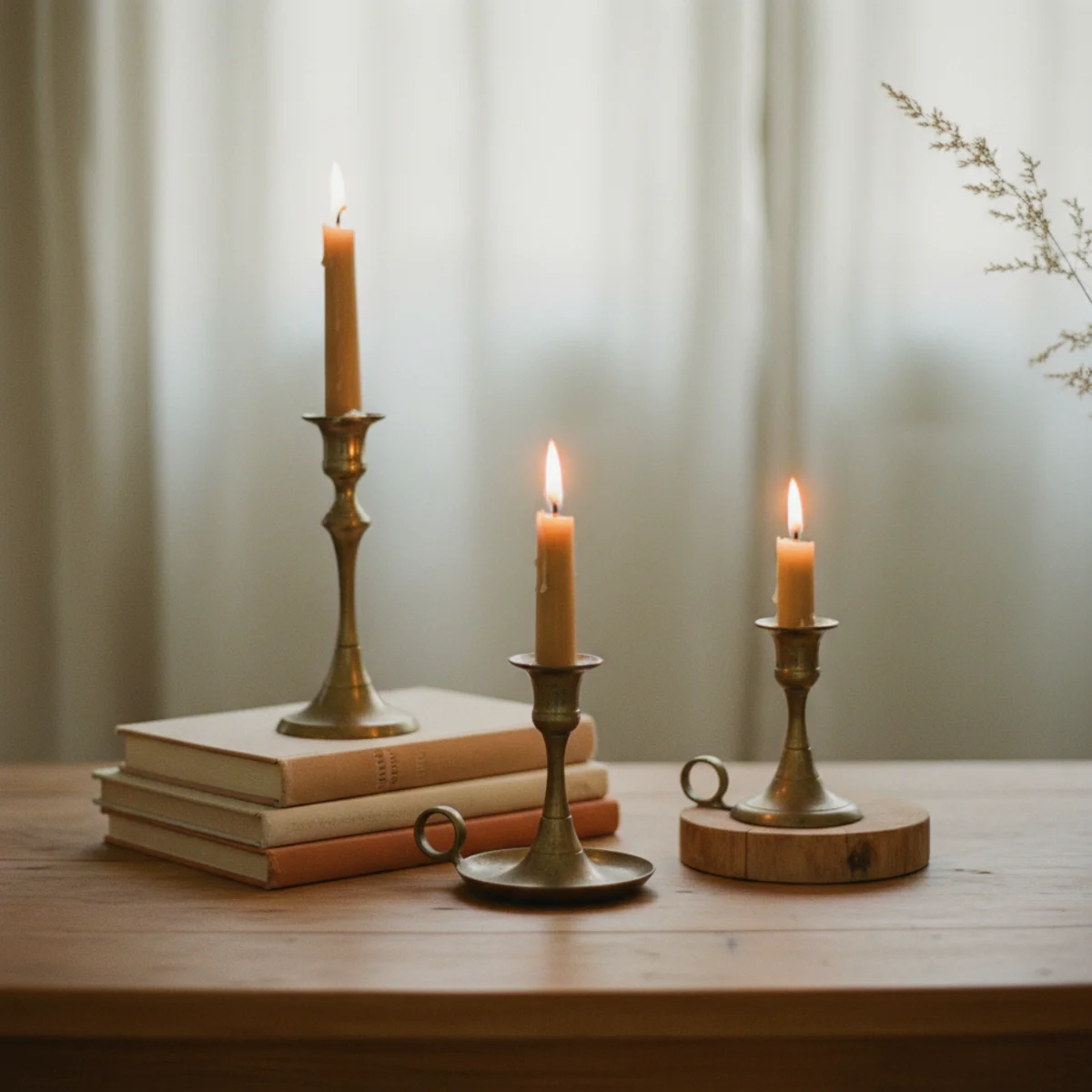
For larger candle displays (especially on mantels, sideboards, or wide consoles), stack holders at different levels — books, small wooden boxes, vintage cake stands, marble blocks — to create vertical variation beyond what the candles themselves provide. The lifted candles read as composed staging rather than as flat lineup, dramatically improving how the display reads from across the room.
Stacking elements for candle styling: BOOK STACKS — 2 to 4 hardcover books stacked beneath a candle holder ($0 if you own books, otherwise $3 to $10 each from thrift). The book-stack approach is especially elegant for taller candle holders on lower surfaces. SMALL WOODEN BOXES — 2 to 6-inch wooden cubes, jewelry boxes, or wood blocks ($5 to $30 each from Marketplace, antique stores, IKEA). VINTAGE CAKE STANDS — small to medium ceramic or glass cake stands ($10 to $40 thrifted) for raising single candles to 6 to 10 inches above the surface. MARBLE OR STONE BLOCKS — small marble pieces ($10 to $30) for substantial stable bases. VINTAGE WOODEN BOXES — antique wood boxes from estate sales ($15 to $40 each) for warm-aged stacking elements. The discipline: mix 3 to 5 stacking element types within one display to create visual layering rather than uniform raising. Vary candle heights AND base heights for compound vertical interest.
AFFILIATE SLOTTECHNIQUEBooks + small wooden boxes + vintage cake stands + marble blocks - mix 3-5 stacking element types in one displayAdd affiliate URL when configuredWhy it works
Because flat-arrangement candle displays (all on the same surface level) read as uniform lineup, which the eye processes quickly and moves on from. Stacked-height displays create vertical journey for the eye — looking from low elements to high, processing the layering, reading the composition as deliberate staging. The same number of candles arranged at flat versus stacked heights produce dramatically different visual impact; stacked reads as 4x as composed.
Pro tip — Use books as stacking elements only if the spines are visible and beautiful — leather-bound vintage books, books with cloth bindings in warm earth tones, books with hand-stamped titles. Generic mass-market paperbacks beneath candle holders read accidental rather than styled; warm-spined hardcovers read as deliberate base composition.
Candles raised on book stack, wooden box, and marble block — layered vertical staging beyond flat lineup. See also: leather-bound vintage books
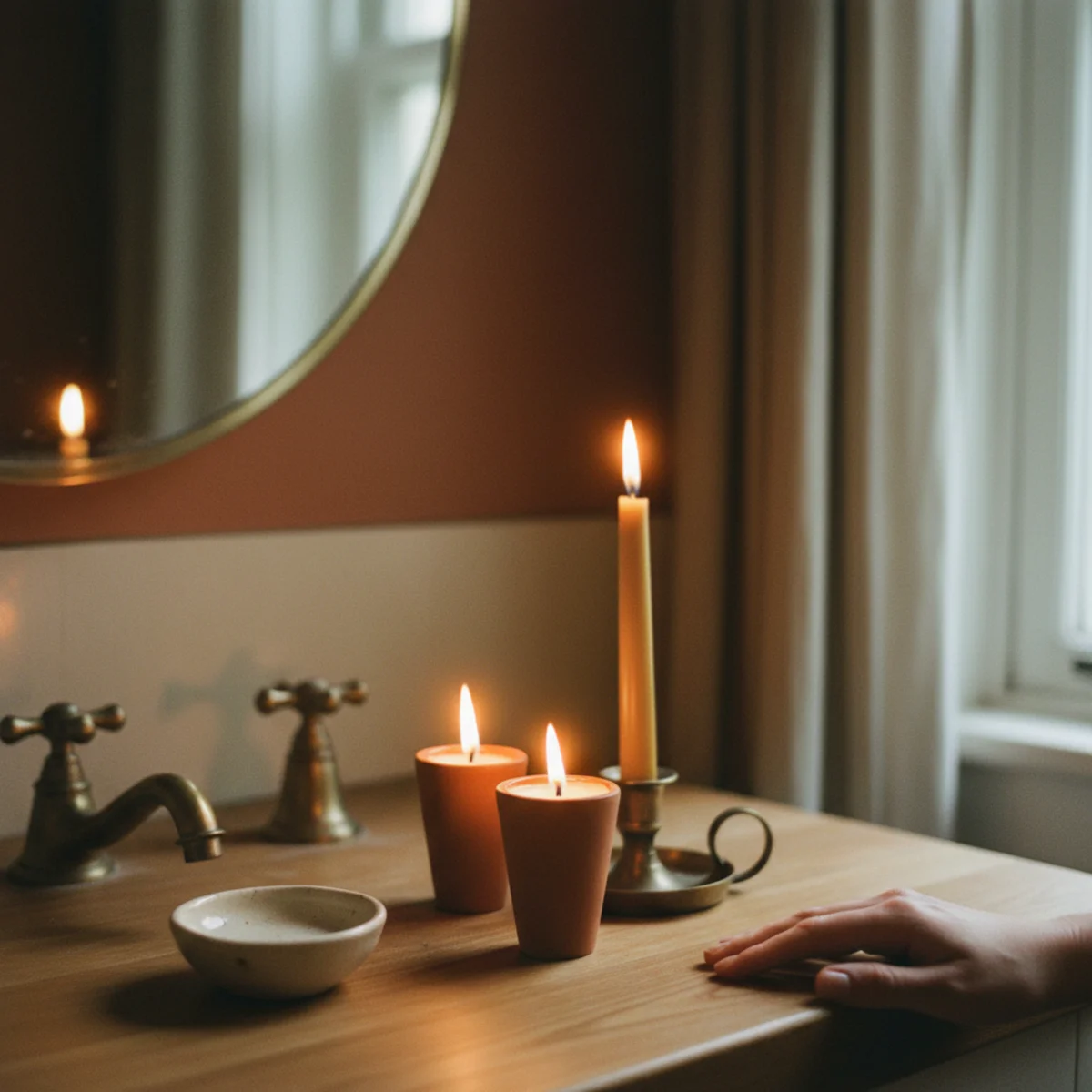
12Keep a Cluster by the Bath
The bathroom candle cluster is the simplest single-use spa ritual — 3 to 5 candles on the counter or windowsill beside the tub, lit specifically for bath times. The cluster transforms an everyday bath into a spa moment, costs nothing extra after initial setup, and provides a daily small luxury that compounds across weeks and months.
Bath candle cluster components: 3 TO 5 CANDLES on the bathroom counter beside the tub, on the window sill, on a small wall shelf, or on a tray balanced on the tub edge (only if safe — never balance candles on bath edge where they could fall into water). Mix types: 1 to 2 pillar candles for visual anchor, 2 to 3 small votives or tealights for distributed light. SCENTED CANDLES work better in bathrooms than in living spaces because bathroom scent is less likely to compete with food smells. Best brands: AERY LIVING (UK warm-tone scents at $30 to $60), DIPTYQUE (premium at $40 to $100), THYMES FRASIER FIR (cozy seasonal at $25 to $50), or local artisan candles at $10 to $30 each. LIGHTING TIMING — light 5 minutes before getting into the tub for full flame development. SAFETY — keep candles 6+ inches from any flammable bath products, away from edge where wet hands or movement could knock them in. Bathroom candles can stay 'set up' permanently as a styled cluster and just be lit for use — no setup time before each bath.
AFFILIATE SLOTBATHROOM3-5 candles by tub including 1-2 pillars + 2-3 votives; scented works well in bathrooms specificallyAdd affiliate URL when configuredWhy it works
Because the bath transformation is one of the highest-leverage daily luxury moves available — a regular bath plus candles reads as spa moment without requiring spa membership or specialized infrastructure. The candle cluster also handles the bathroom's typical harsh lighting (overhead vanity fluorescents) by providing a warm alternative — turn off the overheads, light the candles, and the same bathroom transforms into atmospheric warm space. The compound effect across weeks of bath rituals is significant for daily wellbeing.
Pro tip — Use scented candles in the bathroom (eucalyptus, lavender, vanilla, fir, lemon) rather than reserving scent only for unscented atmosphere — bathrooms are one of the few rooms where scented candles work well because there's no competing food scent or general ambient olfactory complexity. The bath context favors aromatherapy where living rooms favor pure unscented warm light.
Four candles beside the tub — spa-bath ritual with scented atmosphere appropriate to bathroom context. See also: Aery Living
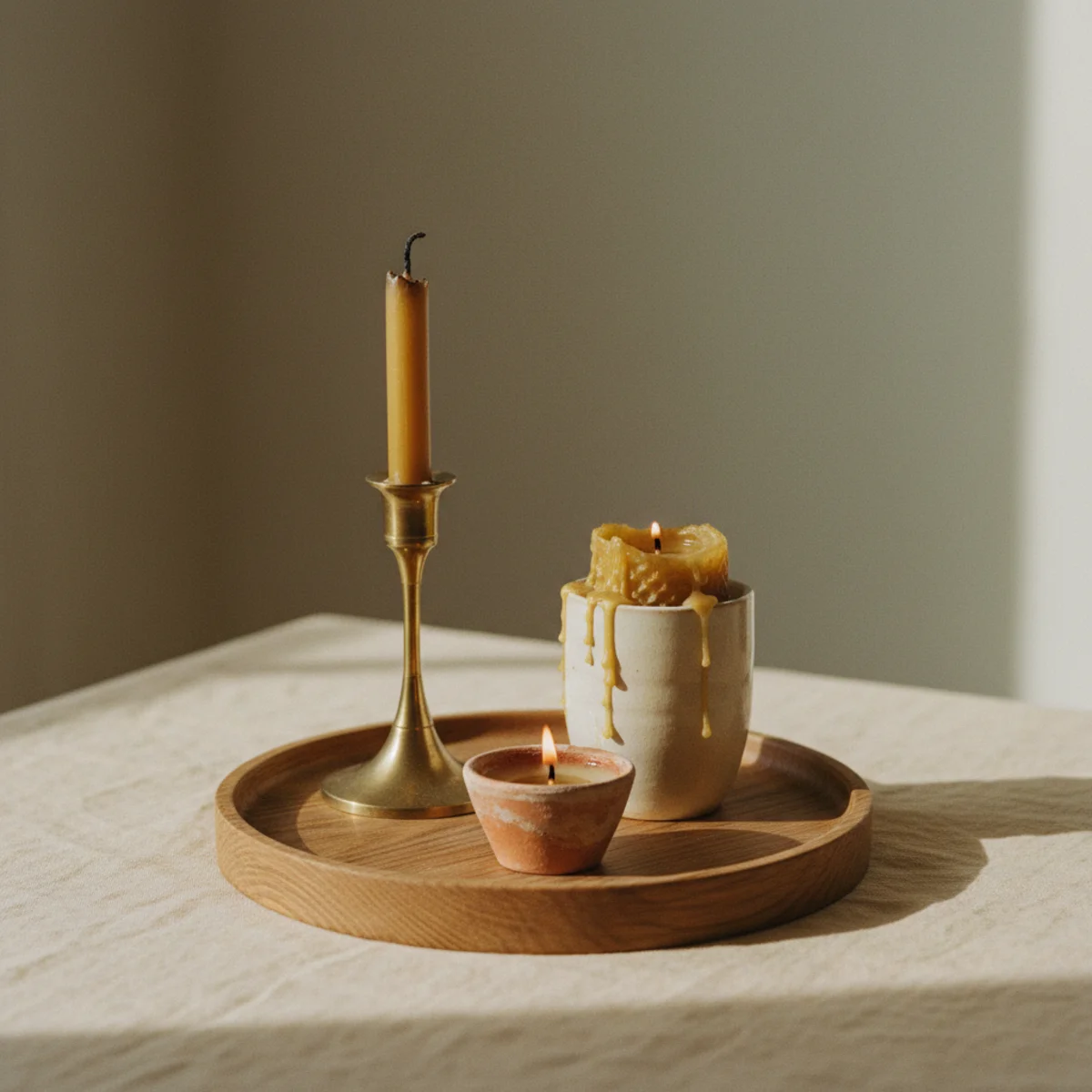
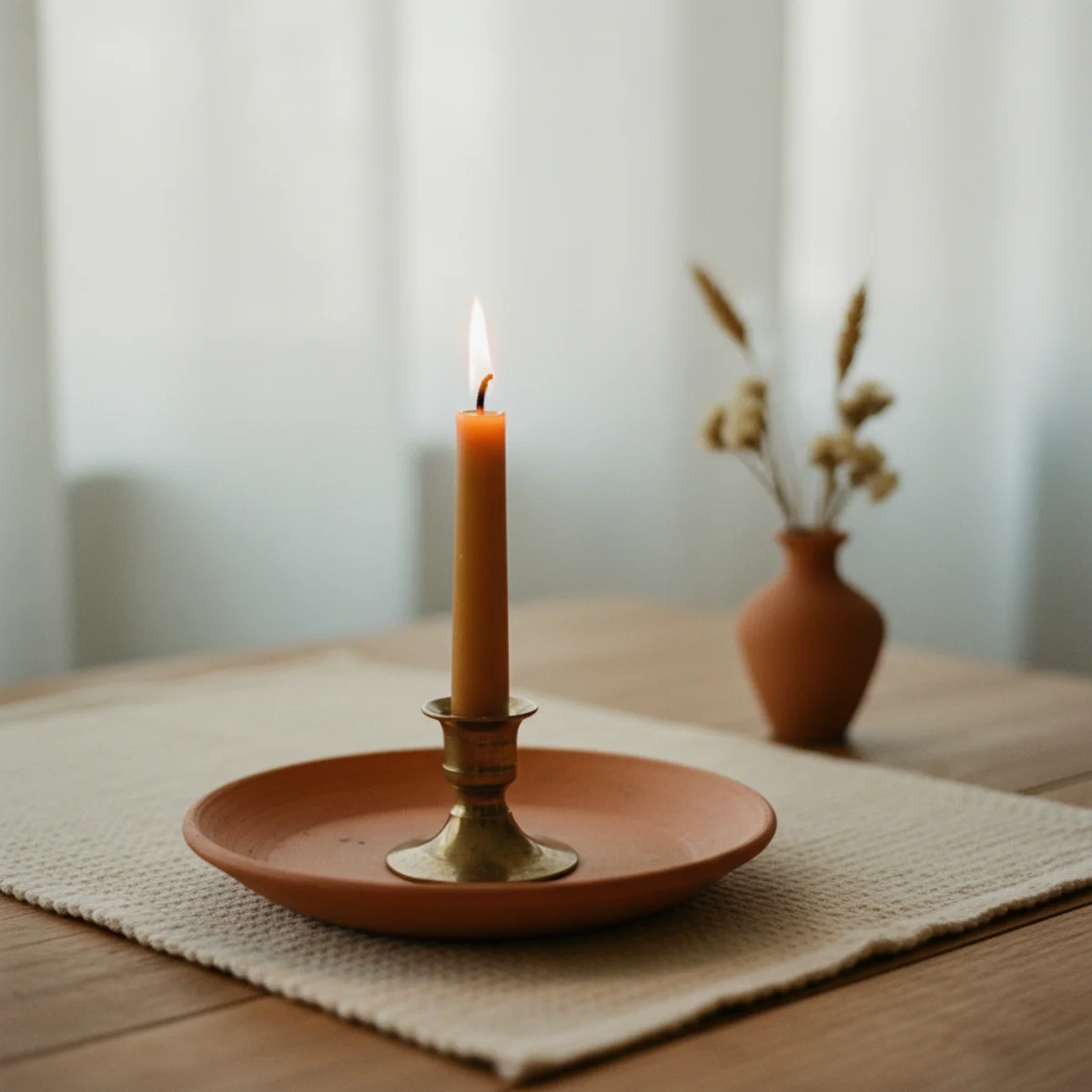
How to style a candle cluster step by step
A coffee table or mantel cluster in four moves.
- 1Choose a tray as the base
Pick a brass, wooden, or ceramic tray to define the grouping and catch wax. A lip helps with drips.
- 2Set three candles at three heights
Place a tall, a medium, and a short candle in a loose triangle — odd numbers, varied heights, never a straight line.
- 3Fill in with one small accent
Add a sprig of greenery, a small vase, or a single object to the tray so it reads as a vignette, not just candles.
- 4Light them below eye level
Position the whole cluster on a low surface so the light glows up. Light at dusk and let the flames do the styling.
Quick tips
- Burn beeswax over soy for clean, long-lasting, honey-scented light — and skip layering multiple scents.
- Cluster odd numbers at varied heights; raise short candles on books if you only have one size.
- Always use a tray with a lip to catch wax and define the grouping.
- Place clusters below eye level so the light glows up into the room.
- Set a mirror behind a cluster to double the flames and the warmth.
- Reserve a single scented candle for the bathroom, where one scent reads as luxury rather than clutter.
Candle styling by room
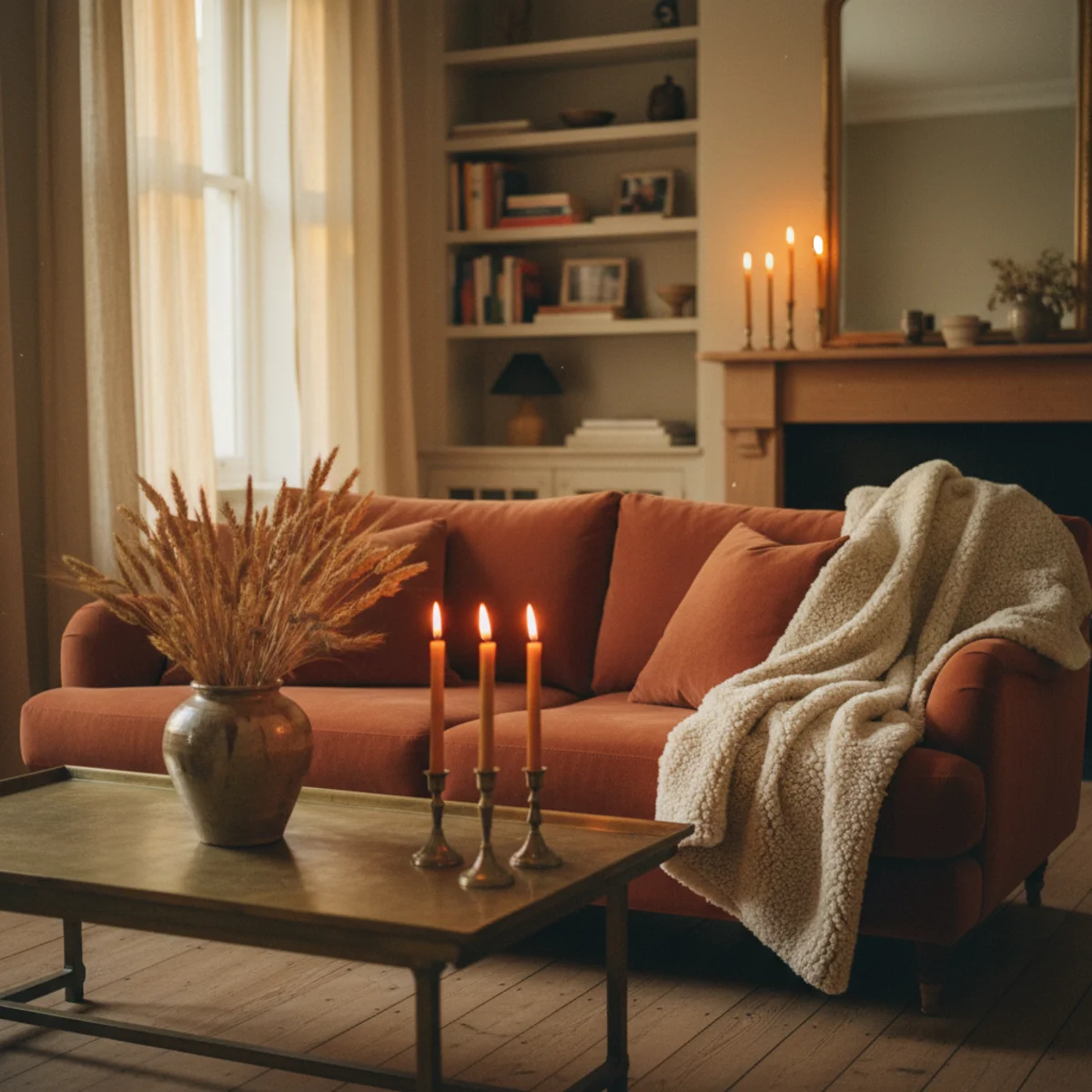
A clustered tray on the coffee table or hearth, below eye level, lit at dusk.
A line of beeswax tapers in brass holders down the center of the table at varied heights.
A small cluster on the dresser for the wind-down; unscented so it doesn't compete with sleep.
One scented candle on a ledge or stool by the tub, where a single scent reads as a small luxury.
Candlelight at the right height does more for a room than any throw pillow ever has.
Frequently asked questions
How many candles should I group together when styling?+
Should I use beeswax or scented candles?+
Why do I need a tray for candle styling?+
Where should I place candles in a room?+
What kind of candle holders should I buy?+
How do I style candles for a dinner party?+
Cluster odd numbers of candles at varied heights on a tray, place them below eye level, and reach for beeswax over scented soy. We'd keep the clusters unscented everywhere but the bathroom — several competing scents in one room is the one way candle styling goes wrong. Light them at dusk and the same few candles that looked scattered all afternoon suddenly turn a whole room warm. It's the cheapest atmosphere money buys.