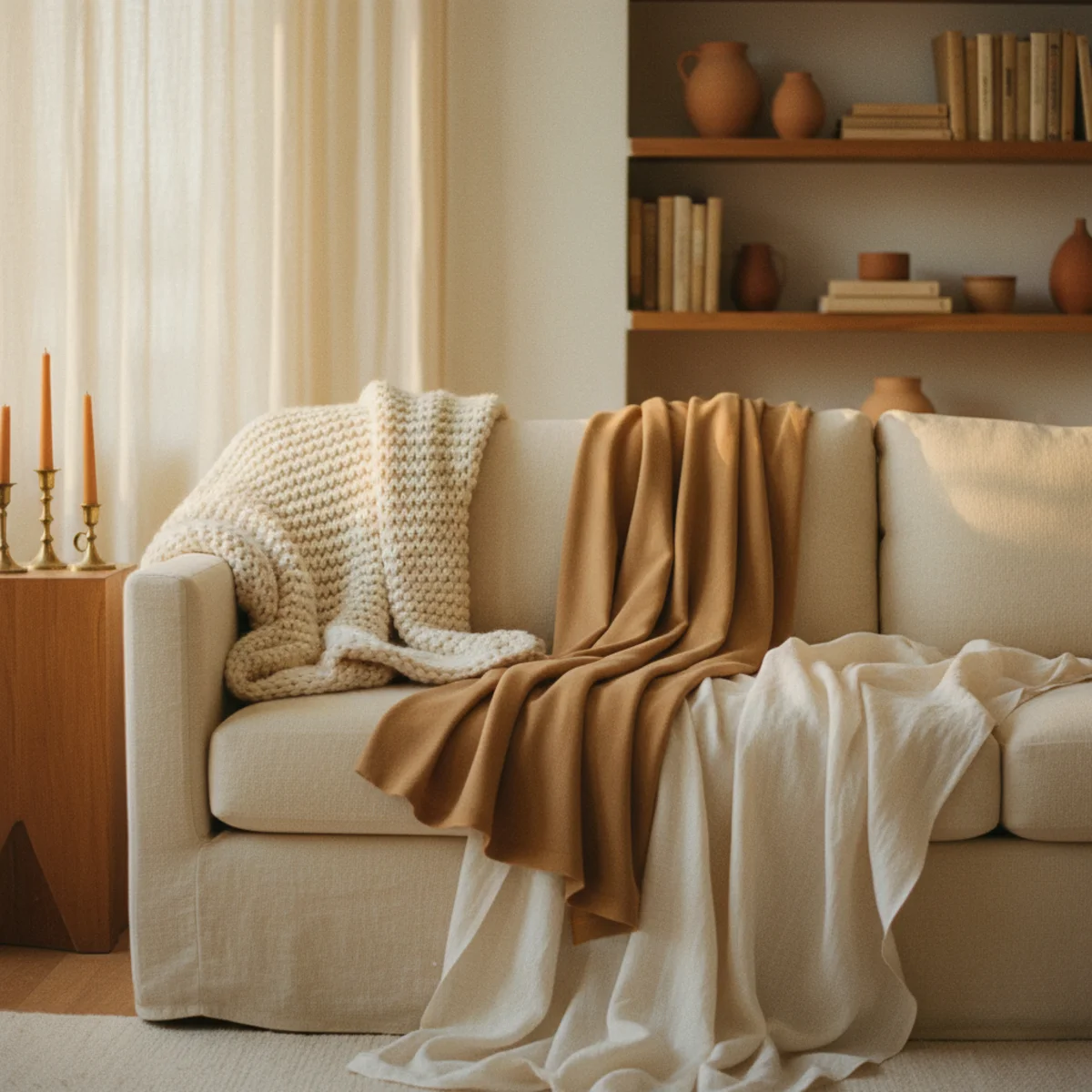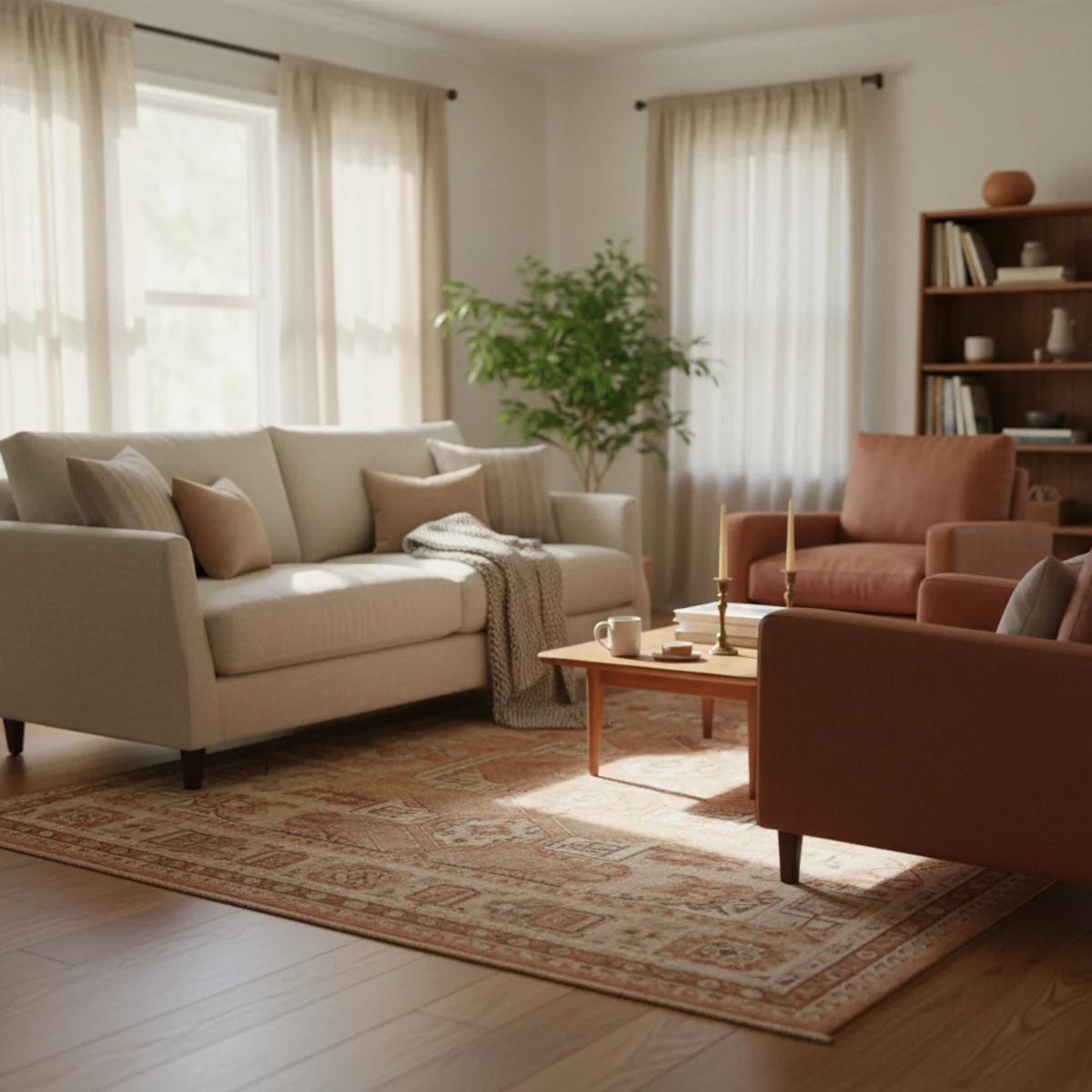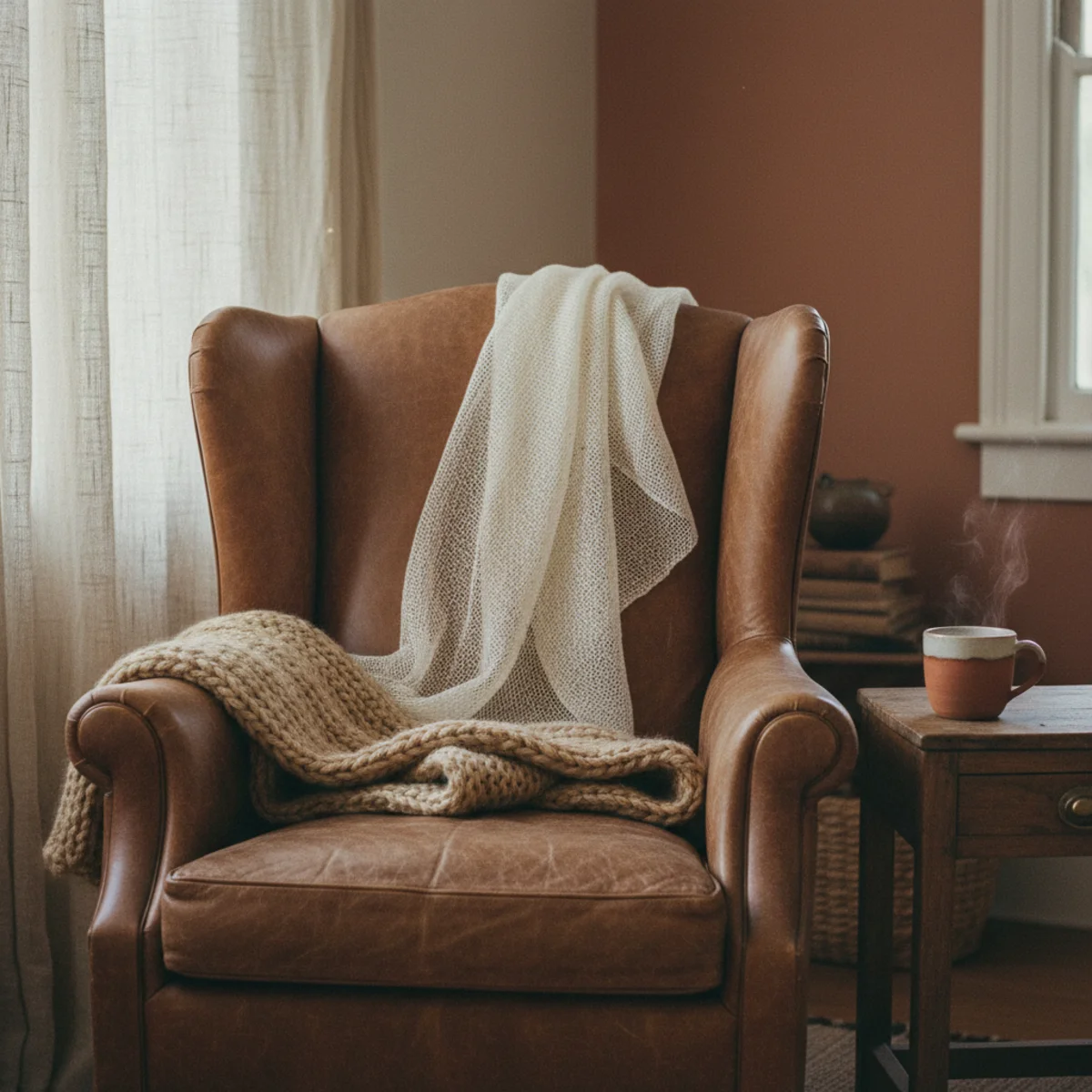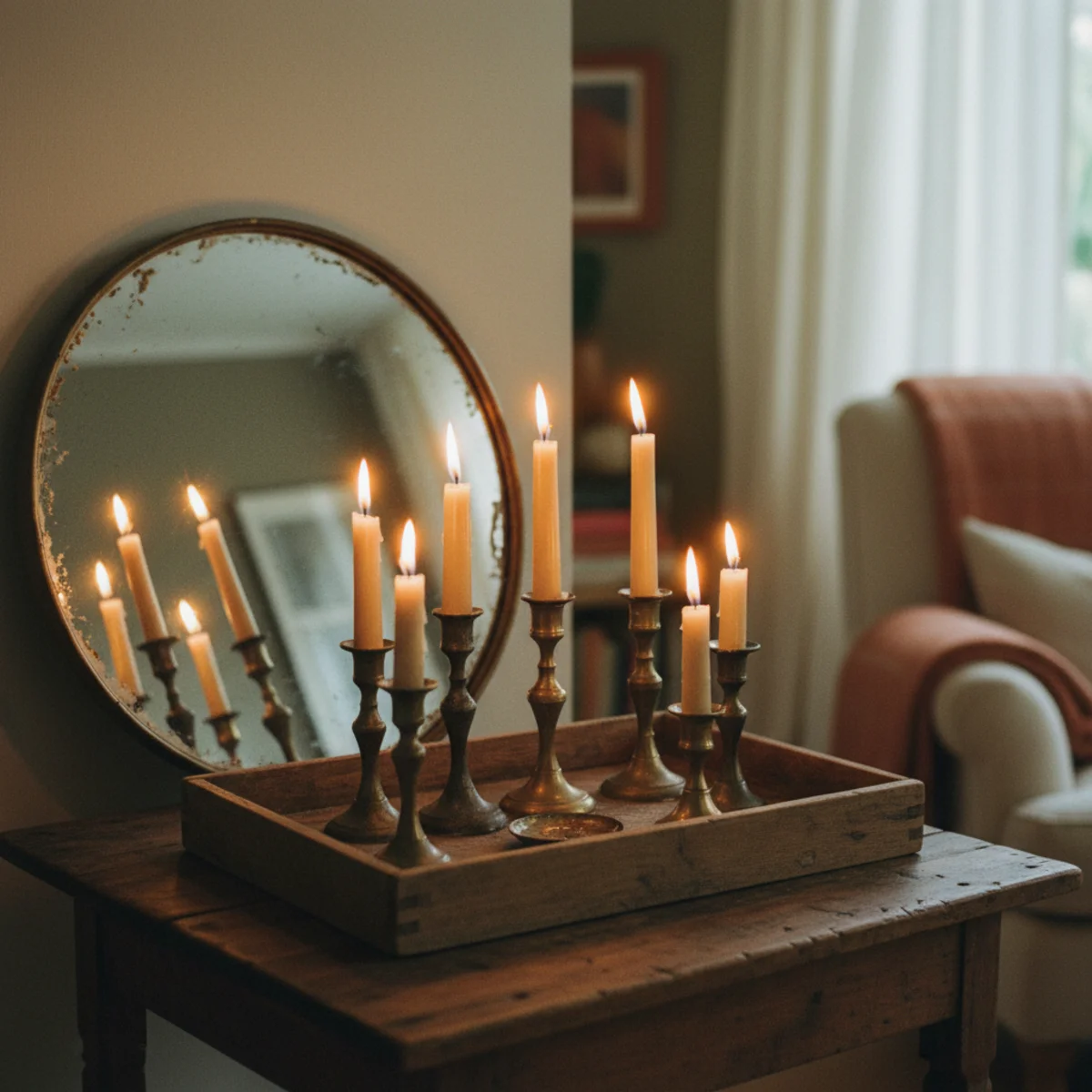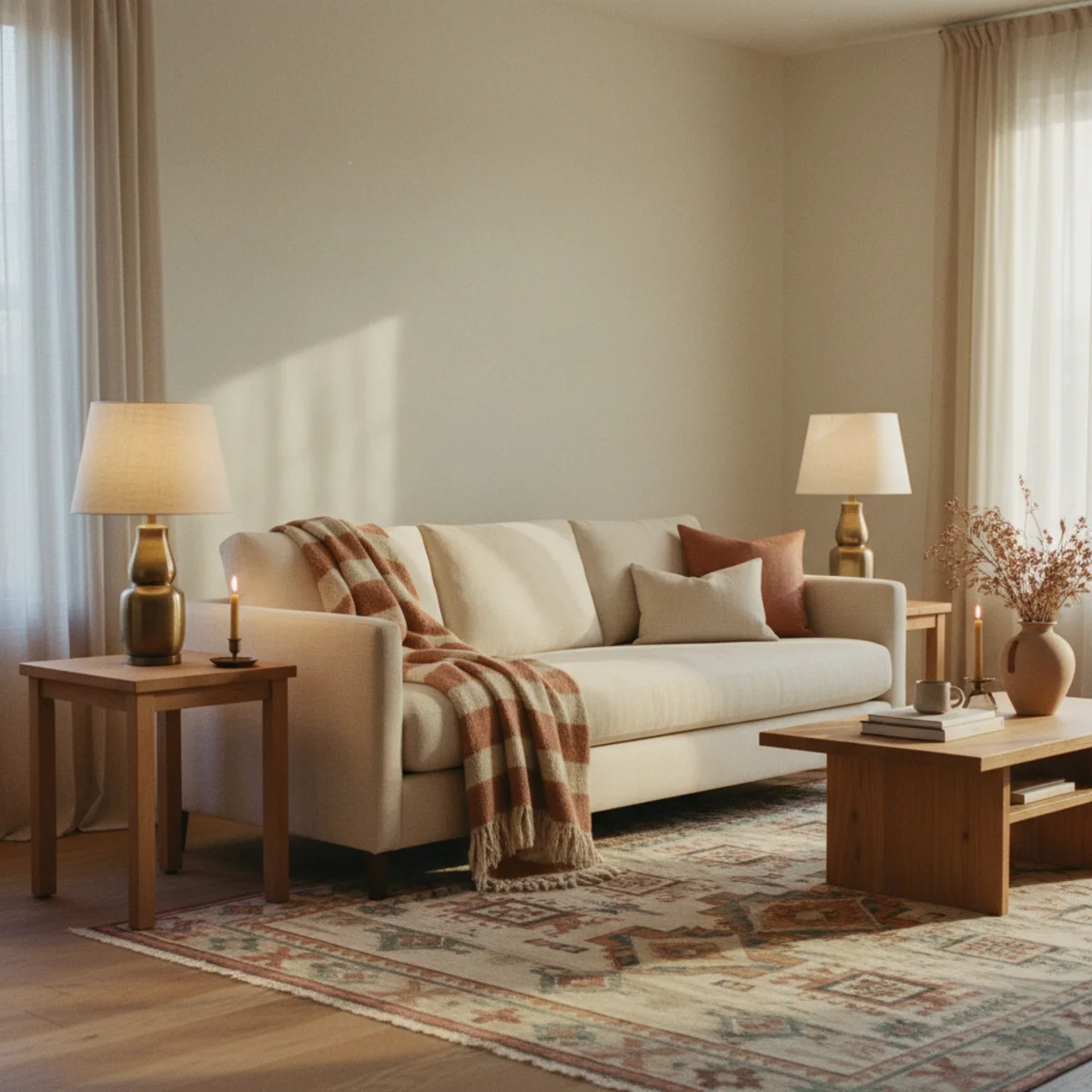
These 34 cozy living room ideas fix exactly that, one small move at a time — and almost none of them require a renovation, a designer, or a budget over $200. If you rent, if you have a flat-pack sofa, if your room is 11 by 13 feet with one window, you can use every idea on this list. The principles are the same in a Brooklyn studio as in a Cotswolds cottage: warm light low to the ground, layered texture at three heights, one good vintage piece, and breathing room around everything else.
We've tested every move below in our own rented apartments and our readers' real homes. Where it matters, you'll find exact measurements, specific bulb temperatures, brand-name product picks at three budget tiers, and the common mistake that quietly ruins the result.
By the end of this guide you'll know precisely which six changes to make this weekend to turn a stiff, lit-from-above room into one your friends sit in for three hours and forget the time.
WHAT'S INSIDE
- The one lighting change that warms any room in ten minutes — and the exact bulb wattage to buy
- Why your sofa placement is almost certainly wrong, and the four-inch fix that costs nothing
- A $30 textile move most stylists use that almost nobody talks about
- Which three textures, layered together, read as truly lived-in (and which combinations to avoid)
The most collected-looking rooms are usually the ones layered with the most patience, not the most money.
— Amber Lewis, as quoted in Architectural Digest [citation needed — verify before publish]
What makes a living room feel cozy?
A cozy living room is one tuned for staying, not for showing. The signals are measurable: warm light placed below eye level, at least three layered natural textures, and seating arranged to face inward rather than line the walls. The opposite of cozy isn't cold — it's <em>unfinished-feeling</em>, a room where the eye keeps moving because nothing invites it to rest.
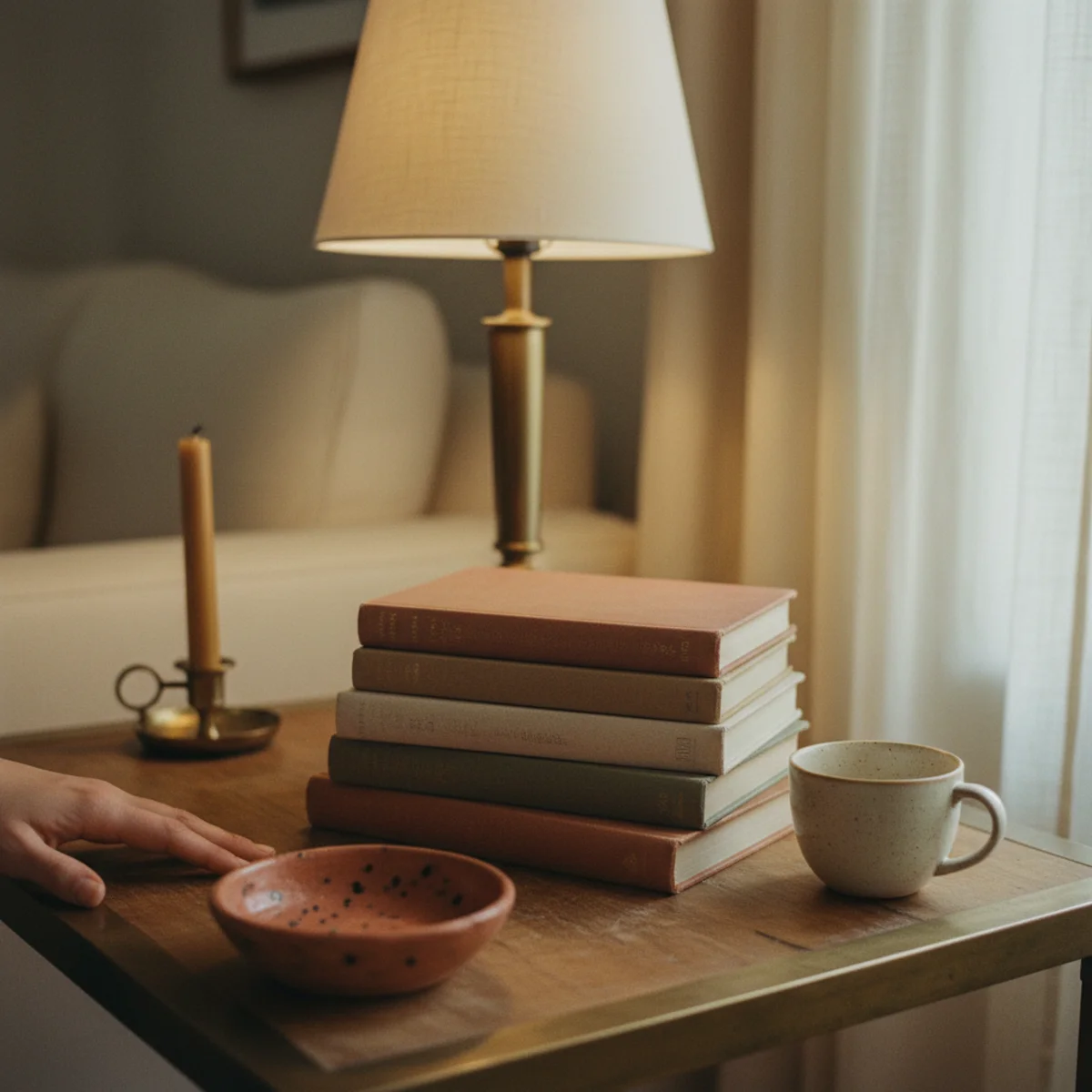
Designer Amber Lewis built an entire studio on this idea, and her phrase for it is the "imperfect, collected look" — rooms that read as gathered over years even when they came together in a season. A single brass floor lamp from an estate sale, a Loloi rug with one faded corner, a stack of real books with cracked spines: each says <em>someone lives here</em> in a way a catalog set never can.
More in By Room you may love
See allWhy warm, layered living rooms are everywhere in 2026
Open any home feed this year and the pattern is obvious: the cold, all-white minimalist room is over. In its place is warm minimalism — the same restraint, but in clay, oat, and olive, with wood and wool doing the work that art used to.
The shift is partly economic. People are staying in, renovating less, and reaching for changes they can make with what they already own. House Beautiful editors have tracked the move toward quiet, tactile rooms for three years running, and Pinterest's cozy and warm searches climb every autumn. What makes it stick is that it forgives: a warm, layered room hides clutter, ages well, and never needs staging.
34 cozy living room ideas, room-tested
01Pull the Sofa a Foot Off the Wall
The most common living-room mistake is also the most quietly damaging: the sofa is pushed flat against the back wall, killing every bit of visual depth the room could have. Pulling it forward by 8 to 12 inches changes how the entire space reads — suddenly there is breathing room behind it, a place to set a console or a lamp, and the seating starts to feel like a deliberate composition rather than furniture stacked along the edges. This works in 600-square-foot apartments as well as it does in larger rooms. It is the rare cozy living room idea that costs nothing and pays back instantly.
Measure your sofa's back depth, then pull it forward 8 to 12 inches — most living rooms benefit from 10. Behind it, leave room for either a console table (32 to 36 inches wide for a standard three-seater) or a slim shelf about 8 inches deep. Add a single 2700K bulb in a back-of-sofa lamp sitting 28 to 34 inches tall so it washes the wall in soft light at evening. The front legs of the sofa should now sit on at least the front edge of your rug, and a vintage 8x10 wool rug from a marketplace listing pulls it all together. Resist the instinct that this will shrink the room — in practice the negative space behind makes it read larger.
AFFILIATE SLOTFURNITURENarrow console table, 32–36 inches wide and 8–10 inches deepAdd affiliate URL when configuredWhy it works
Because the negative space behind the sofa creates visual depth that the eye reads as additional room, while the airflow stops the sofa from looking heavy and stuck. A floating sofa with a lamp behind it reads as a composed scene; a wall-pushed sofa reads as utility seating. The effect holds in apartments under 500 sq ft as reliably as in 2,000 sq ft homes.
Pro tip — If the room is too narrow for a full 12-inch pull, even a 4-inch shift is transformative. Add a thin metal console (8 to 10 inches deep) behind the sofa to define the new negative space — it's the difference between intentional and accidental.
Notice the breathing room behind the sofa and the warm lamp washing the wall. 02Swap Every Overhead for Three Warm 2700K Lamps
Overhead lighting is the single biggest reason a living room can feel cold no matter how much money has been spent on furniture. The light comes from one harsh angle, flattens every face in the room, and washes out every texture you carefully chose. Replacing the overhead — or just turning it off and adding three warm lamps at varying heights — is the cozy living room idea that produces the largest visible result for the smallest dollar. You can do it tonight. You will see the difference the moment the third lamp clicks on.
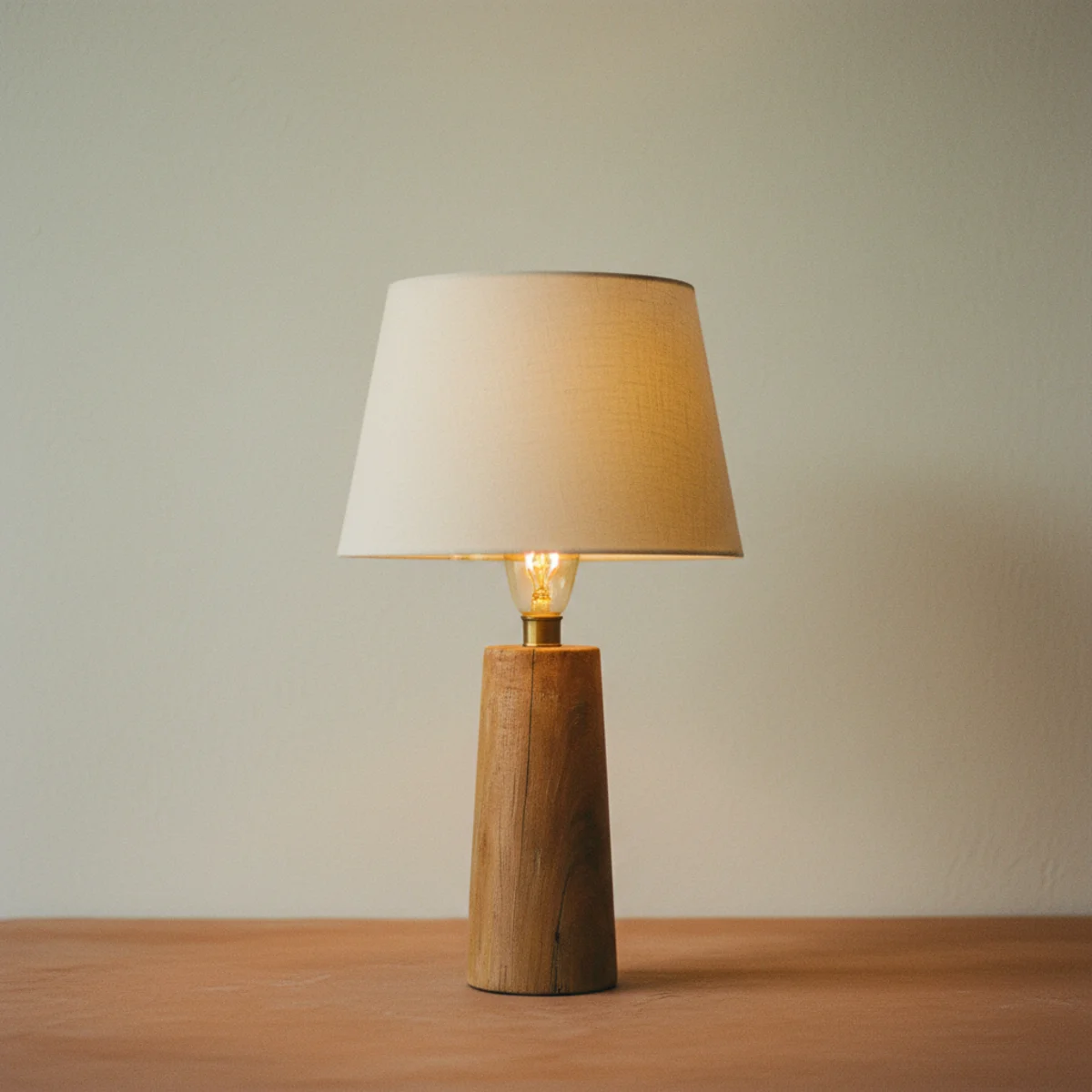
Buy three 2700K LED bulbs (8 to 10 watts each, around 800 lumens) and place them in lamps at three different heights: a tall floor lamp at 58 to 64 inches, a table lamp on a side table at 24 to 28 inches, and one short accent — a brass picture light, a small ceramic lamp on a stack of books, or a battery-powered puck — under 18 inches. The bulbs that matter are warm dimmable LEDs; Philips Hue Warm White and Wiz 2700K both work, and a basic Sylvania 2700K is under $4. Avoid anything labelled "daylight" or 4000K and above — those will give you a kitchen, not a living room. The three-height rule is what makes any room read as warmly lit rather than evenly lit.
AFFILIATE SLOTLIGHTING2700K warm LED bulbs (3-pack, 800 lumens, dimmable)Add affiliate URL when configuredWhy it works
Because low warm light bounces off walls and faces at a flattering angle, while overhead light flattens everything beneath it. Three 2700K bulbs at staggered heights mimic candlelight and lamplight from older eras, when rooms were lit by what people could reach. Higher-temperature bulbs (3000K and up) read as commercial, no matter how nice the lamp.
Pro tip — Put one lamp on a smart plug and set it to turn on automatically at sunset. The room is warm before you walk in — and you stop forgetting to switch the lamp off when you go to bed.
Three lamps at three heights — never one bright ceiling fixture. See also: warm 2700K bulbs
03Layer a Wool Throw and a Sheepskin Together
There is a reason every magazine living room features a throw blanket half-falling off the sofa, and it is not laziness — it is the only way to make new upholstery look lived-in within ten seconds of styling. A single wool throw is a start, but the actual move is layering two: a heavier knit, mohair, or felted wool throw across the seat, and a sheepskin (real or alpaca-blend) draped over the back or the arm. Together they signal that the room is warm enough to need them, which is exactly the feeling a cozy living room should suggest.
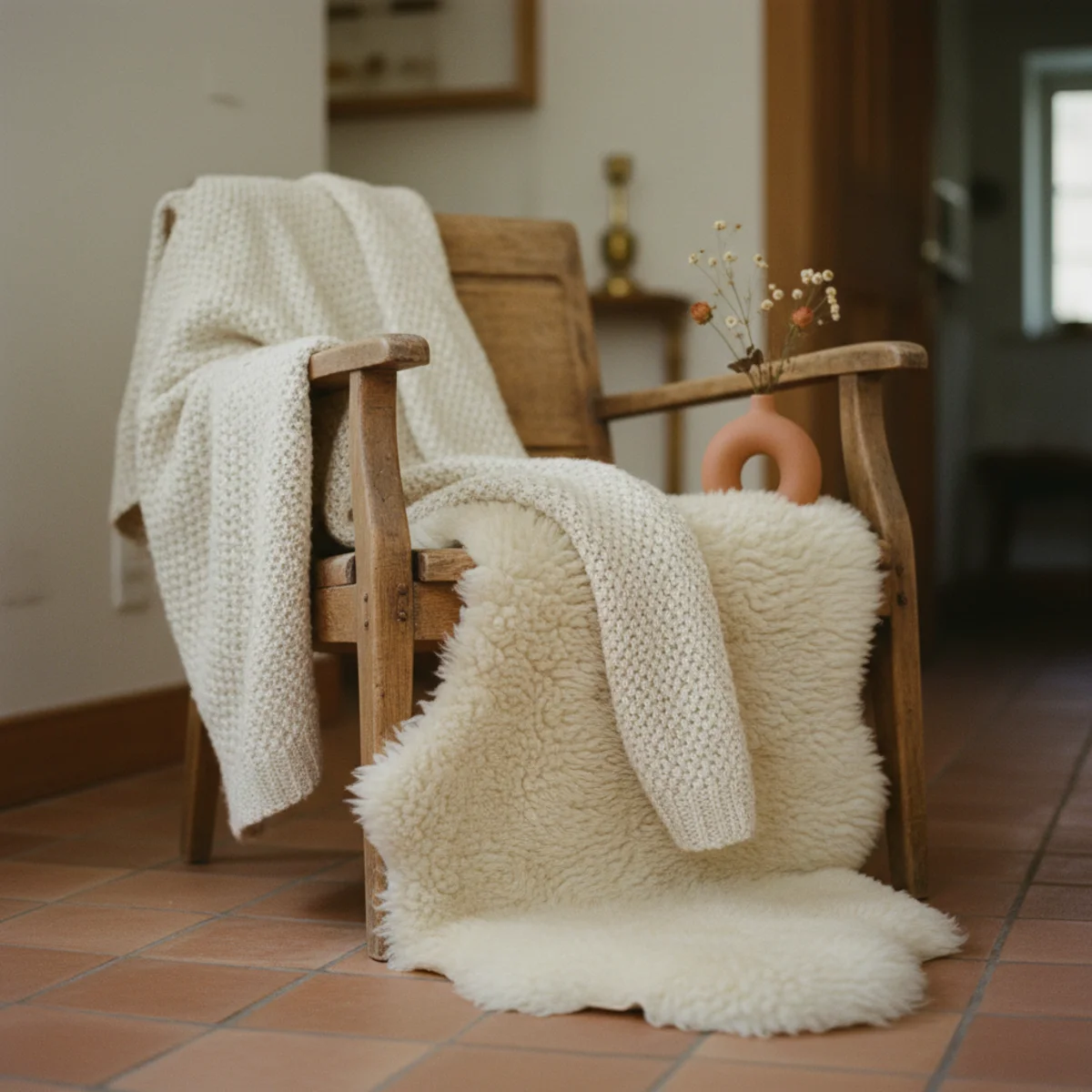
Choose a wool throw in a warm neutral — oatmeal, rust, dusty terracotta, or muted moss — at least 50 by 60 inches; anything smaller looks like a child's blanket. Drape it diagonally across one corner of the sofa seat, then lay the sheepskin over the opposite arm so the two soften the silhouette in different directions. Real shearling sheepskins from Costco run $40 to $60; alpaca blends from Pendleton or West Elm Bouclé sit $90 to $140; a single heavy throw from IKEA POLARVIDE is $5 and works in a pinch. Avoid synthetic fleece throws — they read shiny under warm light and never quite warm up.
AFFILIATE SLOTTEXTILESHeavy wool throw in oatmeal or rust, 50×60 inches minimumAdd affiliate URL when configuredWhy it works
Because the eye reads contrast, not quantity — a wool weave next to a sheepskin's curls reads as collected over time, where one matching throw reads as bought yesterday. A wool throw plus a sheepskin also covers both worn arms of an older sofa, and visually breaks up an oversized cushion run that would otherwise look like a hotel lobby.
Pro tip — Wash wool throws once a year on a wool-cycle with no spin, then lay them flat on a towel to dry — never tumble. A well-cared-for throw becomes the most-touched object in the room and lasts ten years.
Two textures, one corner — the move that ages a new sofa five years in five seconds. See also: wool throw
04Add a Vintage Rug Larger Than You Think
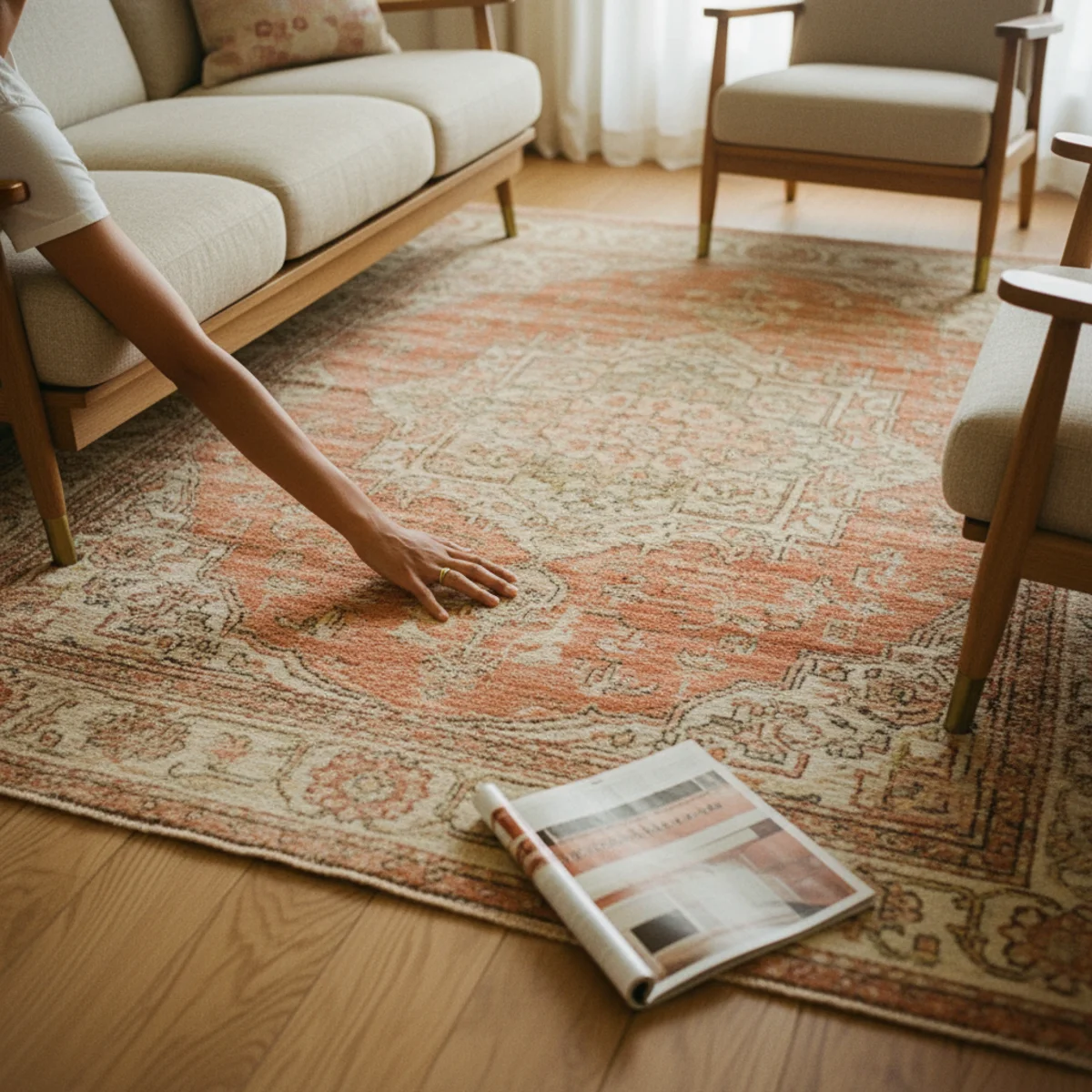
The most common rug mistake in a living room is buying one a size too small, which makes the seating float in the middle of the room like a raft. A properly sized rug visually grounds the sofa and chairs, defines the seating zone, and adds the single biggest texture surface in the room — which is exactly why it has to be the right one. Vintage wool, slightly faded, is the move; new synthetic, no matter how trendy, never reads as warm. This is the cozy living room idea worth saving up for.
For a standard living room, an 8x10 rug is the floor (literally) — a 9x12 is better. The front legs of every seat in the room should sit on it; if you can afford it, all four legs of the sofa and chairs should be on the rug. Vintage Turkish, Persian, and Moroccan wool rugs in faded reds, ochres, and indigos are everywhere on Etsy, eBay's vintage section, and Facebook Marketplace at $200 to $600 for an 8x10. If you must buy new, Loloi Loren and Ruggable's washable wool collection both punch above their price; avoid anything described as "shag" unless you live alone with no pets. The rug should be slightly wider than the sofa on each side, not narrower.
AFFILIATE SLOTRUGSVintage wool rug, minimum 8×10 ft, faded warm tonesAdd affiliate URL when configuredWhy it works
Because the right size grounds the furniture and creates a defined zone the eye reads as one composition, while the wrong size makes the same furniture look like it's floating with no reason to be there. A faded Persian rug at 9x12 will outperform a perfect new rug at 5x7 every time. Pattern and color matter, but size is the foundation.
Pro tip — Buy vintage wool, not new — a 60-year-old Anatolian rug at $400 will outlive any new $1200 piece, and the surface wear is the patina you want. Check Marketplace listings tagged "oriental rug" or "estate" on Sundays — that's when sellers list.
Both front legs of every seat on the rug — the size that grounds a room. 05Build the Coffee Table Around a Tray
A bare coffee table looks unstaged; a coffee table piled with remotes, coasters, and a takeaway menu looks unloved. The fix is a single shallow tray that contains everything — and the moment you put it down, the rest of the styling falls into place around it. The tray gives a coffee table the same thing a runner gives a dining table: a defined center of gravity. This is the simplest, lowest-stakes cozy living room idea on the list, and the one most readers say they wish they'd done five years ago.
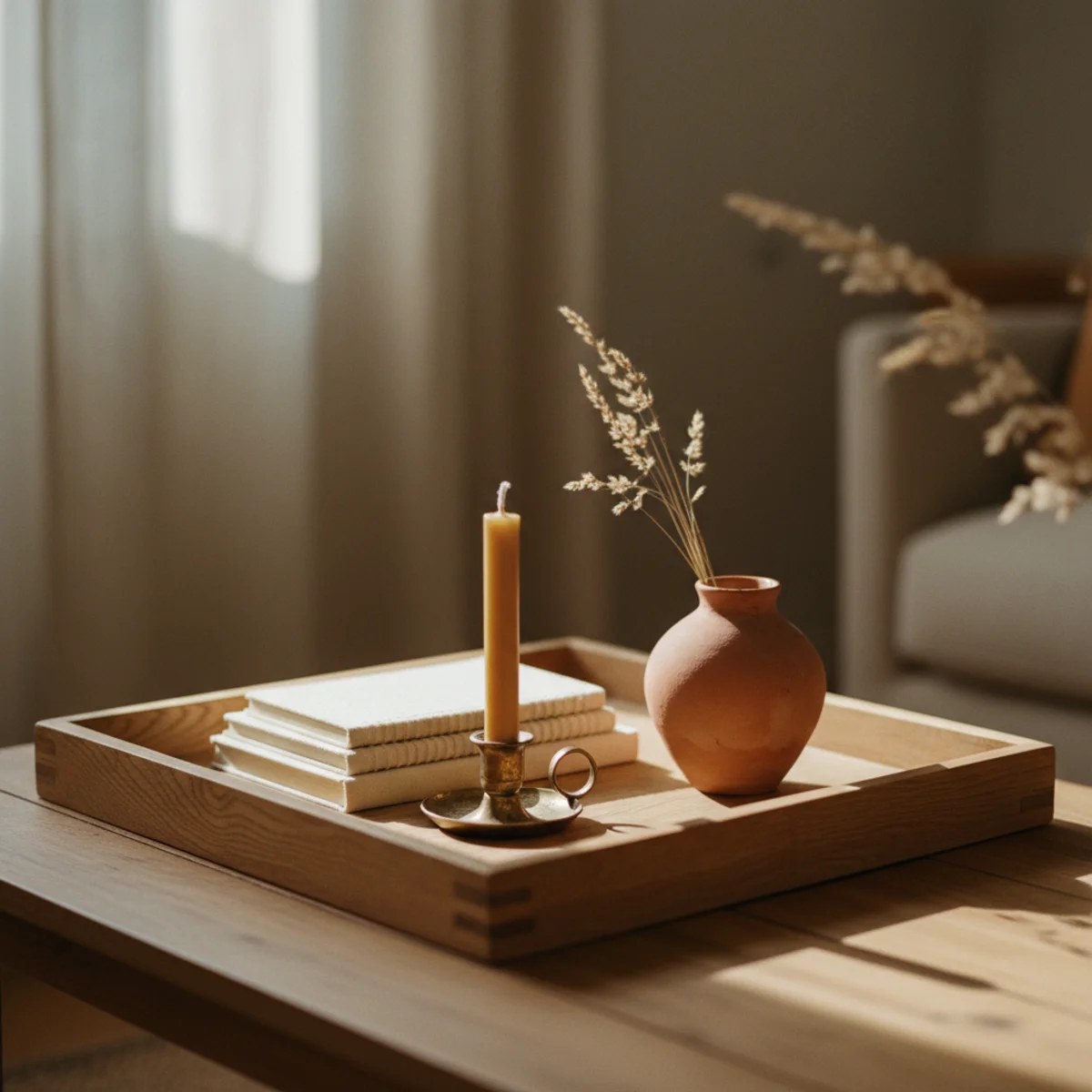
Choose a tray 16 to 22 inches wide, in solid wood, natural rattan, or matte brass — never glass, never mirrored. HomeGoods and Marshalls carry walnut and acacia trays in the $20 to $30 range; the West Elm Mango Wood tray is $44; a vintage brass one from an estate sale runs $15 to $25. On the tray, place three to five objects following the layered triangle rule: one tall (a stem in a small bud vase, 8 to 10 inches), one medium (a stack of two coffee-table books), one low (a small bowl, a coaster set, or a beeswax candle). Off the tray, leave the rest of the table almost empty — one or two large objects max, room to set down a mug.
AFFILIATE SLOTDECORSolid-wood or rattan tray, 16–22 inches wideAdd affiliate URL when configuredWhy it works
Because the tray contains the daily mess (remotes, mail, coasters) inside an intentional rectangle, while leaving the rest of the table breathing. Without a tray, every small object looks scattered; with one, the same objects read as a styled vignette. It's the single piece of styling that makes a coffee table look done.
Pro tip — Rotate the tray contents seasonally without buying anything new — swap the bud vase stem for dried wheat in October, a pine sprig in December, a single magnolia leaf in summer. The room reads as cared-for at zero cost.
One tray, three heights, breathing room around it — the entire trick to a styled coffee table. See also: coffee table
06Hang Curtains Twelve Inches Above the Window
Standard curtain rods come pre-mounted at the top of the window frame, which makes the entire room look shorter and the window smaller than it is. The fix is one of the most transformative cozy living room ideas in the entire list, and it costs the price of one rod and twenty minutes with a drill: mount the rod higher — much higher — and use floor-length panels. The room appears to gain six inches of ceiling height immediately, and the window itself looks fifty percent larger. Magazine living rooms always do this. Real living rooms rarely do.
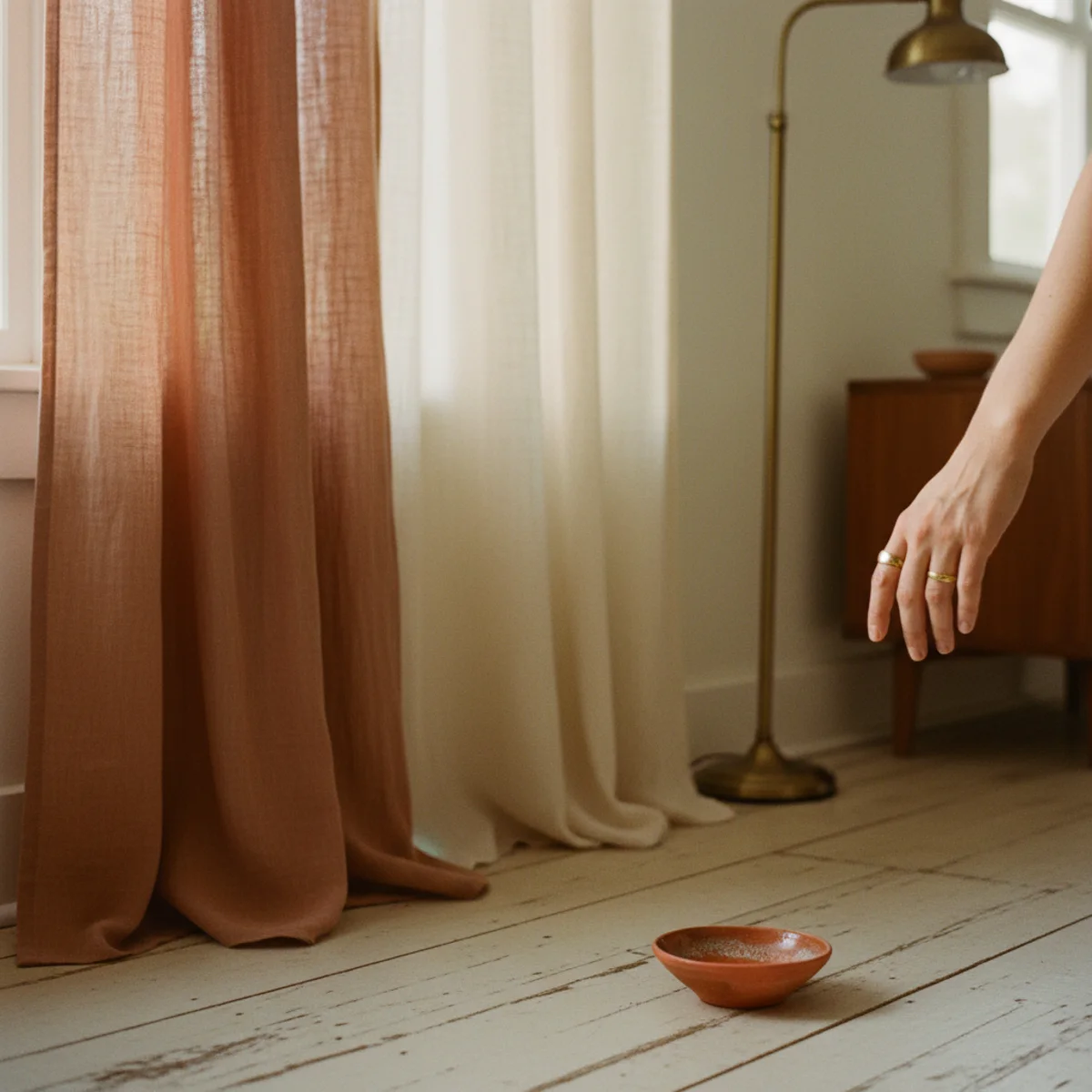
Mount the curtain rod 10 to 12 inches above the top of the window frame — and extend the rod 6 to 10 inches past each side. The curtains should fall from the rod all the way to the floor with a half-inch of break (touching, not pooling) — measure ceiling-to-floor minus an inch before buying. For length: an 84-inch curtain rarely works; you'll want 96 inches or 108 inches. Linen panels from IKEA (LENDA, AINA) are $25 to $50 a panel; Pottery Barn Belgian Linen sits at $129; secondhand vintage lace panels from Marketplace run $20 to $40. Two panels per window, even if you don't intend to draw them — they soften every corner.
AFFILIATE SLOTWINDOWLinen panel curtains, 96 or 108 inches long, two per windowAdd affiliate URL when configuredWhy it works
Because the eye reads the top of the curtain rod as the top of the room, not the top of the window — so when the rod sits 12 inches above the frame and the curtain falls to the floor, the room visually stretches upward by exactly that distance. Mounted at the frame, the same curtains shrink the wall. The trick costs nothing extra to apply when you mount.
Pro tip — If your ceiling height won't accommodate the rod 12 inches above the window, take it all the way to the ceiling instead — even 2 inches below the ceiling line looks intentional, while 2 inches above the window looks like a mistake.
Rod 12 inches above the frame, panel to the floor — the room reads instantly taller. See also: linen panels
07Add a Heavy Floor-Standing Lamp Beside a Chair
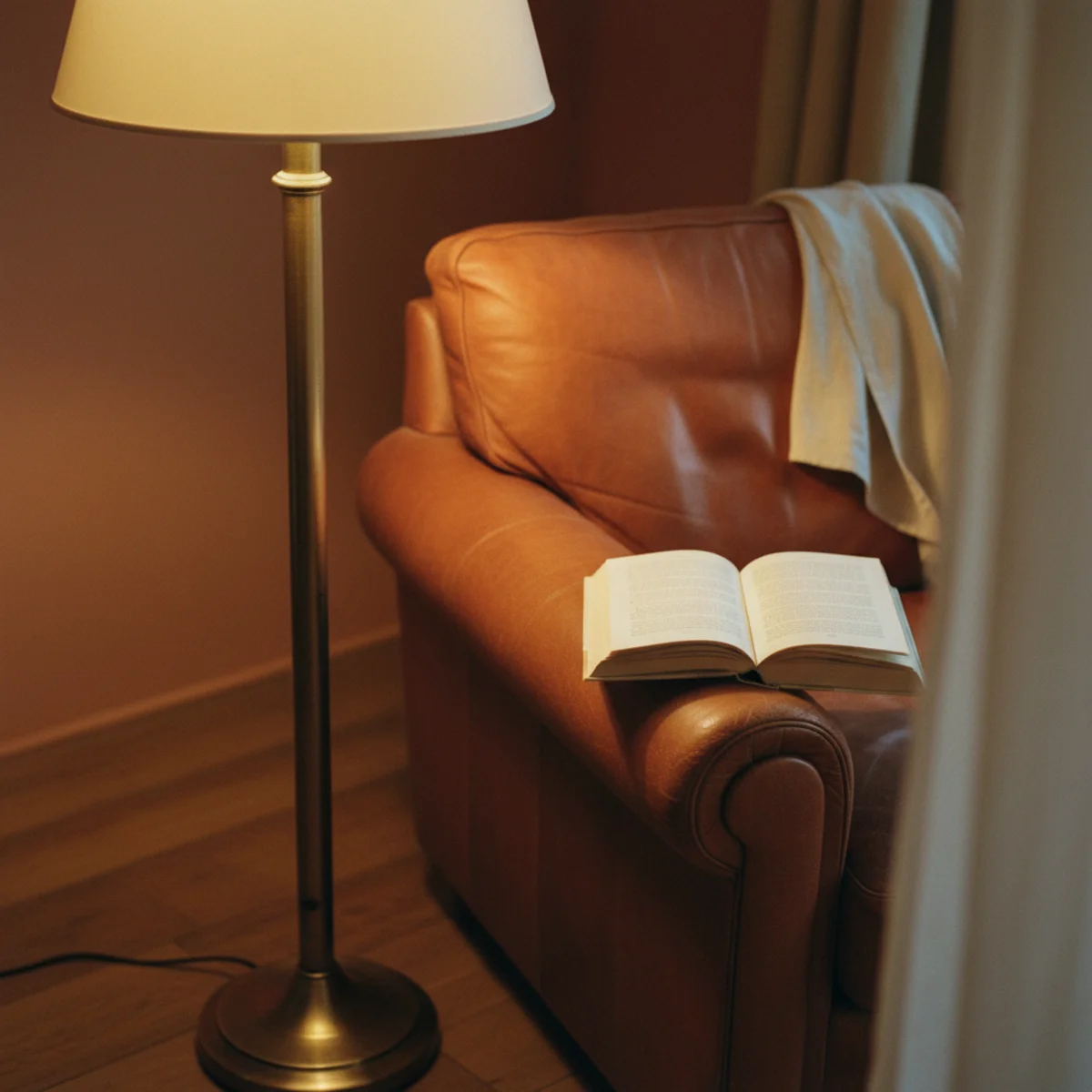
A reading chair without a lamp beside it is just a chair, and most cozy living rooms fail because the single armchair in the corner has nothing that makes someone want to sit in it after dark. A heavy floor lamp at the right height — and the right warmth — turns the same chair into the most-used seat in the room. This is the lighting move that completes the three-height rule from idea two, and it is also the cozy living room idea that quietly says "this room is ready for a quiet evening."
Choose a floor lamp 58 to 64 inches tall total, with the bottom of the shade sitting 40 to 48 inches off the floor — that's the height that drops light over the right shoulder of a seated reader rather than into their eyes. Solid materials matter: a brass or oak base reads warm; chrome and plastic kill the effect. IKEA's HOLMÖ paper-shade floor lamp is $20 (a famous trick — replace the bulb with a 2700K LED and it looks $200), Pottery Barn's PB Classic Brass at $399 is the mid-tier, and Schoolhouse's Princeton at $700 is the heirloom version. Position it 6 to 8 inches behind and to the side of the chair, never in front. Add a 2700K bulb at 800 to 1000 lumens — anything less and you'll squint.
AFFILIATE SLOTLIGHTING58–64 inch floor lamp with linen or paper shade and warm bulbAdd affiliate URL when configuredWhy it works
Because the height of a floor lamp drops light from above the shoulder onto the page — exactly where reading light is meant to fall — while a low table lamp lights the room around the reader rather than the book itself. The 40-to-48-inch shade height also matches standard seated eye level, so the bulb stays hidden behind the shade and never glares into your face.
Pro tip — Look for a lamp with a leather strap or rope pull-chain rather than a base switch — turning a lamp on from the chair you're already sitting in is the small comfort that makes you actually sit down to read.
Shade height 44 inches off the floor — light drops over the shoulder, not into the eyes. See also: floor lamp
08Mix Five Cushions in Three Textures
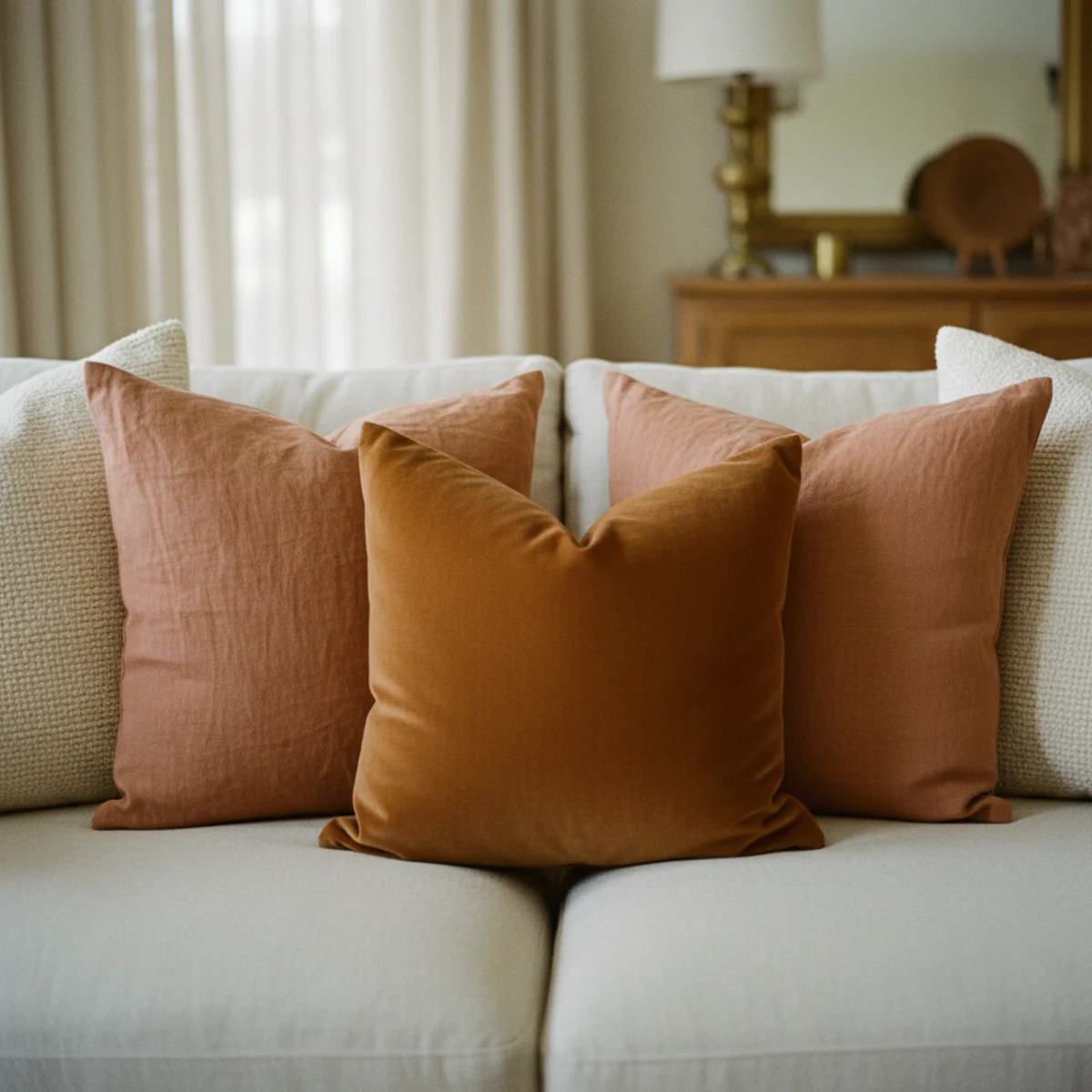
A line of identical cushions across the sofa back is the universal sign of a furniture-store delivery photo — not a lived-in room. The cozy living room idea that fixes it costs about $80 done right: five cushions, three textures, two sizes, one color thread. Done well, the sofa looks like it has been quietly collected from five places over five years. Done poorly, it looks like a Pinterest board printed on linen. The difference is in the texture mix, not the colors.
Use five cushions total on a three-seater sofa, two on a loveseat. Mix three textures from this list: heavy linen, woven boucle, hand-knit wool, velvet (only matte velvet — never shiny), and one sheepskin or mohair. Vary the sizes: two 22-inch square, two 18-inch square or lumbar (12x20), and one 14-inch round or small lumbar. Tie them together with a single accent color woven through three of the five — terracotta, ochre, deep forest, or smoky navy work in nearly every room. Etsy's small-batch makers, H&M Home, and IKEA SANELA covers (zip-off, $7) all work. Skip the symmetric matching pair flanking a center — let the larger ones sit on the ends and the smaller, more interesting ones cluster off-center.
AFFILIATE SLOTTEXTILESCushion covers in linen, boucle, and velvet — mixed sizes, one warm accent colorAdd affiliate URL when configuredWhy it works
Because the eye reads variation as evidence of choice, and matching as evidence of a single delivery. A linen square next to a boucle round next to a velvet lumbar reads collected; five identical velvet squares read catalog. Tying three of the five with a shared color keeps the variation from becoming chaos.
Pro tip — Buy zip-off covers, not whole cushions — IKEA cushion inserts are $5 and you can swap five covers for the price of one finished cushion. Rotate the covers seasonally for free room refreshes.
Three textures, five sizes, one accent color thread — never a matching set. See also: five cushions
09Hang Art at 57 Inches Center, Always
Most art in most living rooms is hung six to eight inches too high — a habit left over from older homes with 10-foot ceilings and bigger paintings. The result is a room that subtly feels off without anyone being able to explain why: the art floats above the seating like it doesn't belong to the people using the space. The fix is the single most reliable cozy living room idea in this section, used by every museum and gallery in the world. Center the artwork at exactly 57 inches from the floor, every time.
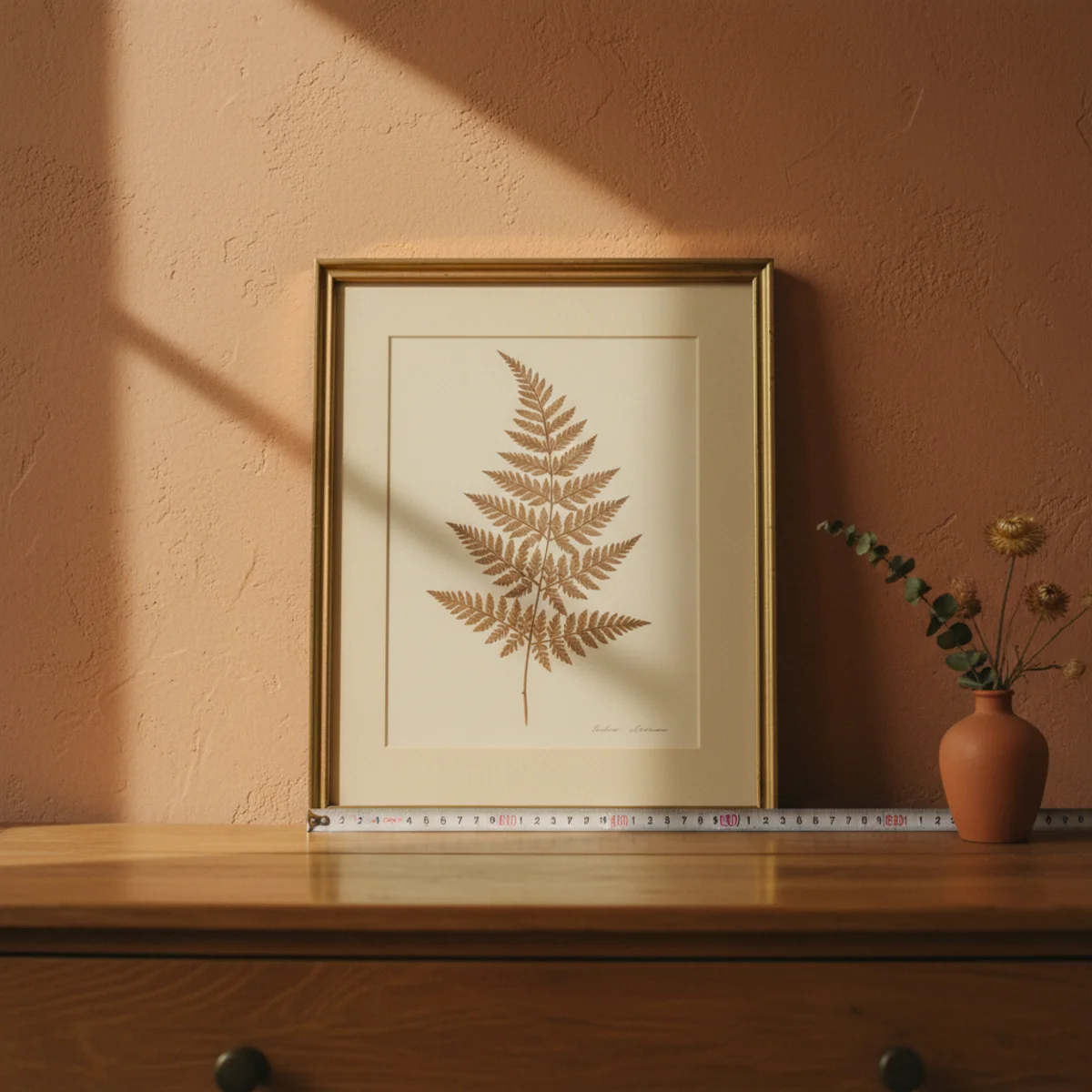
Measure from the floor to the center of the artwork — not the bottom of the frame, not the top — and that number should be 57 inches in any room shorter than 11 feet of ceiling. For art hung above a sofa, the bottom of the frame should sit 6 to 10 inches above the sofa back; anything higher disconnects the art from the room. Frames should be roughly 60% to 75% of the width of the furniture below. For groupings: treat the entire arrangement as one shape, and center that shape on 57 inches. Cheap tools that make this work: a laser level ($15 from Home Depot), 3M Command Strips for renters, and the Hangman Universal hanger for heavier pieces. Print your own art on Society6, find vintage oil paintings on Etsy under "vintage landscape" for $30 to $80, or frame fabric scraps and pressed leaves.
AFFILIATE SLOTWALL ARTFramed vintage landscape or print, mid-size, hung at 57 inches centerAdd affiliate URL when configuredWhy it works
Because 57 inches is approximately the average human eye level when standing, and it's the international gallery-hang standard for a reason — at that height, every piece is positioned to be read by the eye naturally. Hung higher, the art floats and disconnects; lower, it reads as off-balance. Sit, stand, walk around — at 57 inches center, the art works from every angle.
Pro tip — If you hang a gallery wall, lay every piece out on the floor first in the exact configuration you want, then photograph it from above with your phone. Use the photo as your reference instead of measuring each frame on the wall — you'll be done in 30 minutes instead of three hours.
Center the artwork at 57 inches, every time — eye level for standing, balanced for seated. See also: gallery wall
10Bring In One Branch in a Heavy Vase
Fresh flowers are wonderful and they die in five days. A single tall branch in a heavy vase lasts eight weeks, photographs beautifully from any angle, and adds the one thing most living rooms desperately need: a vertical line that interrupts all the horizontal furniture. This is the cozy living room idea that designers use in every shoot and almost no one copies, because it feels too simple to be intentional. It is exactly that simple, and it is exactly that intentional.
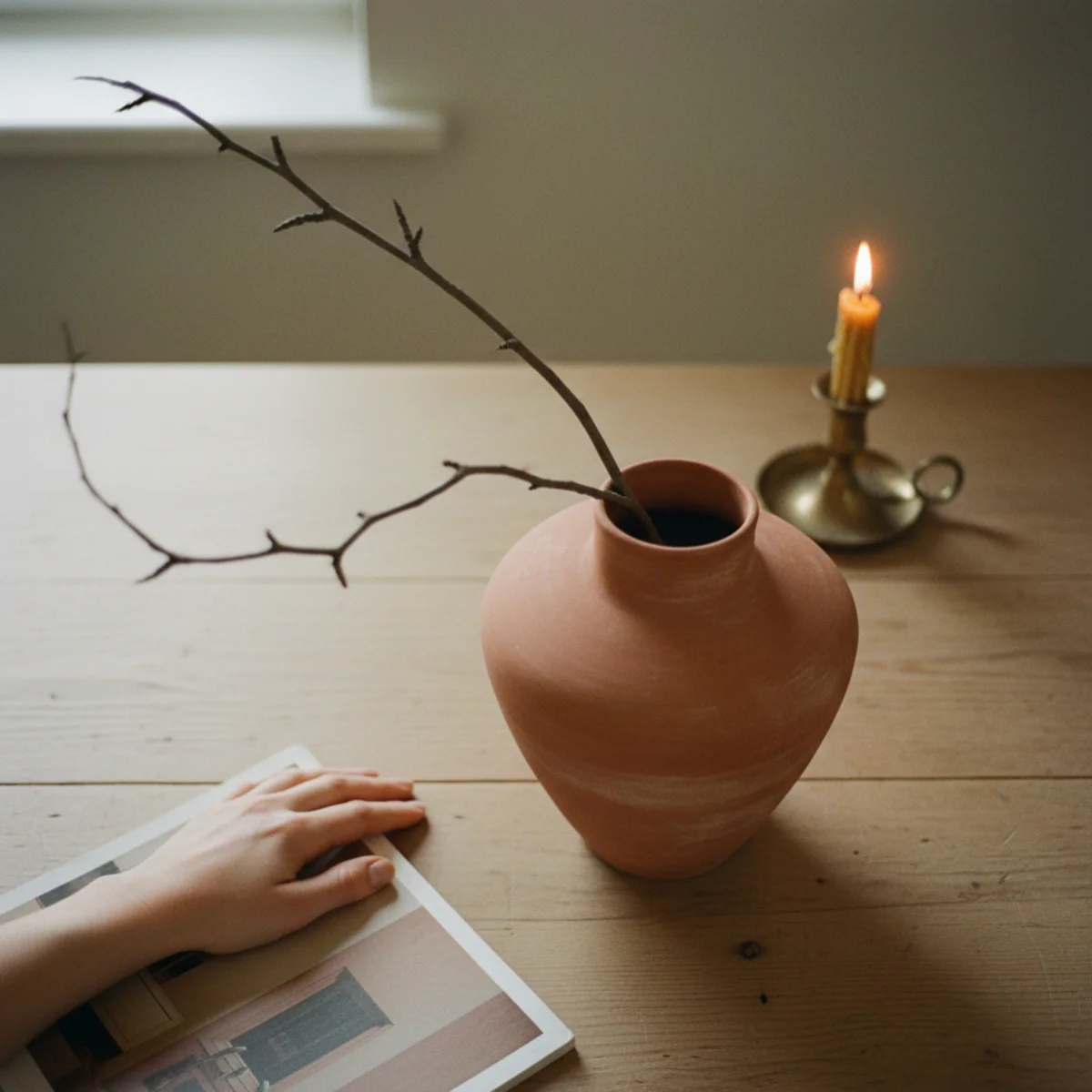
Look for a branch 4 to 5 feet tall, with one strong curve and asymmetric leaves or buds: eucalyptus (gunni or seeded), olive, pussy willow, magnolia, manzanita, or in spring, forsythia or quince. Trader Joe's, your local farmer's market, and "branches" on Etsy all sell them for $8 to $20; a roadside cutting from a willing neighbor is free. Place the branch in a vase with serious weight at the base — a 12-inch terracotta urn, a stoneware crock, a thrifted brass pot, or even a clean recycled olive oil tin filled with sand and water. The vase should be at least 4 inches narrower than the branch is wide and 3 to 5 pounds total — a tippy vase ruins the whole effect. Position it on the floor beside the sofa, or on a console behind it, never on the coffee table where it blocks sight lines.
AFFILIATE SLOTACCENTSHeavy terracotta or stoneware vase, 12+ inches tall, with one tall branchAdd affiliate URL when configuredWhy it works
Because a single sculptural branch gives the room one strong vertical anchor, while a bouquet gives the room a fragrant decoration. Branches are architectural; bouquets are accessories. A tall branch beside a sofa reads like a piece of furniture; the same shelf with a $40 bouquet reads like a hospital reception desk.
Pro tip — Dried branches last six months to a year — eucalyptus, lavender, and pampas all transition from fresh to dried beautifully. Buy fresh, watch them dry in place, and don't replace them until they actually shed.
One branch, one heavy vessel — eight weeks of free vertical sculpture. See also: tall branch
11Hide the TV With a Picture Light
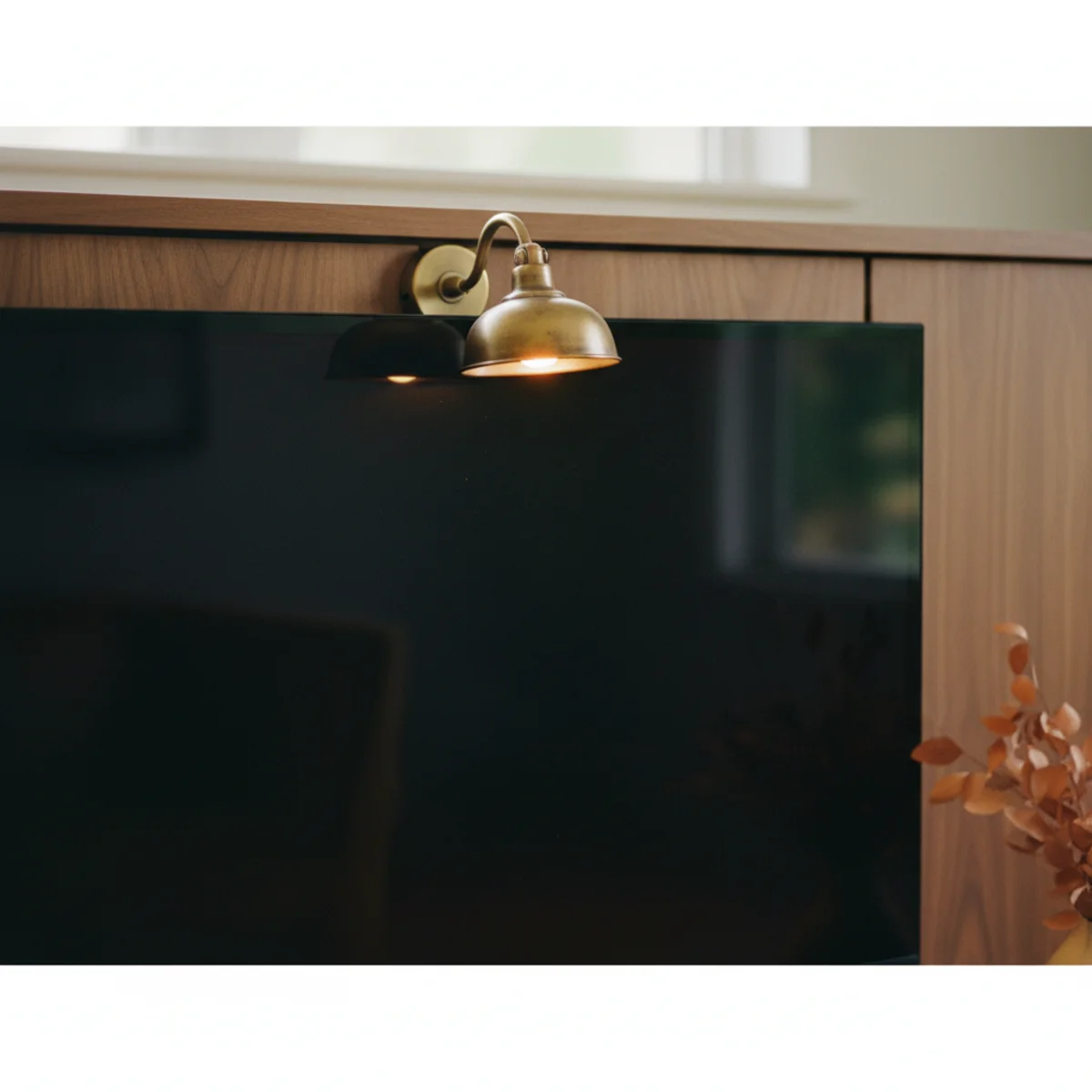
Most living rooms have a television, and most living rooms hate that they have a television. The TV is large, black, glossy, and the moment it's off, it becomes a void on the wall the rest of the room has to dance around. The cozy living room idea that fixes this for a fraction of the cost of a Samsung Frame: a brass picture light mounted above the TV, switched on whenever the screen is off, paired with a low shelf below holding three or four small objects. The eye stops landing on the screen and starts landing on the lit objects below it.
Choose a brass picture light 14 to 24 inches wide, designed to mount above the TV with the cord routed down behind a console or hidden in a cable channel ($8 for a 6-foot raceway from Amazon). Picture lights from Schoolhouse and Visual Comfort run $200 to $400; House of Antique Hardware sells solid brass at $130; the IKEA NYMÅNE under-cabinet light at $30 plus a brass spray-paint job is the budget version. Wire it to a smart plug and set it to turn on whenever the TV turns off. Below, run a console table at TV-screen width with three objects on it — a stack of books, a small ceramic, a low brass bowl. The picture light pulls the eye up to itself, the console pulls it back down to the objects, and the TV becomes the negative space between.
AFFILIATE SLOTLIGHTINGBrass picture light, 14–24 inches wide, mounted above the TVAdd affiliate URL when configuredWhy it works
Because the human eye is drawn to the brightest source in any room — a lit brass picture light competes with and visually overpowers a dark glossy screen below it. Add a styled console below the TV, and the eye traces light-down-to-objects and skips the black rectangle in between. The TV is still there; you just stop seeing it.
Pro tip — Wire the picture light to a smart plug paired with the TV's IR or HDMI-CEC signal — when the TV goes to sleep, the picture light comes on. When the TV wakes up, the light dims. You'll spend $25 and the whole system runs itself.
Light above, objects below — the TV becomes negative space between two intentional moments. See also: picture light
12Stack Real Books Where People Sit
Coffee-table books exist for a reason: not to read, but to add weight, texture, and a layer of personality at exactly the height where the eye lands when someone walks into the room. Most cozy living rooms have a TV-and-screen-time problem; the books, stacked and styled where people sit, are part of the quiet visual cue that says this is a room for slowing down. This is one of the cozy living room ideas readers do least and notice the most — three carefully chosen stacks of books transform a sterile room into one that feels like its inhabitant has a life.
Build three book-stack zones: the coffee table (two stacks of two to four books, varied colors, no jackets), one floor stack of five to eight books beside the chair, and a horizontal run of six to ten books across one shelf section. Look at the spines — solid colors, cloth bindings, and matte covers always win over glossy bestseller dust jackets. Strip dust jackets entirely on the older books; the cloth underneath is almost always more beautiful. Genuine vintage hardcovers cost $1 to $3 at thrift shops and library sales — Half Price Books, Goodwill, and library Friends-of sales are the best sources. For new: Phaidon, Taschen, Assouline, and Rizzoli all make books that double as objects. Avoid stacks of paperbacks unless they're truly used and worn.
AFFILIATE SLOTBOOKSCloth-bound hardcovers, dust jackets removed, matte spines in warm tonesAdd affiliate URL when configuredWhy it works
Because books are visible evidence of time spent, interests pursued, and attention paid — three qualities you cannot purchase in a single object. Five carefully chosen book stacks suggest a reader; an empty coffee table suggests a hotel. Even closed and unread, books add texture, color, and depth that no other object delivers at the price.
Pro tip — Photograph the spine colors of your existing books and rearrange them by hue, not by author or topic — the warm-toned spines (rust, ochre, sage, navy) cluster on display, and the bright reds and bright whites go on a shelf elsewhere or live face-out.
Three stacks, one room — a quiet signal that this is a place for slowing down. See also: shelf styling
13Add One Light at Floor Level
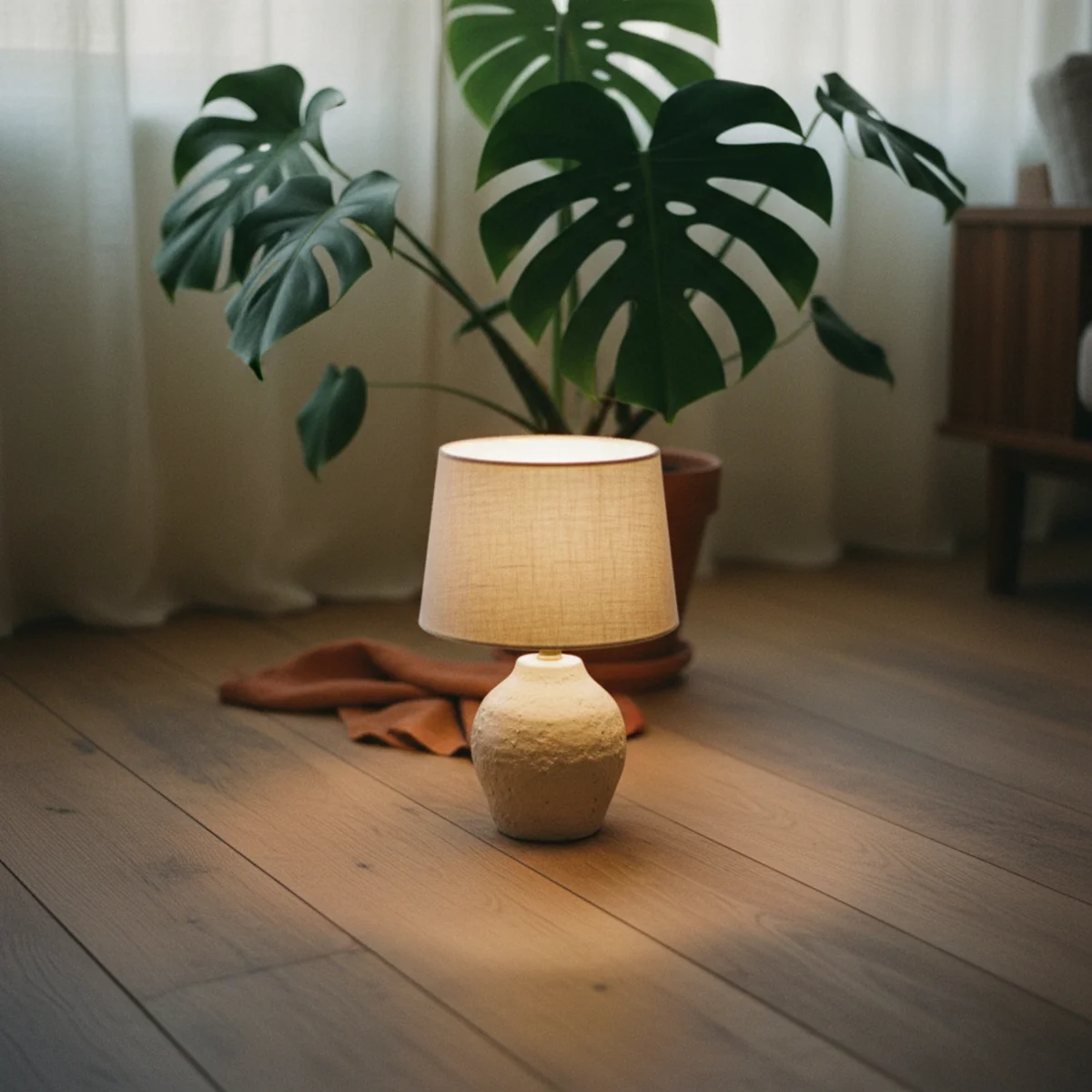
Three lamps at three heights is the rule, but the secret fourth source is a lamp at floor level — under a chair, beside a planter, washing a corner. Floor-level lighting is what separates a warmly lit living room from a magazine-quality cozy living room. The light comes from where light has no business being, the room feels lit by candlelight, and the corners no longer disappear into shadow. This is the most underused cozy living room idea on the list, and the one that takes any room from comfortable to atmospheric.
The cheapest version: a Govee battery puck light at $12 (warm setting, hide it behind a planter or under the lip of a console). The middle: a small ceramic uplight from West Elm or CB2 at $40 to $80, pointed at the wall behind a chair. The heirloom version: a Noguchi Akari floor lamp at $200 to $500 sitting at 18 to 24 inches tall (the 1A or BB3 sizes). Position floor-level lights where they'll cast light upward — behind a console, in a corner, beneath the lip of a built-in. Use a 2700K bulb at 400 to 600 lumens (lower than your main lamps — this is accent, not function). Avoid spotlights and anything that throws light directly across the floor; you want it to wash up the wall and pool gently, not to cast a beam.
AFFILIATE SLOTLIGHTINGSmall uplight or paper floor lamp, 2700K bulb, 400–600 lumensAdd affiliate URL when configuredWhy it works
Because every room is already lit from above and the middle — adding light from below is the source missing from every standard living room. The unexpected angle reads as candlelight or firelight, both warm associations. A single 600-lumen 2700K bulb low to the ground does what a $400 sconce above eye level cannot.
Pro tip — Use a battery-operated puck light with a remote ($15) to test placement before you buy anything permanent — move it around the room over a week and you'll discover the one corner that benefits most. Then invest in the real fixture there.
Light from below — the fourth source that turns warmly lit into atmospheric. See also: uplight
14Leave One Wall Completely Empty
The final, hardest, most-skipped cozy living room idea on this entire list is the discipline of leaving something out. Most living rooms suffer not from too little but from too much: too many wall hangings, too many decorative objects, too many surfaces filled. The room can't breathe. One wall — ideally the wall opposite the seating, or behind a chair — left almost entirely empty, with maybe one small piece at most, gives the eye somewhere to rest. The other styled walls then read as deliberate moments rather than wall-to-wall decoration. This is the move that takes a good cozy living room and makes it feel like a deeply considered one.
Choose the wall that's least decorated by accident, and commit to keeping it that way. Allow at most one small piece — a 12-inch round mirror, a single small painting, a slim plant on a stand — and nothing else. The wall color matters more than usual when it's exposed: a warm white (Benjamin Moore White Dove OC-17, Farrow & Ball Pointing 2003, or Sherwin-Williams Alabaster SW7008) or a soft warm tone (Farrow & Ball Setting Plaster, BM Soft Chamois) reads warm where stark white reads sterile. Add a small in-wall paper texture (limewash, lime paint, or Roman clay) for $40 to $80 in a 4-by-6-foot patch if the wall is otherwise too flat. Resist the urge to fill it for at least three months — you'll discover you stop wanting to.
AFFILIATE SLOTPAINTWarm white or limewash paint for the deliberate empty wallAdd affiliate URL when configuredWhy it works
Because negative space is what gives every styled object around it weight — without an empty wall to absorb the eye, every other piece in the room competes for attention. One quiet wall is the equivalent of one quiet sentence in a paragraph: it gives the rest its rhythm. Maximalist rooms work for exactly the same reason, with empty space taking different forms — but space is always present.
Pro tip — Take a photo of your living room from the doorway every two weeks for two months. The wall that consistently looks busier than the rest is the one to clear first — your eye is already telling you it's too much.
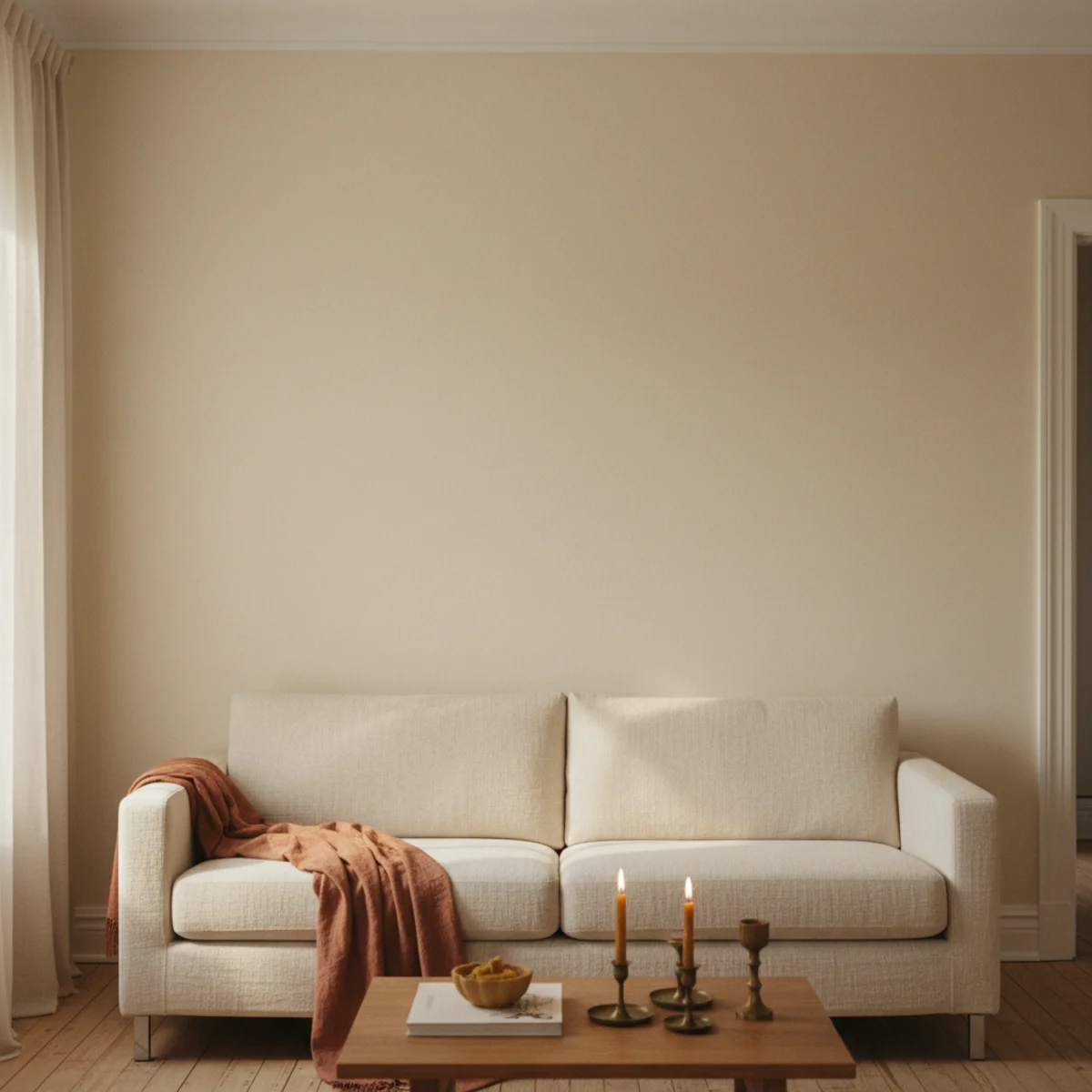
One quiet wall — the discipline that makes the rest of the room read as composed. See also: warm white
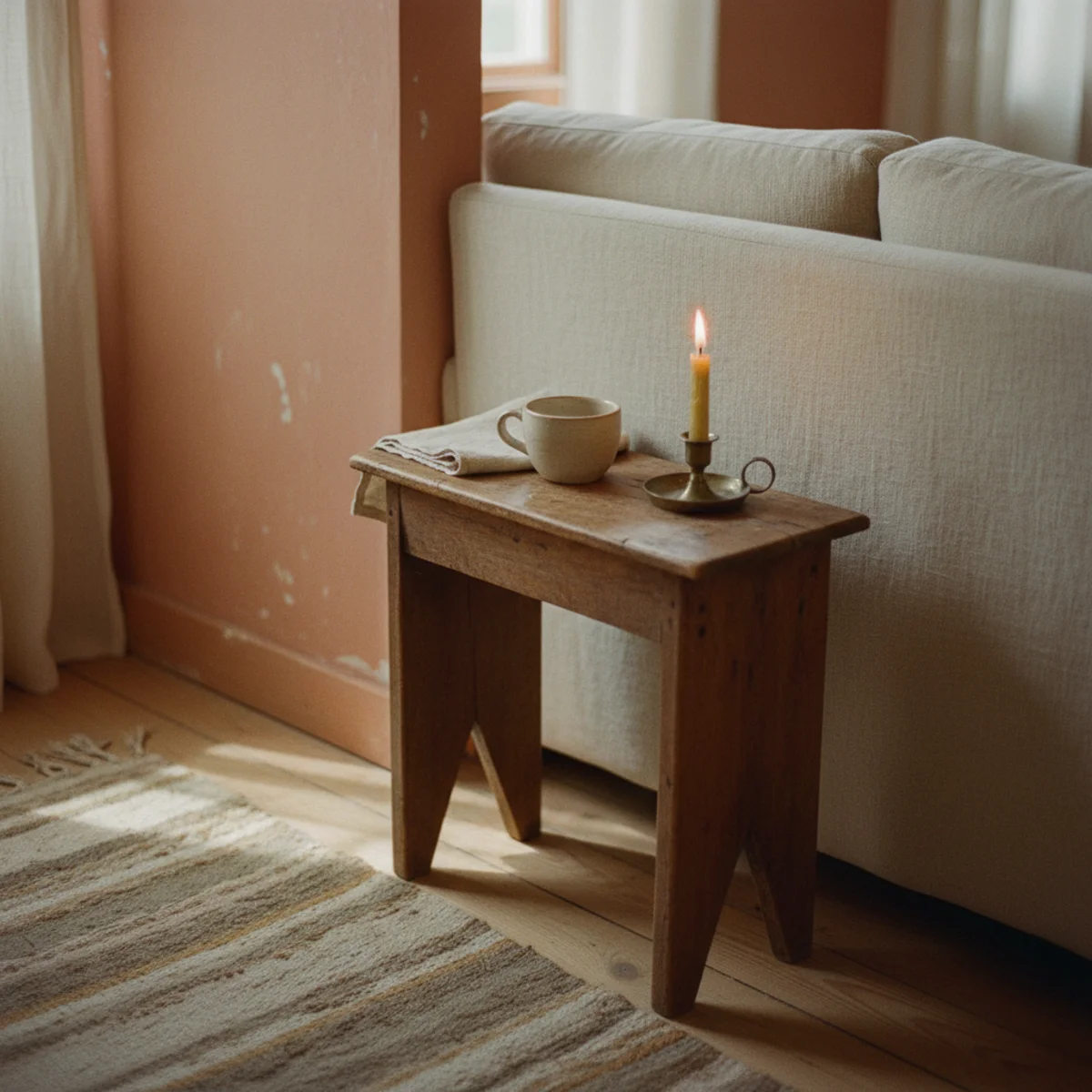
How to warm up a living room, step by step
When a room feels off and you can't say why, run these four steps in order. Most rooms are fixed by step two.
- 1Fix the light first
Turn off the overhead. Add two or three warm 2700K lamps at table and floor height. This single change resolves most cold rooms and costs the least.
- 2Layer three textures
Add a wool throw, a linen cushion, and one woven or wooden element. Contrast in weave is what reads as rich; matching too closely flattens it.
- 3Arrange for inward focus
Pull seating off the walls and angle it toward a center — a coffee table, the fireplace, or each other. A room that talks to itself feels held.
- 4Add one personal object
Finish with a single thing that has a story. This is the step people skip, and the one that separates a warm room from a styled one.
Quick tips
- Rotate throws and pillows every couple of weeks so sunlight fades them evenly.
- Keep one lamp on a timer so no room is ever cold-lit when you walk in after dark.
- Buy the rug one size up from what looks right online — rugs always photograph larger than they live.
- Let wood develop its patina; skip the high-gloss finish that reads as plastic in person.
- Iron linen once a season, then leave it — the soft wrinkle that returns is the lived-in look you're paying for.
- Edit before you add: remove two objects for every new one until the surfaces breathe.
Cozy living rooms for different homes
Scale down, not out: a low leggy sofa, one big mirror, and a clear sightline from the door. Our small living room ideas go deeper on this.
Lean on movable layers — lamps, rugs, throws, a leaning mirror — and skip anything that needs a drill.
Counteract cool light with clay-based warm whites like Farrow & Ball's Setting Plaster and brass that bounces warmth.
Use a large rug and a floated sofa to define the living zone within the larger room.
A living room gets cozy the moment you can imagine setting down a cup of coffee in it.
Frequently asked questions
How do I make my living room feel cozy on a budget?+
What is the most important element in a cozy living room?+
How much does a rug add to a cozy living room?+
How do you make a living room look expensive on a small budget?+
What should I avoid in a cozy living room?+
How do I make a small living room feel cozy without it feeling cramped?+
- StylingThrow Blanket Layering: How to Style Throws Without Clutter (2026)
- Shopping GuidesHow to Choose the Right Rug Size for Any Room (2026)
- Shopping GuidesThe Best Wool Throws for a Cozy Home, Tested and Compared (2026)
- StylingCandle Styling: 20 Ways to Style Candles for a Cozy Home (2026)
- Color StoriesThe Best Warm Paint Colors for a Cozy Home in 2026
Don't try to do everything this weekend. Pick the move that bothers you most — usually the light — and fix that first. Switch off the overhead, add two warm lamps, throw the wool blanket over the arm. Live with it for a week before you touch anything else. A cozy living room was never bought in a single trip; it's the sum of small, specific choices, and the room will tell you what it wants next.