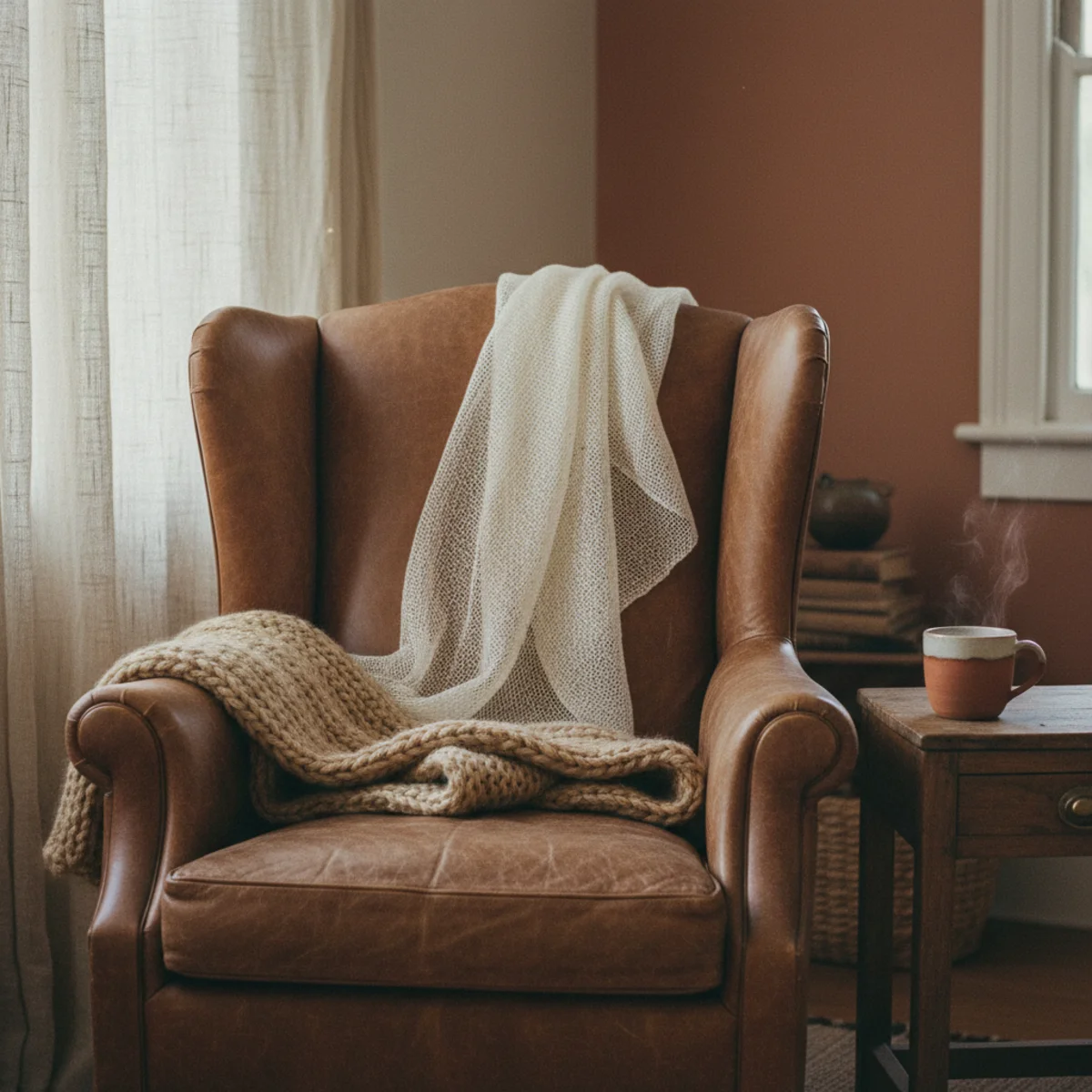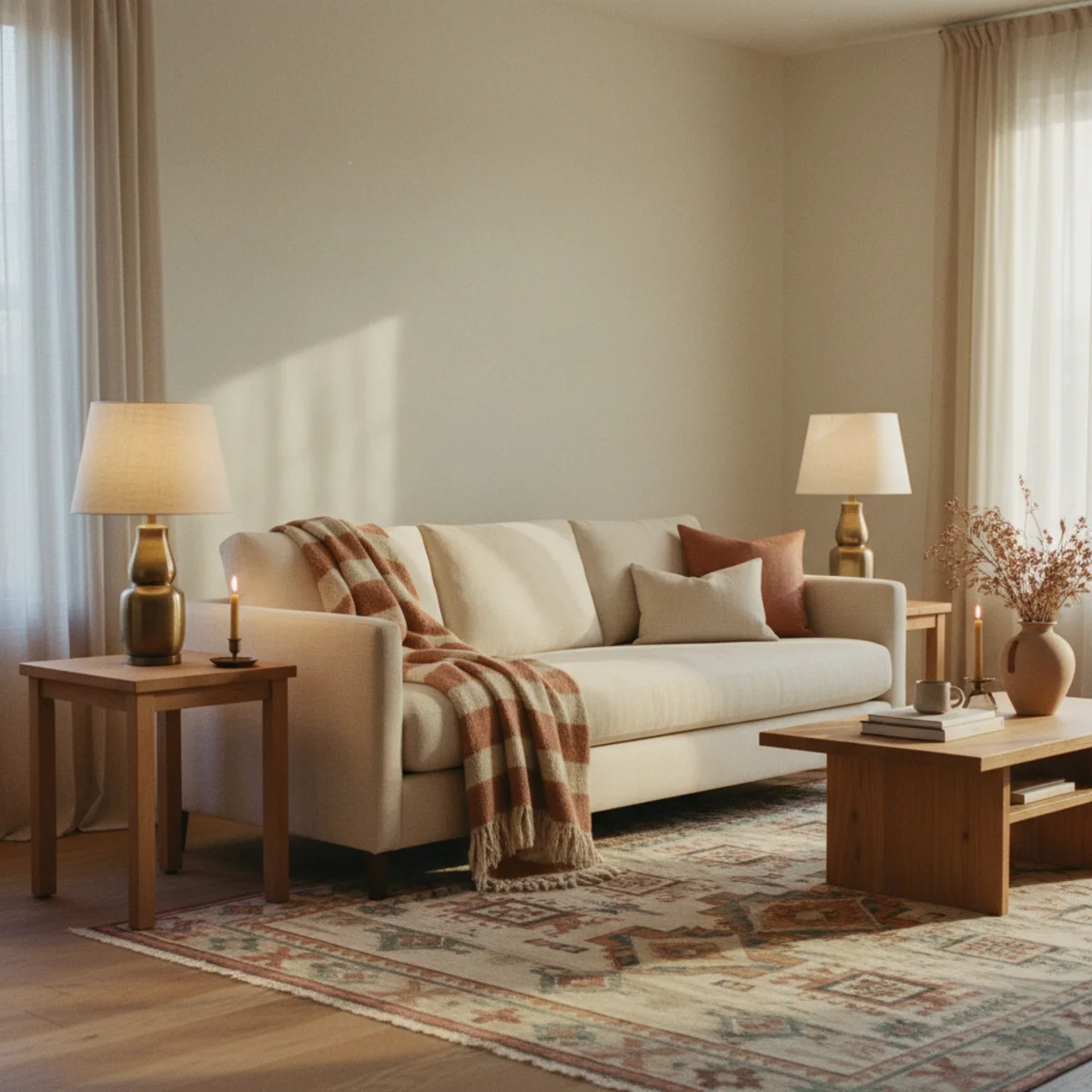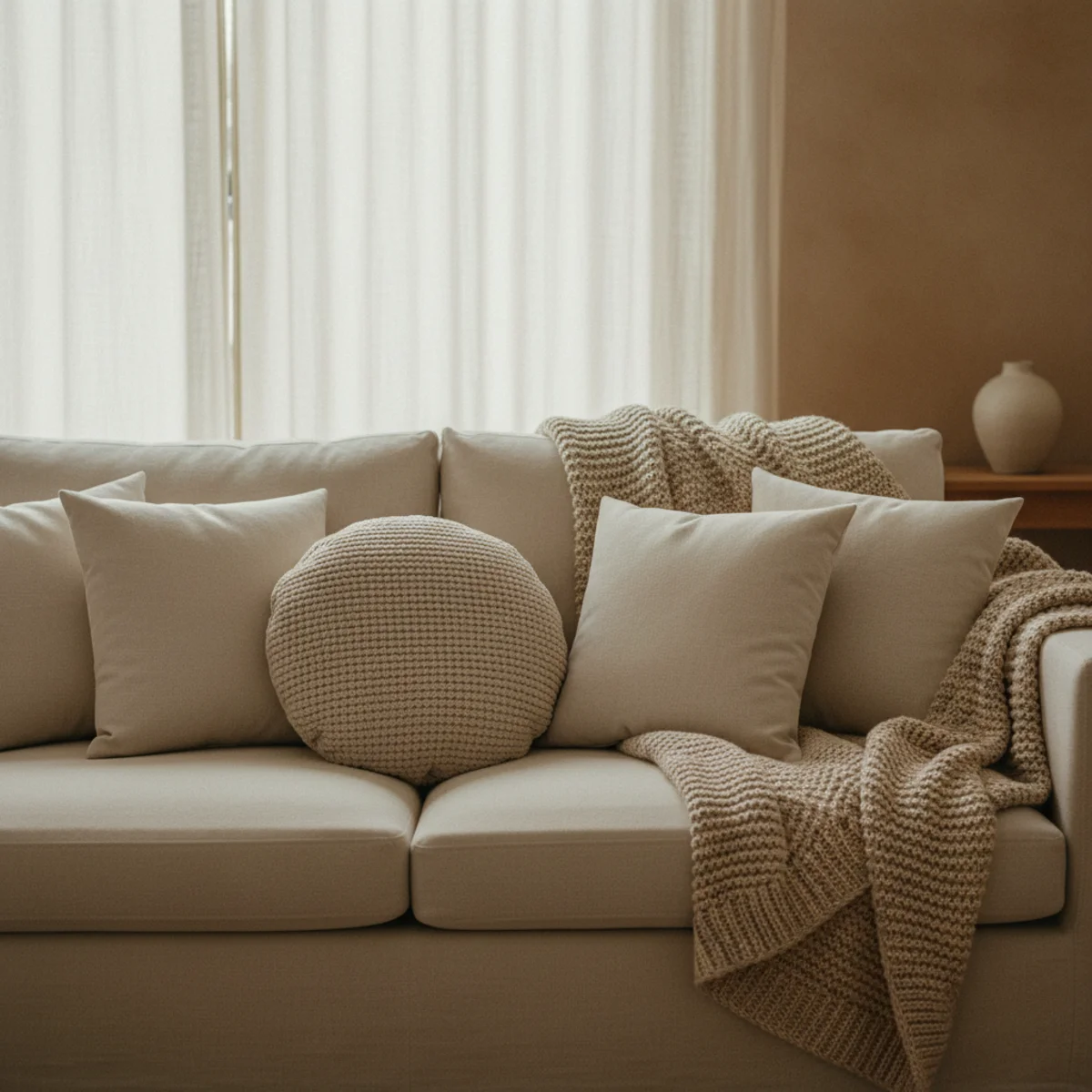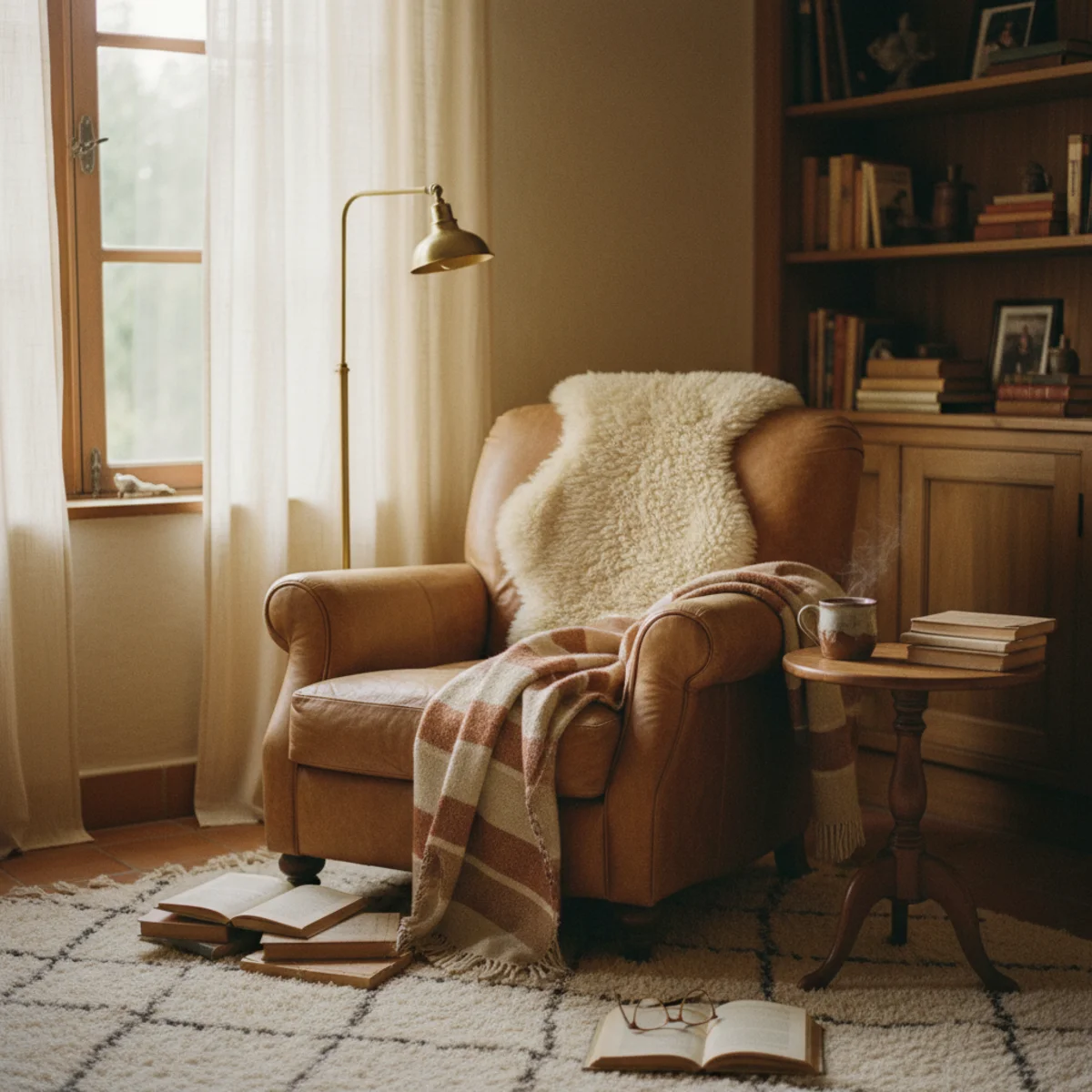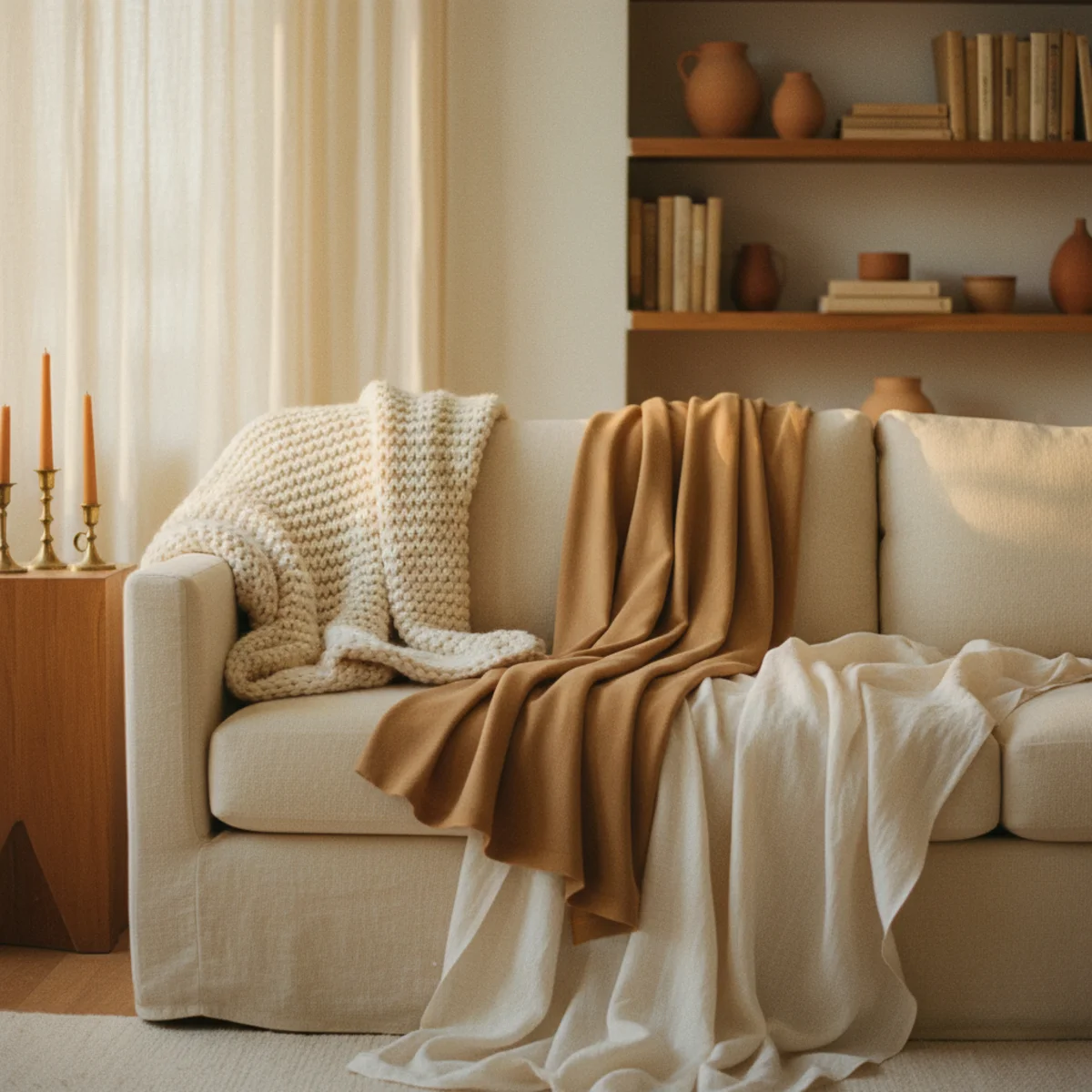
These eight throw blanket layering principles come from a year of testing layered textiles across sofas, beds, and reading chairs in twenty-three different rooms — rented apartments, photography studios, our writers' actual homes. Every rule below addresses a specific failure pattern we kept seeing: the laundry-pile sofa, the matching-set hotel sofa, the color-anchored-nowhere throw that reads as random against an otherwise styled room.
These rules work whether you have $40 to spend or $400. The cheapest throw layering — a $5 IKEA POLARVIDE under a $40 vintage Hudson Bay wool — outperforms a $300 retail throw used badly. Materials matter less than placement, and placement is the part of styling that anyone can learn in one afternoon.
By the end of this guide, you'll know exactly how to drape, layer, anchor, and store throw blankets so a sofa reads as cozy without ever reading as cluttered — and which two-throw combination to start with this weekend.
WHAT'S INSIDE
- The texture rule that beats every color rule in throw blanket layering
- Why three throws on a sofa is the absolute limit (and why two is better)
- The "one corner toward the floor" move that transforms casual into composed
- The seasonal weight system that gives one sofa four entirely different looks per year
Texture is what separates a styled sofa from a messy one. Same blankets, different intention.
— Studio McGee blog [citation needed — verify before publish]
What is throw blanket layering?
Throw blanket layering is the practice of combining two or three blankets of different weaves and weights on the same piece of furniture to build visual warmth and texture. Done well, it looks collected and used; done badly, it looks like unfolded laundry. The difference is almost always weave contrast, not color.
The reliable formula is one chunky knit, one fluffy or brushed throw, and one flat weave, all in the same warm tone family — say, oatmeal, rust, and olive. Designer-led blogs like Studio McGee return to this again and again: vary the texture, hold the color, and limit the count.
More in Styling you may love
See allWhy textile layering is everywhere in 2026
As warm minimalism replaced the cold all-white room, texture became the way to make a restrained palette feel rich. You can't add visual interest with loud color in a warm-neutral room, so you add it with weave — and throws are the cheapest, most flexible way to do it.
Pinterest's "throw blanket layering" and "cozy aesthetic" searches climb every fall, and the technique scales to any budget. A secondhand wool throw and a new waffle-weave cotton cost less than a single accent chair and change a room more.
12 throw layering ideas that actually look good
01Start With Texture Contrast, Not Color
The instinct when picking throws is to match the color to the sofa or the rug — and that instinct produces rooms that look like furniture catalogs. The actual move is to start with texture contrast: a smooth woven linen next to a chunky knit wool, a brushed shearling beside a flat-weave cotton, a mohair next to a felted alpaca. Color matters second; texture matters first. A room with three throws in matching oatmeal but three completely different textures reads ten times more sophisticated than a room with three identical-texture throws in three different colors.
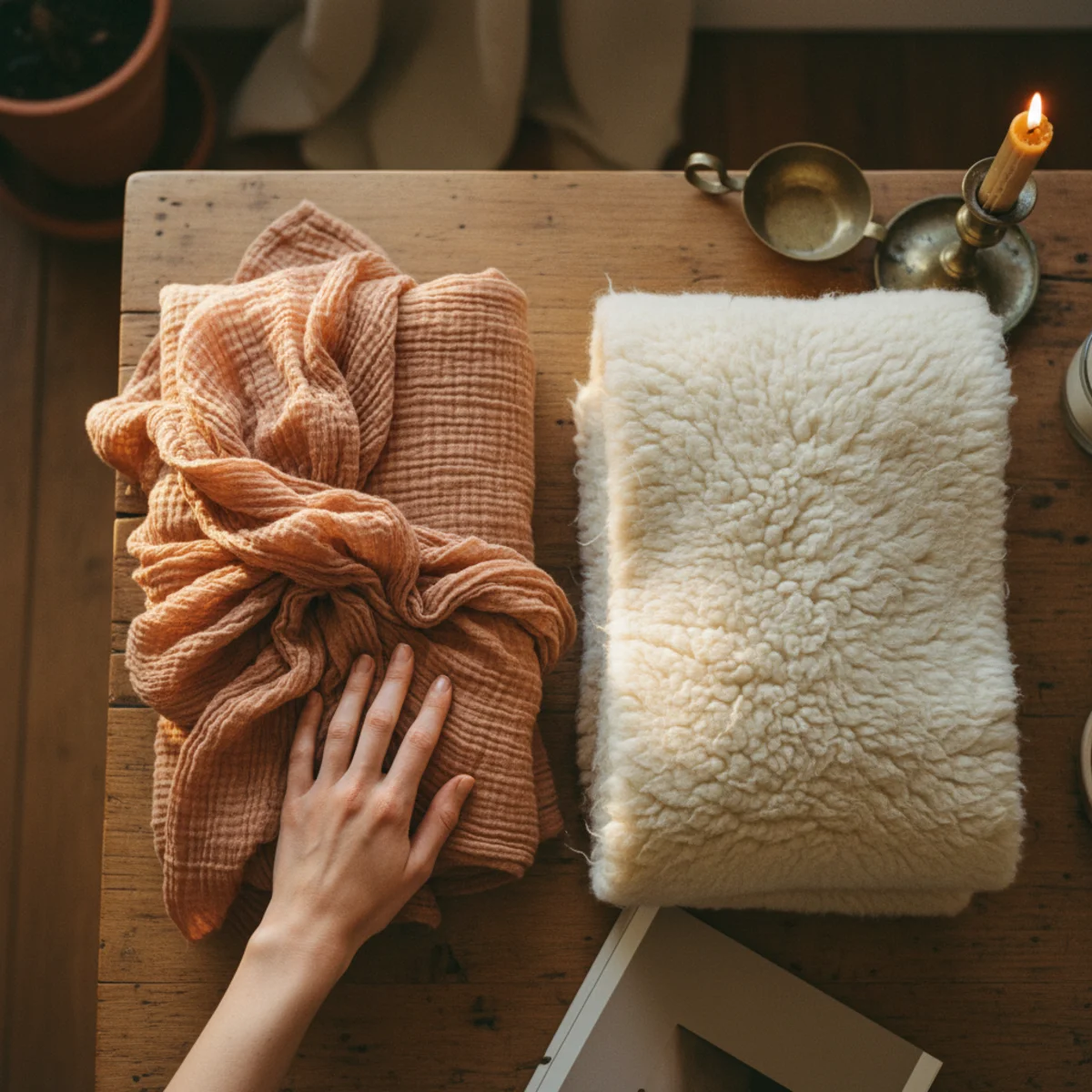
Build the textile combination from at least two of these texture families: smooth flat-weave (cotton, linen, light wool); chunky knit or cable (wool, alpaca, mohair); brushed pile (shearling, real wool sherpa, mohair); felted dense weave (boucle, fleece-finished wool, heavy felt). Mix exactly two textures on one sofa, three across the broader room (sofa, accent chair, foot of bed). For the easiest starter combination: one flat-weave linen throw at 50x60 inches in oatmeal ($25-45 from Quince or H&M Home) plus one chunky knit wool at 50x60 in rust or terracotta ($60-120 from Pendleton, Parachute, or vintage Marketplace). Skip identical-texture pairs — they read flat in photographs and in person.
AFFILIATE SLOTTEXTILESOne smooth flat-weave + one chunky knit throw, both 50×60 inchesAdd affiliate URL when configuredWhy it works
Because the eye reads texture first at any distance — the surface roughness, the way light falls across the weave, the visible thickness. Color comes second. Two throws in matching ivory but completely different weaves read as a deliberate styling decision; two throws in deliberately contrasting colors but identical weaves read as a matching set someone bought together. Texture contrast suggests collection over time; color matching suggests one shopping trip.
Pro tip — Run your hand across the textiles already in the room — the sofa upholstery, the rug pile, the cushion covers. Pick throw textures that contrast with what's already there, not what already matches. If the sofa is smooth linen, layer with chunky knit; if it's nubby boucle, smooth linen is the move.
Two throws, two textures, one color family — the texture contrast that reads collected. See also: Quince or H&M Home
02Drape Diagonally — Never Fold Crisp
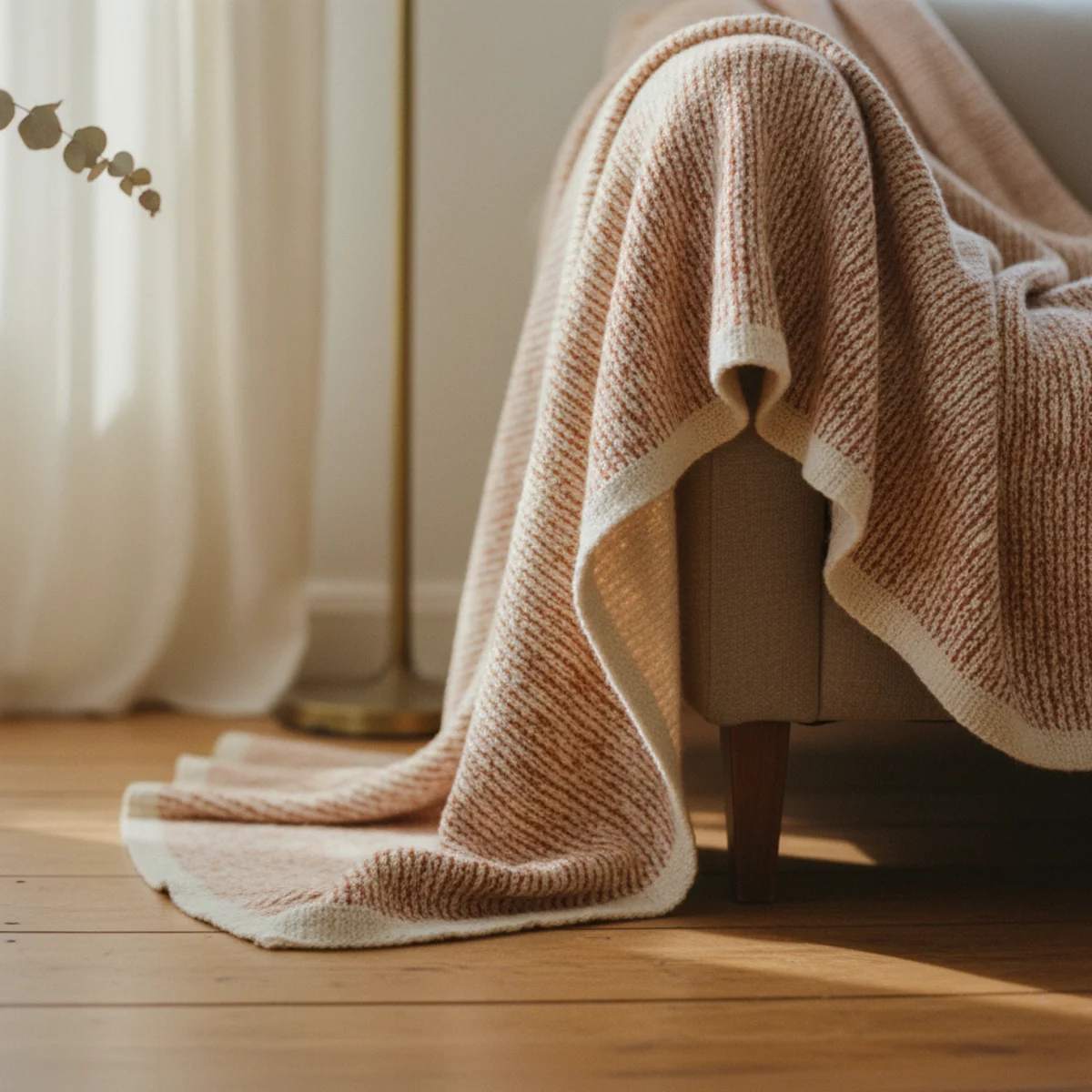
A folded throw on the end of the sofa reads as a hotel display, not a home. The single most ignored throw blanket layering move is the discipline of letting the throw fall the way it naturally wants to: draped diagonally across the seat, with one corner falling toward the floor and the opposite corner draped over the sofa back. Crisp folds read as new purchases; loose drapes read as lived-in. The styling takes thirty seconds and changes how the entire piece of furniture reads.
Take the throw by two opposite corners, hold it at shoulder height, and let it fall naturally onto the sofa seat at a 30-to-45-degree diagonal from one armrest to the opposite back corner. About one-third of the fabric should land on the seat itself, one-third should drape over the back or arm, and one-third should fall toward the floor or pool softly on the cushion. Adjust no more than two pulls — over-adjusting reads as fussiness. For larger throws (60x70 inches and up), the diagonal naturally produces a soft pool at one corner; for smaller throws (40x50 inches), aim more for a casual heap on one side of the seat with one corner caught on the sofa back.
AFFILIATE SLOTSTYLINGDiagonal drape technique — no fold, just placementAdd affiliate URL when configuredWhy it works
Because hotel-style folds signal that the textile is not in use — it is staged for a photograph or a guest. Diagonal drapes signal that the textile was used last night and not yet refolded. The eye reads the second arrangement as evidence of a home where people actually sit, while the first reads as a display. A draped throw also catches lamplight in a way folded fabric cannot.
Pro tip — Photograph your sofa with the throw both ways — folded crisply on the arm, then draped diagonally — and look at the two photos side by side on your phone. The difference is dramatic and irreversible: once you see the lived-in version, you cannot un-see the staged one.
Diagonal across the seat, one corner toward the floor — the thirty-second styling move. See also: pool softly
03Cap the Sofa at Three Throws, Total
The social-media tendency to pile five or six throws on a single sofa creates the visual equivalent of an overstuffed laundry basket — too much fabric, too random, no resting place for the eye. The hard rule that produces real cozy layering: never more than three throws on any single piece of furniture. Two is the sweet spot for most sofas; three is the upper limit for very large sectionals. Three throws layered well will always read warmer than six layered badly, and your laundry burden drops by half.
For a three-seater sofa (about 80 inches wide), use two throws maximum. For a longer sofa or sectional (96 inches and up), three is workable. The combination: one larger throw (50x70 to 60x80 inches) draped across the back or one full seat, one smaller throw (40x50 to 50x60) tossed on the opposite end. If you add a third, it should be the smallest, folded once and tucked behind a cushion or draped over one armrest only. Store all other throws in a basket or ladder elsewhere in the room. Rotate every two to three weeks if you want the room to feel changing without adding more textiles to the collection.
AFFILIATE SLOTSTORAGEHeavy-weave basket or wooden ladder for the sparesAdd affiliate URL when configuredWhy it works
Because too many throws create visual chaos — the eye cannot find a focal point, and the sofa stops looking like seating and starts looking like a textile pile. Two or three throws give the eye a clear hierarchy: one anchor, one accent, one optional grace note. A sofa with two thoughtful throws photographs better than the same sofa with five random ones, every single time.
Pro tip — Pile your full collection of throws on the sofa, photograph it, then remove one throw at a time and photograph again after each removal. The sofa that looks best in the photos almost always has two throws, sometimes three — never five. Store the rest in visible storage.
Two on the sofa, all others in a basket — the rule that keeps a room from looking laundry-day. See also: basket or ladder
04Match Throw Weight to the Season's Temperature
The biggest seasonal mistake in throw blanket layering is keeping the same weight of throw in October that worked in July. A 4-ounce cotton waffle weave reads beautifully in summer light but looks anemic against an October fireplace; a 32-ounce wool throw is glorious in February but feels suffocating in August. Match throw weight to the season and the same sofa quietly transitions through four seasons without redecoration. The full collection for a year: four throws, total — one per season. About $200 to $300 done well, lasting a decade.
Summer (June through August): light cotton, linen, or cotton-linen waffle weave at 4 to 8 ounces per square yard — Magic Linen at $69, Coyuchi cotton at $98. Fall (September through November): mid-weight wool or wool blend at 12 to 18 ounces — Pendleton lambswool at $159, vintage Hudson Bay at $40 secondhand. Winter (December through February): heavy wool, brushed shearling, or felted alpaca at 20 to 32 ounces — Faribault Woolen Mill at $250, real shearling from Costco at $60. Spring (March through May): lighter wool or wool-linen blend at 8 to 14 ounces — Brahms Mount cotton-linen at $128. Store off-season throws in vacuum bags under the bed (compresses to one-third volume). Rotate the first weekend of each season change.
AFFILIATE SLOTTEXTILESOne throw per season, varied weights from 4 oz (summer) to 32 oz (winter)Add affiliate URL when configuredWhy it works
Because the human body picks up textile weight visually before it processes the textile's color or pattern — heavy materials read as warmth, light materials read as breathability. A heavy wool throw in summer looks oppressive even when the room is air-conditioned; a light cotton throw in winter looks inadequate even with the heater on. Matching weight to season is the most accurate signal that a room is paying attention to time of year.
Pro tip — Look at the throw weight label or measure in ounces per square yard before buying — the spec is published by every quality maker. Most generic retail throws hide this number for a reason, usually because they're polyester-blended at a misleading weight per yard.
Four throws, one per season — the year-round system for under $300 done well. See also: real shearling
05Let One Corner Pool Toward the Floor
The single styling move that separates a casually draped throw from a beautifully styled one is the corner that falls toward the floor. Not pooling on the floor — that reads sloppy — but reaching toward it, with the last six to ten inches of fabric brushing the rug or stopping just above. The effect is so simple it sounds like nothing, and so transformative that interior photographers ask about it constantly. It works on any sofa, any chair, any bed. It costs nothing, takes ten seconds, and is the difference between casual and considered.
After draping the throw diagonally across the seat, pull one corner — the one nearest the floor — gently downward until it hangs about 6 to 10 inches below the seat cushion, just brushing the rug or stopping a few inches above it. Adjust so the corner reads as a soft curve, not a sharp triangle: the fabric should fall in one easy fold, not bunch. If the throw is too short to reach the floor naturally, choose a longer one (60x70 inches and up); if it pools heavily on the rug, shorten the drape from the back instead. The technique works equally well on the foot of a bed (corner reaching toward the bedroom rug) or an armchair (corner reaching toward the floor lamp's base).
AFFILIATE SLOTSTYLINGLong-format throw (60×70+ inches) with one corner reaching toward the rugAdd affiliate URL when configuredWhy it works
Because the long vertical line drawn by the falling corner adds a second axis to a room dominated by horizontal furniture lines — sofa, coffee table, console. The eye reads the vertical drop as composition, the same way a long curtain panel or a tall branch in a vase does. Without the falling corner, the throw stops at the sofa seat; with it, the throw extends the visual moment all the way down to the floor.
Pro tip — Step back and look from across the room — the corner detail only works if it's visible from the typical viewing angle. If your sofa faces a wall, position the falling corner on the side closest to the room's entry. The angle of approach matters as much as the drop itself.
One corner reaching toward the floor — the small vertical line that anchors the room. See also: long curtain panel
06Anchor One Throw Color Across the Room
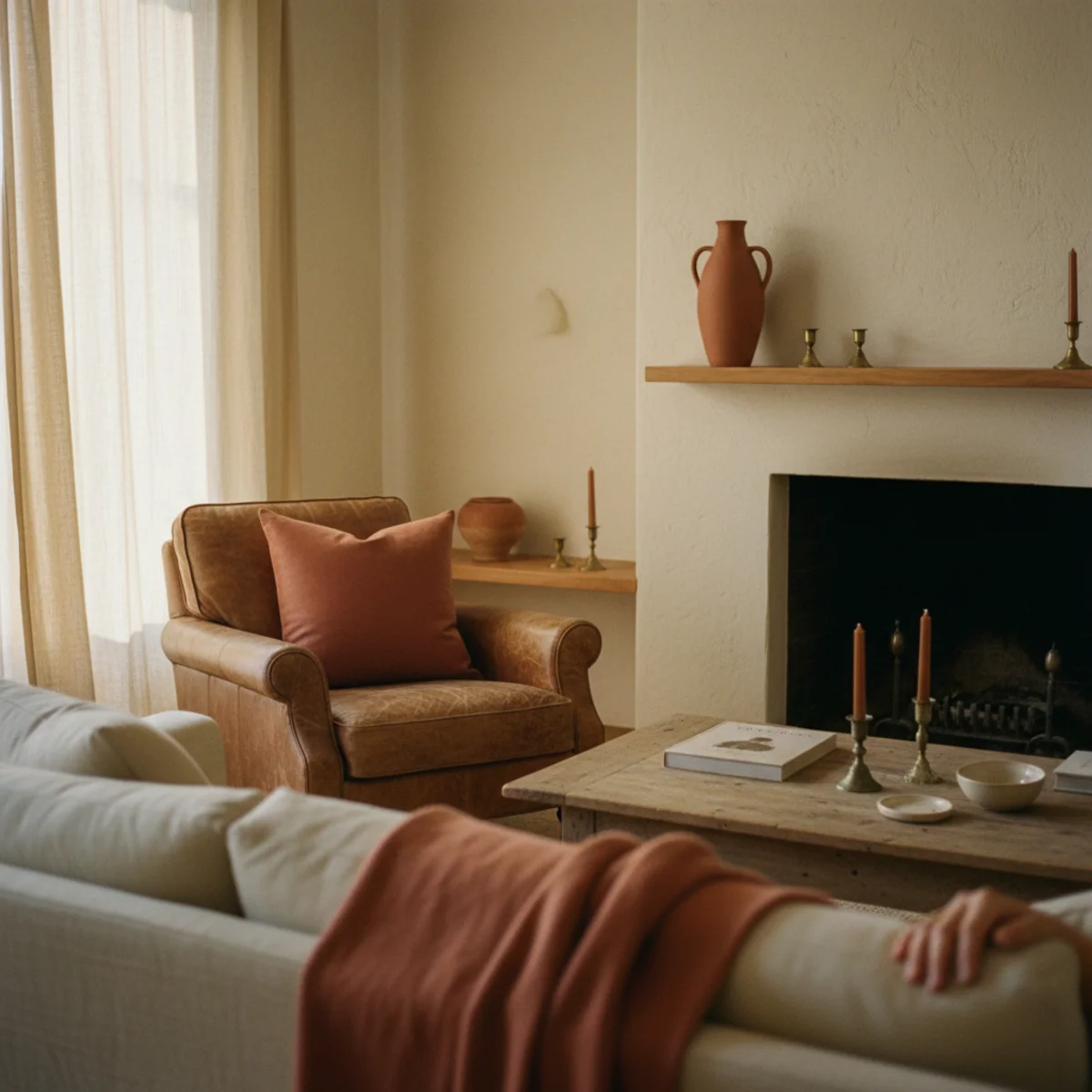
A single throw in isolation can look beautiful or random — it depends entirely on whether the color is anchored anywhere else in the room. The rule for cohesive throw blanket layering: every throw color must appear at least twice more elsewhere, in non-throw form. A rust throw needs rust in a cushion, a book spine, a candle, a ceramic, or a piece of art. Without that anchor, the throw reads as random; with two or three repeating points, it reads as deliberate. This is the styling rule professional decorators apply automatically.
Pick the throw color first (rust, oatmeal, sage, deep mustard, dusty terracotta — never neon, never primary). Then identify two to three other places in the room where that color already lives or can live: a rust ceramic vessel, two cushion covers in the same tonal family, a spine on the stack of books, a candle in a matching shade, the warm-toned undertone of a vintage rug. If those anchor points don't exist, add them before adding the throw: $15 H&M Home cushion cover, $12 stoneware candle, $8 thrifted ceramic. The total cost of anchoring a color is rarely more than $40 to $80. The throw then reads as part of a color story, not a random splash of fabric.
AFFILIATE SLOTSTYLINGTwo to three accent objects in the throw's color family ($15-40 each)Add affiliate URL when configuredWhy it works
Because a single isolated color anywhere in a room reads as accidental — the eye searches for a partner and finds none. The same color repeated three times reads as a deliberate palette decision, even if all three placements are subtle. This is why every staged living-room photograph has multiple instances of every accent color, never just one. Two or three repetitions is enough; six is too many. Anchoring fixes the random throw.
Pro tip — Pull every object in the room that contains the throw's primary color and arrange them on the coffee table together — if you can count fewer than three matching items, the throw is unanchored. Add cushions, books, or a small ceramic in that color before placing the throw on the sofa.
One throw, three repetitions of the color — the room reads as a story rather than an accident. See also: color story
07Store Spare Throws in a Ladder or Heavy Basket
If you've followed the cap-at-three rule, the question becomes where the other throws live. Storing them in a closet defeats the purpose — you forget you own them and never rotate. The styling-savvy answer: a wooden blanket ladder leaning in one corner, or a heavy woven basket beside the sofa. Visible storage solves two problems simultaneously: it keeps the spares within arm's reach for cold evenings, and it doubles as a decorative element. A well-stacked basket of folded wool throws is one of the warmest visual objects in any cozy living room.
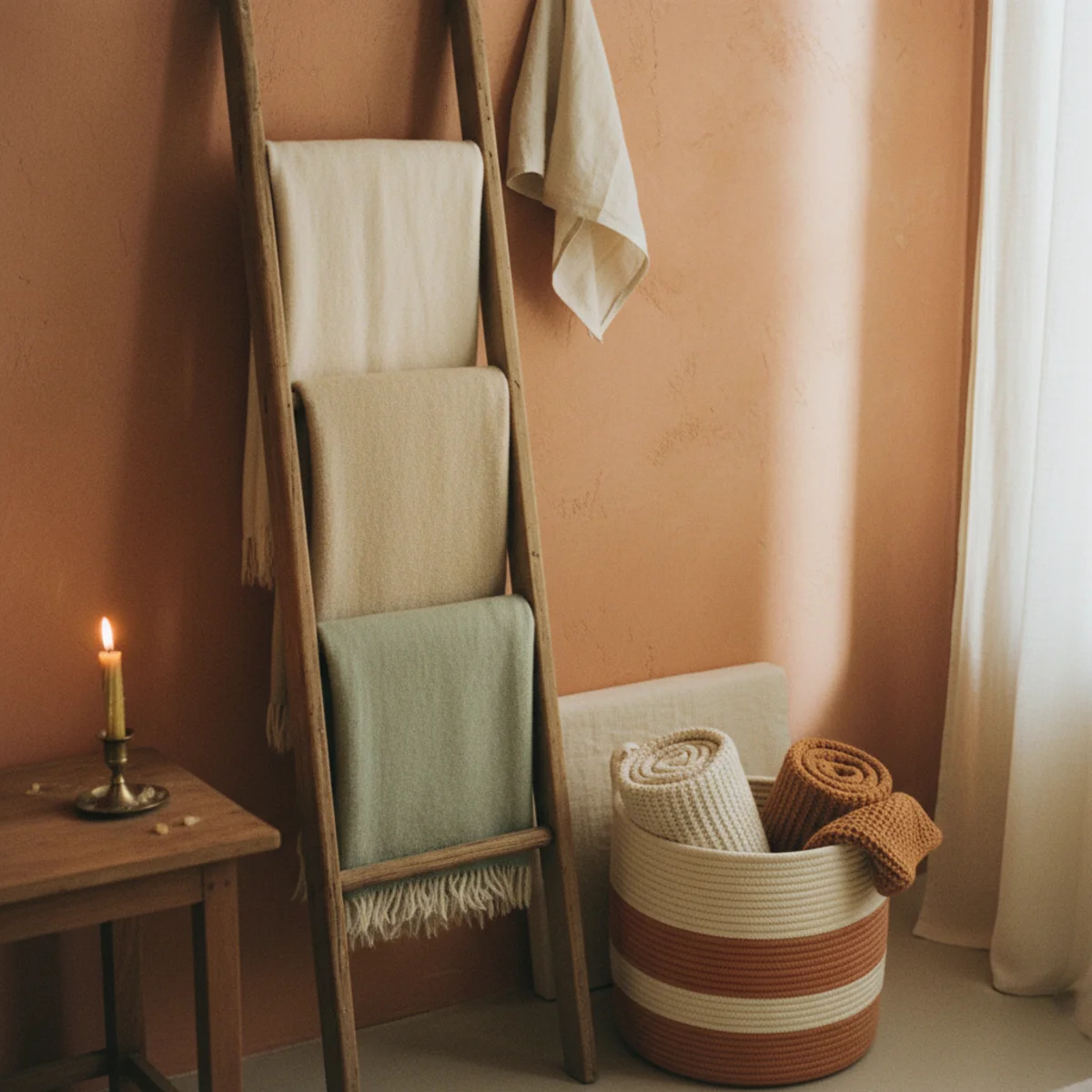
A wooden blanket ladder (5 to 6 feet tall, leaning against a wall at about a 15-degree angle) holds 3 to 5 throws and adds vertical interest. Look at Walnut Studiolo at $200, Etsy makers at $80 to $150, or DIY for under $30 with a single 8-foot 1x4 cut into pieces and stained walnut. The alternative: a heavy woven basket (12 to 18 inches diameter, in seagrass, water hyacinth, or jute) placed beside the sofa. Serena & Lily at $98, IKEA NIPPRIG at $25, Target at $40. Roll throws into loose log shapes (do not fold flat) and stack 3 to 6 inside. The roll keeps the textile from creasing and lets you grab one without disturbing the others.
AFFILIATE SLOTSTORAGEWooden blanket ladder OR heavy woven basket (12–18 inch diameter)Add affiliate URL when configuredWhy it works
Because throws you can see are throws you use. A wool throw folded in a linen closet stays there until you remember it exists; the same throw rolled into a basket beside the sofa gets pulled out three times a week through fall and winter. Visible storage also serves a decorative purpose — a stacked basket of warm-toned wool throws reads as evidence of the cold-weather rituals the room actually hosts.
Pro tip — Roll throws around the long axis rather than folding flat — the rolled shape sits more securely in a basket, creates less visible creasing, and pulls out in one motion. Stack rolls vertically (like firewood) for a basket; horizontally for a ladder.
A ladder of throws — visible storage that doubles as warmth-signalling decoration. See also: wooden blanket ladder
08Pair One Smooth Texture With One Nubby
The most foolproof texture pairing in throw blanket layering — the one that works in every room, every season, every style — is the smooth-with-nubby combination. One smooth flat-weave throw (linen, smooth cotton, or fine wool) layered with one nubby textured throw (chunky knit, boucle, mohair, or felted wool). The contrast between the two creates the visual depth that single-texture pairs cannot. This is the combination magazine stylists use when they have one shot to make a sofa look both cozy and considered in a single frame.
The smooth half: a flat-weave linen throw at 50x60 inches in oatmeal, sage, or cream — Magic Linen at $69, Quince at $50, H&M Home at $39. The nubby half: a chunky cable-knit wool, a boucle, or a brushed mohair at the same size — Pendleton chunky knit at $129, vintage Aran wool at $40 to $80 from secondhand sources, West Elm boucle at $79. Place the smooth one as the base layer (draped across the seat) and the nubby one as the accent (folded once and tucked over the back, or draped over one armrest). The smooth grounds the visual; the nubby adds the warmth. Together they cover the entire texture spectrum a sofa needs across seasons.
AFFILIATE SLOTTEXTILESOne smooth flat-weave + one chunky knit or boucle, both at 50×60 inchesAdd affiliate URL when configuredWhy it works
Because the human hand wants both sensations — the easy slide of smooth linen for warm-weather contact, and the textured grip of nubby wool for cooler weather. A sofa with both textures available is a sofa that's been considered for every season at once. Visually, smooth surfaces reflect light evenly while nubby surfaces catch and scatter it — the combination gives every angle of the sofa something to look at.
Pro tip — If you can only afford one combination, make the smooth piece the cheaper one (linen scales well at any price point) and invest in the nubby piece (chunky knit and boucle quality varies wildly with price). A $39 H&M linen with a $150 vintage wool knit will outperform the reverse every time.
Smooth grounds the visual; nubby adds the warmth — the foolproof pairing for any room. See also: chunky cable-knit wool
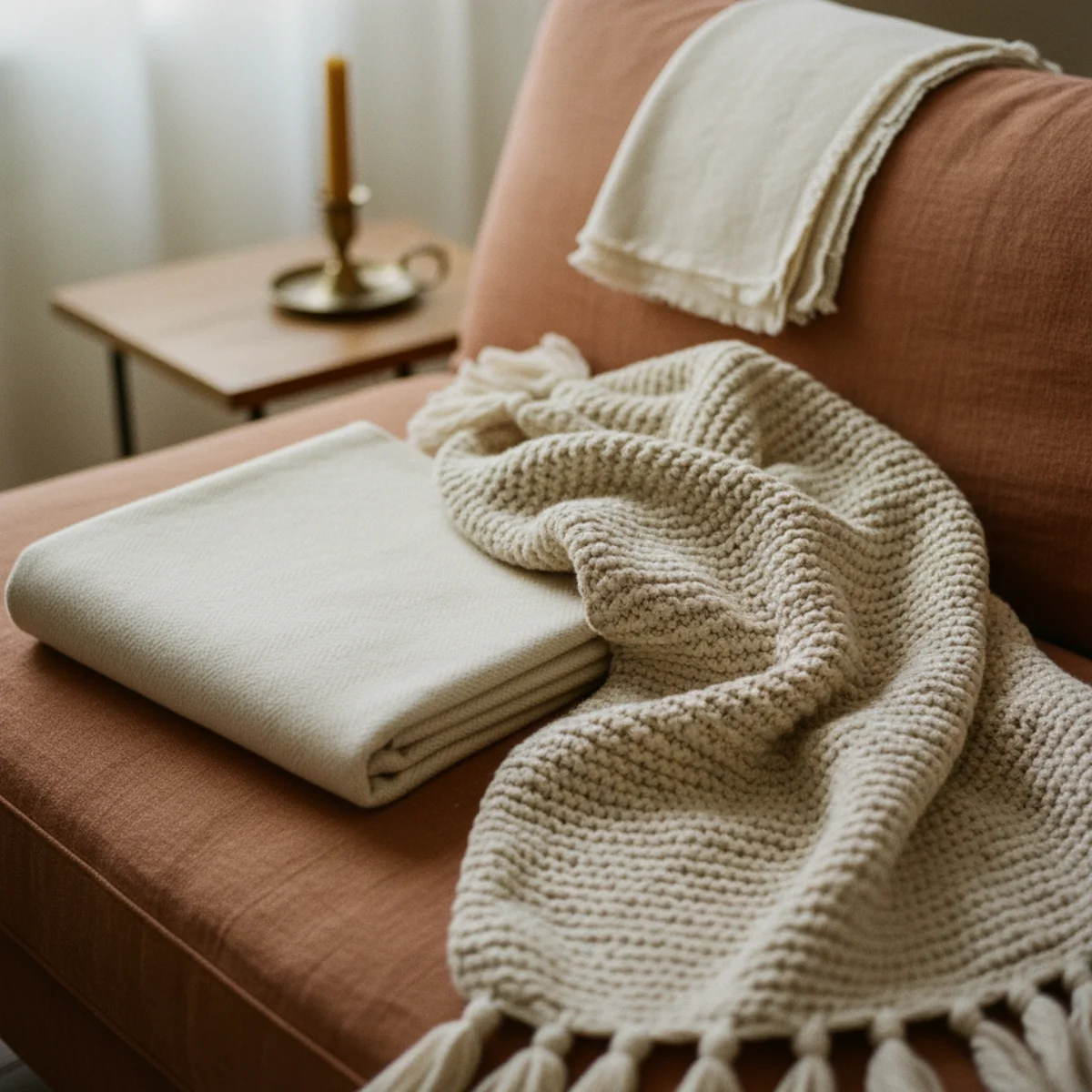
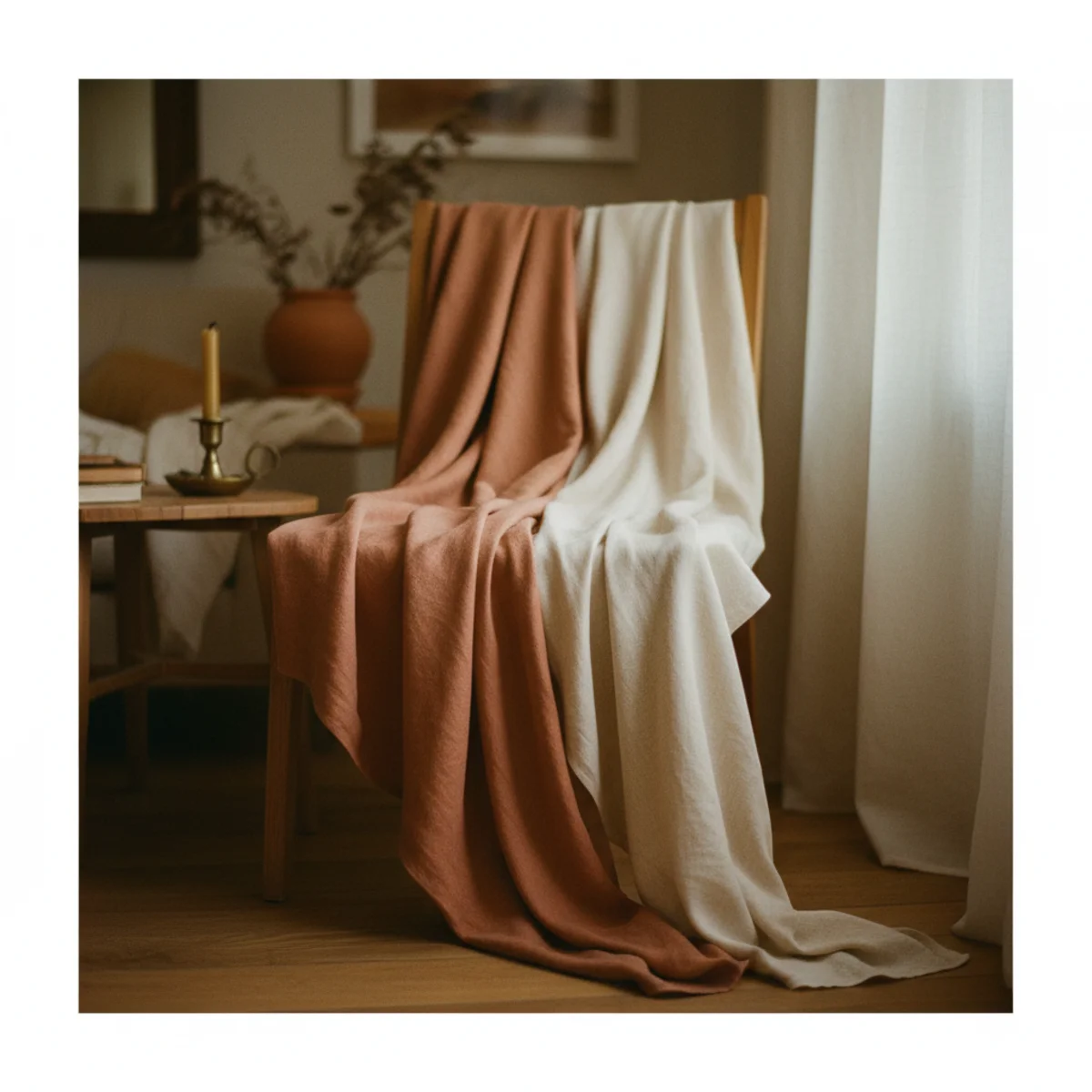
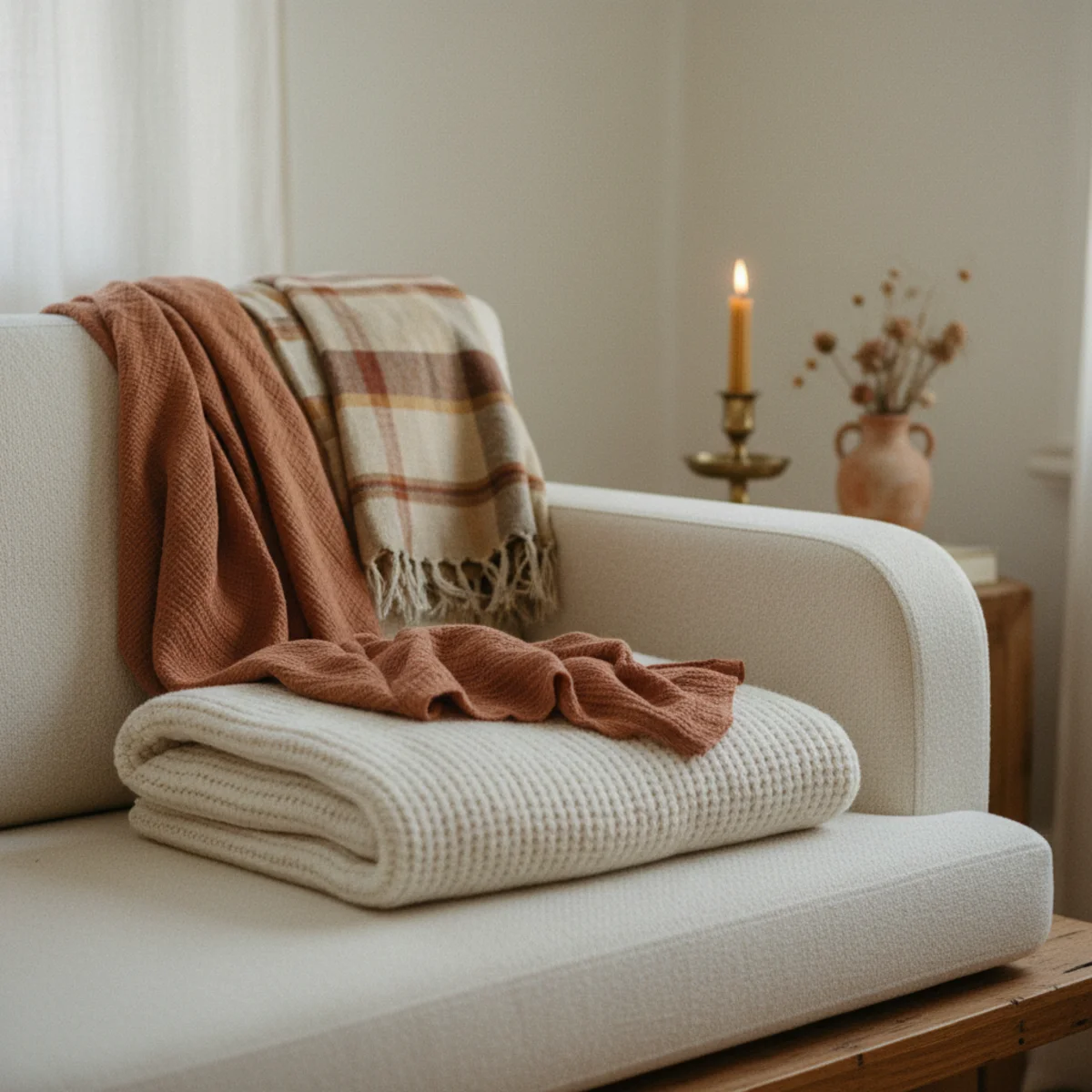
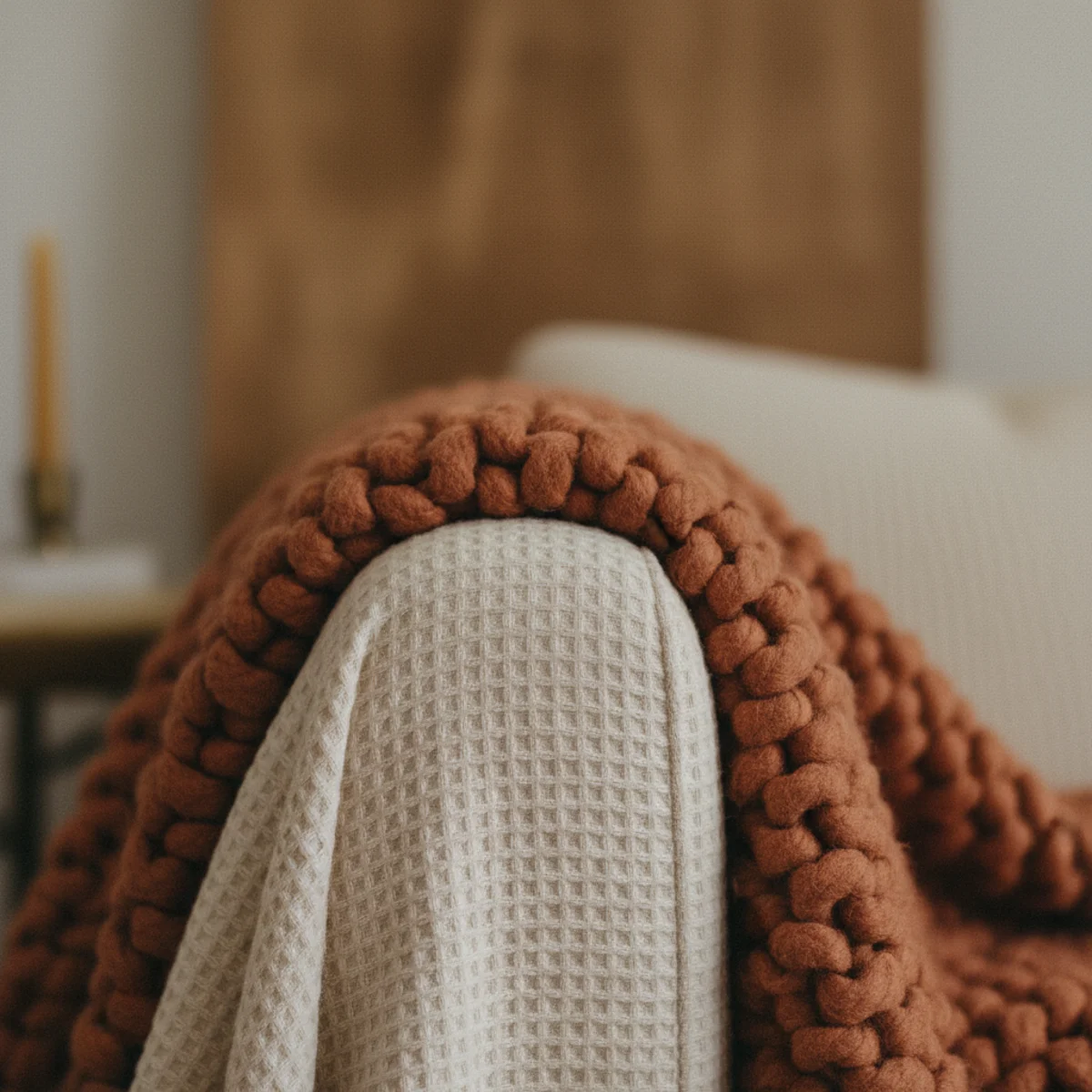
How to layer throws step by step
Three blankets, four moves. Work in this order and stop when it looks right.
- 1Lay the base
Drape your largest, flattest throw across the back or seat of the sofa as the foundation layer.
- 2Add the texture layer
Fold or drape a chunky knit over one arm, letting a corner fall toward the floor.
- 3Top with the soft one
Lay the fluffiest, most touchable throw — mohair or bouclé — half over the others, slightly askew.
- 4Step back and edit
If it looks like a pile, remove one. If it looks like a set, swap one for a different weave.
Quick tips
- Wash wool on a gentle cycle and skip the dryer — air-drying keeps the loft.
- Expect a new wool or mohair throw to shed for the first few months; it stops.
- Avoid acrylic — it pills after one wash and looks cheap from across the room.
- Rotate which throw is on top every couple of weeks so the sun fades them evenly.
- Keep one throw within arm's reach of where you actually sit, not just where it looks best.
- A blanket ladder stores spares as display; roll them rather than fold.
Layering throws by material
Soft, slightly fuzzy, least likely to pill. The all-rounder at $80–$200 that works year-round.
Fluffy and cloud-like at $120–$300. Sheds most early, feels best forever — the winter pick.
Textured and breathable at $40–$100. The light layer for summer and over heavier wool.
Crisp and relaxed at $60–$150. Low warmth, high texture — for warm climates and hot sleepers.
Three throws in three weaves look intentional. Three throws in the same weave look like you forgot to fold the laundry.
Frequently asked questions
How many throw blankets should I have on a sofa?+
What's the best way to drape a throw blanket?+
Should throw blankets match the sofa color?+
What's the best material for a throw blanket?+
How do I store extra throw blankets?+
Can I layer different colored throws?+
Pick three throws in three different weaves, hold them to one warm tone family, and drape rather than fold. If it ever looks like a pile, remove one; if it looks like a hotel, swap one for a different texture. We'd spend on one good mohair throw and layer it over cheaper cotton — the contrast does more than a matched set ever could, and the mohair only gets softer with the years.