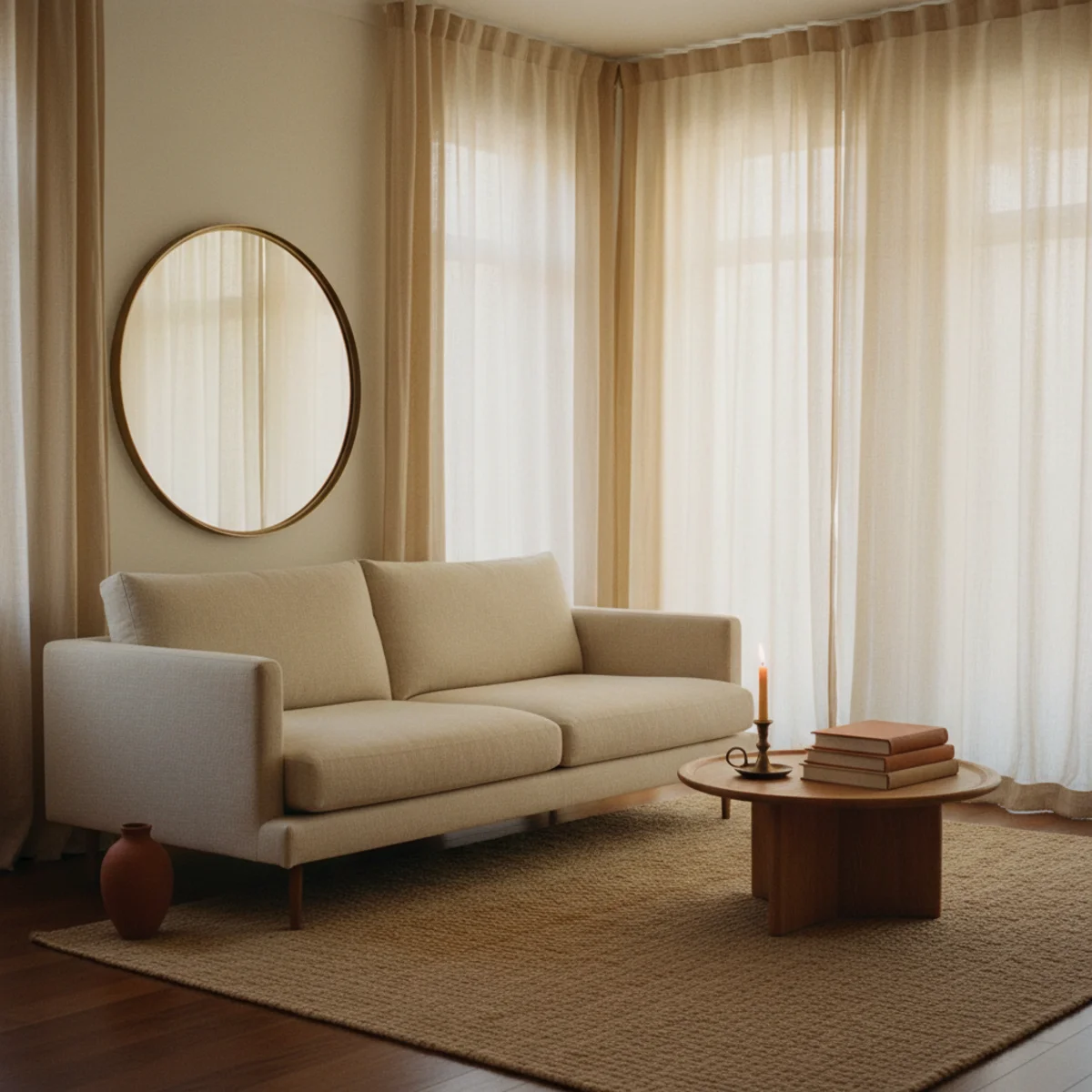
These twelve small-living-room ideas are tested in actual sub-200-square-foot living rooms — apartment livings, studio multipurpose spaces, narrow row-house parlors, rentals with weird angles. Every move below names the exact dimensions, furniture proportions, and visual rules that consistently make small rooms read larger, calmer, and more deliberately styled. None require renovation; most can be done in one weekend with the furniture you already own.
Small living rooms work best when every piece earns its visual weight — there's no room for filler. The discipline of constraint is the secret advantage; small rooms reward editing more than they reward shopping. The twelve principles below all push in the same direction: fewer pieces, better-chosen, occupying defined zones with deliberate empty space between them.
By the end of this guide, you'll know exactly which sofa proportions work in a small room, the high-and-wide curtain rule that visually doubles a small space, and the one big mirror that beats five small framed pieces for opening up a tight room.
WHAT'S INSIDE
- The leggy sofa proportion (you can see under it) that makes a small room read 30% larger
- Why one big mirror beats five small frames for visually expanding a small space
- The single sightline from the door that determines how the whole room reads
- The 3-color rule that keeps small rooms from looking visually chaotic
Small rooms fail from too much, not too little. The fix is almost always subtraction first.
— Apartment Therapy [citation needed — verify before publish]
What counts as a small living room?
A small living room is usually anything under about 200 square feet, though the proportions matter more than the number. A long narrow room and a tight square call for different moves, but both reward the same core principle: edit hard, then layer warmth into what's left.
The second principle is scale. One properly sized sofa beats a loveseat plus two crammed chairs. A single large piece of art beats a scattered gallery wall. Small rooms look bigger when the eye has fewer, larger things to land on — which is also, conveniently, how they get cozier.
More in By Room you may love
See allWhy small-space living is having a moment in 2026
Smaller homes are the reality for more people than ever — first apartments held longer, downsizing by choice, city living that trades square footage for location. Designers have responded by treating small-space design as its own discipline rather than a compromise.
The aesthetic helps. Warm minimalism and the cluttercore counter-movement both work beautifully at small scale, and vintage furniture — which runs smaller than today's oversized sectionals — happens to deliver exactly the proportions tight rooms need. House Beautiful has run small-space features for years precisely because the constraints force good decisions.
28 small living room ideas worth stealing
01Float a Low, Leggy Sofa You Can See Under
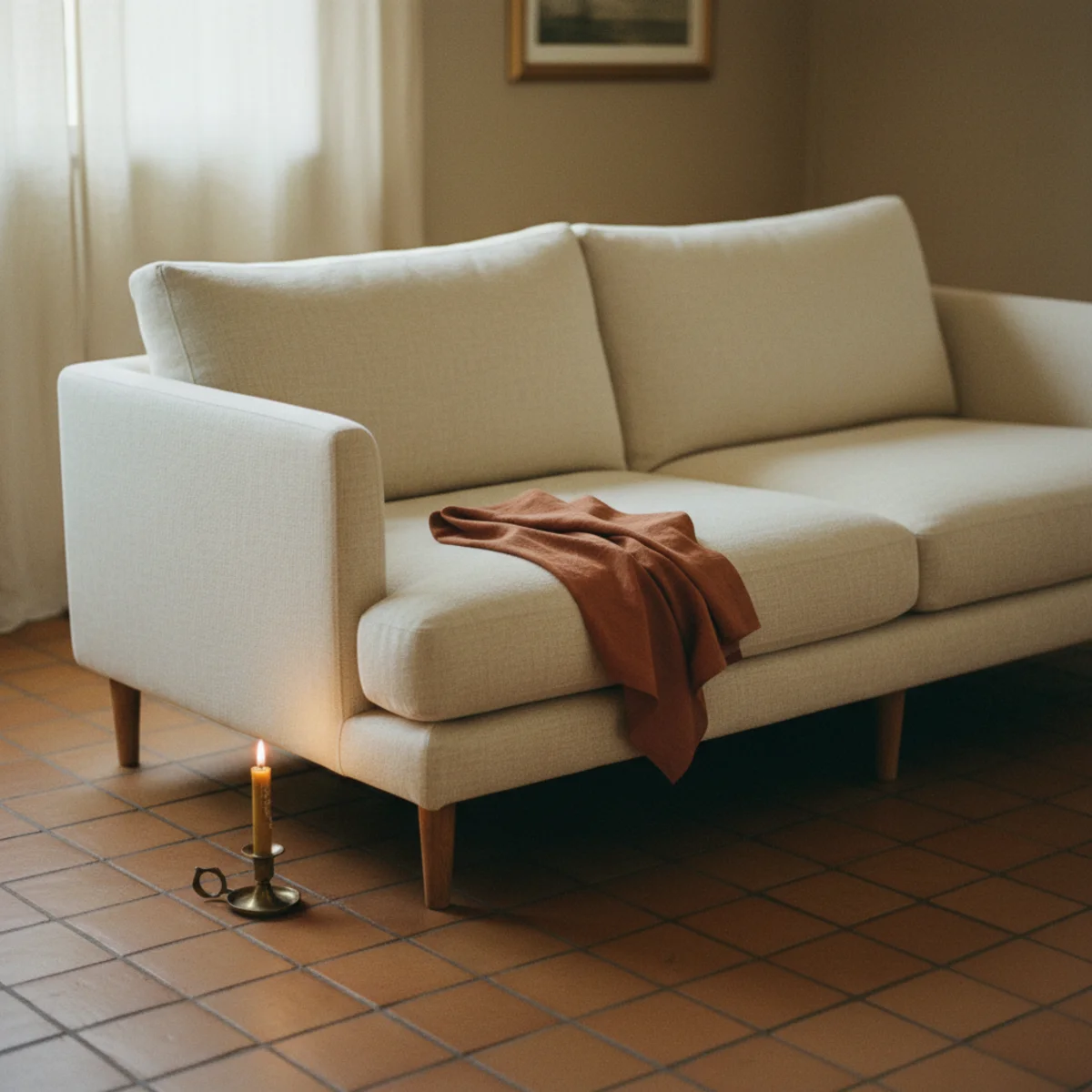
The single biggest small-living-room move is the sofa with visible legs and clear floor space underneath. A traditional skirted sofa or boxy sectional reads as a heavy block consuming floor area; a leggy sofa on tapered 6 to 10-inch legs reads as floating, which makes the floor visible underneath and the room appears larger. The same square footage of sofa, two entirely different visual weights.
Look for sofas with 6 to 10-inch tapered wooden legs that lift the seat off the floor, exposing floor underneath. Best types: mid-century modern designs (Article Sven Charme, West Elm Andes, IKEA SODERHAMN with leg upgrade), traditional with raised legs, vintage Danish-modern at $200 to $600 secondhand. Size: 72 to 84 inches wide for most small living rooms (under 100 inches; 96 inches starts crowding). Float the sofa 4 to 8 inches off the wall (never flush against the wall — even small rooms benefit). The visible floor underneath plus the gap behind tricks the eye into reading the sofa as taking less space than it actually does.
AFFILIATE SLOTFURNITURELeggy sofa with 6-10 inch tapered legs, 72-84 inches wide, floated 4-8 inches off wallAdd affiliate URL when configuredWhy it works
Because the visible floor under the sofa creates visual continuity across the room — the eye reads continuous floor from one side to the other rather than chopped sections divided by the sofa. The brain processes the unbroken floor as more open space, even though the sofa's actual square footage hasn't changed. The same trick works with leggy chairs, leggy consoles, and most other major furniture — the visible-floor principle is universal in small rooms.
Pro tip — If your current sofa sits flat on the floor, lift it onto tapered wood furniture risers ($20 to $40 from Amazon or IKEA EKBY) — the risers add 4 to 6 inches of visible floor underneath and transform how the room reads without buying a new sofa. The trick costs $30 and takes 20 minutes.
Visible floor under the sofa — the proportion trick that makes the same square footage read 30% larger. See also: Article Sven Charme
02Hang Curtains High and Wide
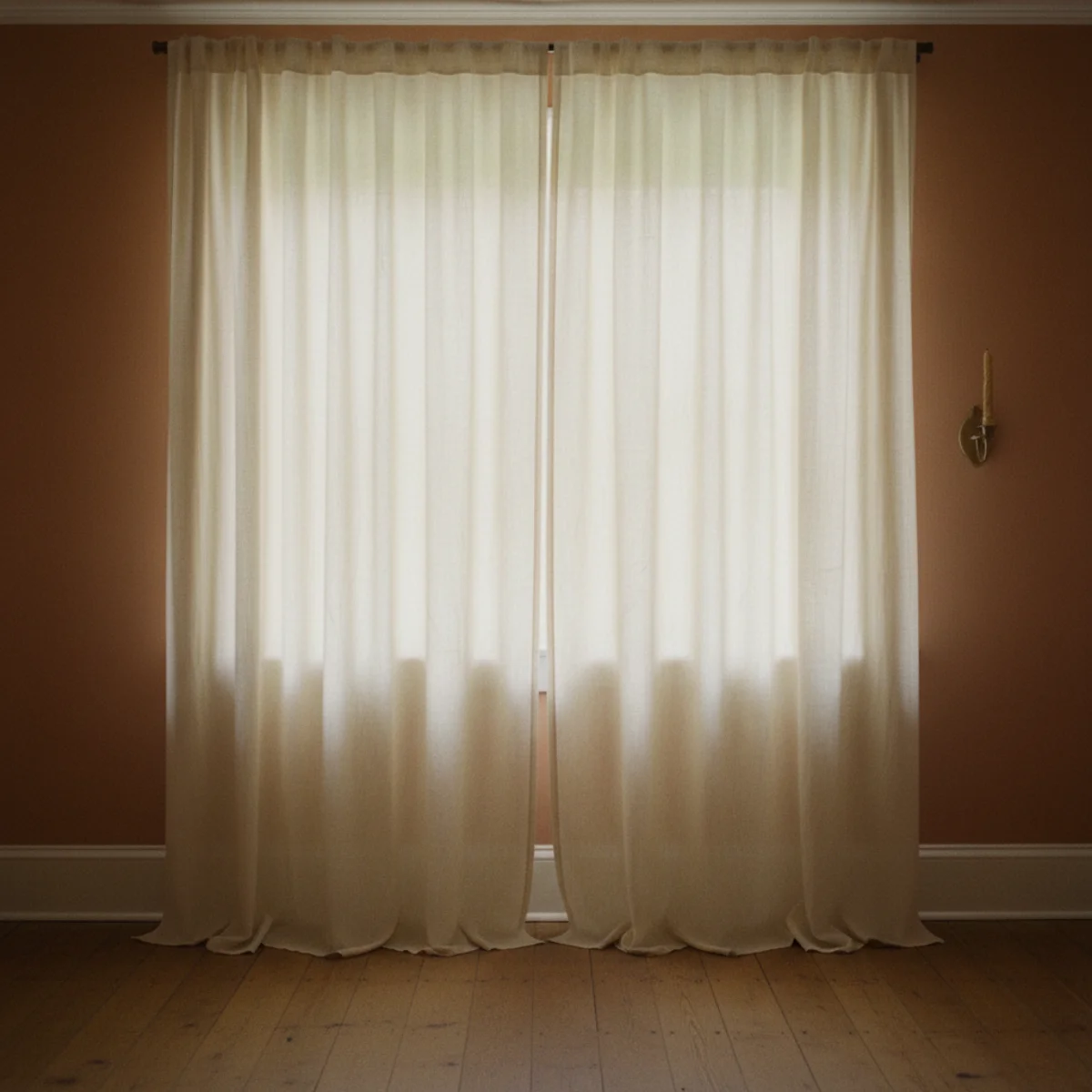
Small rooms benefit even more than large ones from the high-and-wide curtain rule — rod 4 to 6 inches below the ceiling, rod extending 6 to 12 inches beyond the window frame on each side, panels floor-length with 1 to 2-inch puddle. The high-and-wide trick visually doubles the apparent window size and raises the ceiling, transforming how the entire room reads. Cost: $50 to $150 for the rod and curtains.
Mount the rod 4 to 6 inches below the ceiling (not just above the window) and extend it 6 to 12 inches beyond each side of the window frame. Use simple iron or brass rods ($30 to $80 from West Elm). Hang two unlined linen panels per window, wide enough that when fully open they stack beside the window (revealing the entire glass) and when closed they cover the entire window plus the extended rod sections. Length: ceiling to floor, plus 1 to 2 inches puddle. Sources: IKEA AINA ($40 per panel), Quince linen ($69 per panel), no-sew DIY at $50 per panel per the diy-home-decor-ideas guide. Color: oat, natural cream, or warm white. Never bright white synthetic.
AFFILIATE SLOTWINDOWSRod 4-6 inches below ceiling, extended 6-12 inches beyond window each side, with linen panelsAdd affiliate URL when configuredWhy it works
Because the extended rod creates the visual illusion of a larger window — when panels stack beside the actual glass, the brain reads the entire fabric span as the window size, not just the actual glass. The trick is most effective in small rooms with small windows; large rooms with large windows already have the visual scale. For a 36-inch-wide actual window, extending the rod to 60 inches wide makes the window appear to be 60 inches wide, which dramatically affects how spacious the entire wall reads.
Pro tip — Order the linen panels two to four inches wider than what calculator suggests — the slight extra width lets the panels gather more luxuriously when open, reading more designed than panels stretched flat. Wider panels in small rooms read as more thought-through than perfectly fitted ones.
Rod 4 inches below ceiling, 8 inches beyond window each side — the optical illusion that doubles apparent window size. See also: no-sew DIY
03One Big Mirror Over Several Small Frames
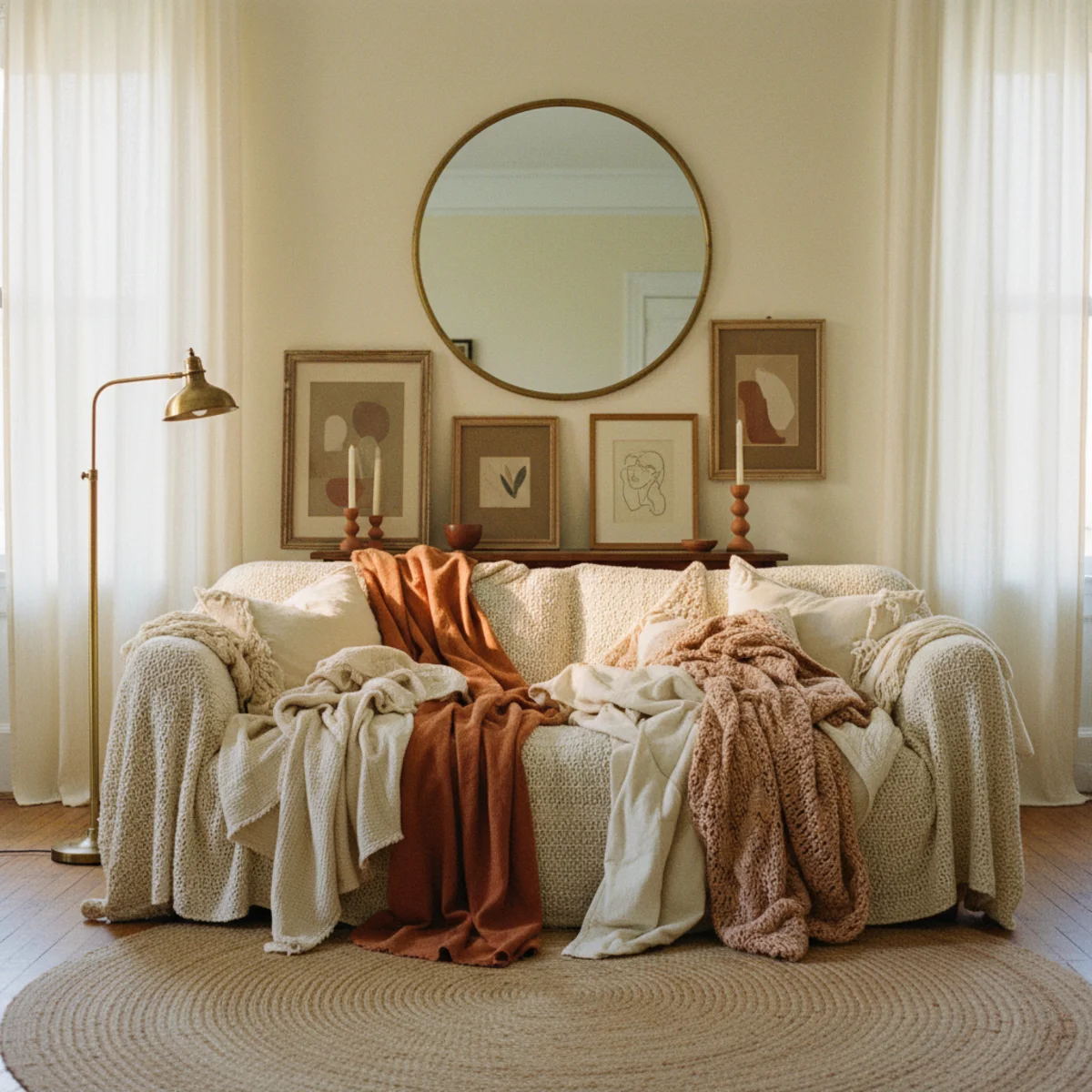
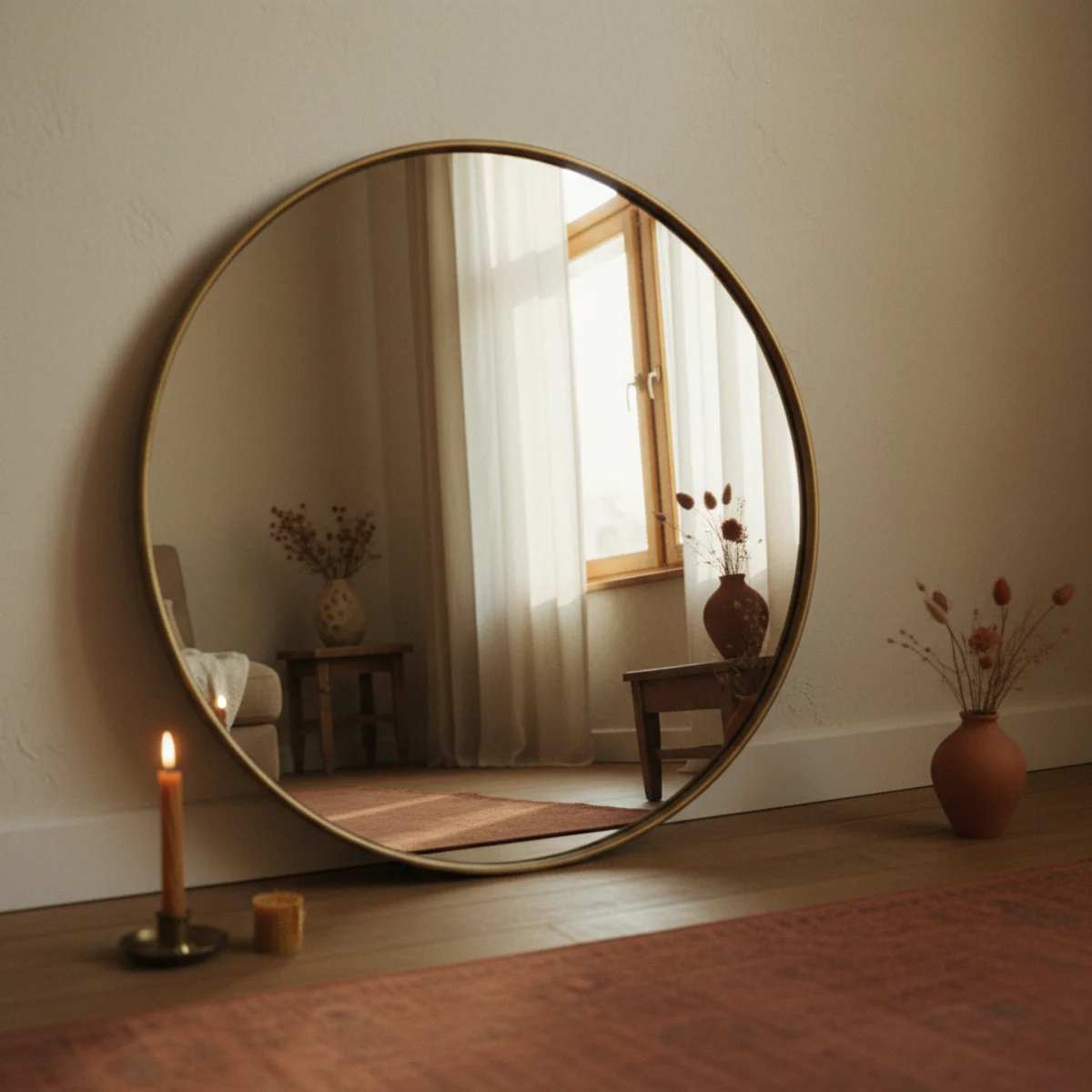
Small rooms work better with one large mirror (36 to 60 inches in any dimension) than with a gallery wall of small frames. The mirror bounces light, visually doubles the apparent room size, and creates a single strong focal point instead of distributing visual weight across many small pieces. The trick has been used in tight European apartments for centuries; small American rooms benefit just as much.
Choose a mirror 36 to 60 inches in the long dimension, ideally placed where it can reflect a window or a light source. Frames: warm wood, aged brass, or unframed beveled edges. Sources: IKEA STOCKHOLM mirror at $250, vintage gilt or wood-framed mirrors at $80 to $250 from estate sales, Article or West Elm at $200 to $600. Position above the sofa (centered), on the wall opposite the largest window (to maximize light bounce), or floor-leaned in a corner. One large mirror per small room is the rule; multiple mirrors compete and fragment the visual gain.
AFFILIATE SLOTWALLOne large mirror 36-60 inches in warm wood, brass, or unframed positioned to reflect lightAdd affiliate URL when configuredWhy it works
Because the mirror does two jobs at once — provides a strong visual focal point and visually doubles the room's apparent size by bouncing light and reflecting opposite views. Multiple small frames distribute visual weight (no single focal point) and don't bounce light. In a small room with limited wall space, the mirror's dual function makes it the most efficient single wall decision available. Gallery walls work in larger rooms with more wall surface to spread; small rooms need concentrated visual moves.
Pro tip — Position the mirror so it reflects a window or a lamp — the bounced light dramatically increases the room's brightness, especially in late afternoon and evening when natural light is weakest. A 48-inch mirror reflecting a window can add the equivalent of one additional lamp's worth of effective light to a small room.
One 48-inch mirror reflecting the window — the wall decision that bounces light and visually doubles the room. See also: vintage gilt
04Use a Storage Ottoman as the Coffee Table
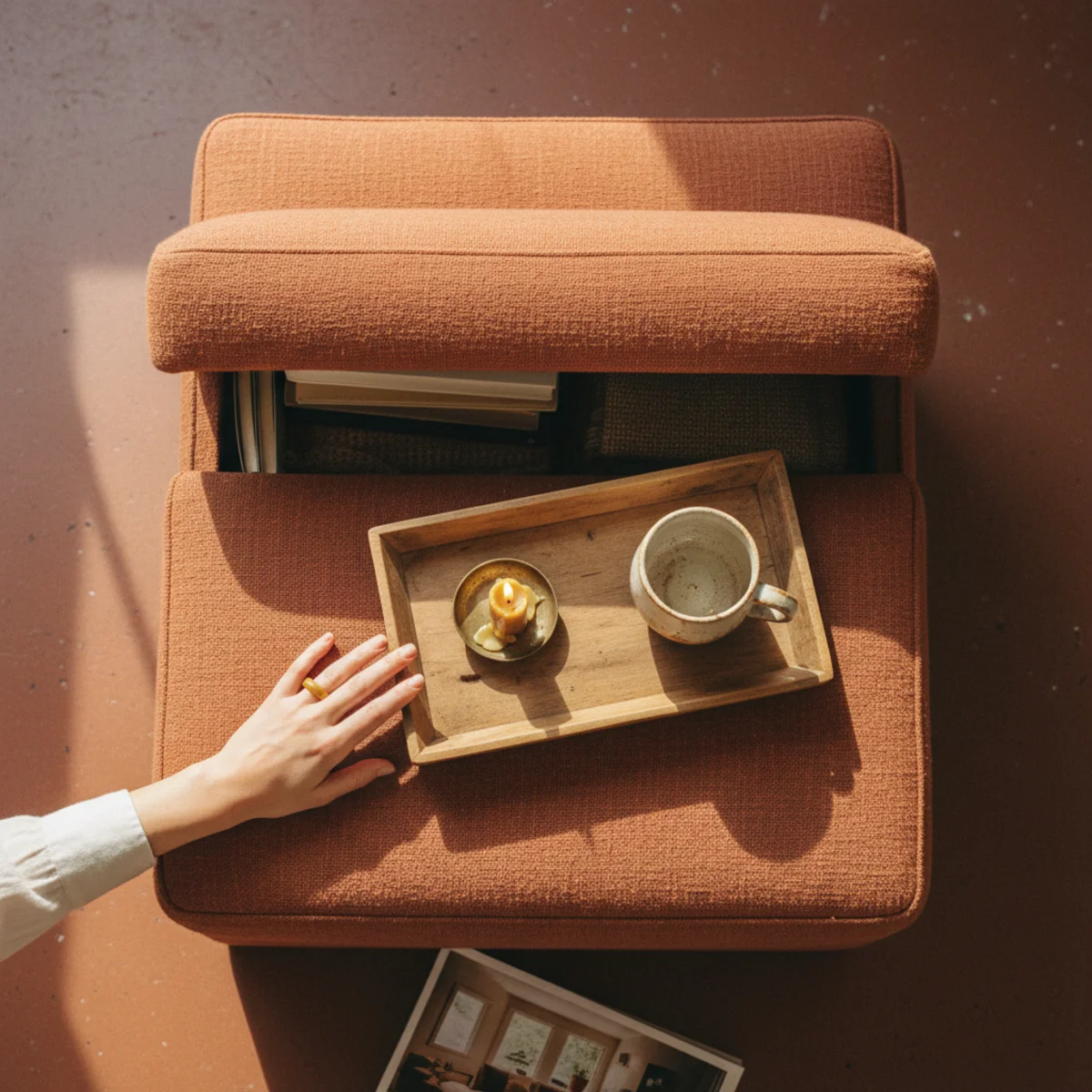
Small living rooms benefit from double-duty furniture, and the storage ottoman is the single highest-leverage example — it functions as coffee table, footrest, occasional extra seating, and hidden storage for throws, books, or kid toys. A large soft ottoman replaces both a coffee table and a separate storage piece, saving 6 to 12 square feet of floor space.
Best small-living-room storage ottomans: large square or rectangular at 30 to 48 inches wide, 16 to 22 inches deep, 16 to 18 inches tall (standard coffee-table height). Upholstered in linen, leather, or boucle. Lid lifts to reveal storage. Sources: Article at $400 to $700, West Elm at $400 to $900, IKEA TUNDRA at $250, Pottery Barn at $400 to $800, secondhand at $80 to $250 from Marketplace. Add a wooden or rattan tray on top (12 to 16 inches across) for daily-use coffee-table function — drinks rest on the tray, not the upholstery. Inside: store wool throws, board games, kid toys, kept-but-rarely-used books.
AFFILIATE SLOTFURNITUREStorage ottoman 30-48 wide x 16-22 deep x 16-18 tall with wooden tray on topAdd affiliate URL when configuredWhy it works
Because the ottoman serves four functions (coffee table, footrest, extra seat, storage) where a coffee table serves one (surface). In a small room where every piece must earn floor space, the four-function ottoman is mathematically better than the one-function coffee table. The soft top also reads as more casual and inviting than a hard-edge wood or glass coffee table, which fits the cozy-warm-home aesthetic specifically.
Pro tip — Use the ottoman's storage for things you actively use but don't want to see daily — wool throws (pull one out when cold), board games, kid toys, last week's magazines. Don't use it for long-term storage (out-of-season clothes, archive boxes) because the inside becomes a black hole; rotate contents every few weeks.
Storage ottoman with tray on top — coffee table, footrest, extra seat, and hidden storage in one. See also: coffee-table function
05Go Vertical With a Tall Narrow Bookshelf
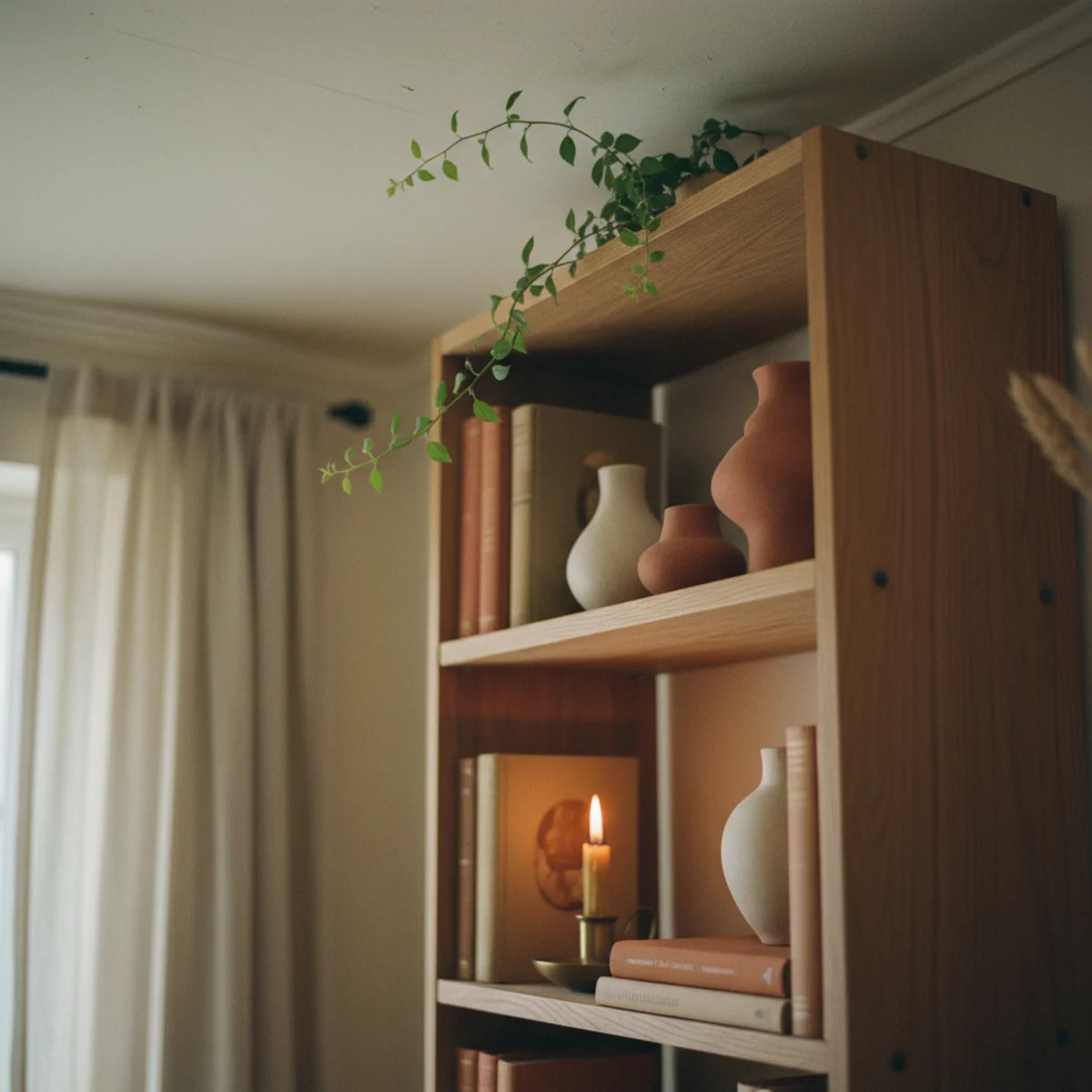
Small rooms have limited horizontal floor area but full vertical wall area — the move is going up rather than out. A tall narrow bookshelf (24 to 36 inches wide, 72 to 90 inches tall) holds the same number of books and styled objects as a wider lower bookshelf while occupying a third of the floor footprint. The vertical line also draws the eye upward, which makes the ceiling read higher and the room read larger.
Look for bookshelves 24 to 36 inches wide and 72 to 90 inches tall (taller than wide by at least 2:1 ratio). Solid wood reads warmer than particleboard; vintage oak or walnut at $80 to $250 from Marketplace and ReStore. IKEA BILLY 31-inch wide ($120) works for budget; West Elm Mid-Century tall narrow at $700 for mid-range. Position against a wall corner or beside a doorway. Anchor to the wall with included furniture-tip-prevention straps. Style with the shelf-styling rules: depth layering, odd numbers, third-empty rule, repeated material across shelves.
AFFILIATE SLOTFURNITURETall narrow bookshelf 24-36 inches wide, 72-90 inches tall, in solid woodAdd affiliate URL when configuredWhy it works
Because floor space is the constraint in small rooms; wall space typically isn't. A tall narrow bookshelf consumes 3 to 4 square feet of floor area while providing 30 to 60 square feet of usable shelf surface — the highest floor-to-storage ratio of any furniture. A wide low bookshelf at the same total shelf area consumes 8 to 12 square feet of floor, double or triple the footprint. In small rooms, every square foot of floor matters; vertical furniture is the way to use wall area instead.
Pro tip — Pair the tall narrow bookshelf with a tall narrow plant (a fiddle leaf fig at 5 to 7 feet, or a snake plant at 3 to 4 feet) — the matched vertical lines reinforce the upward visual movement and make the whole room read taller. Two tall narrow elements work better than one for this trick.
Thirty inches wide, eighty-four inches tall — vertical storage that uses wall space instead of floor. See also: shelf-styling rules
06Commit to One Warm Deep Color
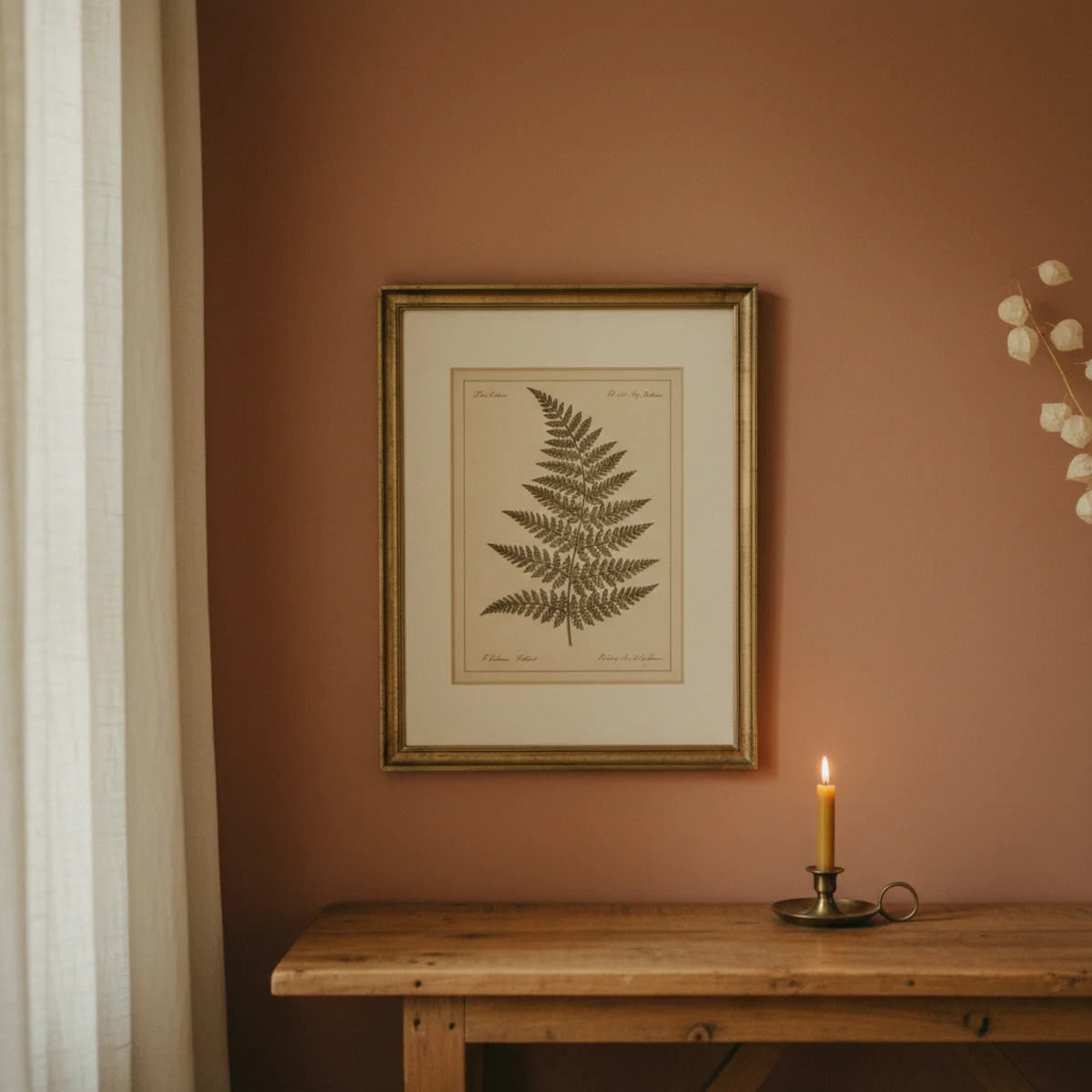
Small rooms benefit from going darker, not lighter — counterintuitive but consistently true. A warm deep color (terracotta, deep olive, warm charcoal, plaster pink) on all four walls plus ceiling creates a cocoon effect that reads larger and more intentional than a small white room would. Light walls in small rooms create high contrast at every corner; dark warm walls absorb the corners and dissolve the boundaries.
Best deep warm colors for small rooms: Farrow & Ball Setting Plaster 231 (plaster pink), F&B Bancha 298 (deep olive), Benjamin Moore Kendall Charcoal HC-166 (warm charcoal), F&B Down Pipe 26 (warm gray-charcoal), BM Cinnamon Slate AF-575 (terracotta). All have LRV between 6 and 30, providing the cocoon effect. Apply to all four walls plus ceiling (skip the white ceiling instinct here especially). Pair with warm-cream trim (BM White Dove), warm wood furniture, and 2700K lighting at multiple low heights. Avoid: cool grays, stark whites, blue-undertone deep colors.
AFFILIATE SLOTPAINTWarm deep color (Setting Plaster, Bancha, Kendall Charcoal) on all four walls + ceilingAdd affiliate URL when configuredWhy it works
Because dark walls absorb the visual edges of the room — the corners disappear into the dark color, and the eye reads the space as continuous rather than chopped. Light walls in small rooms create high contrast at every edge (wall meets ceiling meets floor meets trim), which actually makes the room feel smaller by emphasizing its boundaries. The warm charcoal cocoon trick was used in 18th-century snug rooms for exactly this reason — small spaces become more intimate, not smaller.
Pro tip — Paint the ceiling in the same warm deep color as the walls — most homeowners instinctively leave the ceiling white to make small rooms feel taller, but the white ceiling in a dark-walled room creates a hard horizontal break that emphasizes the room's smallness. Painting ceiling and walls together blurs the boundary completely.
Setting Plaster on every surface, warm lamps below — small rooms feel bigger when painted dark and warm. See also: warm charcoal
07Keep One Clear Sightline From the Door
Walk into your small living room and notice what your eye lands on first — that sightline determines how the whole room reads. The fix: keep one clear visual path from the entry point all the way to the opposite wall, with no large piece blocking it. The clear sightline reads as open space; a blocked sightline reads as cramped regardless of actual square footage.
Stand in your entry doorway and look across the room. Identify the longest possible sightline (typically to the opposite wall or window). Make sure no large piece (sofa back, bookshelf, console) blocks this line at eye level. If a piece does block, move it to the side — even a few inches of repositioning can open the sightline. Use leggy furniture (you can see under it) along the sightline so the visual path stays clear at floor and seat level. Keep the wall at the end of the sightline minimally styled — one piece of art, a mirror, or a window with a single curtain panel — so the eye has a clear destination.
AFFILIATE SLOTARRANGEMENTClear visual sightline from doorway to opposite wall, no large pieces blocking eye levelAdd affiliate URL when configuredWhy it works
Because the first visual impression on entering a room sets the brain's expectation for the room's size, and a clear sightline tells the brain 'spacious' before the eye has registered the actual square footage. Blocked sightlines tell the brain 'cramped' immediately, and no amount of beautiful styling within the room can overcome that first impression. The sightline is the small-living-room equivalent of the first sentence of a book — it sets everything that follows.
Pro tip — Photograph your room from the entry doorway and look at the photo critically — the camera reveals blocked sightlines more honestly than in-person viewing. If the photo looks cramped from the doorway, the room reads cramped to anyone entering. Adjust furniture positions until the doorway photo reads open, even if it means slightly less convenient placement within the room itself.
Clear sightline from the doorway — the first visual impression that tells the brain 'spacious' before square footage. See also: leggy furniture
08Add a Console Behind the Sofa
A narrow console behind a floating sofa adds horizontal surface area (for lamps, plants, small objects) without consuming additional floor space — the console occupies the gap that already exists behind the sofa rather than blocking new floor. The console also visually separates the sofa zone from anything behind it, which clarifies how the room reads spatially.
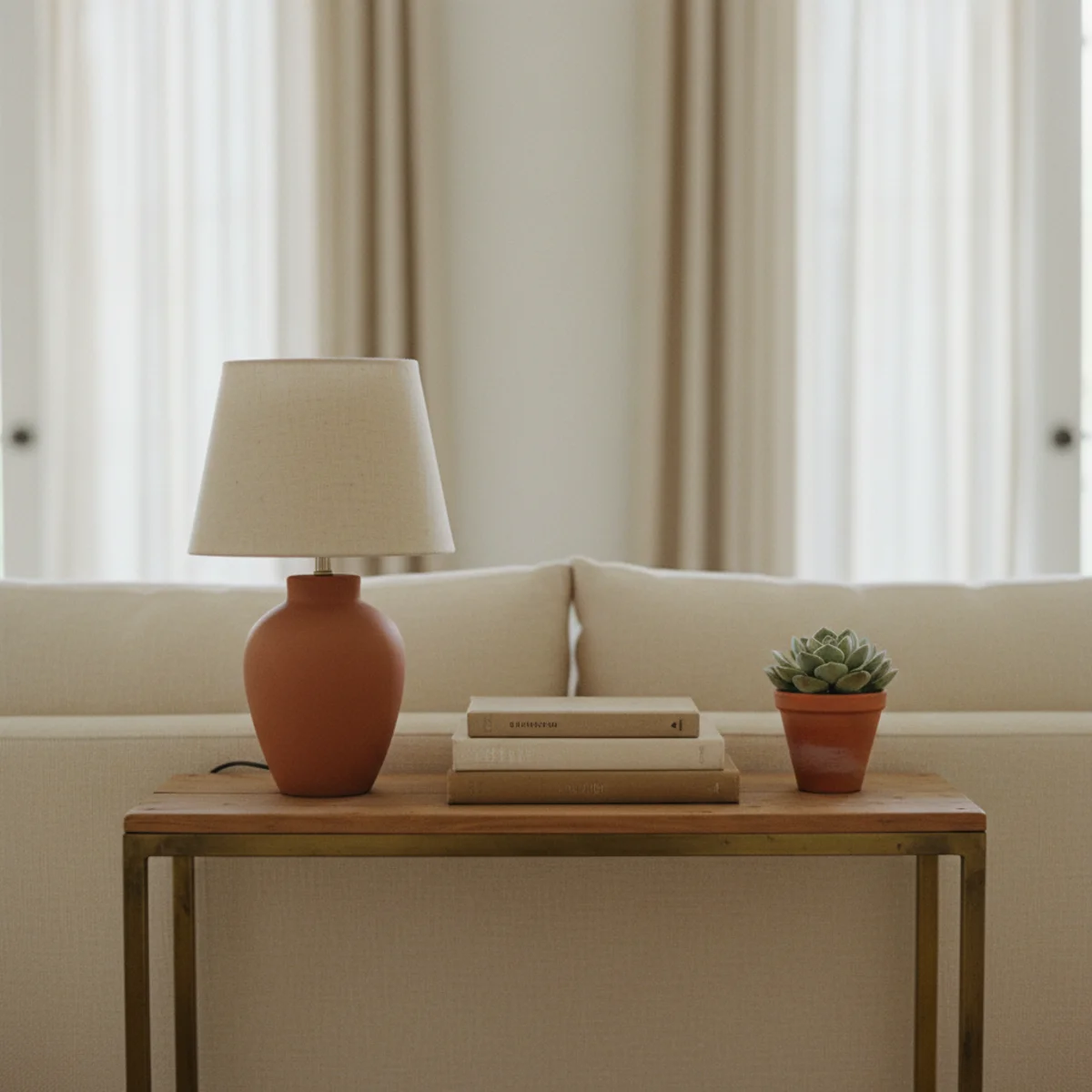
Look for narrow consoles 10 to 14 inches deep (no deeper — the sofa needs to remain the primary visual zone), 60 to 84 inches wide (matching sofa length), 30 to 36 inches tall (just slightly higher than sofa back). Materials: warm wood (oak, walnut), brass-and-glass, or rattan-frame. Sources: Article at $400 to $700, West Elm narrow consoles at $300 to $600, IKEA EKBY shelf + brackets DIY at $80, vintage at $80 to $200 from Marketplace. Style on top with two table lamps (one at each end), a small plant or sculptural object in the center, and 30 to 40% of surface left empty (per the shelf-styling third-empty rule).
AFFILIATE SLOTFURNITURENarrow console 10-14 inches deep, 60-84 inches wide, 30-36 inches tall behind sofaAdd affiliate URL when configuredWhy it works
Because the gap behind a floating sofa is otherwise wasted vertical space — a console fills it productively with surface area for lamps and styled objects without taking new floor. The console also enables the two-lamp pair behind the sofa (instead of two end-tables on either side, which would consume more floor), which is the standard cozy-living-room lighting setup. In small rooms, every furniture decision should serve multiple functions; the console behind the sofa is one of the best examples.
Pro tip — Use the console as the foundation for two matched lamps and a small plant on the center — the symmetric trio reads as deliberate styling and provides the warm-light layer the room needs. The pair-and-center arrangement also leaves the console functional (you can set keys, mail, or drinks on it) without breaking the styling.
Narrow console behind the sofa, two lamps and a plant on top — surface area without consuming new floor. See also: third-empty rule
09Choose Furniture With Soft Rounded Edges
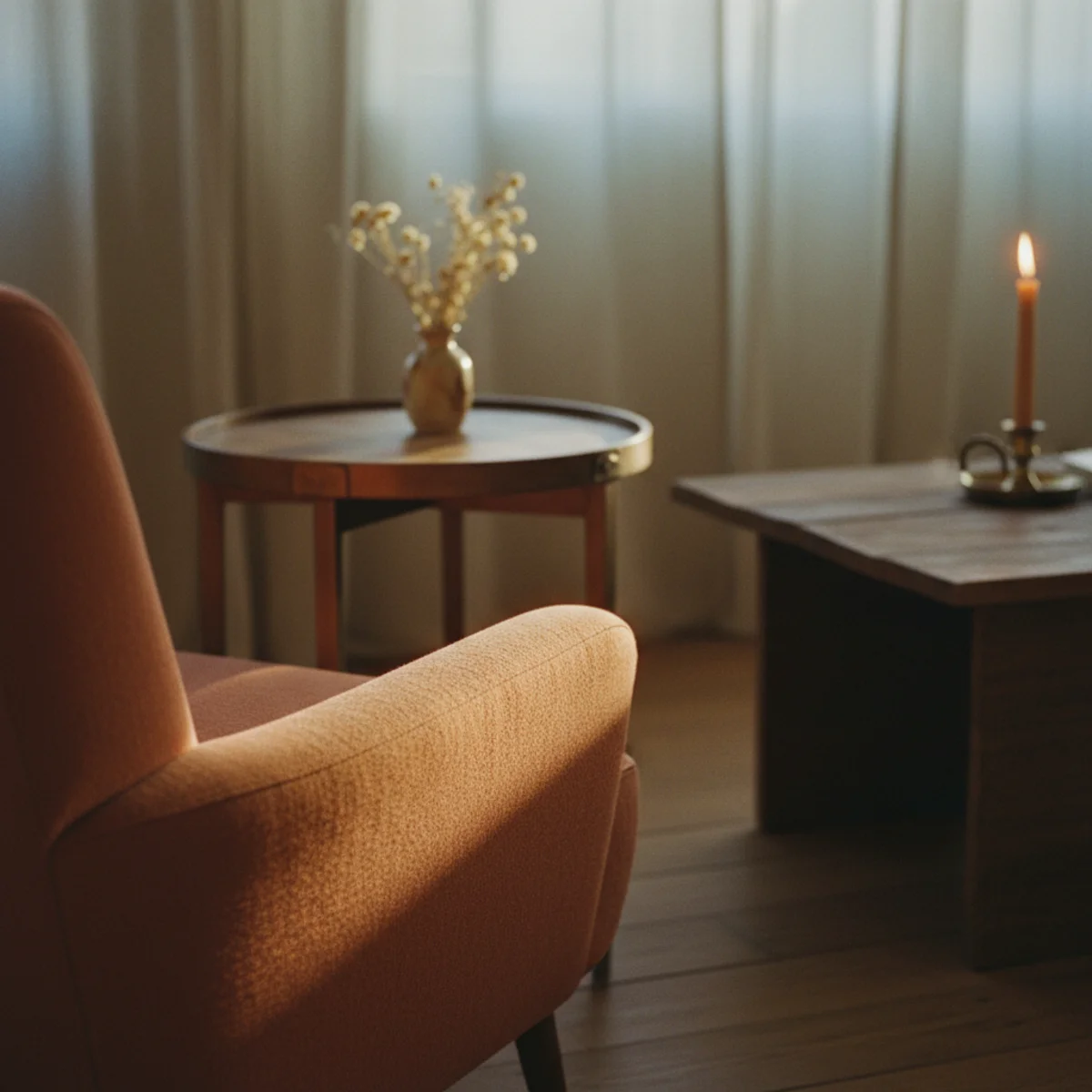
Small rooms feel cramped when furniture has hard sharp corners — every angle creates a visual interruption. The fix is choosing one or two pieces with rounded or curved edges (a round side table, a curved-back chair, a rounded ottoman) to soften the visual angles. The curve break in the otherwise rectangular room reads as easier and more inviting, even though the actual square footage hasn't changed.
Add one or two pieces with rounded edges per small room: a round or oval coffee table or ottoman (24 to 36 inches across), a curved-back armchair (West Elm Cooper at $1,200, Article Sven Curve at $900, IKEA STRANDMON curved at $250), a rounded floor lamp base, a circular side table. Mix rounded pieces with rectangular ones — don't go all-curves (looks themed) or all-angles (feels harsh). The single curved piece in an otherwise rectangular room is the move; multiple curved pieces compete.
AFFILIATE SLOTFURNITURE1-2 rounded-edge pieces: round coffee table, curved chair, round side tableAdd affiliate URL when configuredWhy it works
Because hard angles create visual interruption points where the eye stops scanning; rounded edges let the eye flow continuously around the piece. In a small room with many furniture pieces close together, the cumulative effect of multiple hard angles reads as cluttered, even when the pieces themselves are well-designed. One or two rounded edges break the visual rigidity and create the kind of soft flow that small rooms specifically benefit from.
Pro tip — If you can't afford a new rounded-edge piece, swap one existing rectangular coffee table for a vintage round wooden one from Marketplace at $40 to $120 — the round shape transforms the room's flow more dramatically than the cost suggests. Round coffee tables also enable more flexible seating arrangements; people can sit at any angle without facing a corner.
One round coffee table, one curved chair — the soft edges that break visual rigidity in a small room. See also: vintage round wooden
10Layer a Small Rug Over a Larger Jute
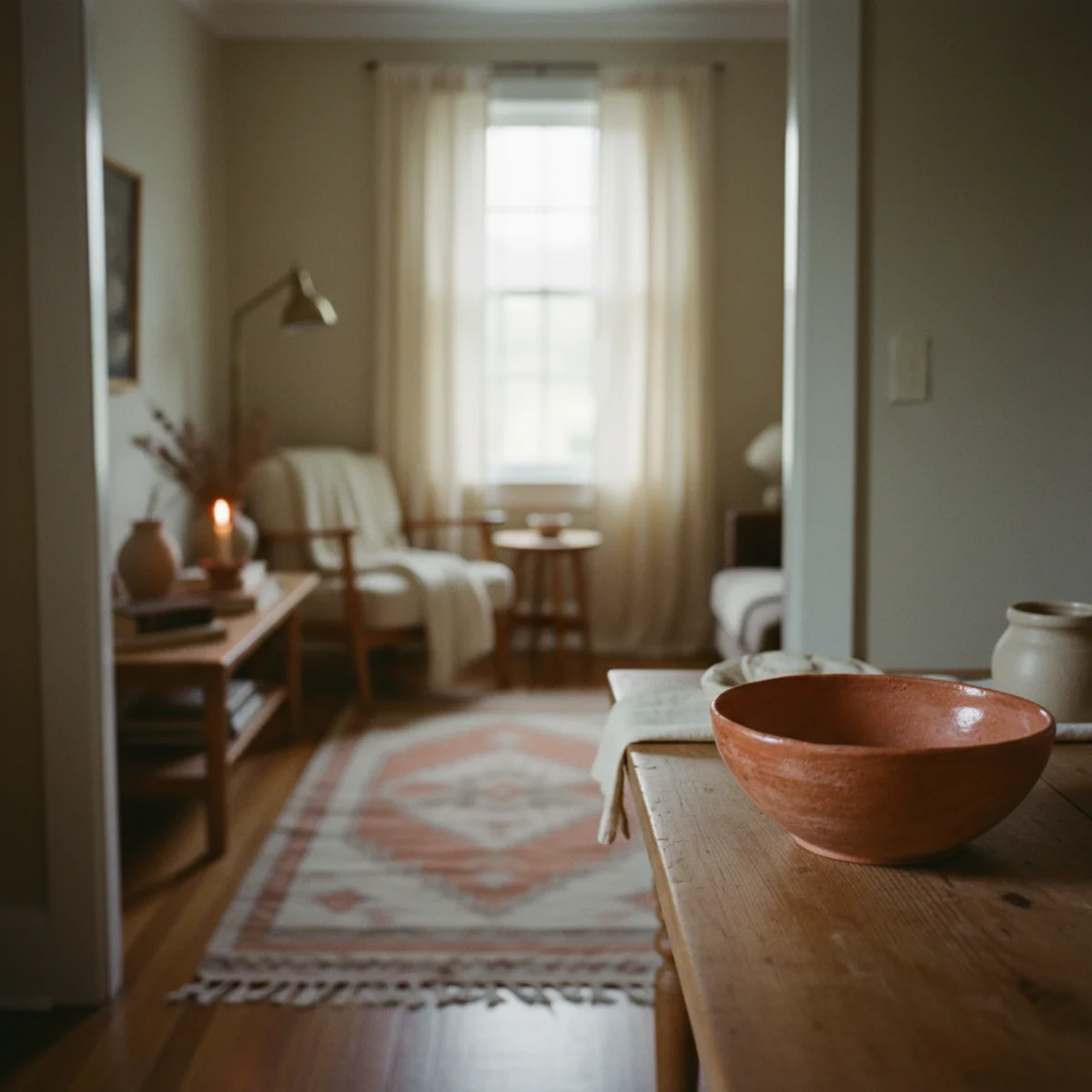
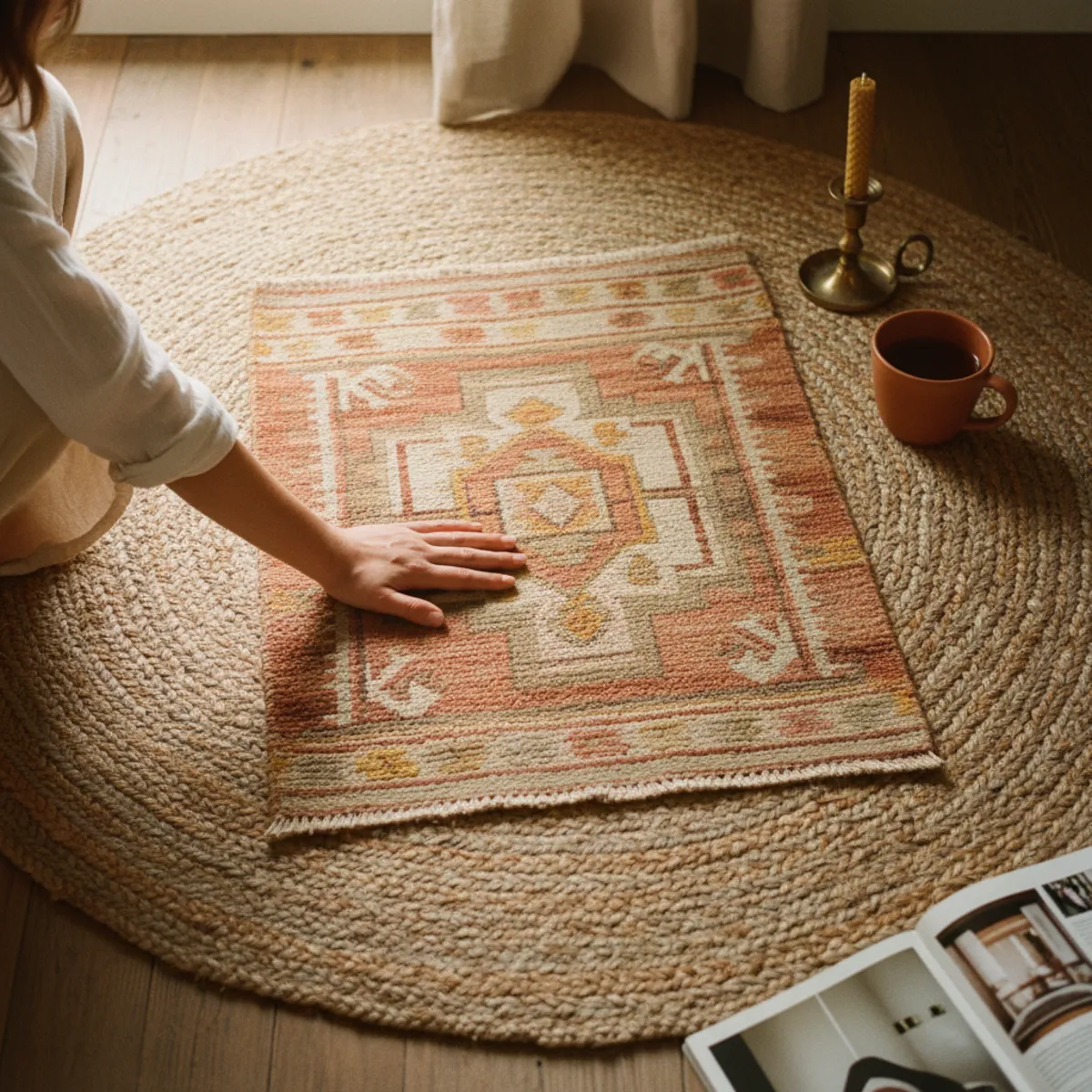
Small living rooms benefit from layered rugs — a larger jute or natural-fiber rug as the base (extending under all furniture) plus a smaller vintage Persian or wool rug layered on top (defining the seating zone). The layering reads more designed than a single rug and creates visual depth through texture and pattern interplay. Cost: $200 to $500 for both rugs versus $600 to $1,500 for a single large quality rug.
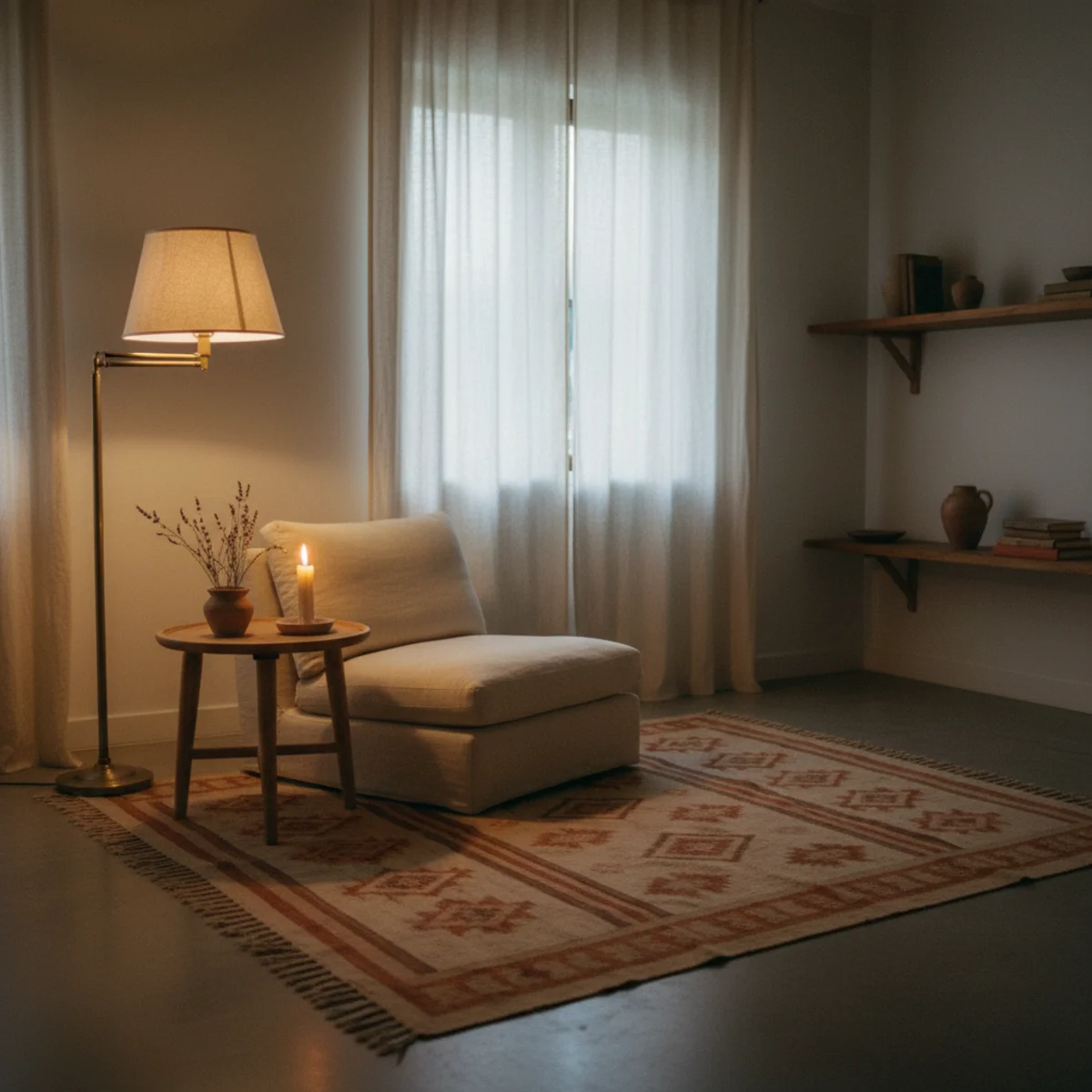
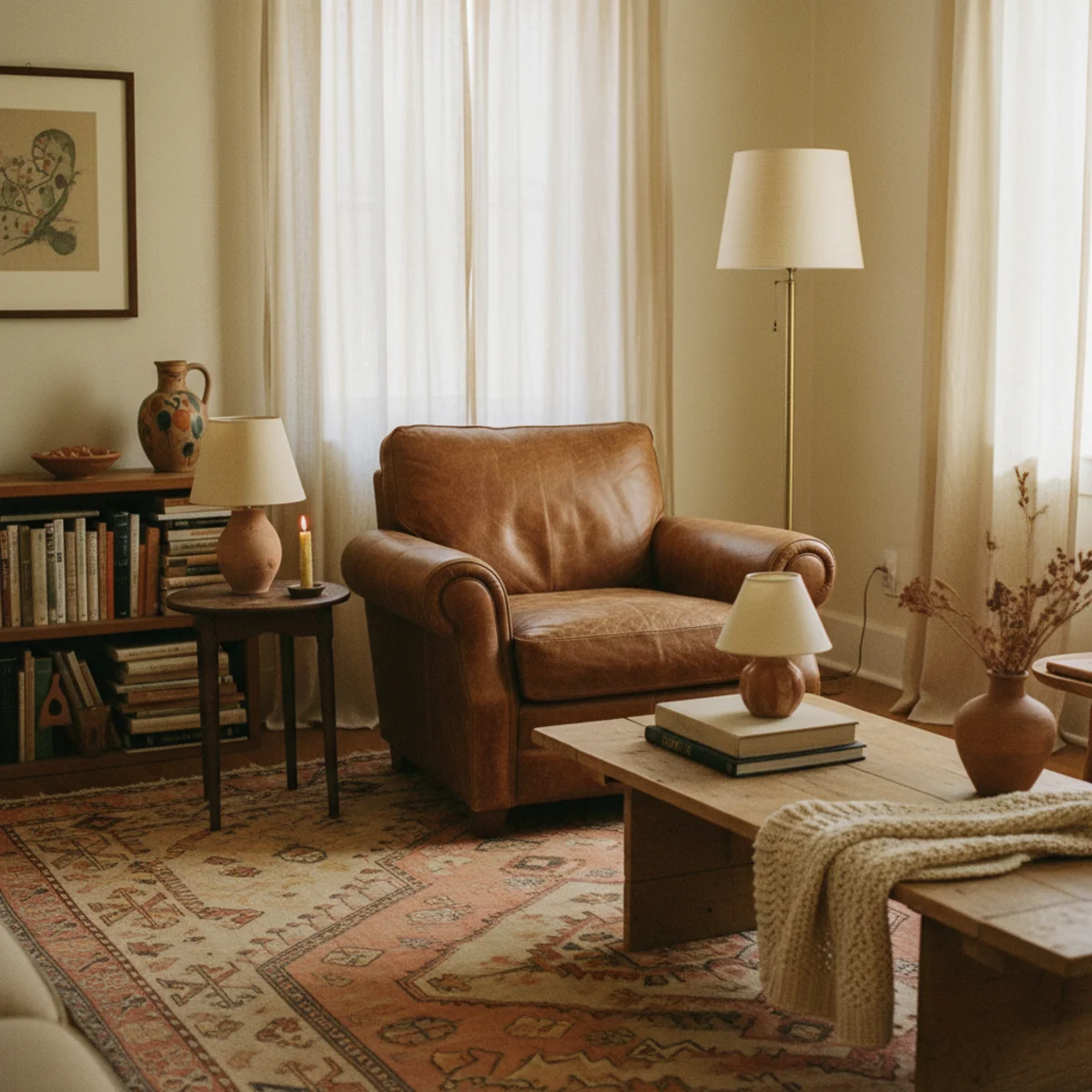
Base rug: jute, sisal, or natural-fiber at 8x10 or 9x12 ($80 to $250 from Rugs USA, Annie Selke, or Pottery Barn). Position to extend under at least the front legs of all major furniture (sofa, chairs). Top rug: vintage Persian, kilim, or wool at 5x7 or 6x9 ($150 to $400 from Marketplace, $400 to $1,000 from vintage dealers). Layer the smaller rug centered on the base rug, leaving 12 to 24 inches of base rug visible on each side. The pattern, color, and texture of the top rug contrasts with the natural fiber base creating visual interest and depth.
AFFILIATE SLOTFLOORJute or sisal base rug 8x10/9x12 + vintage wool or Persian 5x7/6x9 layered on topAdd affiliate URL when configuredWhy it works
Because layered rugs add visual depth and texture without adding furniture — the small rooms's primary constraint. The natural-fiber base extends the visual rug area to cover the full seating zone (which helps the room feel grounded), while the smaller top rug adds the pattern and warmth that pure jute can't provide. The combination delivers what a single rug delivers in a larger room, scaled appropriately for small-room budgets and proportions.
Pro tip — Layer a black-and-white vintage kilim over a jute base for a high-contrast look that works in many small rooms — the natural jute reads neutral, while the kilim adds the pattern and personality that anchors the seating zone. The combination is far cheaper than a single statement rug at the same effect.
Jute base, Persian layer on top — depth and warmth at half the cost of a single large quality rug. See also: vintage Persian
11Hang Art a Touch Lower
Standard art-hanging height (57 inches to the center) was designed for large gallery spaces with high ceilings — in small living rooms with standard 8-foot ceilings, the textbook height hangs too high. The fix: drop art 4 to 6 inches lower than standard, anchoring to 51 to 53 inches center. The lower position reads more grounded, fills the wall space better proportionally, and creates a tighter relationship between art and furniture.
For art above furniture (sofa, console, dresser): hang the bottom edge of the frame 6 to 12 inches above the furniture, regardless of standard centering rules. For art on bare walls without furniture below: center at 51 to 53 inches above the floor (about 4 to 6 inches lower than the standard 57 inches). The lower position is also more comfortable for seated viewing (sofa height) than standard hanging height. Use the rule across all art in small rooms; let textbook 57-inch hanging stay in larger spaces with taller ceilings.
AFFILIATE SLOTARTHang art 6-12 inches above furniture, center 51-53 inches above floor for bare wallsAdd affiliate URL when configuredWhy it works
Because small rooms have shorter sightlines (less distance between viewer and wall), which means art at standard height appears higher relative to the eye's natural rest position. Lowering art 4 to 6 inches brings it back into the natural sightline. The lower position also creates a tighter visual relationship between furniture and the art above it — a 12-inch gap reads cohesive, a 24-inch gap reads disconnected. Small rooms can't afford disconnected vertical layers.
Pro tip — Use blue painter's tape to outline the planned art position on the wall before driving any nails — the tape lets you stand back, see the proportion, and adjust the height by inches without making any holes. After 24 hours of looking at the tape outline from various seating positions, you'll know the right final height.
Art at 52 inches center, 8 inches above sofa — the lower hanging that reads grounded in small rooms. See also: standard art-hanging height
12Limit the Palette to Three Warm Tones
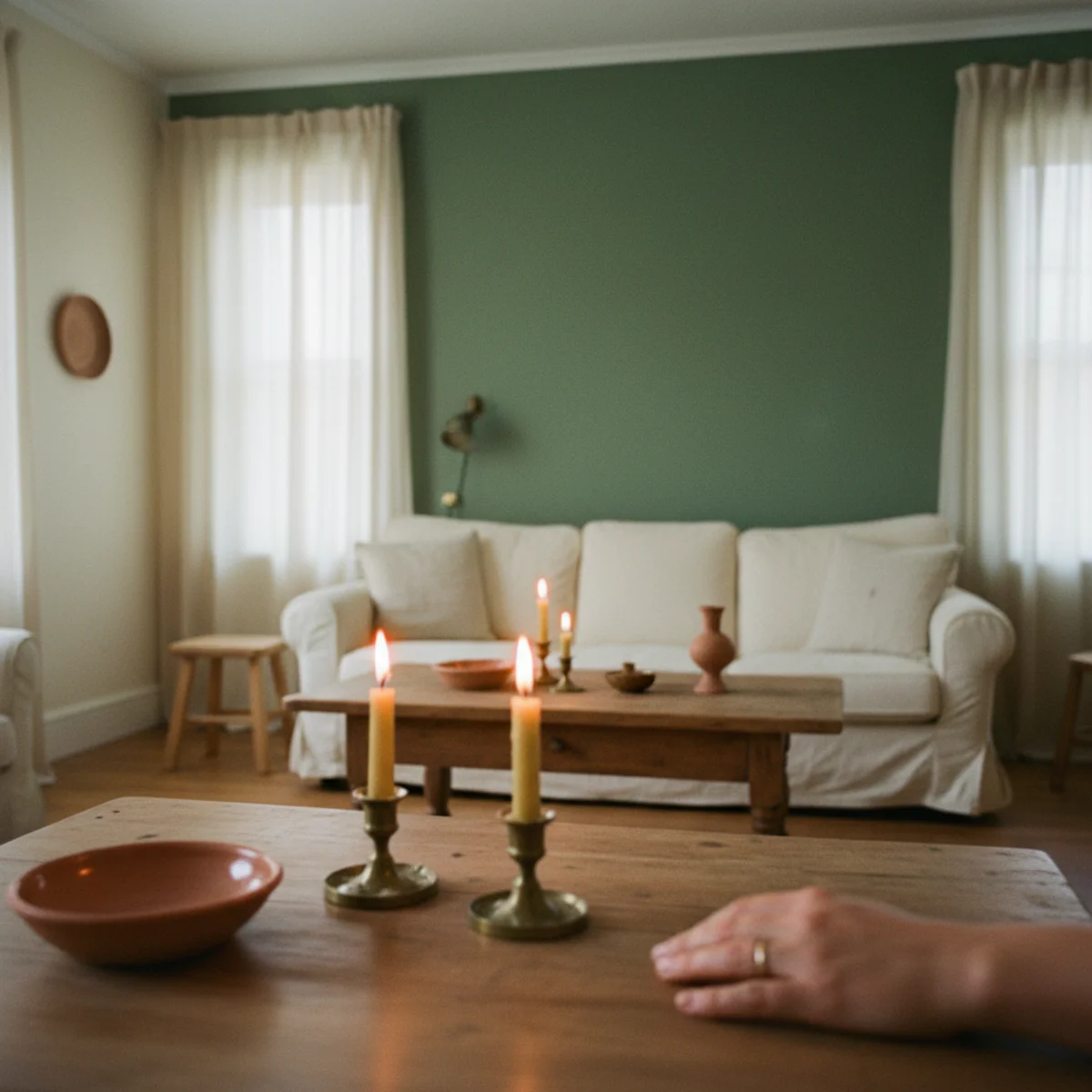
Small living rooms feel calmer when restricted to three warm tones across the entire room — typically a primary neutral (cream, oat), a secondary warmer tone (terracotta, sage, navy), and a wood-and-brass tone for furniture and accents. More than three tones in a small room creates visual chaos that the limited space cannot absorb; fewer than three reads monotonous.
The three-tone palette for small rooms: PRIMARY NEUTRAL (60 to 70% of visible color) — cream, oat, or warm white walls and large upholstery. SECONDARY ACCENT (20 to 30%) — one saturated warm tone applied across two or three small pieces (rust cushion, sage ceramic, navy throw). WOOD-AND-BRASS (10 to 20%) — warm wood for furniture and frames, aged brass for hardware and lamp bases. Avoid: cool grays, bright whites, multiple saturated accent colors, mixed metal temperatures. Sticking to three tones keeps the room calm; expanding to five or six tones creates the visual noise small rooms specifically can't handle.
AFFILIATE SLOTPALETTEThree tones: primary neutral (60-70%) + secondary warm accent (20-30%) + wood/brass (10-20%)Add affiliate URL when configuredWhy it works
Because the human eye registers color information in any visible space, and small rooms compress more color into a tighter field of view. Five or six colors in a 200-square-foot room reads as chaotic; the same six colors in a 500-square-foot room reads as varied. Small rooms benefit from the discipline of three tones precisely because they can't absorb the visual complexity that larger rooms can. The constraint becomes the calm.
Pro tip — Identify your three tones explicitly before any styling decision — write them down on a small card and reference the card every time you consider adding a new piece. If the piece doesn't fit one of the three tones, it doesn't enter the room. The written discipline is the difference between intentional three-tone rooms and rooms that accidentally creep to five tones over time.
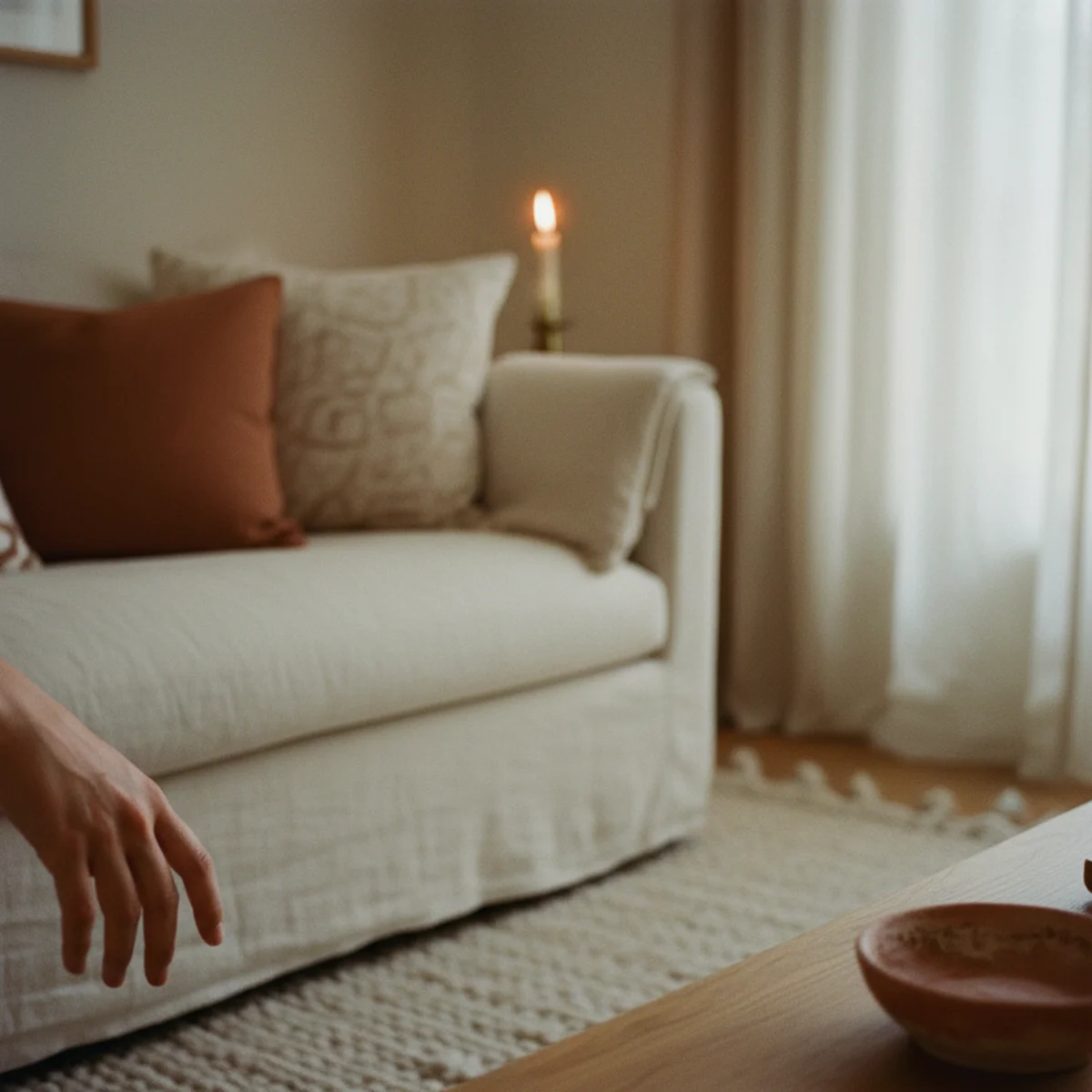
Cream, terracotta, oak — three tones, nothing more — the discipline that keeps small rooms visually calm. See also: warm tone
How to lay out a small living room
Layout is where small rooms are won or lost. Work through it in this order.
- 1Find the focal point
Decide what the room orients around — a window, a fireplace, or the TV — and arrange everything in relation to it. One focal point; two competing ones always feel chaotic.
- 2Place the largest piece first
Set the sofa against the longest uninterrupted wall, leaving at least 18 inches of total breathing room so it isn't wedged corner to corner.
- 3Create one clear walking path
Map the route from the door through the room and keep it about 30 inches wide. Furniture frames the path; it never blocks it.
- 4Anchor with a right-sized rug
Use a rug large enough that the front legs of the seating sit on it. A too-small rug is the most common small-room mistake.
Quick tips
- Match your lamp shades' bulb color across the room; mixed warm and cool light makes a small space feel disjointed.
- Keep the floor as clear as you can — every visible inch of rug or wood makes the room feel larger.
- Skip the matching furniture set; a collected mix at small scale reads as intentional, a showroom set reads as filler.
- Use glass or acrylic for one piece — a clear side table takes up visual zero space.
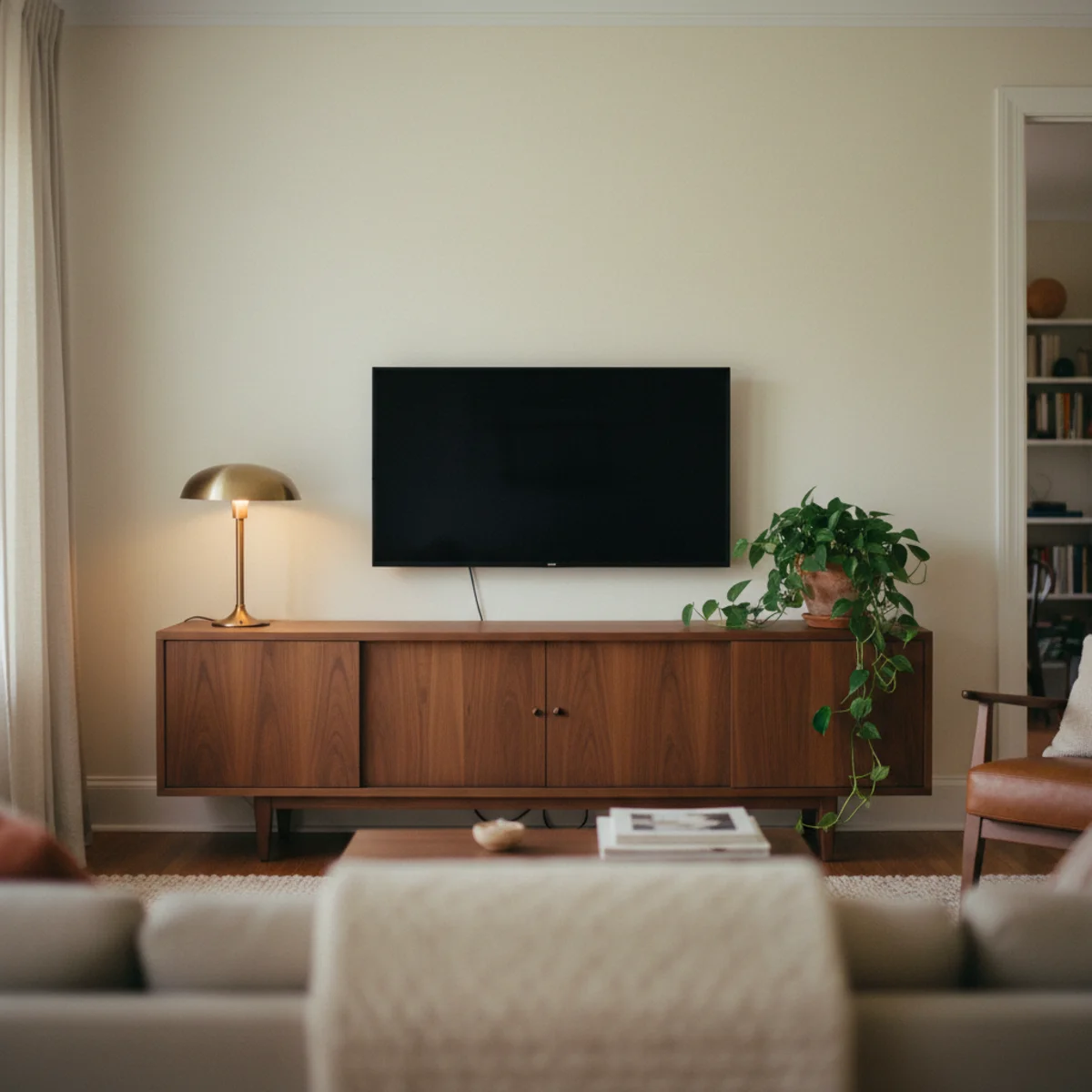
- Mount the TV and hide the cords rather than parking a bulky media console.
- Choose a sofa with storage under the seat if you can find one; small rooms need every hidden cubic inch.
Small living rooms by layout
Furniture along the long walls, a clear runway down the middle, nothing angled. Resist the urge to float a chair into the path.
A single sofa and one or two chairs pulled into a conversational cluster around a central ottoman.
A low bookshelf or console used as a room divider to define the living zone within the larger space.
Mount it low over a long, low console; our small living room with a TV guide covers the layout in full.
A small room doesn't want more furniture against the walls. It wants permission to breathe in the middle.
Frequently asked questions
How do I make a small living room look bigger?+
What's the best sofa for a small living room?+
Should I paint a small living room light or dark?+
How do I arrange furniture in a small living room?+
What kind of rug works best in a small living room?+
How do I make a small living room feel cozy without it feeling cramped?+
Start by removing, not adding. Take one piece of furniture out and live with the gap for a week — most small rooms feel instantly bigger. Then float the sofa, lift the curtains, and add one warm lamp at floor height. We'd spend on a single right-sized rug before anything else; it anchors the whole room and fixes the most common mistake in one move. Scaled right, a small living room can be the warmest room in the place.