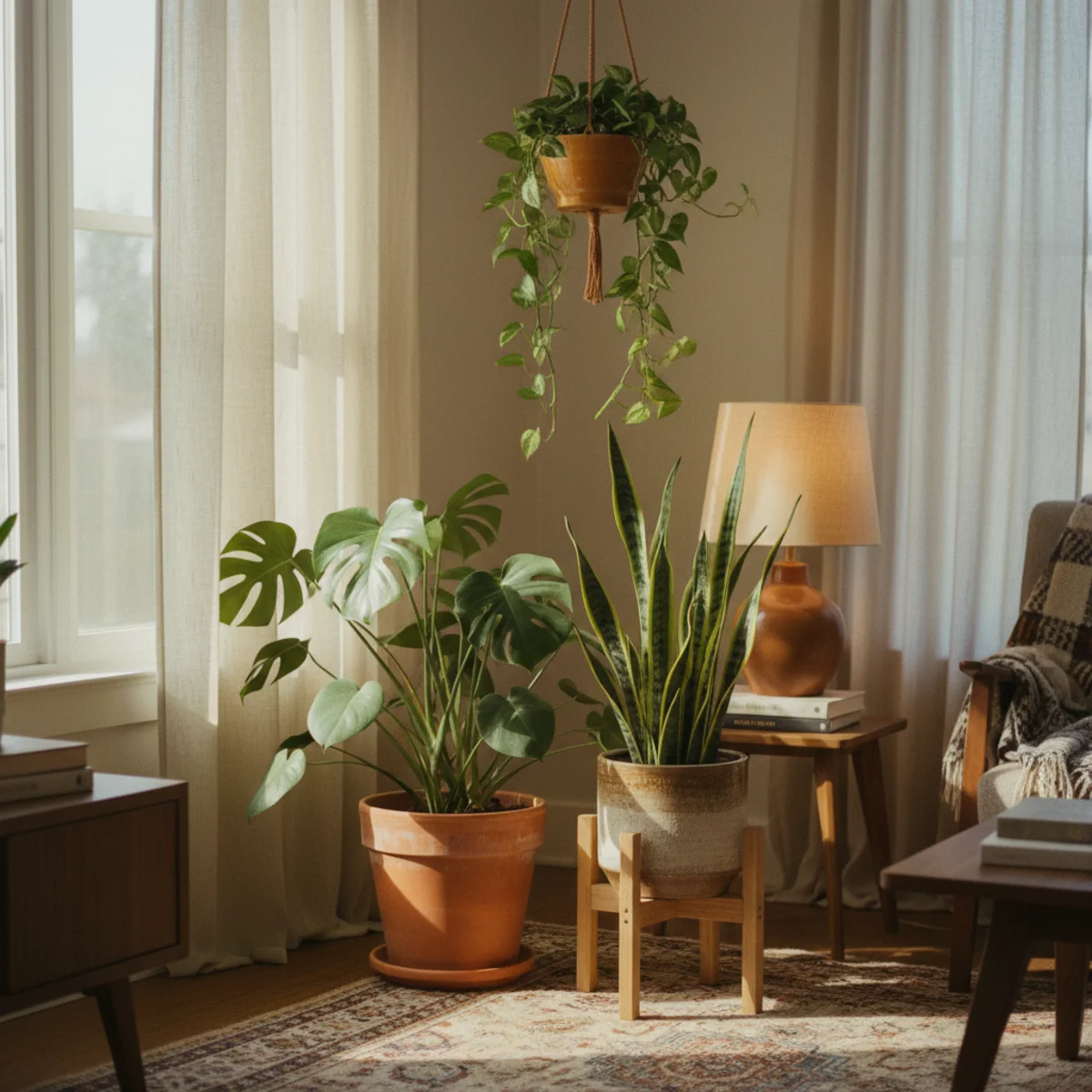
These twelve indoor plant corner principles apply across real homes with real light challenges — north-facing apartments that see no direct sun, south-facing rooms with intense summer light, east-facing bedrooms with gentle morning light, and dim interior corners with only artificial light. Each principle names specific plants for each condition, specific pot choices, specific grouping rules, and the maintenance practices that keep the corner thriving rather than declining across seasons.
Most indoor plant corner failures come from starting with the aesthetic rather than the light — buying gorgeous trailing monsteras for a north-facing dim corner where they'll decline within months, or filling a sunny window corner with shade plants that bleach within weeks. The light assessment must come first; every other decision follows from what the corner can actually support.
By the end of this guide, you'll know how to build and maintain an indoor plant corner — from grouping plants in a cluster and varying heights, through choosing for your actual light first, adding a trailing plant up high, using warm-toned pots, anchoring with one big floor plant, adding a plant stand, mixing leaf shapes, keeping near the light source, establishing a watering routine, layering in a warm lamp, and choosing for low maintenance.
WHAT'S INSIDE
- Why grouping plants in a cluster produces more visual impact than the same plants scattered
- Choosing for your actual light condition first — the decision that determines whether plants live or die
- The warm-toned pot principle — how terracotta and ceramic affect the corner's aesthetic temperature
- The watering routine (not guesswork) that keeps plants thriving rather than slowly declining
Plants grouped together look lush and intentional, and they're happier too — the shared humidity helps. A cluster beats scattered pots every time.
— House Beautiful [citation needed — verify before publish]
What makes a good plant corner?
A good plant corner groups several plants of varied height and form in one spot, in warm-toned pots, positioned to match the light the corner actually gets. Grouping is the key move: a cluster reads lush and intentional where scattered single plants read as afterthoughts, and grouped plants share humidity, which keeps them healthier too.
The other half is honest plant selection. The fastest way to kill a plant corner is to choose plants for looks rather than for the light you have — a sun-lover in a dim corner, or a shade plant in a hot window, will slowly fail. Match the plants to the corner's real conditions, group them at staggered heights with a trailing one up high and a floor plant anchoring below, warm them with terracotta and woven pots, and the corner stays green with little effort.
More in Cozy Corners you may love
See allWhy plant corners are everywhere in 2026
Houseplants stayed central to the warm, natural home, and the styled plant corner — a lush grouping rather than scattered single pots — became the way people bring greenery in. Pinterest's indoor plant and plant corner searches climb steadily, toward grouped, layered, warm-potted displays.
The honest appeal is that plants add life, soften hard rooms, and connect a home to nature cheaply — and grouping them solves the two problems of scattered houseplants: they look haphazard and they're harder to care for. A dedicated corner, chosen for its light and styled as a cluster, looks lusher, cares easier, and turns an awkward corner into a living focal point. It's the cozy corner that grows.
20 indoor plant corner ideas
01Group Plants in a Cluster
The most-important plant corner composition principle: group plants in a cluster rather than distributing them across the room. Five plants grouped within a 3-foot-diameter zone read as a composed botanical corner; the same five plants scattered across the room read as random greenery. The cluster creates the room's green zone — a distinct area that functions as a visual focal point.
Plant cluster composition: ZONE SIZE — 2 to 4 feet in diameter for a typical corner cluster. Can extend slightly larger for rooms with ample floor space. BOUNDARY — the cluster's informal boundary is defined by the plants' outer leaves reaching toward each other. A well-composed cluster has leaf overlap between plants; isolated plants with gaps between them read as separate objects rather than as cluster. PLANT COUNT — 5 to 12 plants for a full corner cluster. Under 5 reads as sparse; over 12 often becomes unmanageable without significant space. ARRANGEMENT WITHIN CLUSTER — taller plants at back or center (depending on viewing angle), smaller plants at front and sides, trailing plants at elevated position with vines falling into the cluster. HOW TO POSITION — start with the largest plant (typically the floor plant per item 6), then arrange smaller plants in progressively smaller sizes around it, tucking plants toward each other so leaves nearly touch neighbors. VISUAL GOAL — from the primary viewing angle (entering the room or from primary seating), the cluster should read as one green mass with varied heights and textures, not as individual plants with gaps between them.
AFFILIATE SLOTCOMPOSITION5-12 plants grouped in 2-4 foot diameter cluster with leaf overlap; largest at back/center, smallest at front, trailing plants elevatedAdd affiliate URL when configuredWhy it works
Because clustering creates critical mass — the visual impression of a garden corner or jungle moment that no individual plant achieves alone. A cluster of 7 plants creates a verdant zone that draws the eye; 7 plants scattered create background greenery that the eye processes as decoration rather than as focal point. The microclimate benefit of clustering (grouped plants raise local humidity, which benefits most tropical houseplants) also makes the plants healthier in clusters than in isolation — the aesthetics and the plant health reinforce each other.
Pro tip — Arrange the cluster before filling any pots permanently — position all plants (in their nursery containers or existing pots) in the intended cluster zone and assess the composition for 24-48 hours before potting or purchasing additional plants. The trial arrangement reveals which heights and sizes are missing before you commit to any purchases.
Eight plants grouped in 3-foot zone with overlapping leaves — the cluster that reads as botanical corner rather than scattered greenery. See also: cottagecore-decor
02Vary the Heights
A successful plant cluster has at least three height levels — floor level (plants 1-2 feet tall on the floor), mid-height (plants 2-4 feet tall on stands or naturally taller), and elevated (plants 3-6 feet in height or trailing plants hung from ceiling or high shelf). The three-height composition creates visual depth and journey that single-height groupings miss.
Three-height plant cluster: LOW LEVEL (floor, 0-24 inches tall) — small pothos in terracotta, small snake plant, small ferns, small succulents in ceramic pots. These hug the floor and define the cluster's base. MID LEVEL (24-48 inches) — ZZ plants, medium snake plants, medium monstera, prayer plants, peace lily. These are the cluster's primary visual body. HIGH LEVEL (48+ inches) — tall snake plant or sansevieria (4-6 feet), tall dracaena, tall fiddle-leaf fig, or the floor plant (per item 6) at 4-7 feet. These create the upper visual boundary of the cluster. ELEVATED/TRAILING — trailing pothos or heartleaf philodendron in hanging planter at 5-7 feet, vines cascading downward through the cluster (per item 4). HOW TO ACHIEVE HEIGHT VARIATION — use plant stands (per item 7) to elevate smaller plants to mid-height, natural plant growth for taller specimens, hanging planters for elevated trailing plants. The height variation doesn't require all-tall plants — a cluster with one tall plant, several medium plants, and some small pots on a stand achieves the three-level composition as effectively as a cluster of naturally varied-height plants.
AFFILIATE SLOTCOMPOSITIONThree height levels: low (0-24 inches on floor), mid (24-48 inches), high (48+ or trailing elevated at 5-7 feet)Add affiliate URL when configuredWhy it works
Because the three-level height structure creates the visual journey that flat-height groupings miss — the eye travels from small pots at floor level, up through medium plants, to the tall floor plant or trailing vine at peak height. This vertical journey reads as garden abundance where same-height plants read as flat display. The height also creates the layering that makes plant clusters feel like they occupy genuine three-dimensional space rather than sitting on a two-dimensional floor plane.
Pro tip — Use plant stands (per item 7) to create height variation from plants you already own — a small pothos on an 18-inch stand reads at the same cluster height as a naturally 18-inch-tall plant but from any nursery-size starter pot. The stand strategy lets you build height variation without waiting for plants to grow into their final heights.
Three height levels from floor to tall — the vertical journey that makes plant clusters read as garden abundance. See also: reading-nook-ideas
03Choose for Your Light First
Before buying any plant, assess your corner's actual light level. This is the single most-important plant corner decision — the right plant in the right light thrives without special care; the wrong plant in wrong light declines regardless of watering attention. North-facing rooms need low-light specialists; south-facing rooms can support most plants; east and west-facing are intermediate.
Light assessment and plant matching: NORTH-FACING or INTERIOR ROOMS (no direct sun, low ambient light) — BEST PLANTS: pothos (Epipremnum aureum) survives in genuinely low light, ZZ plant (Zamioculcas zamiifolia) handles extreme low light, cast-iron plant (Aspidistra), peace lily (Spathiphyllum), snake plant (Sansevieria) low-to-medium light. EAST-FACING (gentle morning sun 1-3 hours) — BEST PLANTS: all low-light plants above, plus maidenhair fern, Boston fern, prayer plant (Maranta), calathea, spider plant. WEST-FACING (afternoon sun 2-4 hours) — BEST PLANTS: pothos, snake plant, ZZ, monstera, heartleaf philodendron, hoya. SOUTH-FACING (bright direct light) — BEST PLANTS: all of the above, plus succulents, cacti, rubber plant, fiddle-leaf fig, olive tree, Bird of Paradise, most tropical plants. LIGHT TEST — hold your hand 12 inches above a white piece of paper on the floor of the intended corner. CLEAR SHARP SHADOW: bright direct light. FUZZY SOFT SHADOW: medium indirect light. NO SHADOW VISIBLE: low light. Choose plants accordingly. THE MOST-COMMON FAILURE: buying aspirational plants (large monsteras, fiddle-leaf figs) for genuinely low-light corners where they will decline.
AFFILIATE SLOTFOUNDATIONLight test before buying: north/low-light use pothos/ZZ/sansevieria; east/medium use ferns/calathea; south/bright support all including monstera/fiddle-leafAdd affiliate URL when configuredWhy it works
Because plant health is the foundation of the corner's entire aesthetic — a declining plant communicates failure regardless of how beautiful its pot is or how well-composed the surrounding cluster is. A thriving pothos in a terracotta pot in the right light corner reads more warmly than a struggling fiddle-leaf fig in the wrong light corner regardless of the relative aesthetic aspirations of the two plant choices. The right plant in the right light requires minimal intervention; the wrong plant in the wrong light requires constant attention and eventually dies anyway.
Pro tip — Observe the corner's light across a full day (morning, midday, afternoon) before buying any plants — the light changes significantly across the day and knowing the peak light time and quality reveals whether you have a high, medium, or low light corner. A 30-minute light-tracking exercise prevents months of plant decline.
Pothos, snake plant, and ZZ in north-facing corner — plants chosen for the actual light, not the aesthetic aspiration. See also: cozy-coffee-corner
04Add a Trailing Plant Up High
A trailing plant hung or positioned at ceiling height (5 to 7 feet above floor) with vines cascading downward into the cluster is the most-impactful single addition to a plant corner — the vertical connection from ceiling to floor creates the dimensional room-filling effect that floor-only plant clusters miss. Best trailing plants: pothos (most forgiving), heartleaf philodendron, string of pearls.
Elevated trailing plant setup: HANGING PLANTER — woven jute planter ($15-40) or macramé planter ($20-60) hung from ceiling hook at 5-7 feet above floor. Ceiling hook into joist or with drywall anchor ($3-8). PLANT OPTIONS for hanging: GOLDEN POTHOS (Epipremnum aureum) — most forgiving, tolerates low light, grows quickly, cascades beautifully ($6-15 starter from nursery or grocery). HEARTLEAF PHILODENDRON — similar care to pothos, slightly softer leaf shape ($8-20). STRING OF PEARLS (Senecio rowleyanus) — requires bright light, dramatic cascading spherical leaves ($10-25). TRAILING MARBLE QUEEN POTHOS — variegated cream-and-green ($8-20). SHELF POSITIONING ALTERNATIVE — if ceiling hooks aren't possible, position a tall bookcase or shelf nearby and place the trailing plant on the top shelf, allowing vines to cascade over the shelf edge and downward. VINE LENGTH — allow vines to grow to 2-4 feet length for dramatic cascading effect. Trim if vines become very long (over 5-6 feet) to maintain composition. WATERING SCHEDULE — hanging planters dry out faster than floor plants because of air circulation; water hanging plants 20-30% more frequently than equivalent floor plants.
AFFILIATE SLOTVERTICALGolden pothos or heartleaf philodendron in hanging jute or macramé planter at 5-7 feet; allow vines to cascade 2-4 feet into clusterAdd affiliate URL when configuredWhy it works
Because it creates the vertical line that connects ceiling and floor — and this vertical dimension is what makes plant corners feel like they occupy the full room height rather than just the floor plane. Without a trailing plant at height, even a large cluster reads as a floor arrangement; with vines cascading from ceiling level, the entire vertical space becomes part of the plant moment. The ceiling-to-floor cascade also creates movement — the hanging vines sway slightly in air circulation, introducing gentle kinetic quality that static floor plants can't provide.
Pro tip — Start the trailing plant with a long vine already established if possible — buy a mature pothos or philodendron at 12-18 inches of vine length (typically $12-20 at nurseries versus $6-8 for starter plants) so the cascade effect begins immediately rather than 3-6 months after planting. The immediate cascade justifies the slightly higher price.
Hanging pothos with 3-foot cascading vines — the vertical connection from ceiling to floor that floor-only clusters miss. See also: window-seat-ideas
05Use Warm-Toned Pots
Pot material and color affects the plant corner's entire aesthetic temperature. Warm-toned pots — unglazed terracotta, hand-thrown ceramics in earth tones, woven baskets, warm wood planters — read as warm-collected. Cool-toned pots — white plastic, grey concrete, black ceramic, glossy commercial plastic — fight the warm aesthetic regardless of how beautiful the plants inside are.
Warm pot options and sourcing: UNGLAZED TERRACOTTA — the most-authentic warm pot material at $3-25 per pot depending on size. Ages beautifully (mineral deposits, moss) across months of use. Garden centers, hardware stores, HomeGoods. HAND-THROWN CERAMICS in earth tones — terracotta glaze, warm brown, muted cream, sage glaze, warm stone from Etsy artisans ($20-80 each), local pottery studios ($25-100 each), or estate sales/thrift stores ($5-30 for vintage pieces). WOVEN BASKETS OR RATTAN PLANTERS — warm natural fiber over plastic nursery pot (the basket acts as outer pot only, the nursery pot holds the plant). $10-40 from HomeGoods, TJ Maxx, or import stores. WARM WOOD PLANTERS — solid wood or reclaimed wood rectangular planters at $25-80. WHAT TO AVOID — white plastic nursery pots left uncovered (remove from sight or cover with a basket), grey concrete pots (too cool for warm aesthetic), glossy pure-black pots (too dramatic), purely commercial-looking plastic in bright colors. MIXING POT TYPES — the most visually interesting plant corners mix terracotta with hand-thrown ceramics with one or two baskets rather than using all the same pot type. The variation reads as accumulated collection rather than as purchased set.
AFFILIATE SLOTPOTSUnglazed terracotta ($3-25), hand-thrown ceramics in earth tones ($20-80), woven baskets ($10-40), warm wood planters ($25-80); mix typesAdd affiliate URL when configuredWhy it works
Because the pot is often more visually prominent than the plant it holds — especially for small and medium plants where the pot base occupies as much visual area as the leaves above. The pot's material and color temperature registers at close range (where plant corners are often examined) and sets the corner's warm or cool reading at the most intimate viewing distance. A beautiful plant in a cool-grey pot fights the warm corner; the same plant in a terracotta pot supports it.
Pro tip — Repot plants from nursery plastic immediately into warm-toned pots upon purchase — most plants come in green or black plastic nursery pots that fight warm aesthetics. The repotting takes 5-10 minutes per plant and costs $3-15 for a new terracotta pot. The transformation is immediate and significant.
Terracotta, hand-thrown ceramic, and woven rattan — warm-toned pots supporting every plant they hold. See also: terracotta-color-palette
06Anchor With One Big Floor Plant
Every plant corner benefits from one large floor plant — a 4 to 7-foot tall specimen that anchors the cluster visually and establishes the corner as a dedicated plant zone rather than as an accumulation of small pots. The floor plant is the corner's architectural element; everything else clusters around it. Best large floor plants: fiddle-leaf fig (bright light), snake plant or dracaena (any light), olive tree (bright light), bird of paradise (very bright).
Large floor plant options by light level: BRIGHT LIGHT (south or west-facing, 4+ hours direct) — fiddle-leaf fig (Ficus lyrata) at 4-7 feet ($60-200 for substantial specimen), bird of paradise (Strelitzia) at 4-6 feet ($80-250), olive tree (Olea europaea) at 4-6 feet ($80-300), rubber plant (Ficus elastica) at 4-6 feet ($40-120). MEDIUM LIGHT (east-facing, 2-4 hours indirect) — large monstera deliciosa at 3-5 feet ($40-150), large rubber plant, large pothos trained to grow tall on moss pole. LOW LIGHT (north-facing, no direct sun) — tall dracaena marginata at 4-6 feet ($50-150), large snake plant (Sansevieria laurentii) at 3-5 feet ($40-100), large ZZ plant at 3-4 feet ($50-120). POSITIONING — place the large floor plant at the back or the center-back of the cluster (per height variation principle), positioned where it can grow upward without ceiling obstruction. The large plant determines the corner's maximum height. ONGOING CARE — dust large plant leaves monthly with damp cloth for optimal photosynthesis and clean appearance. Rotate the plant quarterly so all sides receive light equally.
AFFILIATE SLOTANCHOR4-7 feet tall floor plant chosen for actual light level: fiddle-leaf fig/olive/bird of paradise (bright), monstera (medium), dracaena/snake plant (low)Add affiliate URL when configuredWhy it works
Because the floor plant provides the structural scale that small and medium plants cannot — its height establishes the corner's upper boundary, its trunk or main stem provides visual architecture, and its leaf mass creates the green density that makes the corner read as a proper plant zone rather than as a collection of small pots. Without the large floor plant, even a grouping of 10 small plants can read as scattered; with one floor plant of appropriate scale, 5 small surrounding plants create a complete composition.
Pro tip — Buy the large floor plant at a nursery rather than online — large plants ship poorly (leaf damage, root stress, disorientation) and most online plant retailers overprice large specimens. Local nurseries typically have better-quality large floor plants at $60-200 that have been properly maintained, with visible trunk structure and full leaf mass. Visit multiple nurseries to find the right size and structure.
5-foot fiddle-leaf fig anchoring the cluster — the architectural element that makes small surrounding plants cohere. See also: cottagecore-decor
07Add a Plant Stand or Shelf
One or two plant stands within the cluster elevate smaller plants to mid-height, creating the height variation (per item 2) that transforms the cluster's visual composition. Plant stands also create visual interest through their own form — wooden pedestals, tiered stands, geometric metal stands — before a single plant sits on them.
Plant stand options: SIMPLE WOODEN PEDESTAL — 12 to 24 inches tall, in warm oak or walnut, 10 to 16 inches in diameter. $30-120 from HomeGoods, Pottery Barn, or vintage at $15-40 from estate sales. TIERED PLANT STAND — two or three tiers allowing 3-6 plants at varying heights within a compact footprint. $40-150 from Amazon, HomeGoods, or IKEA. RATTAN OR BAMBOO STAND — warm natural material at 18-24 inches tall. $30-80. VINTAGE WOODEN STOOL repurposed as plant stand — excellent for plant corners because the low stool (16-18 inches) elevates a small pot to exact mid-height while adding character. $10-30 from estate sales. WHAT TO AVOID — chrome or stainless steel stands (too cool), glass-shelf stands (too modern), white laminate stands (too commercial). POSITIONING WITHIN CLUSTER — place the plant stand toward the front or side of the cluster so the elevated plant creates the mid-height level that defines the cluster's three-height structure. The stand should be partially visible (not hidden behind other plants) as its form contributes to the composition.
AFFILIATE SLOTELEVATIONWooden pedestal ($30-120), tiered stand ($40-150), rattan stand ($30-80), or vintage stool ($10-20 from estate sales) at front or side of clusterAdd affiliate URL when configuredWhy it works
Because plant stands are immediately available and adjustable where natural plant height takes years to develop. A $30 wooden pedestal elevates an existing small pothos to the exact mid-height position needed for the cluster's composition; waiting for a plant to grow to that height might take 2-3 years. The stand also introduces an additional warm material (wood, rattan, or warm ceramic) into the cluster's material mix, adding variety to what would otherwise be all-plant-and-pot.
Pro tip — Use vintage wooden stools from estate sales as plant stands — a 16-18 inch wooden stool at $10-20 perfectly elevates most 4-6 inch pot plants to mid-cluster height, has more character than purchased plant stands, and costs a fraction of retail alternatives. Look specifically for 1950s-1970s wooden stools at estate sales.
Oak pedestal elevating pothos to mid-height — creating height variation immediately without waiting for plants to grow. See also: shelf-styling-ideas
08Mix Leaf Shapes and Textures
A visually interesting plant corner mixes different leaf shapes and textures — large broad leaves (monstera, rubber plant, bird of paradise), small rounded leaves (pothos, trailing philodendron), strappy leaves (snake plant, dracaena), and delicate textured leaves (fern, calathea). The variety creates visual texture that monoculture plant collections miss.
Leaf variety categories: LARGE BROAD LEAVES — monstera (iconic split leaves), rubber plant (large oval glossy), bird of paradise (large oval paddle), fiddle-leaf fig (large violin shape). These create visual dominance and anchor the botanical reading. STRAPPY OR UPRIGHT LEAVES — snake plant (tall vertical stripes), dracaena (narrow long leaves), agave, bromeliad. These create vertical linear interest contrasting the broad leaves. SMALL ROUNDED TRAILING LEAVES — pothos (heart-shaped pointed), heartleaf philodendron (similar), string of pearls (spherical). These create density and movement. DELICATE TEXTURED LEAVES — fern (feathery pinnate), calathea (patterned), prayer plant (maranta). These create fine detail and pattern. SUCCULENT GEOMETRIC — echeveria, aloe, haworthia. These create structural geometric accent. THE MIX PRINCIPLE — aim for at least 3 different leaf categories in the cluster. A cluster of all large-leaf plants reads as monotonous; a cluster mixing large, strappy, small-rounded, and one textured-delicate plant reads as rich and varied.
AFFILIATE SLOTTEXTUREMix at least 3 leaf categories: large broad (monstera/rubber plant) + strappy upright (snake plant/dracaena) + small trailing (pothos) + delicate textured (fern/calathea)Add affiliate URL when configuredWhy it works
Because the visual interest of a plant cluster comes from texture and variety rather than from quantity — 5 plants with dramatically different leaf shapes produce more visual richness than 10 plants of the same type. The variety also creates resilience: clusters with leaf-shape diversity typically include plants with different care requirements, which means the cluster has different strengths across the year. Some plants look best in winter dormancy; others peak in summer growth. The variety keeps the corner visually active across all seasons.
Pro tip — Use the leaf-shape variety principle when adding plants to an existing cluster — assess which leaf category the cluster is currently missing and buy for that category. If the cluster is all broad-leaf plants, add a snake plant for strappy vertical interest; if all strappy, add a pothos for trailing small-leaf contrast.
Large monstera, strappy snake plant, trailing pothos, delicate fern — four leaf categories creating visual texture richness. See also: what-is-japandi-style
09Keep It Near the Light Source
The plant corner's position in the room should prioritize proximity to the strongest available light source — usually a window, sometimes supplemental grow lights. Most indoor plants' failures come from being positioned too far from the light source. The aesthetically-perfect dark corner is the functionally-wrong corner for most plants; the architecturally-less-dramatic window corner is usually the right one.
Light proximity guidelines: WITHIN 6 FEET OF A WINDOW — the optimal range for most medium-light plants (monstera, rubber plant, pothos with good growth, ZZ, snake plant). Plants at 6+ feet from windows receive dramatically less light than plants within 2 feet — light intensity decreases by approximately 75% for every doubling of distance from the window. WITHIN 2 FEET — optimal for most plants, allows light-demanding species (succulents, herbs, bird of paradise). WITHIN 10 FEET — still adequate for low-light specialists (pothos, ZZ, snake plant, cast-iron plant). SUPPLEMENTAL GROW LIGHTS — for truly dark corners (10+ feet from any window), an LED grow light on a timer ($20-50 for small plant clip-light, $50-150 for larger panel) extends the range of plant possibilities significantly. Look for grow lights with warm color spectrum (not blue/purple which looks unpleasant in living spaces) and timer capability for 12-16 hours of light daily. WINDOW DIRECTION CONSIDERATION — all windows within the same distance are not equal. South-facing window at 4 feet provides more light than north-facing at 4 feet. Assess window direction AND distance together.
AFFILIATE SLOTPLACEMENTWithin 6 feet of window for medium-light plants; within 2 feet for light-demanding; 6-10 feet for low-light specialists; supplemental grow light for dark cornersAdd affiliate URL when configuredWhy it works
Because light is the primary energy source for plant growth and health — inadequate light cannot be compensated by perfect watering, perfect soil, or perfect humidity. A plant in insufficient light will decline regardless of other care; a plant in appropriate light survives minor watering mistakes and care lapses. The plant corner's position relative to light determines the ceiling of possible health for every plant in it. The right-light-wrong-position plant slowly loses vigor; right-position-same-plant thrives with minimal attention.
Pro tip — Rotate plants a quarter-turn each week — plants grow toward their light source and can become lopsided if not rotated. The weekly quarter-turn takes 30 seconds per pot and keeps plants growing symmetrically. The rotation habit also forces regular close observation of each plant, which catches early signs of pest, disease, or watering problems before they spread.
Plant cluster within 4 feet of south-facing window — the light-proximity that makes every plant care decision easier. See also: cozy-living-room-ideas
10Add a Watering Routine, Not Guesswork
The single most-important plant corner maintenance practice is a regular watering routine — not watering 'when I remember' or 'when the soil looks dry' but a scheduled, routine-based approach. Most indoor plants die from inconsistent watering (alternate neglect and over-watering) rather than from incorrect watering amounts. A Wednesday-Sunday watering schedule for most plants works for most households.
Watering routine setup: ESTABLISH A SCHEDULE — TWICE WEEKLY (Wednesday and Sunday works well) check every plant. At each check: feel the top 1-2 inches of soil. If dry: water thoroughly until water drains from drainage hole. If still moist: wait until next check. WATERING TECHNIQUE — water slowly until water flows from drainage holes (indicates root zone has received water). Discard drainage water immediately (don't let pots sit in water). PLANT-SPECIFIC ADJUSTMENTS — succulents and cacti: check weekly, water only when soil is bone dry (every 2-4 weeks typically). Tropical plants (monstera, pothos, philodendron): check twice weekly, water when top inch dry. Ferns and calathea: never let soil fully dry, water when top feels barely dry. Snake plants and ZZ: check weekly, water when soil is completely dry (every 2-3 weeks). WATERING CALENDAR — mark watering days on a phone calendar with a repeating event and the plant names. The phone reminder prevents the 'when did I last water this?' problem. SEASONAL ADJUSTMENT — water more frequently in spring and summer (active growth), less in fall and winter (dormancy). Reduce winter watering by approximately 30-50% for most plants.
AFFILIATE SLOTMAINTENANCETwice-weekly soil-check-and-water schedule; water when top 1-2 inches dry; phone calendar reminder; seasonal adjustment (less in winter)Add affiliate URL when configuredWhy it works
Because intuitive watering produces the most-common indoor plant killer — inconsistent watering that alternates between neglect and over-compensation. A regularly-checked plant on a twice-weekly schedule receives appropriate water regularly; an intuitively-watered plant receives no water for 2 weeks and then excessive water in a catching-up overwatering event. The routine removes the emotional component (guessing, anxiety about whether to water) and replaces it with a simple physical check (is the soil dry?) that produces correct watering consistently. Plants on regular watering routines consistently outperform the same plants in the same conditions under intuitive watering.
Pro tip — Keep a small watering jug or can in the plant corner permanently — the physical presence of the watering tool at the plant location makes the twice-weekly routine take 2 minutes rather than 5 (no fetching the can from another room). The lower friction increases routine completion rates significantly.
Small ceramic watering can at cluster base — the tool-at-location that makes twice-weekly routine take 2 minutes. See also: cozy-living-room-ideas
11Layer in a Warm Lamp
Adding a warm lamp near the plant corner serves both function (supplemental light for plants) and atmosphere (the warm 2700K glow at plant-corner height creates an evening focal point that transforms the corner from daytime greenery to evening warm zone). A small floor lamp, table lamp on an adjacent surface, or clip-on grow lamp all work.
Plant corner lamp options: SMALL FLOOR LAMP — 50-60 inches tall with warm ceramic or warm-metal base and linen shade, positioned at the plant corner's edge ($60-300 retail or $20-80 thrifted). The floor lamp both supplements plant light during shorter winter days and provides warm atmospheric glow at evening. CLIP-ON GROW LAMP — dual-purpose option: a warm-spectrum LED grow light clipped to a nearby shelf or attached to the floor plant's stake provides actual plant supplemental light AND warm glow at 2700K spectrum ($20-50 for small clip-on grow lamp in warm spectrum). TABLE LAMP ON ADJACENT SURFACE — place a small table lamp on a nearby side table or console at plant-corner edge. Warm 2700K LED at 40-60 watt equivalent in ceramic or warm-metal base. AMBIENT EFFECT — with overhead lights dimmed or off, a warm lamp at plant corner level creates a pool of warm light that makes the plants' leaves glow against the darker room background. The evening plant-and-lamp composition is often the most beautiful the corner ever looks. SMART PLUG scheduling — schedule the plant corner lamp to turn on at sunset for automated evening ambiance.
AFFILIATE SLOTLIGHTINGSmall floor lamp (50-60 inches) OR clip-on warm-spectrum grow lamp OR adjacent table lamp at 2700K; smart plug for automated sunset activationAdd affiliate URL when configuredWhy it works
Because plants are primarily daytime visual elements — they look best with natural light on their leaves, which fades after sunset. The warm lamp placed near the plant corner continues the warm-light-on-leaves effect into the evening hours, extending the corner's visual contribution to the room's atmosphere beyond daylight. The warm 2700K light also makes terracotta pots and warm-toned ceramics glow amber, which compounds the warm-home atmosphere. The plant corner without evening lighting contributes nothing after sunset; with a warm lamp, it becomes the room's evening focal point.
Pro tip — Use a smart plug ($10-25) to automate the plant corner lamp to turn on at local sunset each evening — the automatic activation ensures the warm plant-corner ambiance happens every evening without requiring manual switching. The consistency of the automated warm glow makes the plant corner a reliable daily atmospheric element.
Warm floor lamp illuminating plant corner at evening — the daytime greenery transformed into evening focal point. See also: best-lamps-warm-light
12Choose Low-Maintenance Plants
The most beautiful plant corner is one that stays beautiful — and that requires choosing plants appropriate to your actual care capacity rather than to your aspirational care level. Low-maintenance plants that thrive with modest attention outperform high-maintenance plants that require constant intervention and produce guilt and decline when life gets busy.
Low-maintenance plant recommendations by category: MOST FORGIVING OF ALL — ZZ plant (Zamioculcas zamiifolia): tolerates 2-4 weeks without water, survives very low light, basically thrives on neglect. Snake plant (Sansevieria): similar durability, minimal water, any light from low to bright. INTERMEDIATE EASE — pothos: fast-growing, signals needs visibly (leaves droop when thirsty, perk up immediately after watering), tolerates low light but looks better in medium. Heartleaf philodendron: similar to pothos in care. BEAUTIFUL AND MANAGEABLE — rubber plant (Ficus elastica): water when fully dry, bright to medium light, beautiful large glossy leaves. Monstera deliciosa: water when top inch dry, medium to bright light, iconic leaves. LOW-MAINTENANCE SMALL PLANTS — succulents: water every 2-4 weeks, bright light required. Spider plant: water weekly, any light, continuously produces babies. AVOID FOR BEGINNERS — fiddle-leaf fig (sulks from temperature changes, drops leaves from drafts), calathea (requires high humidity, precise watering), maidenhair fern (requires very consistent moisture and humidity). THE CARE CAPACITY PRINCIPLE — choose plants for the care you'll reliably provide rather than for the care you aspire to provide. A thriving easy plant reads better than a struggling difficult plant every time.
AFFILIATE SLOTSELECTIONCore: ZZ plant + snake plant (most forgiving). Mid-tier: pothos + heartleaf philodendron + spider plant. Occasional: rubber plant + monstera. Avoid: fiddle-leaf fig + calathea for beginnersAdd affiliate URL when configuredWhy it works
Because plant corner quality is directly tied to plant health — and plant health is tied to appropriate care. A household that provides consistent twice-weekly watering checks (achievable by most) with ZZ plants and snake plants produces a permanently beautiful plant corner; the same household attempting to maintain fiddle-leaf figs and maidenhair ferns may produce a thriving corner for 3 months and a declining corner for the following 9 as real-life care capacity fluctuates. Match the plants to the realistic care commitment, and the corner thrives indefinitely.
Pro tip — Build the core of the corner from ZZ plants and snake plants (the most forgiving), then add 1-2 slightly more demanding plants (monstera, rubber plant) once the routine is established. The forgiving core plants provide ongoing beautiful visual base; the more demanding plants add aspiration and reward the care habit once it's established.
ZZ plant, snake plant, pothos, spider plant — the forgiving core that thrives with consistent modest care. See also: cozy-living-room-ideas
How to style a plant corner step by step
Choose for the light, then group for lushness. Work in this order.
- 1Assess the corner's light
Note how much real light the corner gets — bright, medium, or low — and choose plants that suit it. This is what keeps the corner alive.
- 2Anchor with a floor plant
Place one larger floor plant suited to the light as the grouping's anchor and tallest element.
- 3Layer mid and trailing plants
Add mid-height pots on a stand or stool and a trailing plant up high, varying heights and leaf shapes for a full, layered look.
- 4Warm and finish it
Pot everything in terracotta and woven pots, add a small warm lamp, and set a simple watering routine so the corner thrives.
Quick tips
- Choose plants for the light the corner actually gets, not for the photo.
- Group plants in a cluster of varied heights — it looks lusher and they're healthier.
- Start with forgiving plants — pothos, snake plant, ZZ — if you're new.
- Pot in warm terracotta and woven pots to tie the group together.
- Most plant deaths are overwatering; check the soil before you pour.
- Add a warm lamp or a grow-bulb to make a dim corner both cozy and viable.
Plant corners by light
A fiddle leaf or rubber plant anchor, succulents and herbs, and trailing string-of-pearls up high.
A monstera anchor, pothos, philodendron, and a fern grouped at varied heights.
Snake plant, ZZ plant, and pothos — the forgiving group that survives dim corners.
Frame a cushioned window seat with plants for a living, light-filled nook; see our window seat ideas.
A plant corner is the cozy nook that's literally alive — group for lushness, choose for the light, and it stays green.
Frequently asked questions
How do I make an indoor plant corner?+
What are the best low-light indoor plants?+
How should I group indoor plants?+
What pots should I use for an indoor plant corner?+
How often should I water indoor plants?+
What are the best plants for a dark interior room?+
A plant corner is the cozy nook that's literally alive, and the two secrets are grouping for lushness and choosing for the light you actually have. Cluster plants of varied heights in warm terracotta pots, anchor with a floor plant, and let a pothos trail from up high. We'd choose for the corner's real light before the photo; a forgiving plant that thrives beats a dramatic one that slowly dies. Group them, match the light, and an awkward corner becomes a living, growing focal point.