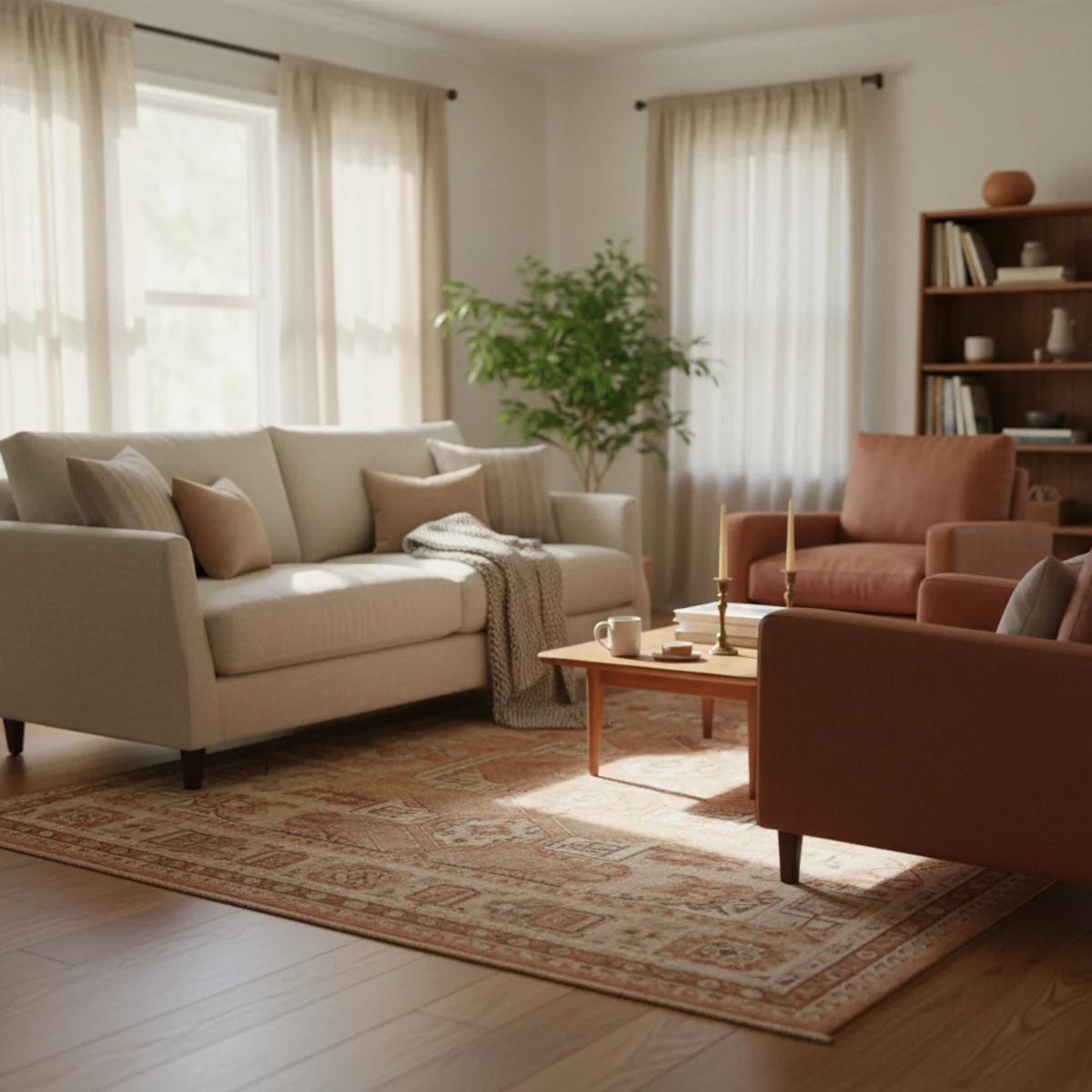
These eight rug sizing principles apply to living rooms, bedrooms, dining rooms, entryways, and the specific configurations (all legs on, front legs on, runners at sides) that each room requires. Each principle names the specific minimum dimensions for common furniture sizes, the visual logic behind the rule, and the most common sizing error for that context.
The core problem with online rug shopping is scale distortion — a rug photographed on a white background with no furniture reference looks significantly larger than it is. The same rug placed in an actual room with actual furniture reads as the small object it physically is. Knowing the correct size for each room context — and consistently buying one size larger than initially seems right — is the entire content of rug sizing guidance.
By the end of this guide, you'll know exactly what size rug to buy for every room and configuration — all legs on or front legs on for the living room, leaving a floor border, extending past the bed in bedrooms, using runners beside the bed as an alternative, sizing for dining rooms where chairs stay on when pulled out, scaling to entryways, why to size up from what looks right online, and how layering fakes a larger rug.
WHAT'S INSIDE
- The all-legs-on rule versus the front-legs-on rule — which applies and when
- Why dining room rugs specifically must accommodate pulled-out chairs
- The online-photo size distortion that makes rugs look larger than they are
- Layering to fake a larger rug — the solution when a larger rug isn't possible
The number one rug mistake is going too small. A rug should connect the furniture, not float between it like an island.
— Architectural Digest [citation needed — verify before publish]
How do you choose the right rug size?
The right rug size connects the furniture into a grouping rather than floating between it, and the rules change by room. In a living room, the rug should be large enough that at least the front legs of all the seating sit on it — ideally all the legs do. In a bedroom, it should extend well beyond the bed on the sides and foot. In a dining room, it must be big enough that the chairs stay on it even when pulled out.
The unifying principle is that bigger is almost always better. The most common and most damaging rug mistake is going too small — a rug that floats in the center, untouched by the furniture, makes a room feel cramped and disconnected, while a generous rug that anchors the furniture makes the whole space feel larger and pulled-together. Rugs also photograph larger than they live, so the size that looks right online is usually one size too small in person.
More in Shopping Guides you may love
See allWhy rug size matters more in 2026
As the rug became the anchor people build a room around, getting its size right became one of the most-searched decorating questions — Pinterest's rug size and rug size guide searches climb steadily, because the too-small rug is such a common and visible mistake.
The honest reason it matters is that rug size does more for a room's sense of cohesion and scale than almost any other single choice, and it's the easiest thing to get wrong by buying online. As warm, layered rooms made the rug central, the cost of an undersized rug — a room that feels cramped and disconnected — became more obvious. Knowing the room-by-room rules, and erring larger, is what separates a pulled-together room from a floating-island one.
8 rug size rules by room
01Living Room: All Legs On, or Front Legs On
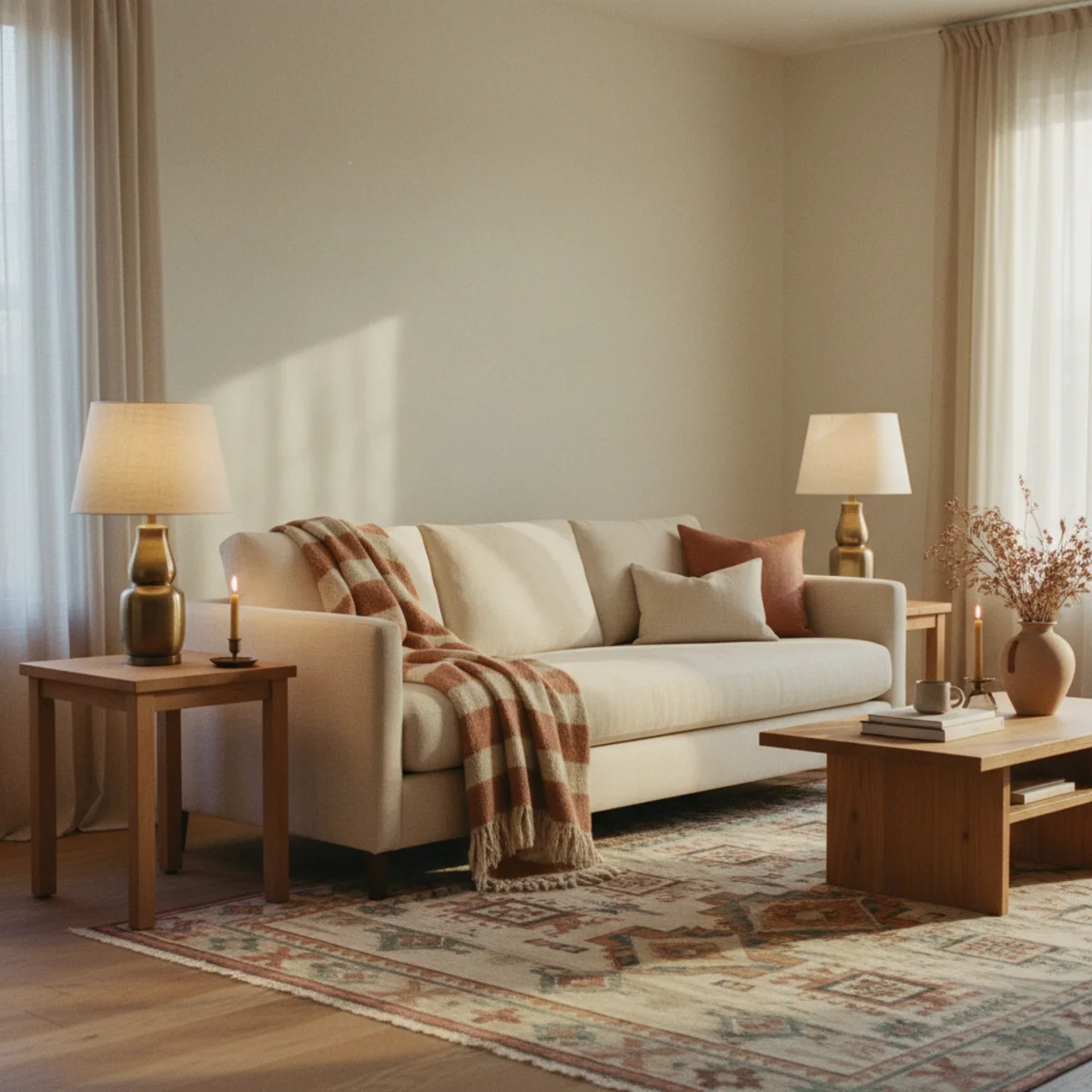
Two valid living room rug configurations: (1) all four legs of every piece of furniture on the rug, or (2) only the front two legs of the sofa and chairs on the rug, with back legs off. Both read correctly when executed at the right rug size. The 'all legs on' configuration requires a larger rug but produces the most unified seating zone. The 'front legs on' configuration allows a smaller rug but requires consistent application across all pieces.
Living room rug sizing rules: ALL LEGS ON — rug must extend 12-18 inches beyond the outer legs of each piece of furniture on all sides. For a standard living room with an 84-inch sofa + two 30-inch accent chairs in L-configuration: minimum rug size is 8x10 feet. For larger groupings (sectional + two chairs): 9x12 feet. FRONT LEGS ON — rug extends under the front two legs of all seating pieces; back legs sit on bare floor. The rug's edge aligns approximately with the back of the front sofa cushions when seen from above. This configuration requires the same rug to span the width of the seating arrangement with 12 inches to spare on each end. For an 84-inch sofa: a 8-foot wide rug minimum. WHAT DOESN'T WORK — furniture floating entirely off the rug (rug isolated in the center with all furniture around it). This makes the rug read as a bath mat in a large space. STANDARD SIZES — 5x8 is too small for most living rooms; 6x9 works for very small living rooms (under 120 sq ft); 8x10 is the standard for most living rooms; 9x12 for large or open-plan living rooms.
AFFILIATE SLOTLIVING ROOMAll legs on: 8x10 for standard (84-inch sofa + chairs), 9x12 for large. Front legs on: width spanning all front-leg positions +12 inches each side. Minimum 8x10 for most rooms.Add affiliate URL when configuredWhy it works
Because rugs create visual zones that anchor furniture within them — the rug-and-furniture relationship communicates 'this seating area belongs to this zone.' When all furniture floats off the rug, the zone-anchoring relationship is broken: the rug becomes a random carpet piece in the center of the room rather than the seating zone's foundation. Even one piece of furniture with legs on the rug establishes the relationship; zero pieces fails it entirely.
Pro tip — Tape the rug dimensions on the floor with painter's tape before purchasing — cut strips to the proposed rug dimensions and tape them on the floor in the intended position, then arrange the furniture as if the rug were there. The tape test reveals exactly whether the dimensions work before any purchase is made. Remove the tape; buy the rug with confidence.
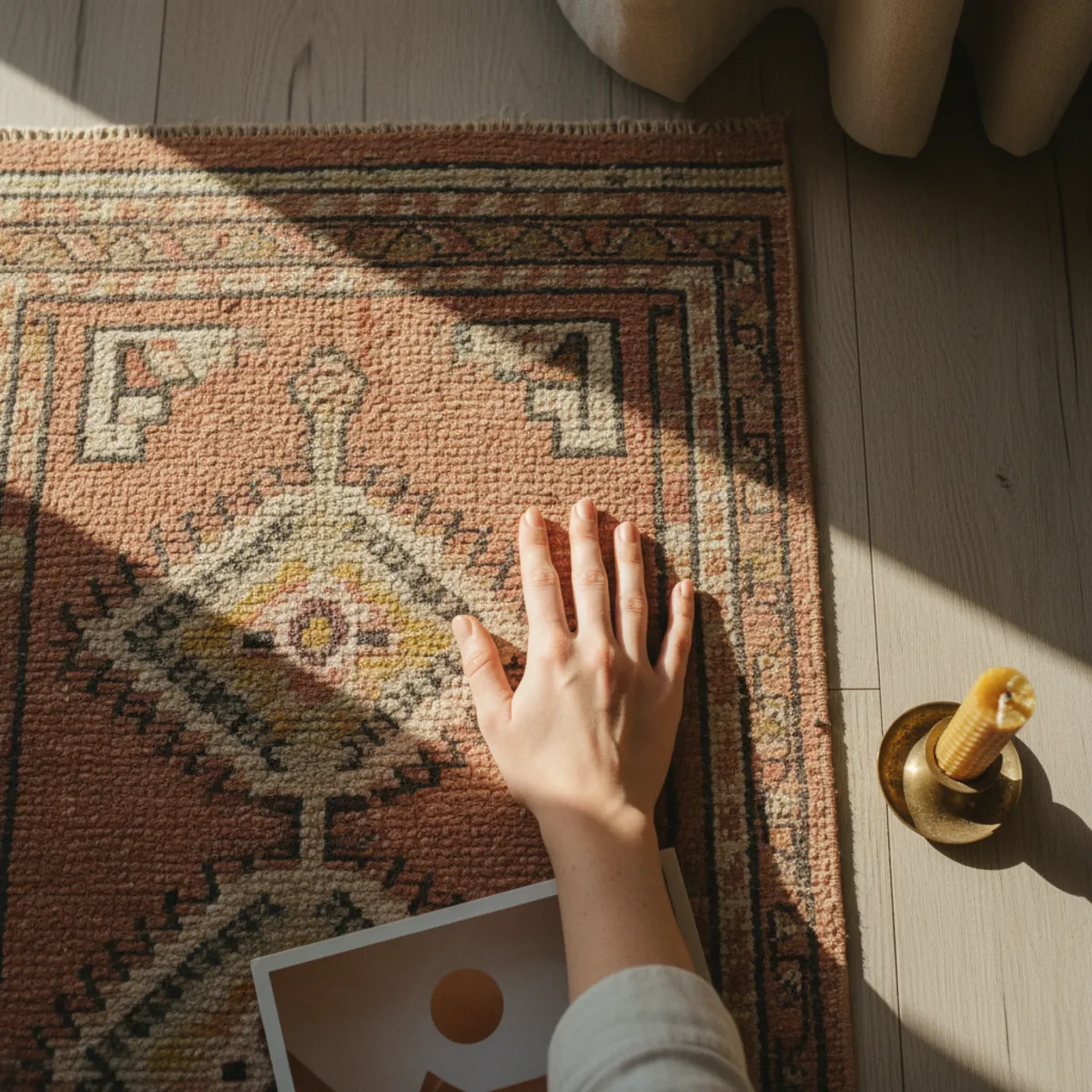
All four legs of sofa and chairs on the rug — the all-legs-on configuration that reads as a unified seating zone. See also: cozy-living-room-ideas
02Living Room: Leave a Border of Floor
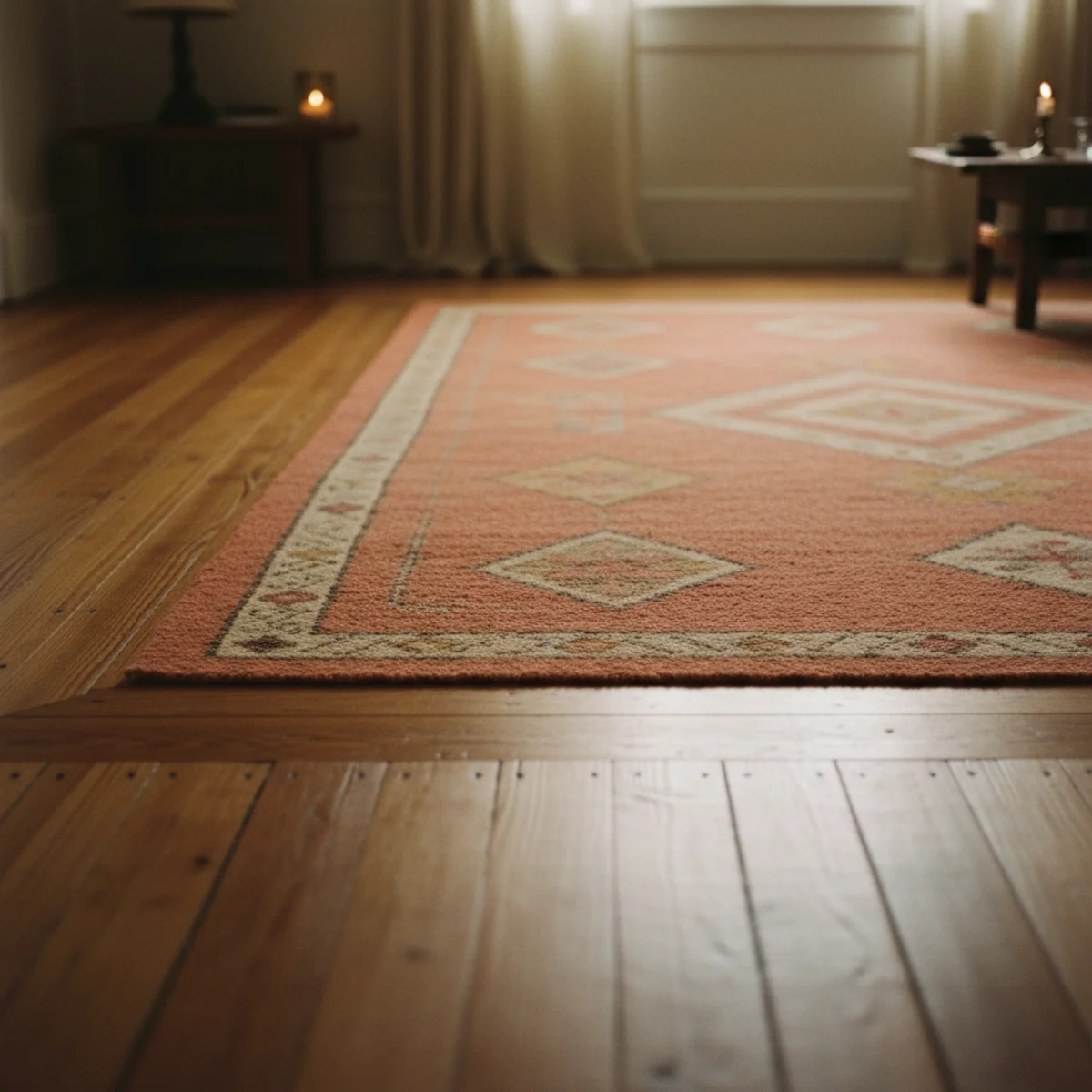
Even in the all-legs-on configuration, a visible floor border around the rug is required — the floor surrounding the rug should be visible on all four sides, creating the rug-as-zone-within-room reading. The border should be 12-24 inches of bare floor on each side of the rug. A rug that extends wall-to-wall reads as fitted carpet, not as an area rug anchoring the seating.
Floor border specifications: MINIMUM BORDER — 12 inches of bare floor visible on the side of the rug closest to the wall. More where the room allows: 18-24 inches is ideal in rooms 14 feet or wider. MEASURING — measure from the rug's planned edge to the nearest wall. This determines whether the rug fits with appropriate border. In a 12x14 living room: a 9x12 rug leaves only 18 inches on each 14-foot-wide side and 12 inches at each 12-foot end — tight but workable. A 10x14 rug would leave only 12 inches at the ends and nearly no border at the sides — too large. VISUAL FUNCTION — the bare floor border reads as the room's floor continuing around the rug zone. The rug sits in the room like an island; the visible floor around it establishes the island's relationship to the room. Without a border, the rug reads as carpet (continuous floor covering) rather than as rug (defined zone). DARK FLOOR WITH LIGHT RUG — the contrast between a warm wood floor and a lighter area rug creates the most visually clear border effect; lighter floors with neutral rugs need more border width to maintain the visual zone separation.
AFFILIATE SLOTLIVING ROOMMinimum 12-inch bare floor border on all sides of rug; 18-24 inches ideal; rug reads as zone within room, not as carpet; measure wall-to-rug-edge before purchasingAdd affiliate URL when configuredWhy it works
Because the rug's job is to define a zone within the room — and a zone can only be defined if the room itself (the floor around the rug) is visible as context. A rug that extends to the walls reads as the room's floor covering rather than as a defined area within the room. The border of bare floor is literally what makes the rug read as a rug rather than as carpet.
Pro tip — Map out the rug position and border before purchasing by measuring from each wall to the planned rug edge — record the four measurements (one per side) and confirm each is at least 12 inches. If any side measures less than 12 inches, the rug is too large for the room and a smaller size is correct.
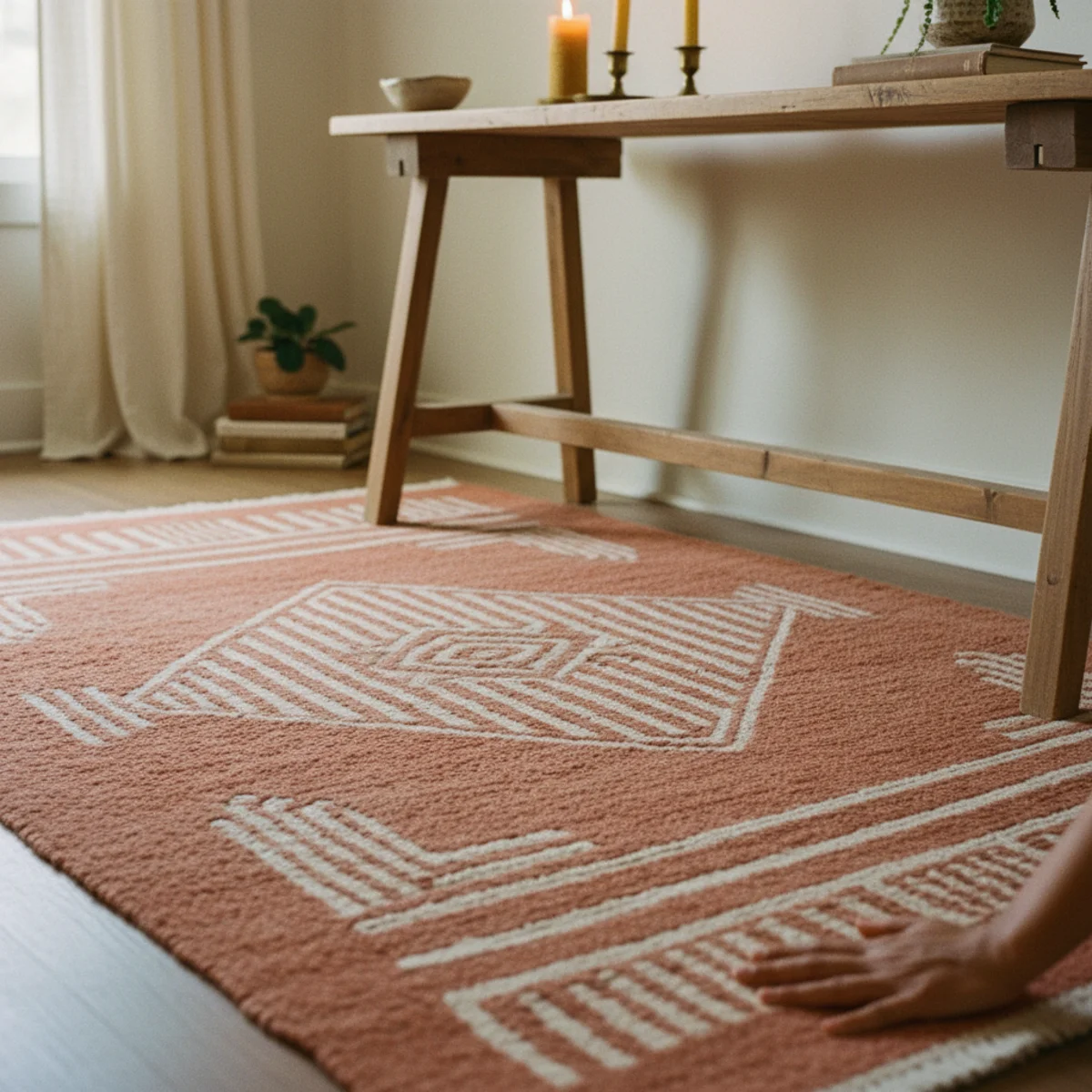
18-inch warm wood border on all sides — visible floor establishing the rug as a defined zone rather than as carpet. See also: best-area-rugs
03Bedroom: Extend Well Past the Bed
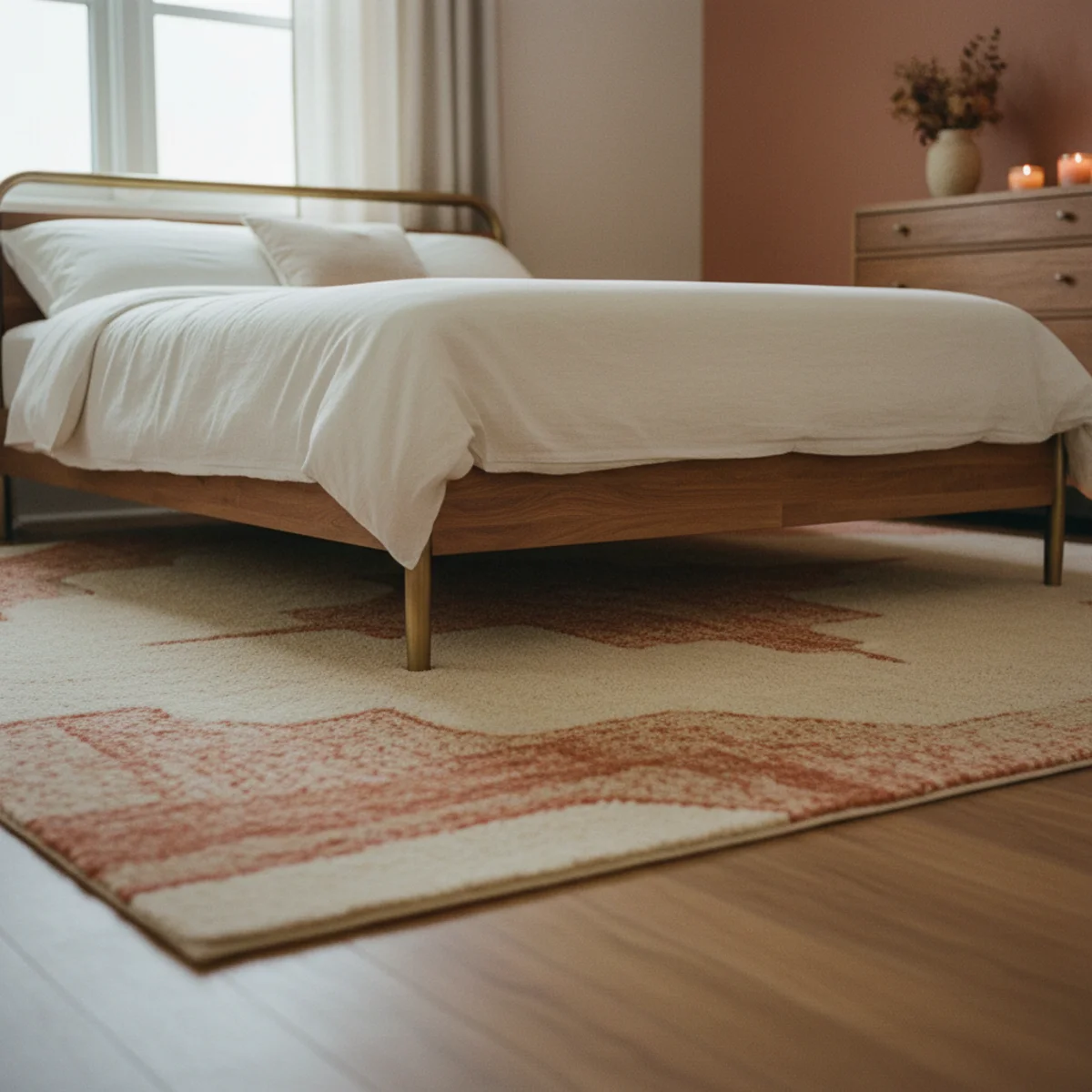
The bedroom rug should extend 18-24 inches past the bed on both sides and at the foot. When you sit on the bed's edge to put on shoes, your feet should land on the rug. When you wake up and stand, your feet should land on the rug. The rug that only covers directly under the bed — with bare floor visible beside the bed at foot-landing positions — fails the bedroom's primary daily rug function.
Bedroom rug sizing by bed size: QUEEN BED — queen bed frame is 60 inches wide, 80 inches long. For 18-24-inch extension on each side: minimum rug width 60 + 36 = 96 inches (8 feet). Rug length with extension at foot: 80 + 24-36 inches at foot = 104-116 inches (approximately 9 feet). Standard recommendation: 8x10 or 9x12 rug for a queen bed. KING BED — king bed frame is 76 inches wide. For 18-inch extension on each side: minimum rug width 76 + 36 = 112 inches (approximately 9-10 feet). Standard recommendation: 9x12 rug for a king bed. KING IN LARGE BEDROOM — 10x14 rug allows full 24-inch extension on each side for a king in a large primary bedroom. FULL/DOUBLE BED — 8x10 minimum for a double bed with proper extension. TWIN BED — 6x9 minimum for a twin bed. The most common bedroom rug sizing error: placing a 5x8 rug under a queen bed. The 5-foot width leaves only 12 inches on each side of the 5-foot (60-inch) queen bed — far below the 18-inch minimum for comfortable morning foot-landing.
AFFILIATE SLOTBEDROOMQueen bed: 8x10 minimum (18-inch extension each side), 9x12 preferred. King bed: 9x12 minimum, 10x14 for large room. Twin/full: 6x9 minimum. Feet land on rug when sitting on bed edge.Add affiliate URL when configuredWhy it works
Because bedrooms are experienced from the sitting-on-the-bed-edge position as much as from the standing position — and the sitting-on-edge posture places your feet forward of the bed frame, in the zone that the extension covers. A rug that ends at the bed frame (zero extension) leaves bare floor at the exact position where feet naturally land from the sitting position. The morning foot-landing on warm rug versus bare floor is the bedroom rug's most-noticed daily function; undersizing eliminates this function entirely.
Pro tip — Measure from the planned rug edge to the wall at the bed's foot before purchasing — in most bedrooms, the bed foot is 8-10 feet from the foot-of-bed wall, leaving ample room for a 9x12 rug with a proper floor border. In smaller bedrooms (under 12 feet long), a 8x10 rug may bring the foot-of-rug too close to the wall; in this case, a rug with 12-inch extension at the foot and the standard 18-inch extension at sides is the compromise.
9x12 rug extending 24 inches beyond the queen bed — morning foot-landing on warm rug rather than bare floor. See also: master-bedroom-ideas
04Bedroom: Or Two Runners at the Sides
An alternative to a large area rug under the bed: two long narrow runners (2x6 or 2.5x8 feet each) positioned along each side of the bed, where feet actually land. The two-runner approach costs significantly less than a large area rug (two $80-150 runners versus one $300-600 8x10 rug), leaves the center of the bed area bare (appropriate if the under-bed storage is accessible or the existing floor is beautiful), and delivers warm underfoot at the positions that matter most.
Bedroom runner specifics: RUNNER DIMENSIONS — 2 feet wide and 6-8 feet long each. Position each runner flush against the bed frame on each side, extending from headboard end to about 18 inches past the foot of the bed. RUNNER PLACEMENT — the runner's outer edge is approximately 24 inches from the bed center-line (flush against the bed frame side). The runner runs from the headboard end to past the foot of bed. ROOM WHERE THIS WORKS — platforms beds and bed frames with low clearance where the floor under the bed isn't visible anyway. Beds in rooms where the floor itself is beautiful (warm wood or terracotta tile). NOT APPROPRIATE when the floor under and around the bed is cold (concrete or cold tile) and warmth throughout is needed. RUNNER MATERIALS — same quality considerations as area rugs (wool or vintage wool runners, not polypropylene). Vintage Turkish or Persian runners at $100-300 each from estate sales for maximum character. LAYERING OPTION — a large natural-fiber base rug (jute, 8x10) under the bed with two small vintage runners on each side of the bed creates a composed layered look.
AFFILIATE SLOTBEDROOMTwo 2x6 or 2.5x8 runners on each side of bed; vintage Turkish or Persian runners at $100-300 each; rug pad under each; leaves under-bed zone bareAdd affiliate URL when configuredWhy it works
Because the bedroom rug's primary function is underfoot warmth at the positions where feet land — beside the bed when rising and sitting. Two runners deliver exactly this function at exactly these positions with less material and lower cost than a full area rug, while leaving the under-bed zone (which is typically invisible anyway and often used for storage) uncovered. The two-runner approach also allows each runner to be a quality piece (a vintage Persian runner at $150-200) that two quality runners wouldn't represent in a single large area rug format at the same total cost.
Pro tip — Anchor runners beside the bed with rug pads cut to runner dimensions — runners are prone to bunching and sliding because of their narrow width and long length. Non-adhesive felt-and-rubber rug pads ($20-30 for each runner size) prevent the bunching that makes runners look messy within days of placement.
Two vintage Turkish runners at each bedside — warm underfoot at foot-landing positions at lower cost than a single large rug. See also: bedroom-cozy-ideas
05Dining Room: Chairs Stay On When Pulled Out
The dining room rug's critical sizing rule: all chairs must remain on the rug when fully pulled back for seating — typically 18-24 inches pulled out from the table edge. A chair that starts on the rug but lands off the rug when pulled out creates an unstable awkward seating experience and makes the rug look undersized. Dining room rugs are almost always sized too small.
Dining room rug sizing: CALCULATION — measure the table length and width. Add 24 inches on each side (the chair pull-out distance). Add another 6-12 inches on each side for visual border. For a 36x72-inch dining table: minimum rug size = (36 + 48) x (72 + 48) = 84 x 120 inches = 7x10 feet. Standard recommendation: 8x10 for a 36x72 table. For a 48x84-inch table: (48+48) x (84+48) = 96x132 = 8x11 feet — an 8x10 works if the table isn't too long; 9x12 is safer. ROUND TABLE — for a 48-inch diameter round table: 72-inch minimum rug diameter or an 8-foot round rug. MOST COMMON WRONG SIZE — 5x8 under a 6-person dining table. A 5-foot wide rug under a standard 3-foot wide table leaves only 12 inches on each side — far less than the 24-inch chair pull-out. Chairs fall off the rug when anyone sits down. DINING RUG MATERIAL — flat-weave rugs (cotton dhurrie, Moroccan kilim, flat-weave wool) work better under dining tables than pile rugs — chairs roll more smoothly on flat surfaces, and flat-weave rugs clean more easily (food spills surface rather than sink into pile).
AFFILIATE SLOTDINING ROOMTable + 48 inches (24 per side) = minimum rug dimensions. 8x10 for most 6-person tables. 9x12 for 8-person tables. Flat-weave for chair mobility and cleaning ease.Add affiliate URL when configuredWhy it works
Because the act of sitting creates rearward movement — you pull the chair back from the table to create sitting clearance, and the chair's back legs move approximately 18-24 inches from their at-table position. If the rug ends less than 24 inches from the table edge, back chair legs land off the rug at the seated position. The rocking motion of chair legs between rug surface and bare floor is both physically awkward and audibly noticeable (the transition from rug to floor creates a noise at the back leg). A properly sized dining rug eliminates this entirely.
Pro tip — Put a chair at the table and pull it back to sitting position before marking the rug boundary — the actual pull-back distance for your specific chairs may differ from the standard 24-inch estimate (shorter chairs, lighter chairs, or room configuration differences affect this). Marking the actual position with tape before purchasing confirms the right size.
All chairs on the rug when pulled back to seated position — correct dining rug sizing with 24-inch extension on each table side. See also: cozy-tablescape-ideas
06Entryway: Scale to the Space
Entryway rugs are typically too small — a small 2x3-foot mat reads as a doormat inside a proper entryway, while a properly-scaled entryway rug fills the full visual width of the entryway zone and anchors any console, bench, or coat storage to a visual base. Scale the entryway rug to fill 60-70% of the entryway's width, not to fit just under the door.
Entryway rug sizing: STANDARD ENTRYWAY (5-8 feet wide, 4-8 feet deep) — 3x5 or 4x6 rug fills the space appropriately. The rug should extend from just inside the door to the transition point between entryway and the main living space. NARROW ENTRYWAY or HALLWAY — a runner (2-2.5 feet wide, 6-10 feet long) runs the length of the hallway. The runner should span from just inside the door to the hallway's transition to the main room. CONSOLE OR BENCH — if a console table or bench is present in the entryway, the rug should extend under the front legs of the console or bench (same front-legs-on principle as living room). DURABILITY PRIORITY — entryways receive the most foot traffic in the house. Choose flatweave wool or jute (durable and easy to shake out or vacuum), vintage wool kilim (durable pile), or a washable cotton rug. VISUAL FUNCTION — the entryway rug is the first impression of the home's floor surface. It should read as a designed element of the entryway, not as a door mat upgraded.
AFFILIATE SLOTENTRYWAY3x5 or 4x6 for standard entry (60-70% of entry width); runner for narrow halls (2x6 to 2.5x10); front legs of any console on rug; flatweave wool or jute for durabilityAdd affiliate URL when configuredWhy it works
Because the entryway is the home's first impression — the first floor surface and warm material guests encounter. A small 2x3 mat reads as a practical object (protect the floor from wet shoes); a properly-sized 4x6 rug reads as the home's warm welcome. The visual difference between a doormat and a room rug is primarily size; the right-sized entryway rug makes the entryway feel like a room rather than like a transition zone.
Pro tip — Buy an entryway rug that can withstand frequent vacuuming or shaking — entryways accumulate dirt, grit, and moisture from outside at significantly higher rates than interior rooms. Natural fiber rugs (jute, sisal) are the most practical for entryways because they can be shaken out and cleaned without the delicacy concerns of quality wool pile rugs.
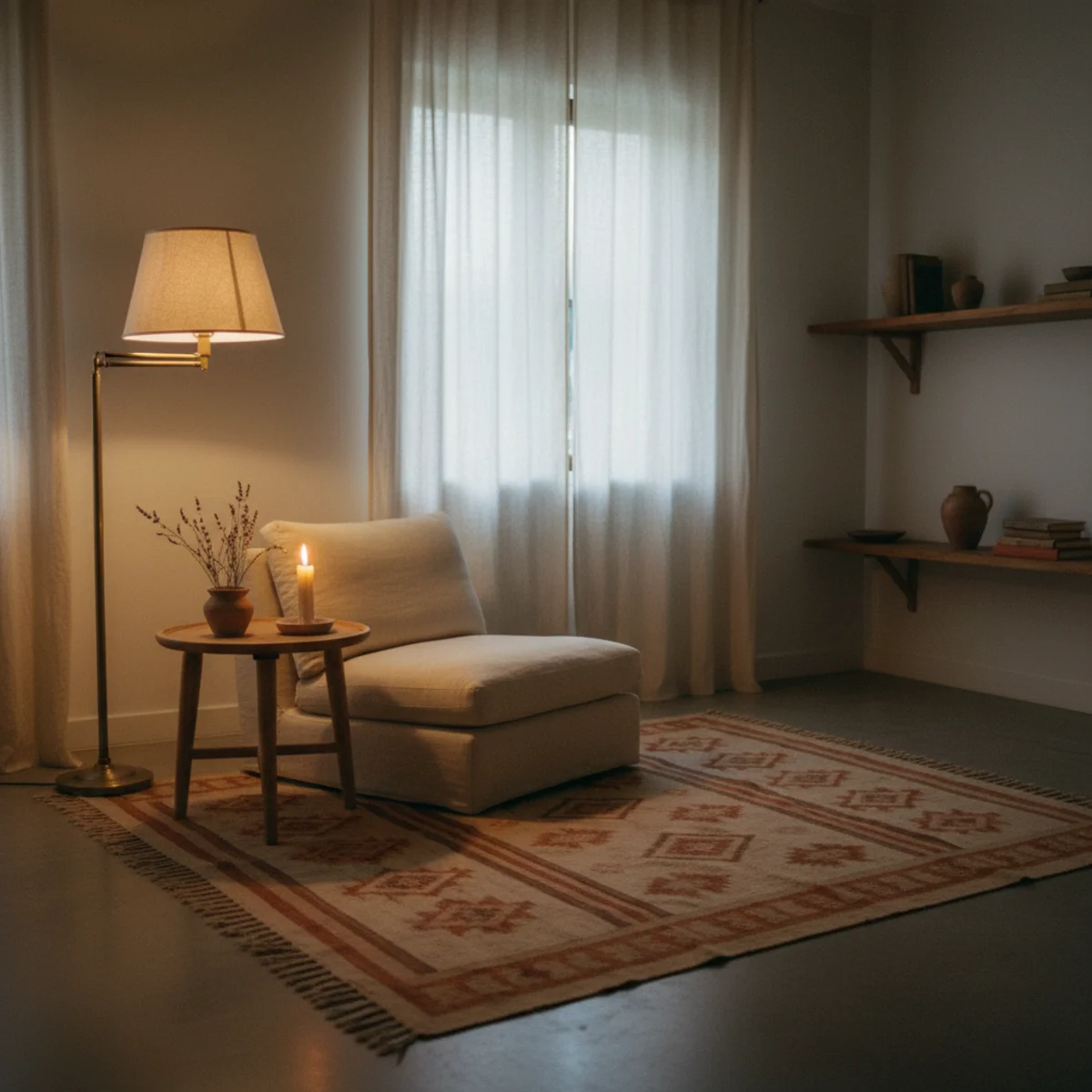
4x6 rug filling the entryway zone with console front legs on — warm welcome rather than practical doormat. See also: entryway-decor
07Size Up From What Looks Right Online
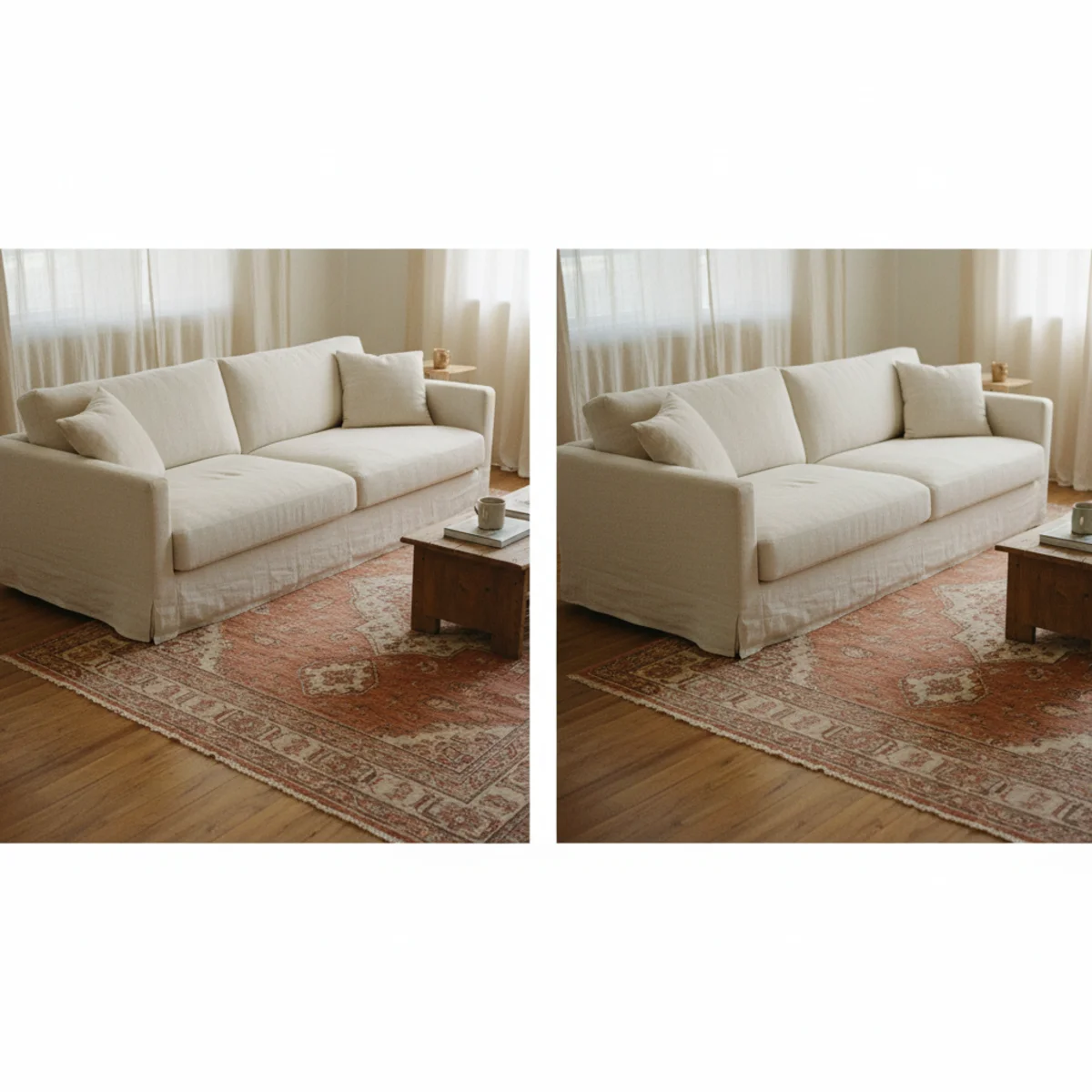
This is the single most-actionable rug sizing piece of advice: when a rug looks the right size in a product photo on a white background, buy one size larger. Online rug photography consistently makes rugs look larger than they are because the white background, close-up photography, and absence of scale reference all inflate the apparent size. The rug that looks right in the photo reads as too small in the room.
The online size distortion problem: WHY PRODUCT PHOTOS MAKE RUGS LOOK LARGER — (1) Photographed from directly above on a white background with no furniture: no scale reference. (2) Close-up crop reduces visible surrounding space. (3) Digitally stretched or perspective-enhanced in some commercial photography. (4) Our brain fills in 'normal room scale' that doesn't match the product's actual scale. THE SIZE-UP RULE — when deciding between two sizes (5x8 or 8x10; 8x10 or 9x12), buy the larger one. The larger rug will read correctly in the room approximately 80% of the time; the smaller rug reads too small approximately 80% of the time. RETURN POLICIES — most quality rug retailers (Rugs USA, Pottery Barn, West Elm, Anthropologie) offer free returns on standard rug sizes. Buy the larger size; if it genuinely reads too large (which is rare), return for the smaller. TAPE TEST BEFORE ORDERING — use painter's tape to mark both proposed rug sizes on the actual floor before ordering. The tape test eliminates size uncertainty entirely at zero cost. LIFESTYLE SITUATION — when in doubt, almost everyone who has sized up regrets nothing; almost everyone who sized down regrets it within a month of living with the rug.
AFFILIATE SLOTGUIDANCEAlways buy one size up from what looks right in product photos; use painter's tape test to verify dimensions before ordering; check lifestyle photos not product-only shotsAdd affiliate URL when configuredWhy it works
Because size perception requires scale reference — we understand the size of an object by comparing it to other objects we know the size of. A product photo on white background provides zero scale reference; a rug in a room with a sofa, coffee table, and lamp provides multiple scale references. Without scale reference, the brain defaults to guessing the object is a normal comfortable size rather than whatever it actually is. The white-background photograph is specifically designed to make the product look appealing, not to communicate accurate scale.
Pro tip — Check the product page's lifestyle photo (rug shown in a room setting) rather than the white-background product photo — lifestyle photos with furniture provide the scale reference that white-background photos lack. If the lifestyle photo shows the rug looking right with furniture, it will likely look right in your room at similar furniture scale.
Same rug in product photo versus furnished room — the scale distortion that makes sizing up the reliable rule. See also: best-area-rugs
08Layer to Fake a Larger Rug
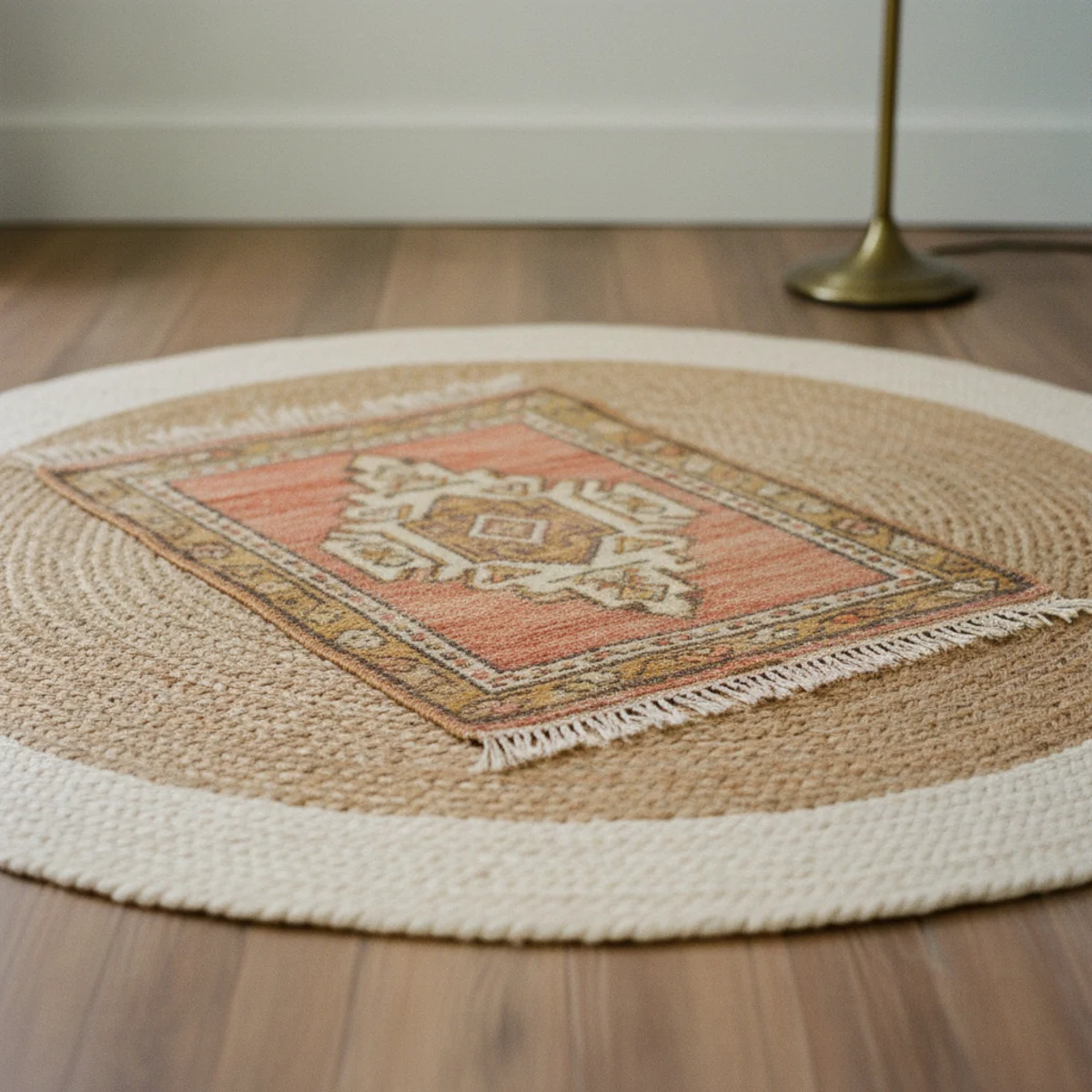
When the correctly-sized rug for a room is beyond budget, or when the available rug in the right size and quality doesn't exist, layering a smaller patterned rug over a larger natural-fiber base produces the visual impression of a larger rug at lower cost. A $100 jute base plus a $200 vintage kilim reads as a single $400-500 composed rug installation.
Layering to solve the too-small rug problem: THE COMPOSITION — a large natural-fiber base rug (jute, sisal, or flat-weave cotton, 8x10 or 9x12) as the foundation, with a smaller vintage or quality rug (5x7 or 4x6) centered on top. The base rug fills the visual zone at correct scale; the top rug provides the pattern, color, and character at lower cost than a single quality rug at the full size. BASE RUG SIZING — the base rug should be sized correctly for the room (per rules in items 1-5 above). The base rug does the sizing work; the top rug does the character work. VISUAL PROPORTION — leave 12-18 inches of base rug visible on all sides of the layered rug. The visible border of natural fiber around the patterned top rug creates the composed two-rug framing effect. SECURING — tape the corners of the layered rug to the base rug with carpet tape ($5-10) to prevent slipping and bunching in active rooms. QUALITY ALLOCATION — invest the quality budget in the top (character) rug, not the base. A $100 IKEA jute base under a $300 vintage kilim reads as better than a $400 single low-quality rug at the same total cost.
AFFILIATE SLOTTECHNIQUELarge jute/sisal base at correct room size ($100-300) + smaller vintage kilim or quality rug on top ($200-600); 12-18 inch base border visible; carpet tape at cornersAdd affiliate URL when configuredWhy it works
Because the too-small rug problem is a zone-definition problem — the smaller rug doesn't fill the seating zone that the room requires to read as properly designed. The larger base rug fills the zone; the smaller character rug provides the visual interest. Together they solve both problems (zone scale and visual interest) that each fails at individually. The smaller rug alone fails the zone; the base rug alone lacks character. The combination of the right size base plus a right-character top rug solves what neither solves individually.
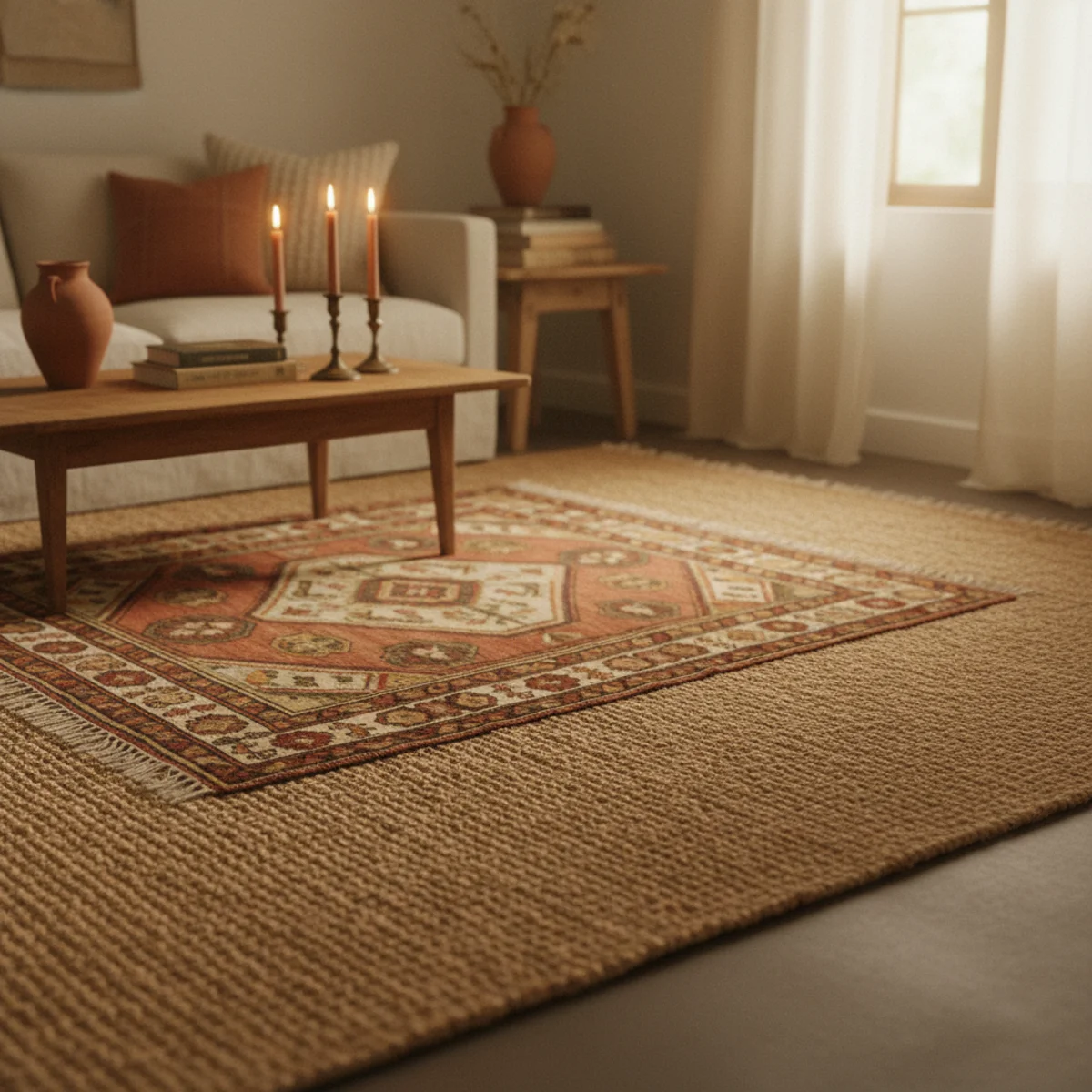
Pro tip — Choose the base rug in a tone that complements the layered rug's palette — natural honey-tan jute works with most warm-toned vintage kilims; cream flat-weave cotton works with more diverse patterns. The base should recede visually so the character rug reads as the primary element; a competing base color undermines the composition.
Jute base with vintage kilim on top — two rugs together solving the zone-scale and character problems that neither solves alone. See also: best-area-rugs

How to choose a rug size step by step
Measure, tape it out, and err larger. Work in this order.
- 1Identify the room's rule
Living room: front legs of all seating on the rug at minimum. Bedroom: extends well past the bed. Dining room: chairs stay on when pulled out.
- 2Measure the furniture grouping
Measure the footprint the rug needs to cover — the seating arrangement, the bed plus its margins, or the table plus pulled-out chairs.
- 3Tape out the footprint
Mark the rug's size on your actual floor with tape and live with it for a day. The screen deceives about scale; the tape tells the truth.
- 4Size up and check the border
When between sizes, go larger, and leave a consistent 8 to 24 inch border of floor around it rather than going wall-to-wall.
Quick tips
- Always err larger; too-small is the most common and most damaging rug mistake.
- Tape out the rug's footprint on your actual floor before buying — the screen deceives.
- Living room: front legs of all seating on the rug at minimum, all legs ideally.
- Bedroom: extend the rug 18 to 24 inches beyond the bed on the sides and foot.
- Dining room: ensure chairs stay on the rug even when pulled out.
- Layer a smaller rug over a jute base to hit the right size affordably.
Rug sizing by room
Large enough for at least the front legs of all seating, with an even border of floor; all legs on reads most generous.
Extending 18 to 24 inches past the bed, or two side runners on a budget.
Big enough that chairs stay on it when pulled out — about 24 inches beyond the table all around.
Use correctly sized rugs to define each zone — living, dining — within the larger space.
Bigger than you think, every time. The postage-stamp rug that floats between the furniture is the number one decorating mistake.
Frequently asked questions
What size rug should I get for my living room?+
What size rug should I get for my bedroom?+
What size rug should I get for my dining room?+
Is a 5x8 rug too small for a living room?+
How do I know if a rug is the right size?+
Rug size does more for a room than almost any other single decision, and the rules are simple once you know them: living room, front legs of all seating on at minimum; bedroom, well past the bed; dining room, chairs stay on when pulled out. The one universal rule is to err larger — the postage-stamp rug that floats between the furniture is the number one decorating mistake. We'd tape out the footprint on the actual floor before buying; the screen lies about scale every time, and bigger is almost always right.