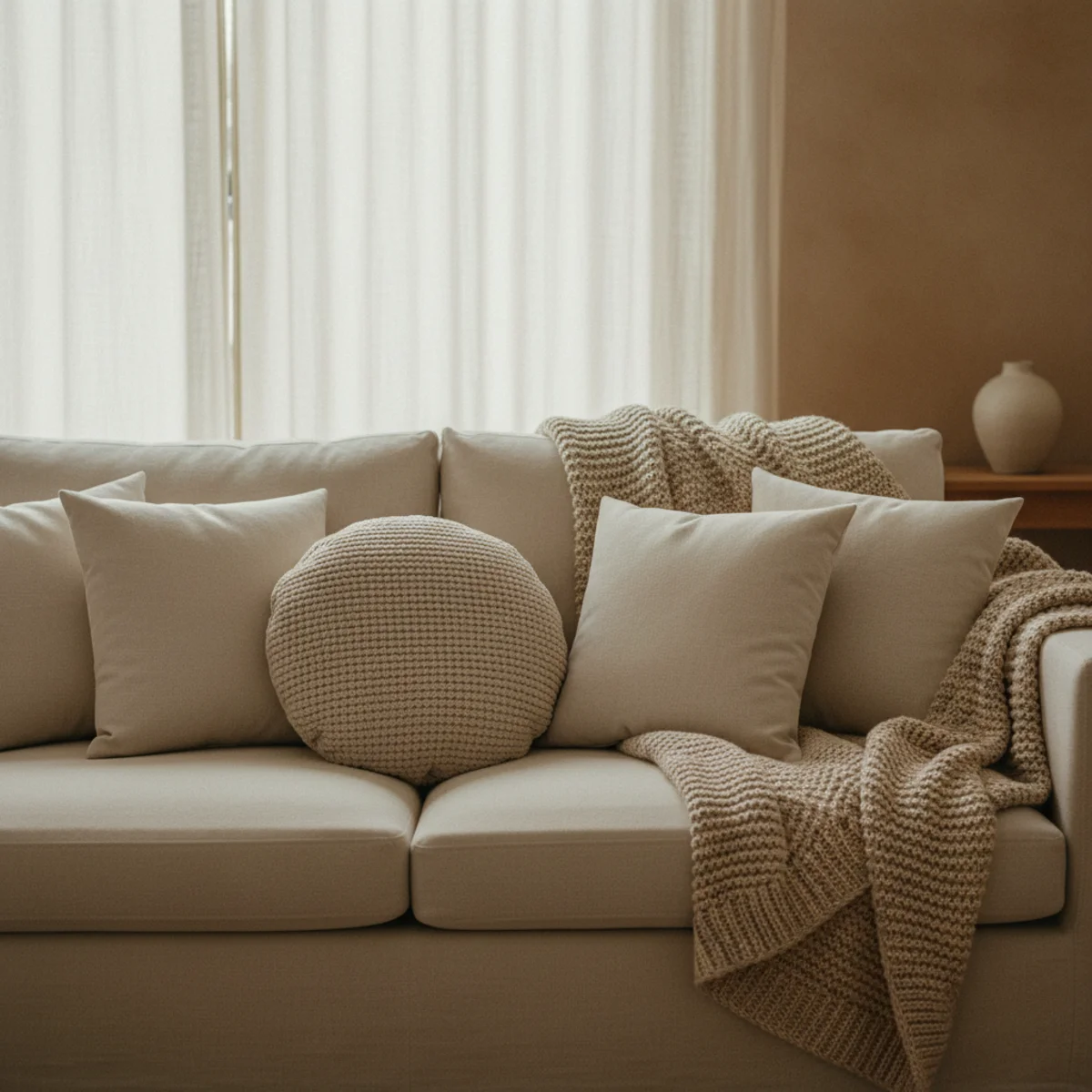
These eight textile layering principles are tested across actual styled rooms where the goal is genuinely cozy rather than cluttered — sofas with multiple throws and cushions, beds layered with sheets and blankets and throws, dining tables with multiple linen layers, reading nooks with throws and ottoman drapes. Each principle below names specific decisions that separate effective layering from accumulation: which textiles to combine, in what color relationships, in what counts, in what draping postures, and how to maintain the discipline against natural drift toward adding-more.
The textile layering problem is that the line between cozy-layered and cluttered-piled is invisible in the moment but obvious in the result. Most homes that aim for cozy textile layering end up with cluttered accumulation because they add textiles based on individual purchase decisions rather than based on composition rules. The eight principles below provide the actual rules — variation in weave but not color, capped counts at about three, drape rather than fold, mix smooth with nubby, limit patterns hard, weight-based rotation by season, echo one texture across the room — that let layering work.
By the end of this guide, you'll know exactly which moves let you layer multiple textiles without the result reading cluttered — the vary-weave-not-color principle, the tight color story discipline, the count-cap-at-three rule, the drape-don't-fold posture, the smooth-with-nubby mixing, the pattern limits, the weight-based seasonal rotation, and the texture-echo principle that ties everything together across the room.
WHAT'S INSIDE
- Why varying weave texture beats varying color when adding multiple textiles to one space
- The tight color story discipline — staying within 2-3 shades of one warm palette family
- The count cap at about three textile layers per surface — and why exceeding it slides into cluttered
- The drape-don't-fold posture that's specifically less stiff than folded textile arrangements
Texture is the answer to a quiet room. Vary the weave and you add richness; vary everything and you add noise.
— Studio McGee blog [citation needed — verify before publish]
What does layering textiles actually mean?
Layering textiles means combining different fabrics — throws, cushions, rugs, curtains — of varied weave and weight to build visual warmth and depth, especially in a restrained, warm-neutral palette where you can't add interest with loud color. It's the technique that keeps a calm room from reading flat.
The defining principle is weave contrast over color contrast. A chunky knit, a flat waffle weave, and a smooth linen in the same warm tone family read as rich and considered; the same three pieces in clashing colors or identical weaves read as messy. Layering done well is about texture variety held within a tight color story, and about knowing when to stop.
More in Styling you may love
See allWhy textile layering matters in 2026
As warm minimalism replaced the cold all-white room, texture became the main way to make a restrained palette feel rich — you can't add visual interest with bright color in a warm-neutral room, so you add it with weave. Pinterest's textile layering and cozy aesthetic searches climb every year.
People keep asking how to do it without clutter because the technique is genuinely easy to overdo. The instinct is to keep adding throws and cushions until the room feels full, which tips it into mess. The honest rule — vary the weave, hold the color, cap the count at about three per zone — is what separates a richly layered room from a cluttered one, and it's what most tutorials skip.
8 rules for layering textiles without clutter
01Vary the Weave, Not the Color
The most-important textile layering principle: vary the weave texture (smooth linen, chunky knit wool, nubby boucle, fine cashmere, ribbed cotton) rather than varying the color across layers. Multiple textiles in the same warm-cream palette but different weaves read as composed layering; multiple textiles in different colors read as cluttered accumulation regardless of how warm the individual colors are.
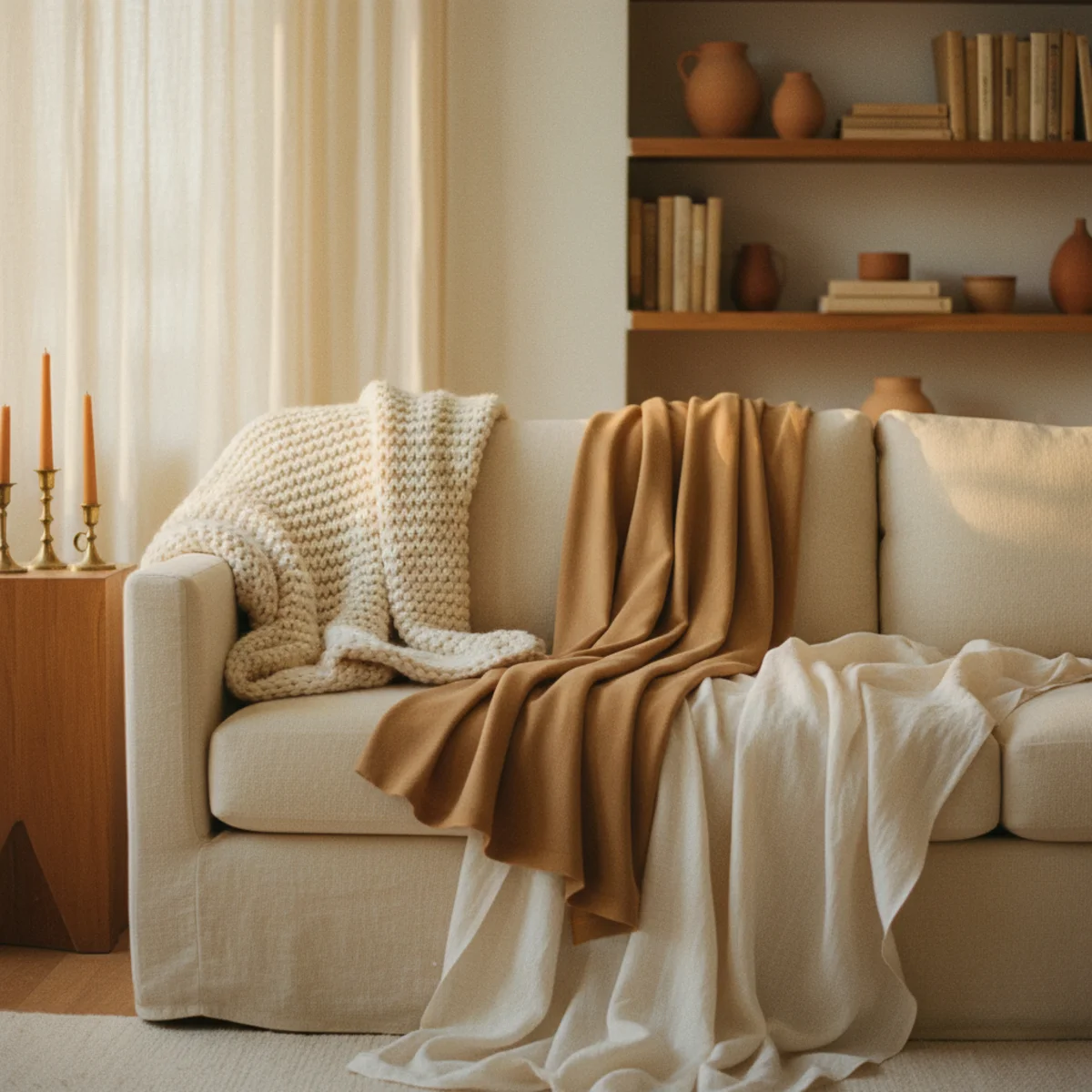
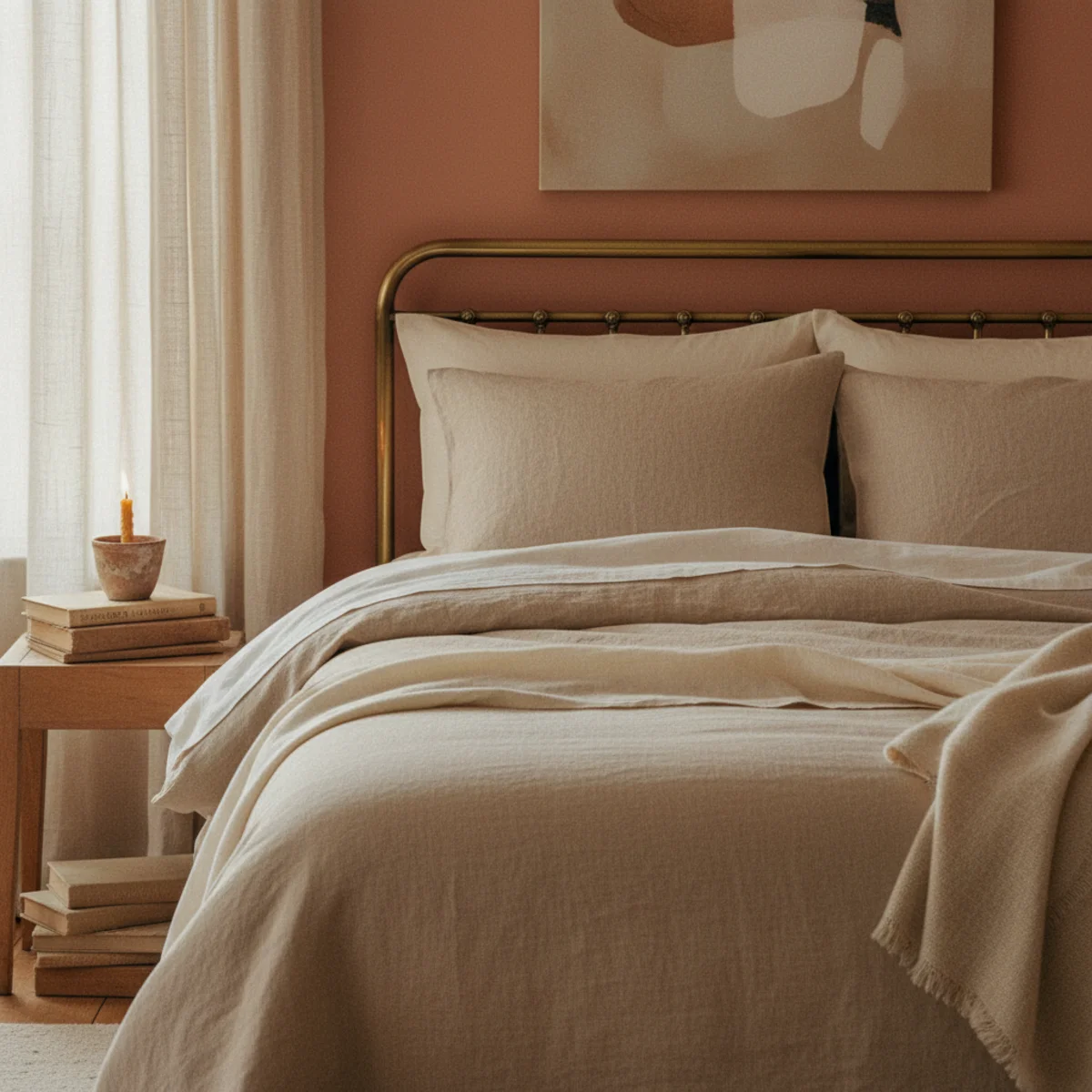
Weave-variation strategy applied: ON A SOFA — base linen slipcover (smooth flat weave) + chunky knit cream throw (open loose weave) + small ribbed cotton boucle cushion (textured small weave) + smooth cashmere blanket (fine tight weave). All in cream-and-oat palette but four different visible weave structures. ON A BED — flat linen sheets (smooth) + wool blanket (medium weave with visible pattern) + linen duvet cover (smooth substantial drape) + chunky knit throw at foot (open large weave). All in cream/oat palette but visibly differentiated through weave. ON A DINING CHAIR or ARMCHAIR — base cushion in linen + folded boucle throw + small cotton cushion. Same color, three weaves. THE WEAVE TYPES that read distinctly: smooth flat weave (linen, fine cotton, sateen), waffle weave (textured cotton, waffle cotton), ribbed (cotton ribbed, jersey ribbed), chunky knit (wool, alpaca, mohair), boucle (looped wool or cotton), nubby slub (washed linen, raw cotton), velvet (smooth pile), corduroy (ribbed pile). Mix 3-4 of these within one warm palette family.
AFFILIATE SLOTPRINCIPLEVary weave (smooth linen + chunky knit + boucle + cashmere + ribbed) within one warm color paletteAdd affiliate URL when configuredWhy it works
Because the eye reads color variation as 'multiple different things stacked together' (cluttered) and reads weave variation within consistent color as 'one warm composition with rich textural depth' (composed). Color is the brain's primary categorization signal for objects — different colors register as different categories. Texture is a secondary detail that registers as richness rather than as multiplicity. The same number of textiles in one color but multiple weaves reads as 2-3x more visually quiet than the equivalent in multiple colors. Color is also harder to coordinate (every color pairing requires palette discipline); weave variation works automatically with consistent color discipline.
Pro tip — Photograph your current textile layering in black-and-white before adding more layers — without color, you can see whether the layers are differentiated by texture alone. If the photo looks cluttered in black-and-white, the layering isn't working at the texture level; if it looks composed in black-and-white, the textile foundation is right and color can be a coordinating element on top.
Four weaves, one palette — variation through texture rather than through color. See also: throw-blanket-layering
02Hold a Tight Color Story
The corollary to the vary-weave principle: hold a tight color story across all textiles in one space. All textiles should fall within 2-3 shades of one warm palette family — terracotta family (terracotta + cream + oat + warm taupe), sage family (muted sage + cream + warm stone + soft olive), or cream-only family (cream + oat + soft beige + warm white). The tight discipline is what lets multiple textiles coexist without competing.
Tight color story principles: PICK ONE WARM PALETTE FAMILY for the room and apply across all textiles. TERRACOTTA FAMILY palette spectrum: deep clay > terracotta > warm rust > muted ochre > soft cream > warm taupe. All these tones blend warmly; mixing any 4-5 of these reads as coherent palette. SAGE FAMILY palette spectrum: deep moss > muted sage > soft eucalyptus > warm stone > soft cream > pale warm taupe. CREAM-ONLY FAMILY palette spectrum: warm white > cream > oat > soft beige > pale stone > warm taupe. The discipline rules: NO COOL TONES (cool greys, blues, cool whites) mixed with warm palette families. NO HIGH-CONTRAST tones (deep black, deep navy, saturated colors) breaking the warm tonal family. NO MIXING palette families — terracotta family does not mix with sage family in the same room; either commit to one or merge through neutral cream/oat that bridges both. The tight color story is what allows the count cap (per item 3) and the weave variation (per item 1) to produce coherent composition rather than cluttered accumulation.
AFFILIATE SLOTPRINCIPLEOne warm palette family across all textiles in a room: terracotta family OR sage family OR cream-only family; 2-3 shades withinAdd affiliate URL when configuredWhy it works
Because adding more textiles within tight color discipline reads as 'depth in one warm theme' where adding textiles across multiple colors reads as 'multiple competing themes.' The tight color story essentially makes the layered textiles function as one composition rather than as multiple separate pieces. Without color discipline, even well-chosen individual textiles fight each other for attention; with color discipline, even basic textiles unite into composition. The principle borrows from classical painting (where color palette discipline is foundational) and applies equally to textile arrangement.
Pro tip — Test new textile purchases against your existing textile collection BEFORE buying — bring fabric swatches home and place beside existing throws, cushions, blankets in the actual room lighting before committing to purchase. Many textiles look good in store but break the color story at home where the existing palette context matters.
All textiles within 2-3 shades of one warm palette — tight color story enabling weave variation. See also: cozy-bedroom-inspo
03Cap the Count at About Three
The most-counterintuitive principle: cap the textile layer count at roughly three per surface. Three throws on a sofa reads as composed layering; five throws reads as cluttered pile. Three cushions on a bed reads as styled; seven cushions reads as 'where do I sit?' The count cap forces editing discipline that maintains coziness without sliding into accumulation.
Count cap applied to specific surfaces: SOFA — 2-3 cushions + 1 throw draped + 1 occasional accent textile (lap blanket or seasonal addition). Total visible textiles: 3-4 pieces, not counting the sofa upholstery itself. BED — base sheets + duvet + 1 wool blanket between + 1 throw at foot + 2-4 pillows including sleeping pillows. Total visible textiles: 4-5 pieces beyond the base sheets. ARMCHAIR — 1 cushion + 1 throw draped over back or arm. Total: 2 pieces. DINING CHAIR (when styled) — single cushion only. OTTOMAN — single throw draped if any. CONSOLE OR SIDE TABLE — single small textile (folded napkin, small runner) if styled at all. WINDOW NOOK or READING CORNER — base cushion + 1 throw + 1 small accent cushion = 3 pieces. The count discipline applies per surface; the room's total textile count adds up to roughly 8-15 textile pieces depending on size, but each individual surface stays within the cap. The cap forces 'which textile earns its place?' decisions rather than 'why not add another?' decisions.
AFFILIATE SLOTDISCIPLINECap at 3 layered textiles per surface: 2-3 cushions + 1 throw on sofa; cushion + throw on chair; single textile on small surfacesAdd affiliate URL when configuredWhy it works
Because three is the most-pieces the eye can read as 'composition' without slipping into 'accumulation.' At 3 layered textiles, the eye perceives an intentional composed group; at 4-5 textiles on the same surface, the eye perceives a pile of stuff. The cognitive psychology of grouping favors small numbers (chunks of 3-4) for perception as discrete units. The cap also enforces editing discipline against natural drift toward adding more — without an explicit cap, households add textiles continuously across years until cluttered, where the cap-at-three rule maintains coziness indefinitely.
Pro tip — Apply the cap visually rather than counting precisely — when a surface looks busy, remove one textile (move to storage, donate, or rotate to another surface). When a surface looks underdressed, add one. The visual test is more reliable than counting because some textile combinations (large throw + small cushion + small cushion = 3 pieces) look balanced while others (three large throws stacked = 3 pieces) look cluttered.
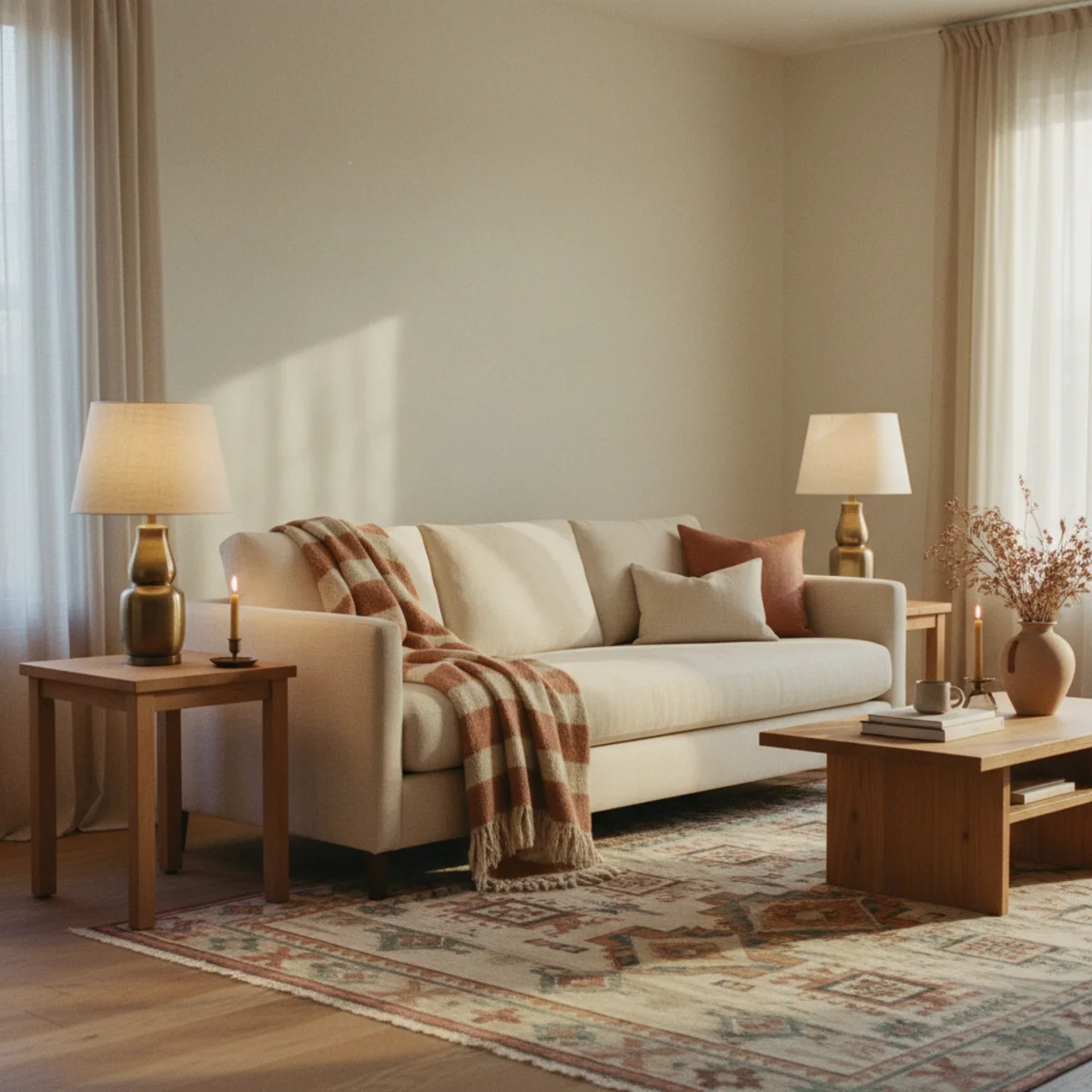
Two cushions and one throw — three textiles is the cap that maintains composed cozy. See also: warm-minimalism
04Drape, Don't Fold
The drape-versus-fold decision matters more than most textile shoppers realize. Throws draped casually (over sofa back, across arm, hanging from chair) read as warm and inviting; throws folded into precise rectangles read as stiff and commercial. The drape posture signals 'this textile is in active use' where the fold posture signals 'this textile is displayed.'
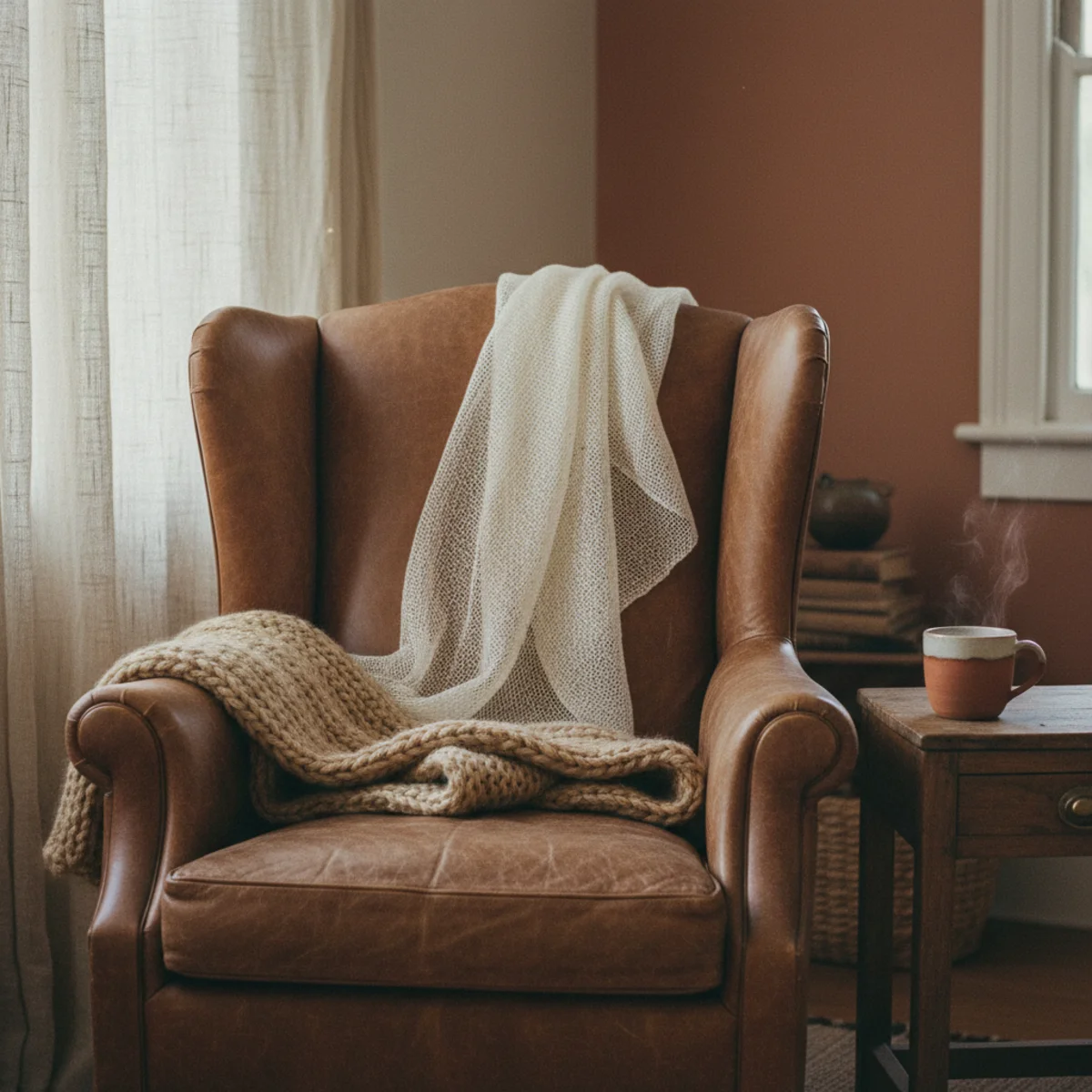
Drape versus fold applied to specific situations: SOFA THROW — drape over one arm (50% of throw hanging, 50% on seat) OR drape diagonally across one cushion (one corner reaching down to floor, opposite corner over back of sofa). Skip neat folded rectangles. BED THROW — fold loosely lengthwise once and drape across foot of bed, allowing 6-10 inches of overhang on both sides. Skip precisely folded rectangles centered on bed. ARMCHAIR THROW — drape over back of chair (50% hanging, 50% on seat back) OR over one arm (similar to sofa). Skip precisely folded throws on chair seats. OTTOMAN THROW — drape loosely with one corner trailing off the side. WINDOW SEAT — throw casually with visible looseness; if seat doubles as storage opening, drape the throw partially over the lid. THE PRINCIPLE — visible looseness, slight overhang, slight tousled posture all signal active use; precise folded geometric shapes signal staged display. The drape doesn't need to be sloppy (avoid actively unattractive drape posture); it needs to read as 'recently placed by household member who lives here' rather than 'arranged for photo shoot.'
AFFILIATE SLOTPOSTUREDrape throws casually with visible looseness and slight overhang; never fold into precise rectangles on usable surfacesAdd affiliate URL when configuredWhy it works
Because folded textiles signal commercial display (where folded inventory is the default storage posture) while draped textiles signal home use (where casual placement is the default living posture). The visual difference is significant — folded throws on sofas read as showroom display, where draped throws on the same sofa read as warm-collected home. The same textile in the same color in the same room produces dramatically different aesthetic impact based on this single posture decision. The drape posture also makes the textile look like it's about to be used (or has just been used), which signals warm-collected aesthetic.
Pro tip — Practice the 'casual flick' draping technique — pick up the throw, hold it by one corner or one edge, flick it onto the surface with a small intentional motion, then make 2-3 small adjustments to the resulting drape. The technique produces the 'just placed' posture more reliably than methodical folding or arrangement. Avoid: smoothing wrinkles flat, aligning edges with sofa edges, arranging into precise geometric shapes.
Chunky knit throw draped casually across one cushion and arm — drape posture that signals warm home use. See also: throw-blanket-layering
05Mix Smooth With Nubby
Within the weave-variation principle, the most-effective specific mix is smooth-with-nubby — smooth flat-weave textiles (linen, fine cotton, sateen) combined with nubby textured textiles (chunky knit wool, washed linen with slubs, raw cotton with visible weave, boucle). The contrast between smooth and nubby creates visual dialogue that single-weave-type rooms miss.
Smooth-with-nubby mixing strategy: SMOOTH TEXTILES contribute structure and substance — linen flat sheets, smooth cotton percale, fine cashmere blankets, smooth wool blankets, sateen pillowcases. The smooth pieces read as foundational and quiet. NUBBY TEXTILES contribute character and warmth — chunky knit wool throws, washed linen with visible slubs, raw cotton with open weave, boucle cushions, mohair throws with halo, alpaca with subtle nub. The nubby pieces read as collected and characterful. THE COMBINATION — base layer in smooth (foundational), accent layer in nubby (character), with both adhering to the tight color story. A SOFA in cream linen slipcover (smooth) gets cream boucle cushions (nubby) + chunky knit cream throw (nubby) + smooth linen lumbar cushion (smooth) for back-and-forth texture dialogue. A BED in linen sheets (smooth) + wool blanket with visible weave (slightly nubby) + linen duvet (smooth) + chunky knit throw at foot (very nubby) + boucle Euro pillow (nubby) for similar dialogue. The smooth-nubby alternation is what makes the textile layering read interesting; all-smooth reads as too-uniform, all-nubby reads as too-textured.
AFFILIATE SLOTMIXINGSmooth (linen, percale, cashmere, sateen) + nubby (chunky knit, slubby linen, boucle, raw cotton) in alternating contrastAdd affiliate URL when configuredWhy it works
Because the eye benefits from textural contrast within consistent color story — smooth-with-nubby creates the visual variation that pure color variation would create (but without the color disruption that breaks tight color stories). The contrast also engages tactile imagination — viewers mentally feel the difference between smooth and nubby textures, which adds sensory dimension to the visual composition. All-smooth or all-nubby textile layering reads as uniform (one texture only); smooth-nubby layering reads as composed (multiple textures in dialogue).
Pro tip — Build the textile collection by adding the missing texture rather than the duplicate texture — if you have multiple smooth pieces and want to add a throw, choose chunky knit or boucle; if you have multiple nubby pieces and want to add a cushion, choose smooth linen or sateen. The deliberate mixing approach beats accidental accumulation of similar pieces.
Smooth linen alternating with nubby chunky knit and boucle — texture dialogue across the layered composition. See also: best-linen-bedding
06Limit the Patterns
Most cluttered textile layering comes from too many patterns competing for attention. The discipline: 1 pattern per surface maximum, with the surrounding textiles in solid colors from the tight color story. The single pattern becomes a focal point; multiple patterns become visual noise. Best patterns for warm-home layering: subtle natural texture patterns, vintage-inspired botanical, simple stripe, hand-block print.
Pattern limits applied: PER SURFACE — 1 patterned textile maximum, with 2-3 solid-color textiles in the same warm palette family providing the layering. PATTERN OPTIONS that work within warm-home aesthetic: SUBTLE NATURAL TEXTURE patterns (chunky knit cable patterns, herringbone weaves, basketweave) that read as texture rather than as graphic pattern, BLOCK PRINT PATTERNS in earth tones (terracotta block print on cream, sage block print on oat), VINTAGE FLORAL or BOTANICAL prints in muted colors (cabbage rose in faded cream-pink, eucalyptus botanical in oat), SIMPLE STRIPES in 2 warm colors (cream-and-oat stripe, terracotta-and-cream stripe), KILIM or WOVEN GEOMETRIC patterns in earth tones (small accent cushion with kilim pattern). PATTERNS TO AVOID: bold modern graphic patterns, high-contrast geometric prints, large-scale animal prints, busy florals with saturated colors, plaid or check in high contrast. PATTERN POSITIONING — one patterned cushion among 2-3 solid cushions, or one patterned throw among solid layered base. The pattern serves as accent within the composition, not as competing element.
AFFILIATE SLOTDISCIPLINE1 patterned textile per surface among 2-3 solid layers; subtle natural texture, block print, vintage botanical, simple stripe acceptableAdd affiliate URL when configuredWhy it works
Because patterns are inherently visually demanding — each pattern requires the eye to process individual pattern repeats, color combinations, and pattern boundaries. Multiple patterns in the same composition force the eye to process multiple visual demands simultaneously, which the brain reads as cluttered or busy. A single pattern among solid textiles can read as composed accent; multiple patterns read as competing visual claims. The discipline applies regardless of how warm or coordinated the individual patterns are.
Pro tip — Photograph the patterned textile in the room before purchase — many patterns that look good in store fight existing patterns or textures in the home context. The pre-purchase photo test costs nothing and prevents the regretful purchase that breaks the composition.
Single block-print cushion among solid layers — pattern as accent, not as competing element. See also: warm-minimalism
07Layer by Weight, Then Rotate
The seasonal textile rotation principle: layer multiple weights of textile across the year, swapping heavier weights for lighter weights as seasons change. Winter layering uses chunky wool, heavy linen, dense cashmere; summer layering uses lightweight cotton waffle, sheer linen, washed cotton. The weight rotation maintains visual layering year-round while functionally adapting to temperature.
Weight-based seasonal rotation: WINTER (December-February) — chunky knit wool throws (heavy weight), thick wool blankets, dense cashmere, mohair with substantial fiber, heavy linen duvet covers, multiple textile layers on every surface. Visible warm material abundance. SPRING (March-May) — transition weight, lightweight wool and cotton blend throws, medium-weight linen, fewer layers but still warm tones. SUMMER (June-August) — cotton waffle weave throws (lightweight), washed lightweight linen (breathable), small linen lumbar cushions, single textile per surface (minimum count), maximum breathable variety. AUTUMN (September-November) — return toward winter layering with chunky knit additions, deeper warm-tone textiles, additional throw layers, more substantial weights. ROTATION SCHEDULE — 4 major rotations per year (one per season), with possible mid-season adjustments. STORE off-season textiles in clear bins under bed, in linen closet, or in vacuum-sealed bags with cedar sachets for moth deterrent. The rotation prevents textiles from looking out-of-season AND prevents the natural drift toward all-year textile accumulation that fills closets without rotating off old pieces.
AFFILIATE SLOTROTATION4 seasonal rotations: winter heavy/chunky, spring medium, summer lightweight, autumn medium-heavy; store off-season with cedarAdd affiliate URL when configuredWhy it works
Because textile weight should match ambient temperature — heavy wool throws in summer make sofas feel uncomfortable in warm rooms, lightweight cotton throws in winter look insufficient. The rotation also keeps the textile composition feeling responsive to actual seasons (which matches warm-home aesthetic of being-in-time with nature), and gives the household 4 different visual textile compositions across the year rather than one static setup. The rotation also forces editing discipline — old textiles that no longer serve get noticed during rotation and can be donated rather than continuing to take closet space.
Pro tip — Photograph your current seasonal textile setup before rotating to the next season — the photo documents what worked for future reference and helps you replicate the successful arrangement next time the season returns. The photo archive also helps identify which textiles you actually rotated in versus which you forgot in storage.
Winter chunky wool layering versus summer cotton waffle — weight-based rotation across the year. See also: winter-decor
08Echo a Texture Across the Room
The final layering principle: echo one specific texture across multiple surfaces in the room — chunky knit throw on sofa + chunky knit cushion on armchair + chunky knit basket beside fireplace, OR linen sheets on bed + linen curtains + linen runner on console + linen napkins. The repeated texture ties the room together through textural language rather than through matching colors or matching pieces.
Texture-echo strategy: CHUNKY KNIT ECHO — chunky knit throw on sofa + chunky knit cushion on armchair + chunky knit storage basket beside fireplace + chunky knit pouf as ottoman alternative. Total: 4 chunky knit pieces tying the room together. LINEN ECHO — linen flat sheets and duvet on bed + linen panel curtains + linen runner on console + linen napkins on dining table. Total: 4 linen pieces. BOUCLE ECHO — boucle cushion on sofa + boucle cushion on armchair + boucle Euro pillowcase on bed (if visible from adjacent room). Total: 3 boucle pieces. WOOL FELT ECHO — wool felt slippers in entryway + wool felt rug + wool felt placemats on dining table. Total: 3 wool felt pieces. THE PRINCIPLE — choose one texture that you love and apply it in 3-5 specific places throughout the room. The repeated texture creates visual cohesion (the room feels unified) without requiring matching colors or matching specific pieces. The cohesion works because the eye picks up the repeated texture across surfaces and reads the room as one composition with consistent textural language. AVOID: echoing 2+ different textures across the same room (chunky knit AND boucle AND linen all echoed simultaneously) — too much textural repetition becomes its own form of busy-ness.
AFFILIATE SLOTCOHESIONEcho one texture (chunky knit OR linen OR boucle OR wool felt) across 3-5 specific surfaces and items in one roomAdd affiliate URL when configuredWhy it works
Because the eye groups objects by shared qualities — and repeated texture creates strong grouping signal across surfaces that color matching alone cannot achieve. A chunky knit throw on a sofa and a chunky knit basket beside the fireplace read as related compositions even when the colors differ slightly. The texture echo also lets the rest of each surface vary independently (cushions in different solids, throws in different weaves) while the room still feels unified through the one texture thread. The technique is borrowed from professional interior design where 'textural threading' is a recognized cohesion strategy.
Pro tip — Start the texture echo with one statement piece (a particularly nice chunky knit throw, or a beautiful linen panel) and let the rest of the texture echo build organically from that piece — when you find a beautiful chunky knit storage basket months later, it ties into the existing texture echo automatically. The strategy works through accumulation rather than through one-time setup.
Chunky knit echoed across sofa, armchair, basket, and pouf — textural language tying the whole room together. See also: cozy-living-room-ideas
How to layer textiles without clutter step by step
Build by weave within one color story, and stop at three.
- 1Set the color story
Choose two or three warm tones, pulled from the rug or one anchor cushion. Every textile stays within them.
- 2Add the base layer
Start with the largest, flattest piece — a throw across the sofa back or seat as the foundation.
- 3Add contrasting weaves
Layer a chunky knit and a smooth or nubby piece on top, varying the texture but holding the color.
- 4Edit to three and drape
Cap each zone at about three pieces, drape rather than fold, and let only one corner touch the floor.
Quick tips
- Vary the weave, not the color — texture contrast is what reads as rich.
- Hold every textile to two or three warm tones pulled from one anchor piece.
- Cap each zone at about three layers; rotate the rest seasonally.
- Drape throws loosely and let only one corner touch the floor.
- Pair smooth with nubby for the most reliable texture contrast.
- Limit patterns to two or three and let texture carry the rest.
Layering textiles by zone
One base throw, one chunky knit over the arm, one or two cushions in varied weave — three to four pieces, one color story.
Layered linen, a textured sham, and a wool throw at the foot; see our throw blanket layering guide.
A single draped throw or a sheepskin over the back — one piece is enough in a small zone.
Echo one material — linen, wool — in cushions, curtains, and a throw to tie the whole space together.
Three textures in three weaves look intentional. Three textures in the same weave look like the laundry pile.
Frequently asked questions
How do I layer textiles in a living room without it looking cluttered?+
How many throws should I have on a sofa?+
Can I mix patterns in textile layering?+
Should I match my throws and cushions or mix them?+
How do I rotate textiles for different seasons?+
What's the difference between layered textiles and cluttered textiles?+
Layering textiles without clutter comes down to four rules: vary the weave, hold the color, cap the count at three per zone, and drape rather than fold. We'd obsess over weave contrast and ignore the urge to add more — a chunky knit, a flat linen, and a smooth velvet in one clay tone will read richer than seven mismatched throws ever could. When in doubt, take one away. The room almost always looks better with less out and more contrast in what's left.