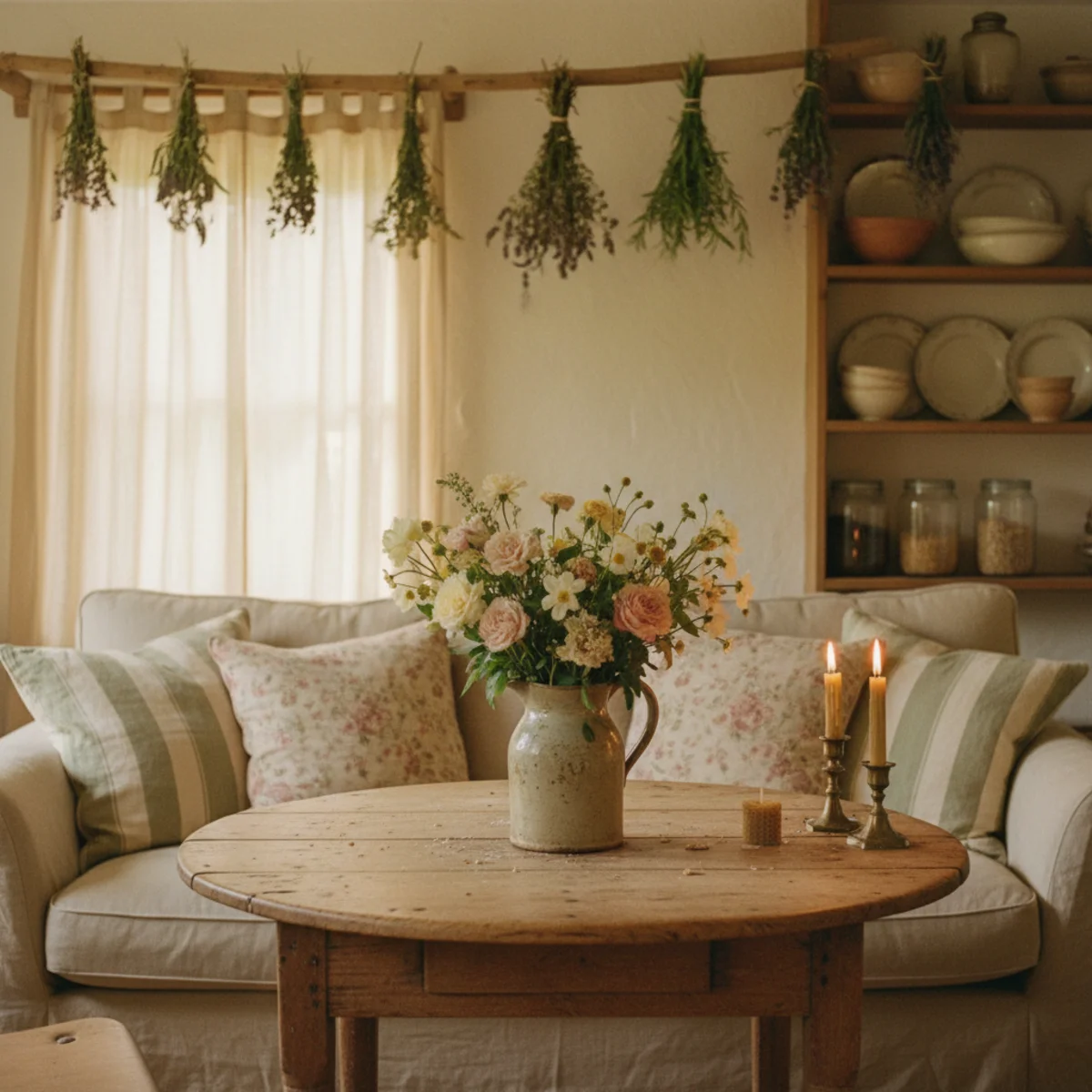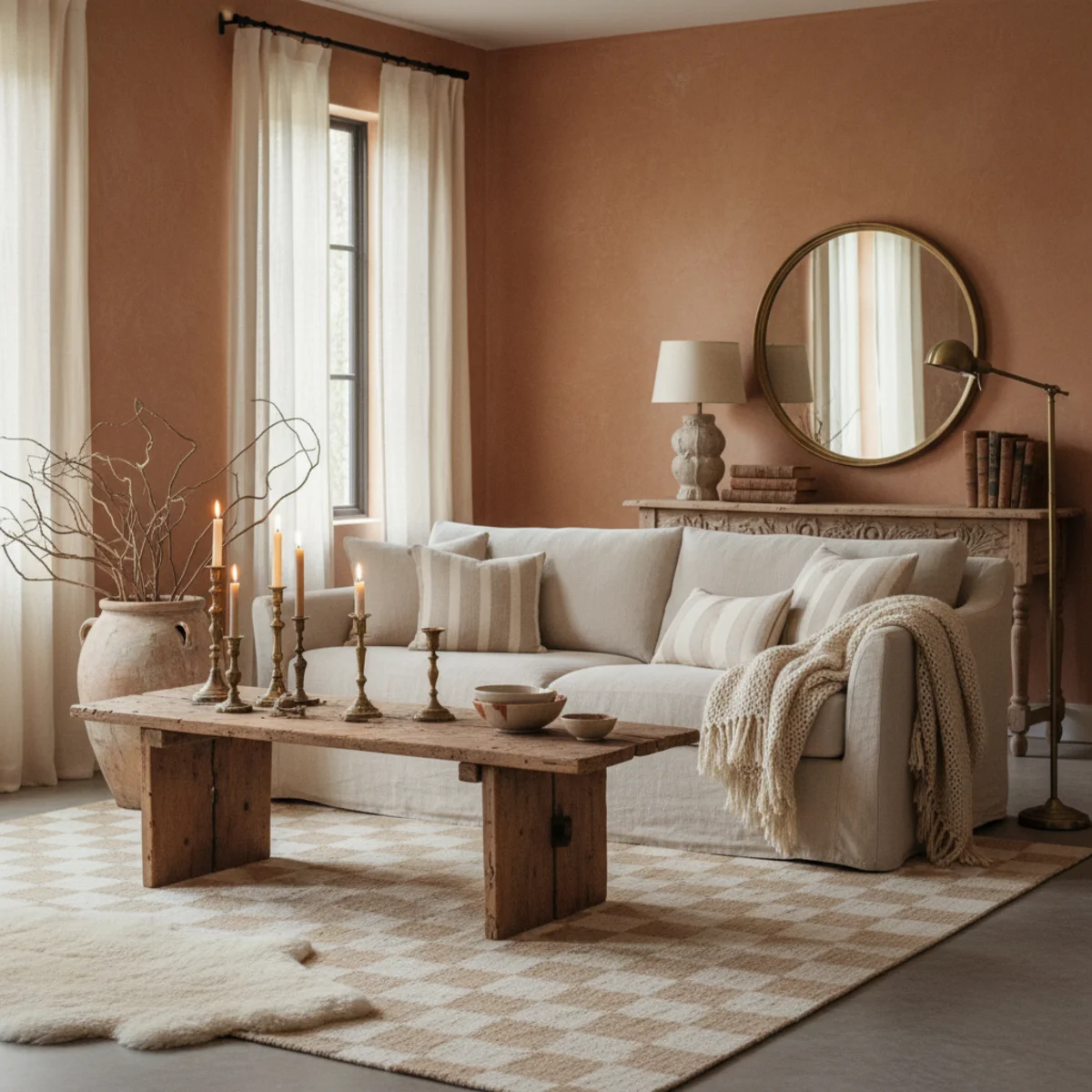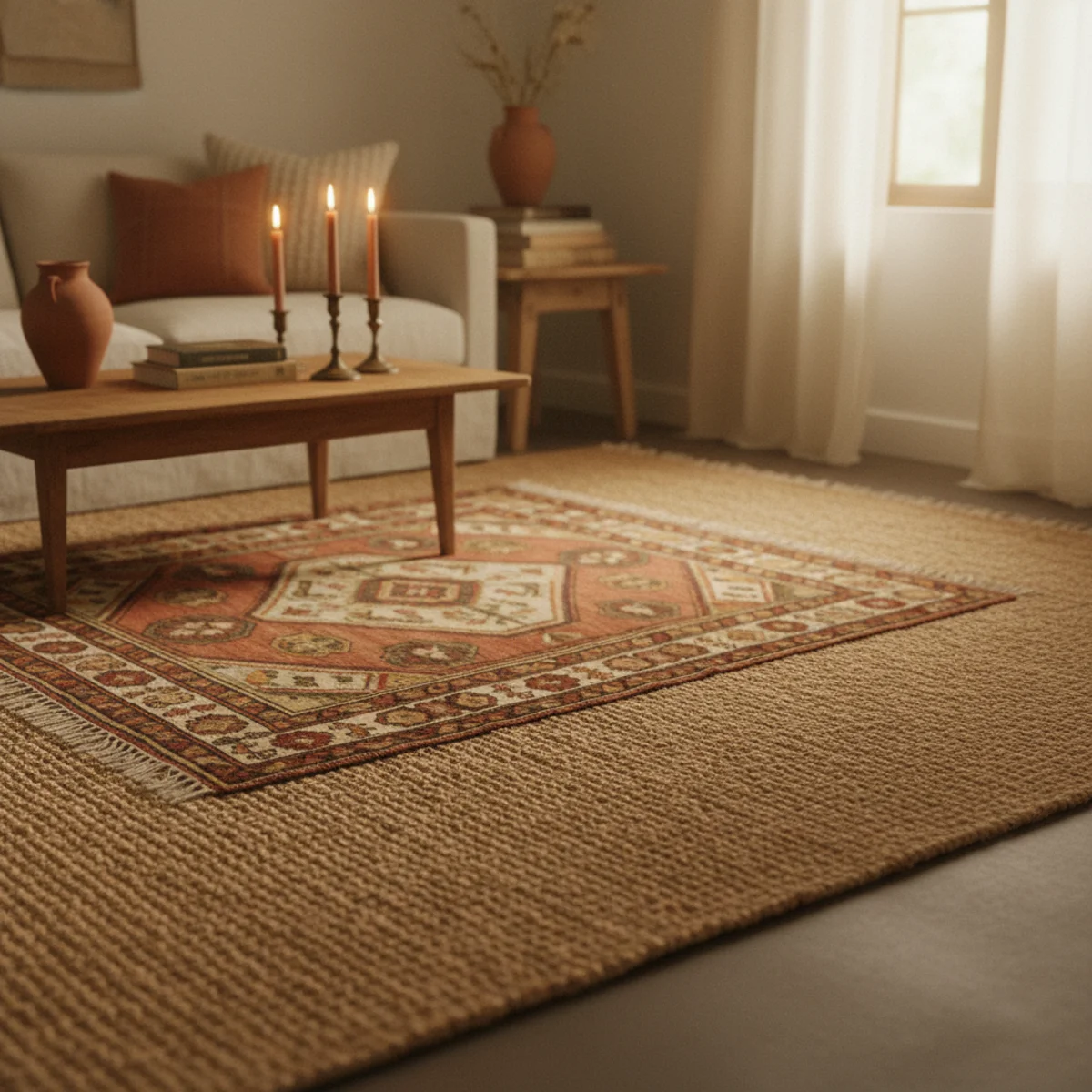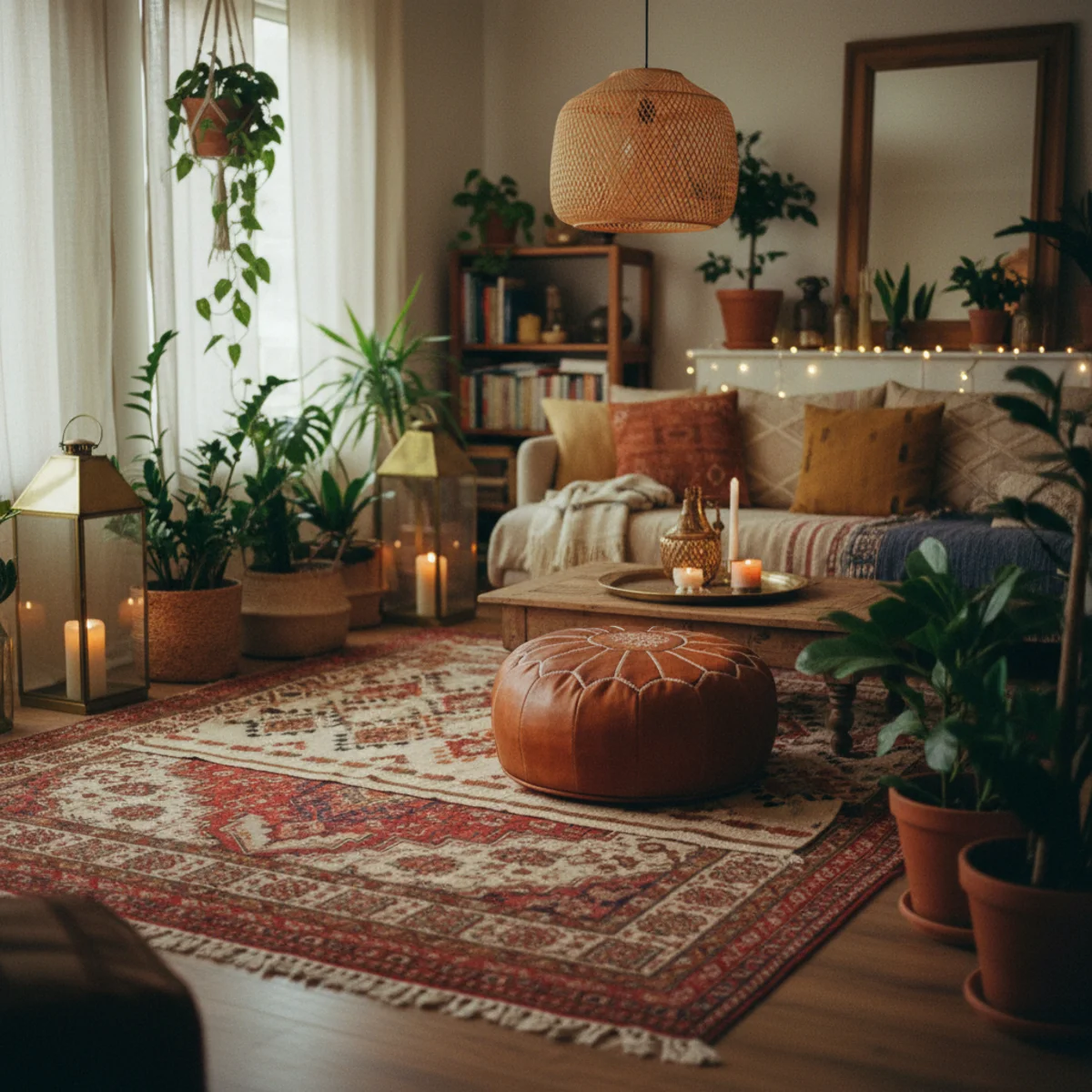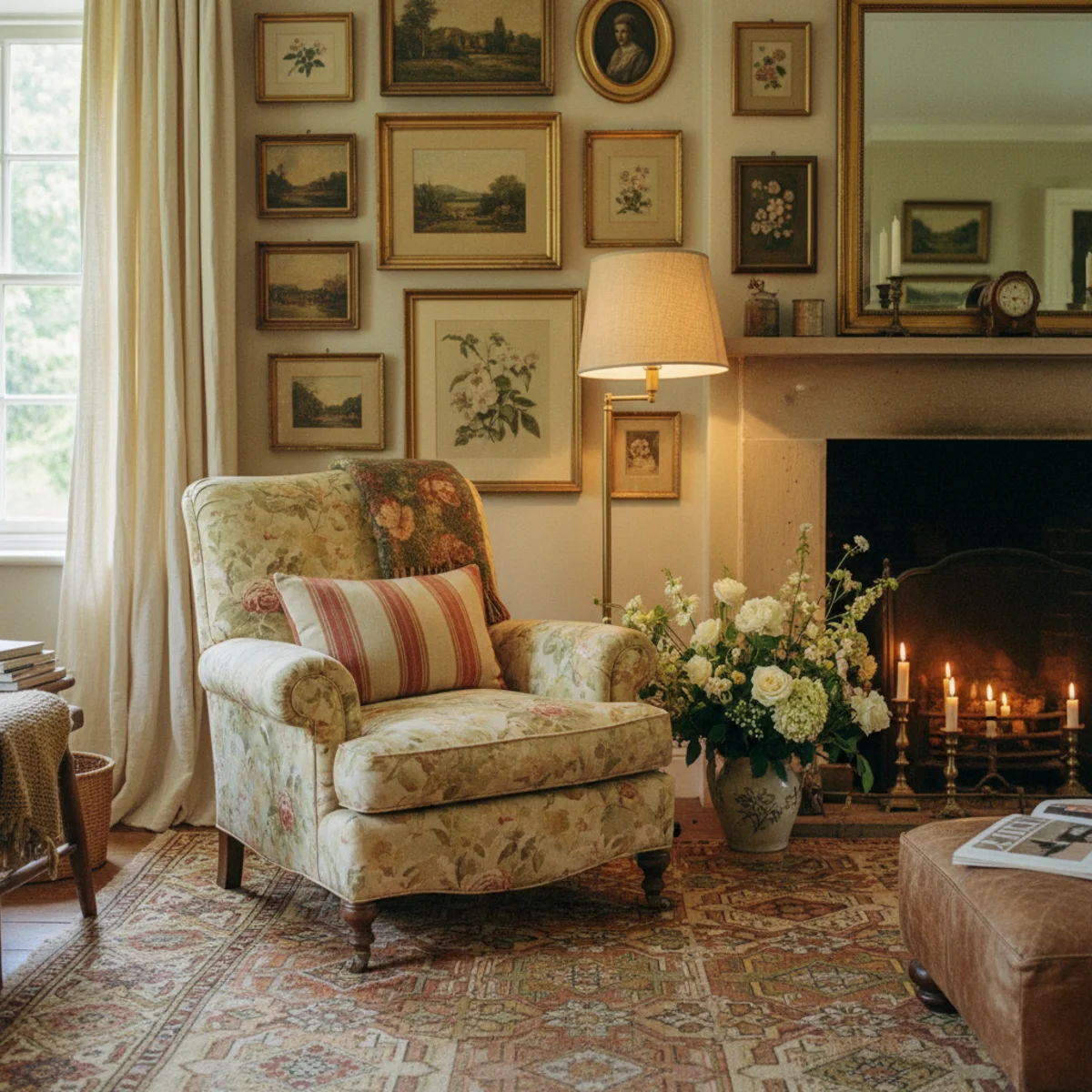
These twelve English country decor principles are grounded in the actual tradition — Georgian and Victorian country houses, the Arts and Crafts movement, the specific English relationship to gardens and countryside, the particular accumulation-over-generations that characterizes genuine English domestic spaces. Each principle names specific materials (faded chintz, worn leather, real antiques), specific layering approaches (patterns together without clashing, rugs that don't quite match), and the specific behaviors (keeping a fire, using comfortable worn furniture rather than precious preserved pieces) that distinguish authentic English country from commercial approximations.
Most commercial 'English country' or 'British cottage' decor fails because it's too new — too-bright chintz patterns without the fading that generations of washing produce, too-pristine antiques that have been over-restored, too-uniform layering that signals single-trip purchasing. The twelve principles below require the patience that the aesthetic demands: actual vintage and antique sourcing, real aging in textiles and furniture, accumulated-over-years rather than assembled-at-once.
By the end of this guide, you'll know exactly which moves produce genuine English country warmth — the layered patterns, the real antiques, the rich faded colors, the faded chintz, the mismatched rugs, the wall-filling art and books, the comfortable worn furniture, the collected objects, the fire and warm lamplight, the fresh flowers, the aged brass and metals, and the permission to let everything look genuinely lived-in.
WHAT'S INSIDE
- Why layering patterns (florals with stripes with geometric) is the defining English country move
- Real antiques versus reproductions — the visible difference that commercial English country misses
- The faded chintz — specifically faded, not newly printed, not reproduction
- The lived-in principle — the permission to stop trying to maintain perfection
The English country house is the original maximalism — but a warm, faded, lived-in maximalism, where every piece has a story and nothing is too precious to use.
— House Beautiful [citation needed — verify before publish]
What is English country decor?
English country style is a warm, layered, traditional look built on antique furniture, layered patterns — florals, chintz, stripes, and checks together — rich but slightly faded color, and a deeply collected, lived-in feel. It's the aesthetic of the old English country house, where rooms were furnished over generations rather than decorated all at once, so everything is comfortable, used, and a little worn.
The defining quality is layered abundance held in balance. Unlike the spare warm-minimalist styles, English country embraces pattern-on-pattern and a room full of collected things — but it's warmed and unified by faded color, the patina of genuine age, and the sense that nothing is too precious to actually use. Done well it's cozy and grand at once; done badly it's either a stiff museum or an overwhelming chintz explosion. The faded, lived-in quality is what keeps it warm.
More in Color Stories you may love
See allWhy English country is everywhere in 2026
After years of cold minimalism, English country surged as the warm, characterful antidote — Pinterest's English country and English country home searches climb steadily, and the look anchors the broader 'grandmillennial' and maximalist revival. People wanted rooms full of warmth, pattern, and story.
The honest appeal is that it's the opposite of disposable. English country is built on antiques, layered over time, and meant to last generations — which resonates as people turn away from fast, matching, all-at-once decorating toward the collected and the secondhand. The faded chintz and the scarred antique table read as warmth and history, exactly what a cold, brand-new room lacks. The 2026 version leans cozy and faded rather than stiff and formal.
12 ways to get the English country look
01Layer Patterns Together
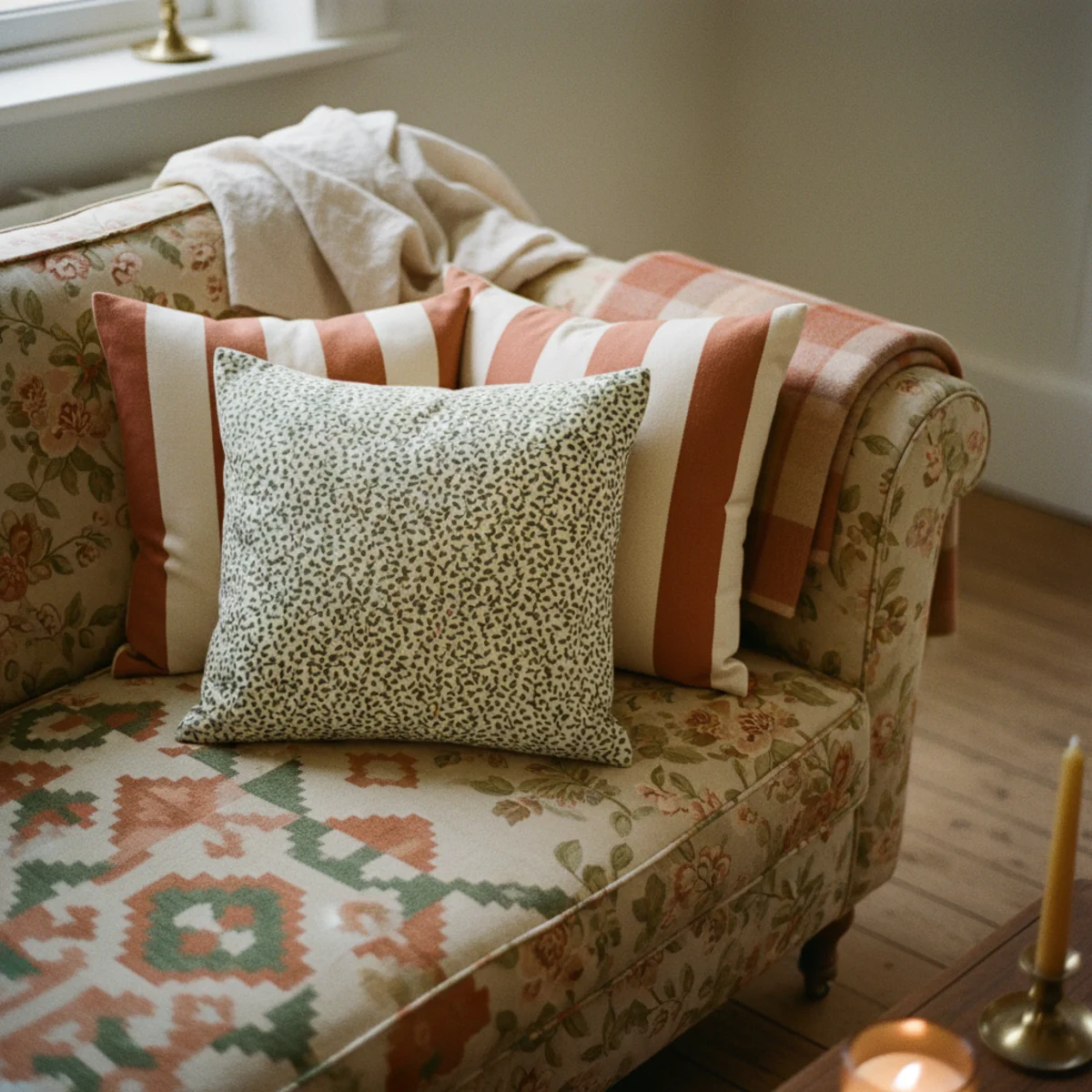
The defining English country move: layering multiple patterns in the same room without following the 'no more than three patterns' rule that simpler aesthetics observe. English country rooms have florals with stripes with geometric with plaid with chintz with paisley — but all in a coordinated color family that prevents the layering from becoming chaotic. The discipline is color, not pattern count.
Pattern layering strategy for English country: COLOR DISCIPLINE OVER PATTERN DISCIPLINE — all patterns share a color family regardless of how different their scales and types. In a room with terracotta, cream, deep forest green, and dusty blue as the palette: the floral sofa fabric can have all four; the stripe cushion can use two of the four; the geometric rug can use three; the plaid throw can use two. The shared colors tie the patterns together even when the scales and types are completely different. SCALE VARIATION — mixing small-scale prints with large-scale prints specifically prevents the patterns from competing. One large-scale floral (on a sofa or curtain), one medium-scale geometric (on a cushion or rug), one small-scale stripe or check (on a throw or napkin). PRIMARY PATTERN as anchor — the room's largest textile (sofa or curtains) sets the primary pattern; all others coordinate with it. VINTAGE AND ANTIQUE PATTERNS — English country pattern layering works best when some of the patterned textiles are genuinely old (faded, worn) rather than all new. The age variation makes the layering read as 'accumulated' rather than 'assembled to look accumulated.' START GRADUALLY — for households not used to pattern mixing, start with one patterned element per room and add second, then third over 6-12 months. The gradual addition builds confidence.
AFFILIATE SLOTPATTERNLayer floral + stripe + geometric + plaid in shared color family; large, medium, small scale variation; vintage and new patterns mixedAdd affiliate URL when configuredWhy it works
Because English country interiors developed over centuries through the accumulation of objects and textiles across generations of household life — and household life naturally accumulates patterns without a single designer's coordinating eye. The patterned Victorian wallpaper behind the Edwardian floral sofa fabric behind the Georgian geometric rug behind the Arts and Crafts throw didn't share a palette by design; they share a palette by the household's consistent warm-color preference across generations. The layered-patterns aesthetic is the visual record of that accumulated household life. Commercial 'English country' often layers patterns by purchasing coordinated sets, which produces visually similar but experientially different results — the patterns match too well.
Pro tip — Start pattern mixing with cushion covers — they're the lowest-stakes pattern introduction and are easily swapped. Buy one floral cushion for a sofa that currently has solid cushions. Then add one stripe cushion. Then one geometric. Over 6 months, the sofa builds toward English country pattern layering without any single dramatic intervention.
Floral sofa, stripe cushions, geometric rug, plaid throw — accumulated pattern layering with color discipline. See also: cottagecore-decor
02Anchor With Real Antiques
English country interiors require actual antiques — not reproduction Victorian side tables, not 'antique-look' furniture from commercial retailers, but genuine Georgian, Victorian, or Edwardian pieces sourced from estate sales, auction houses, or antique dealers. The visible age of real antiques (patina, wear, original hardware, period joinery) is what the aesthetic depends on.
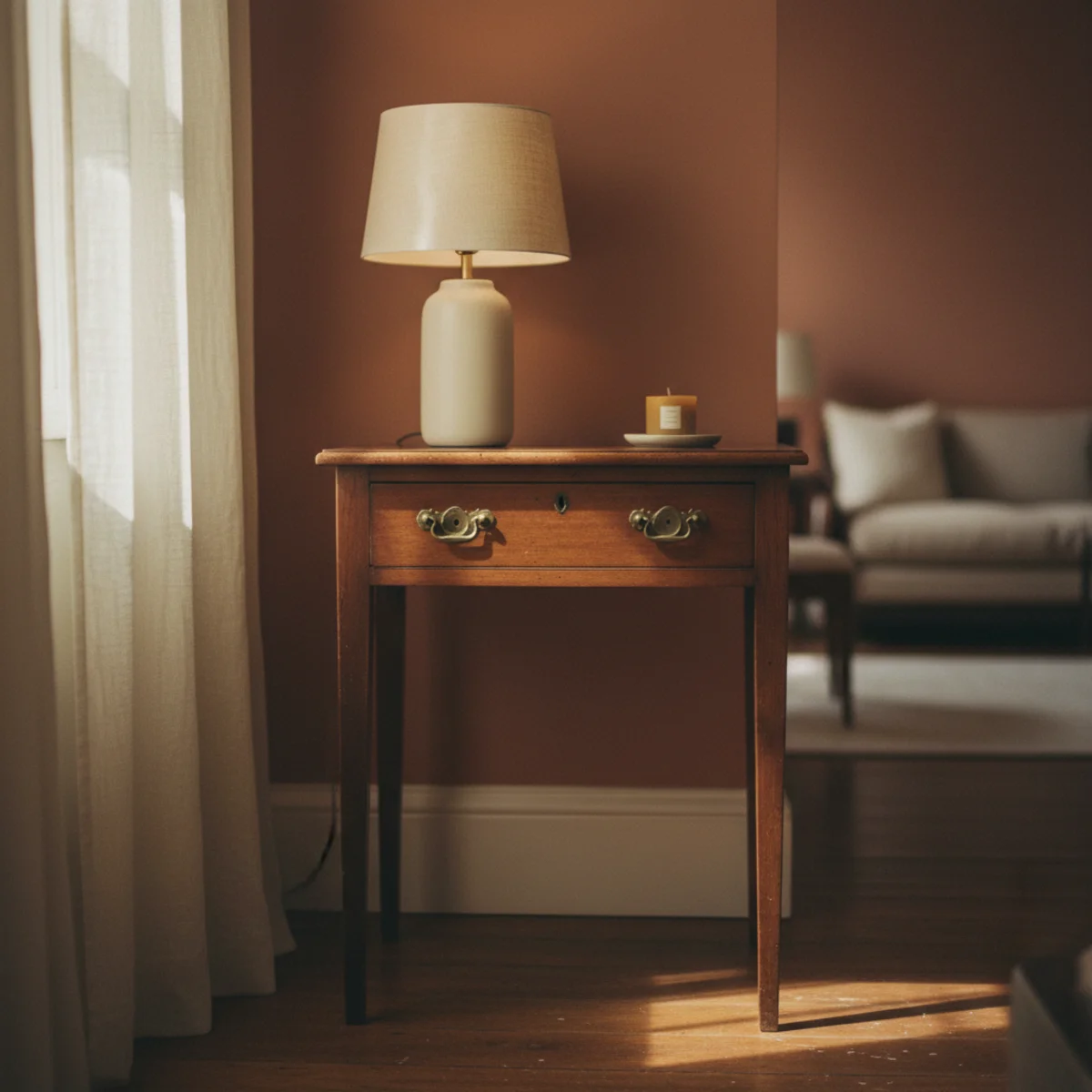
Antique sourcing for English country: PRIORITY ANTIQUE CATEGORIES — Georgian or Victorian side tables ($100-500 at auction or estate sales), Victorian or Edwardian upholstered armchairs (reupholster if needed at $200-600 for the chair + $80-200 for reupholstery), period chests of drawers or tallboys ($150-600), Victorian writing desks ($200-800), Edwardian bookcases ($150-600). SOURCING VENUES — estate sales (best prices, require patience), local auction houses (good prices for Georgian and Victorian), antique dealers (convenient, higher prices), Marketplace and Craigslist (irregular but often excellent finds), Chairish and 1stDibs (online with reliable authentication at premium prices). THE VISIBLE AGE TEST — genuine antiques show: brass hardware with authentic patina (not polished uniform shine), drawer runners with worn grooves from decades of use, original finish that's worn at wear points (handles, edges, tops), period construction methods (hand-cut dovetails, wooden pegs rather than screws). REPRODUCTIONS ARE VISIBLE — the manufacturing consistency of reproduction 'antique-look' furniture is visible on close inspection. Original antiques have slight imperfections and wear patterns that mechanized reproduction cannot produce.
AFFILIATE SLOTFURNITUREGenuine Georgian/Victorian/Edwardian pieces from estate sales, auction houses, Marketplace; visible patina, original hardware, period joineryAdd affiliate URL when configuredWhy it works
Because English country is built around visible generational time — the pieces that have been in the house since the grandparents or great-grandparents era, the furniture that has accumulated decades of polish, use, and repair. Reproduction antiques cannot carry this because they have no actual generational time. A genuine Victorian chest of drawers with its original brass handles worn smooth from seventy years of morning openings carries something no reproduction at any price point can — the physical evidence of household life across time. English country specifically romanticizes this accumulated evidence; reproduction lacks it entirely.
Pro tip — Buy furniture at auction preview days before the sale — attending the preview lets you physically examine condition, confirm period authenticity, and assess any repairs needed before bidding. Auction house estimate catalogs often have notes on condition and period that help identify genuine pieces. Budget 15-30% of auction hammer price for repairs or reupholstery of period upholstered pieces.
Victorian mahogany with original brass hardware worn smooth — the physical evidence of household time that reproductions lack. See also: thrifted-decor-ideas
03Use Rich but Faded Color
English country palette is rich in variety but faded in saturation — deep rose that has softened across decades of sunlight, hunter green that has quieted to forest, deep gold that has mellowed to ochre, deep blue that has washed to dusty. The 'faded rich' quality is what distinguishes English country from both commercial country (too bright) and minimalism (too pale).
English country palette specifics: COLOUR FAMILY — the palette is broader and richer than most warm-home approaches. Where Japandi uses 2-3 muted neutrals and cottagecore uses soft faded pastels, English country uses multiple rich colors simultaneously — deep rose, forest green, warm gold, dusty blue, terracotta, cream, warm red-brown. FADED QUALITY — the key is that rich colors should read as faded and aged, not as fresh commercial paint. Achieve this with: specific paint colors (Farrow & Ball's whole range works, particularly their 'Historic' colors — Porphyry Pink 49, Hague Blue 30, Calke Green 80, Cooking Apple Green 32), aged textiles rather than new ones, actual sunlight fading across years for textiles positioned near windows. PAINT COLOURS — F&B Porphyry Pink 49, BM Red Parrot 2084-30 (but add white to mute), SW Muted Clay SW 9120, F&B Hague Blue 30, F&B Green Smoke 47, F&B Orangery 70. DISTRIBUTION — unlike most warm home aesthetics where one or two colors dominate, English country allows 4-6 colors simultaneously but each in small doses (one room predominantly one deep color, with the other colors as accents in pattern, textiles, art).
AFFILIATE SLOTPALETTEF&B Porphyry Pink 49, Hague Blue 30, Green Smoke 47, Calke Green 80, Orangery 70; 4-6 rich-but-faded colors simultaneously; aged textiles for authentic fadingAdd affiliate URL when configuredWhy it works
Because unfaded, commercially-bright English country palette reads as theme park rather than as genuine English country interior. The specific faded quality of authentic English country interiors comes from exactly what it sounds like — actual fading. Chintz curtains that have hung in sunny rooms for 20 years, Persian rugs worn through generations of use, wallpaper that has absorbed decades of fireplace smoke and household air. The fading is the evidence of the household life that English country romanticizes. New bright colors reference English country; faded rich colors embody it.
Pro tip — Look for genuinely faded textiles at estate sales — English country palette is most authentically achieved by purchasing vintage and antique textiles that have already undergone 20-40 years of fading. The faded chintz cushion from a 1970s estate sale is more authentically English country than any new chintz cushion at any price.
Deep rose, forest green, dusty blue, warm gold — the rich multi-color palette that reads as aged household rather than as designed. See also: warm-paint-colors
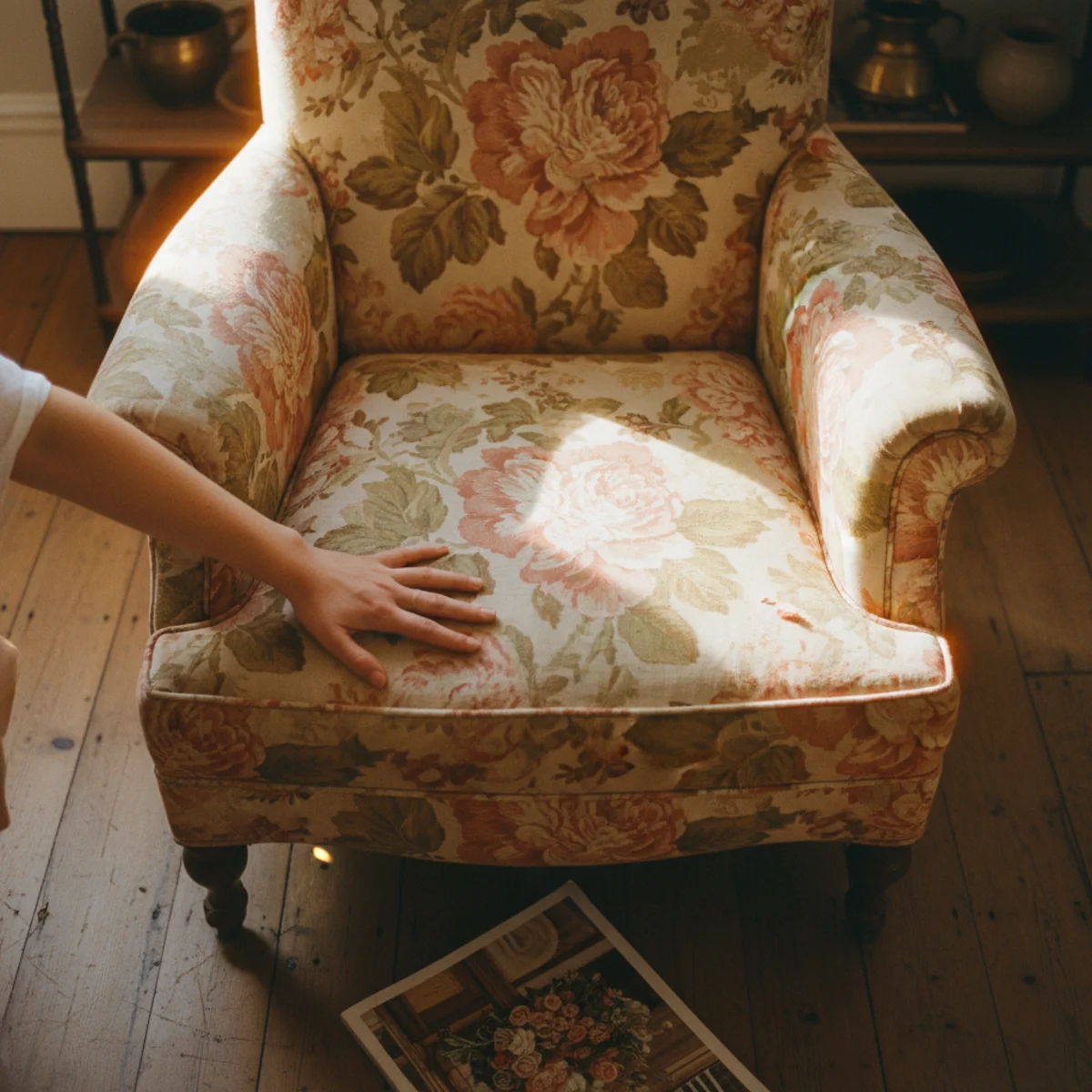
04Add a Faded Chintz
Faded chintz — the large-scale floral cotton print traditionally used for English country upholstery, curtains, and cushions — is the signature English country textile. The specifically-faded version (genuine vintage chintz that has lost its original brightness through decades of use) is the authentic form; new reproduction chintz is the commercial approximation.
Faded chintz sourcing and use: AUTHENTIC VINTAGE CHINTZ SOURCES — estate sales (look for 1950s-1970s upholstered furniture or curtain fabric), vintage fabric retailers on Etsy ($8-30 per yard for genuine vintage chintz), eBay vintage textile sellers, charity shops in older UK-style neighborhoods. PATTERN REQUIREMENTS — large-scale floral (roses, peonies, tropical flowers, garden flowers) with multiple colors. The pattern should have red, pink, cream, green, and possibly blue or gold as palette. FADED READ — the authentic vintage chintz has: slightly dulled color that differs from the commercial original, slightly softened contrasts that read as washed, a surface character that shows fabric aging (slight texture change, slight sheen loss). NEW CHINTZ ALTERNATIVES — Colefax and Fowler, Sanderson, Designers Guild, Lee Jofa, and Brunschwig & Fils produce high-quality English country chintz ($30-100 per yard) that is not 'faded' by the vintage standard but is correctly patterned and colored. For households who want the aesthetic without the vintage hunting, these commercial options deliver the pattern correctly. APPLICATIONS — primary sofa or chair upholstery (the largest application, most impactful), curtain fabric (second-largest application, creates full-room chintz context), cushion covers (smallest and most-accessible application). AVOID — polyester chintz-look fabric that lacks the natural cotton breathing quality and ages poorly.
AFFILIATE SLOTTEXTILEGenuine vintage large-scale floral chintz from estate sales/Etsy vintage; OR Colefax & Fowler/Sanderson new chintz; on primary upholstery, curtains, or cushionsAdd affiliate URL when configuredWhy it works
Because authentic English country interiors had chintz that was genuinely old by the time they became the reference aesthetic — the Colefax and Fowler rooms that defined 'English country' in the 20th century already had 30-50 year old chintz that had faded through generations of use. The faded quality is not a stylistic preference but a temporal reality: the English country chintz that became the aesthetic reference was already old when photographed and admired. Reproducing the reference requires reproducing the age, which commercial new chintz cannot do.
Pro tip — Source vintage chintz fabric from estate sales and use a local upholstery shop to reupholster existing furniture — vintage chintz fabric at $5-20 per yard from estate sales plus local upholstery at $300-600 per piece produces genuinely faded authentic chintz furniture at 40-60% of the cost of purchasing new chintz from design-trade fabric houses.
Vintage armchair in faded rose-and-green chintz — the specifically-aged textile that makes authentic English country read correctly. See also: cottagecore-decor
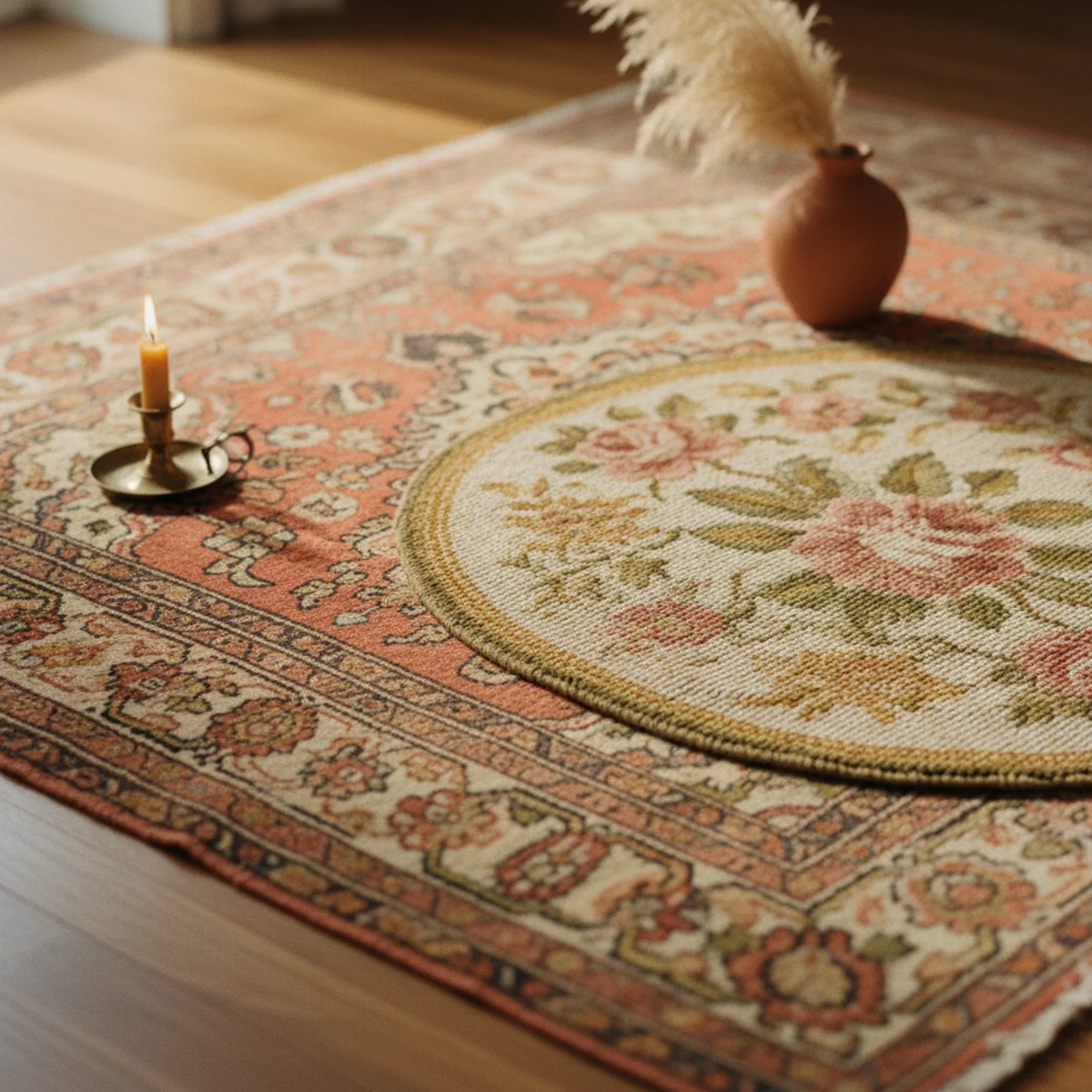
05Layer Rugs That Don't Quite Match
English country rooms often have multiple rugs — a large Persian or Turkish carpet as the primary floor covering, with one or two smaller rugs layered over or beside it. The rugs share the room's general color family but are different enough in pattern and style to read as collected-from-different-sources rather than as purchased-as-set.
English country rug layering: PRIMARY RUG — a large antique or vintage Persian, Turkish, or Caucasian hand-knotted rug ($300-3,000 depending on age, size, and condition, with excellent pieces at $400-800 from estate sales and rug dealers). The primary rug establishes the room's primary floor-level pattern and color. SECONDARY RUG — a smaller rug (3x5 or 4x6 feet) layered over or adjacent to the primary rug. Can be a needlepoint rug (very English country, $200-600 vintage), a smaller Persian or tribal rug, or a flat-woven kilim. LAYERING TECHNIQUE — place the primary rug anchoring the primary seating group. Place the secondary rug over one corner of the primary rug or adjacent to it, tucked slightly under furniture. The overlap of 6-10 inches at one edge reads as organic rather than as deliberate layering. COLOUR RELATIONSHIP — both rugs should share at least one or two colors from the room's palette but need not match each other. A red-and-navy Persian under a green-and-cream needlepoint reads as English country collected; two perfectly matched Persian sets read as purchased together. VINTAGE SOURCING — vintage and antique rugs are available at estate sales ($50-500 for smaller pieces), rug dealers, auction houses, and Marketplace. The vintage sourcing is essential; new rugs with vintage-inspired patterns lack the wear and age that authentic English country floors require.
AFFILIATE SLOTRUGSPrimary vintage Persian or Turkish hand-knotted rug + secondary needlepoint, kilim, or smaller Persian sharing color family but not matchingAdd affiliate URL when configuredWhy it works
Because the layered mismatched rugs express exactly what genuine English country interiors represent: accumulated household objects from various sources across various periods, none purchased for the purpose of matching but all landing in the same room because this is the family's home. The primary Persian rug was a grandmother's wedding present; the small needlepoint was found at a village fete; the kilim was brought back from a foreign trip. The non-matching layering IS the evidence of accumulated household life.
Pro tip — Source vintage needlepoint rugs specifically for English country rooms — needlepoint rugs (hand-stitched wool onto canvas in floral or scenic patterns) are specifically associated with English country interiors, appear frequently at estate sales in older neighborhoods at $50-250 for small to medium pieces, and layer perfectly with Persian or Turkish primary rugs.
Vintage Persian carpet with small needlepoint layered over one corner — non-matching rugs from different sources accumulating at the floor. See also: modern-farmhouse-decor
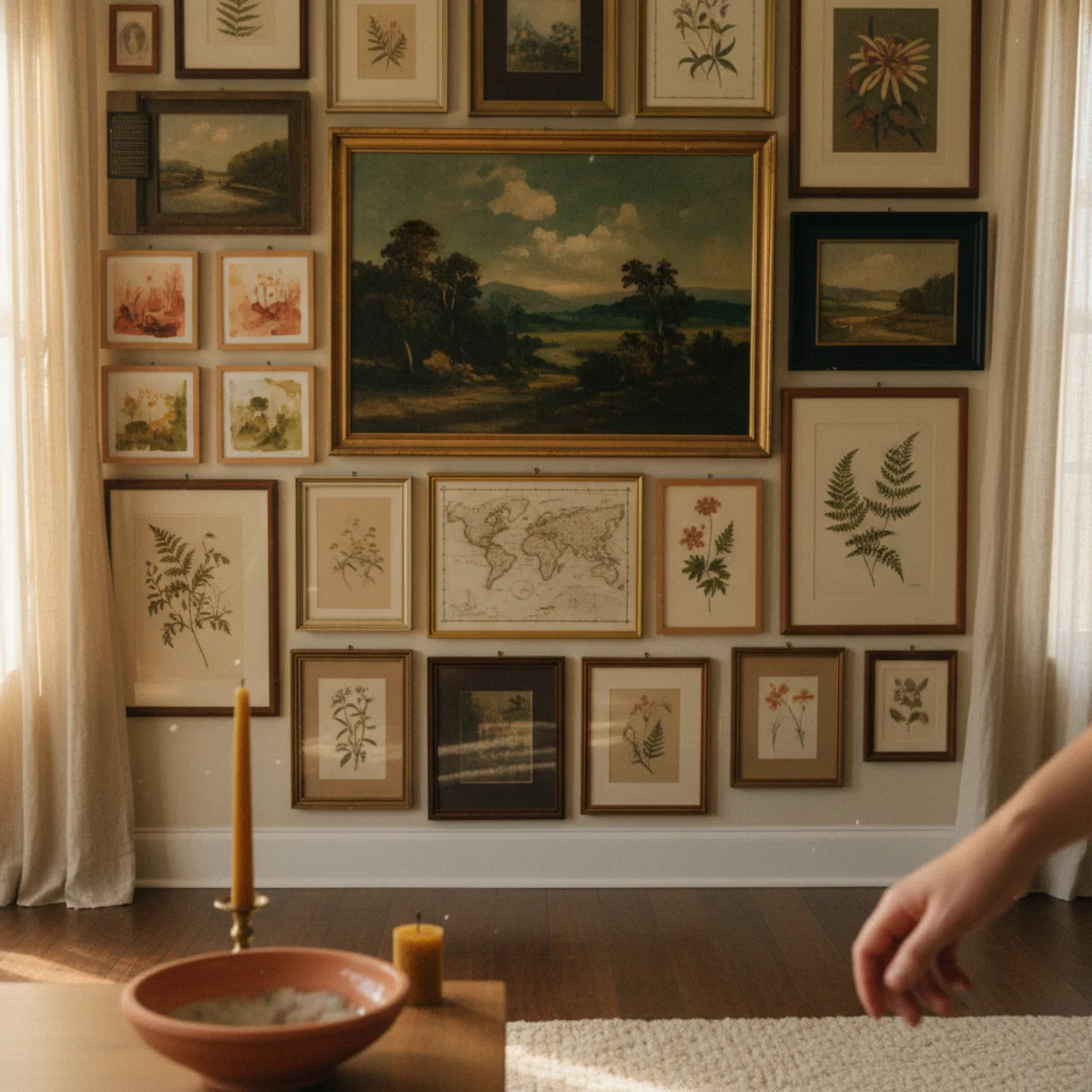
06Fill the Walls
English country walls are full — not the single-statement-piece-per-wall approach of Japandi or warm minimalism, but multiple pieces at varied heights with occasional overlapping frames, floor-to-ceiling bookcases on some walls, and the specific accumulation of art and books that generations of household life produce. The full walls read as library-study-home rather than as gallery.
Wall-filling English country approach: ART — multiple pieces of varied size and subject in related-but-not-matched frames. Watercolors, botanical prints, oil paintings (landscapes, portraits, still life), hunting scenes, maps, engravings — a mix of subject matter that accumulated rather than was curated. FRAME VARIETY — wood frames of different periods, gilded frames of different sizes, simple frames, ornate frames — all in the warm-metal/wood family but varied in specific design. HANGING DENSITY — pieces may be hung 2-3 per wall section, at varied heights, with frames close enough that negative space between them is minimal. This is the opposite of the 'one piece per wall with breathing room' principle; English country walls are dense with art. BOOKCASES — floor-to-ceiling bookcases on one or two walls, filled with actual books (not decorative display books). Books color-coded or organized by subject depending on household preference; the point is genuine use. STACKING AND LEANING — small pieces leaned against larger pieces on shelves and mantels, books stacked horizontally in front of upright books, small framed photos among larger paintings. HEIGHT VARIATION — pieces hung at different heights rather than all aligned to a consistent rail height.
AFFILIATE SLOTWALLSMultiple varied art pieces in mixed frames at varied heights; floor-to-ceiling bookcases with actual books; stacked and leaning objects; dense not sparseAdd affiliate URL when configuredWhy it works
Because the full walls express accumulated intellectual and aesthetic life — the generations of household members who collected art, read books, received gifts of watercolors, inherited portraits, and hung everything rather than selecting a few pieces. Empty wall space in an English country interior is not 'breathing room' but 'wall that hasn't accumulated enough yet.' The fullness is the point.
Pro tip — Build the full walls gradually over years — the single most-common mistake in attempting English country is buying 20 inexpensive prints at a single visit to fill all the walls at once. The accumulated character requires actually accumulating across time. Add one piece per month from varied sources; the year-long wall-building produces more authentic English country than any single shopping trip.
Dense varied wall art in mixed frames — the accumulated aesthetic and intellectual life of a household across generations. See also: gallery-wall-ideas
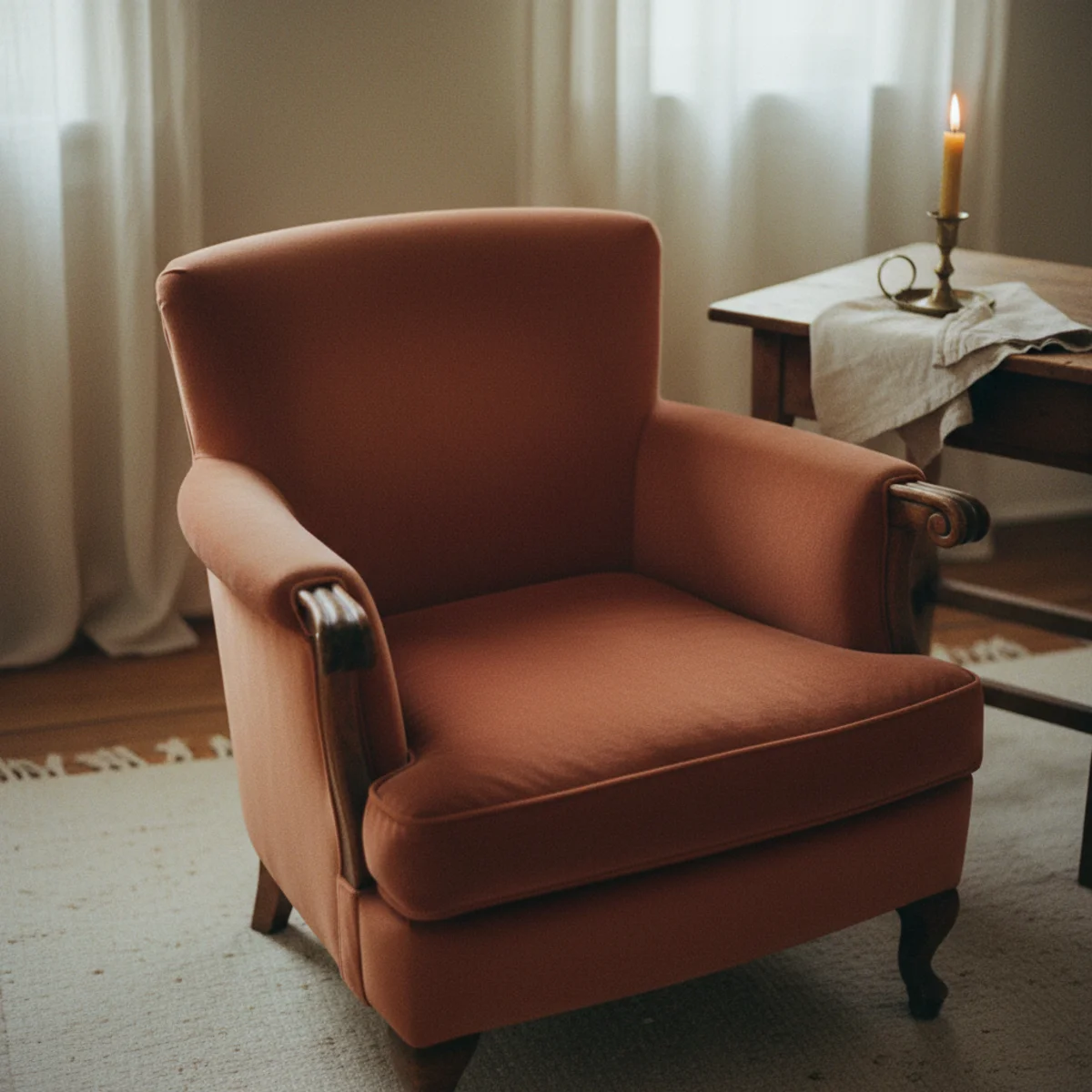
07Add Comfortable, Used Furniture
English country sofas and chairs should look used — slightly settled, slightly worn at arm rests and seat edges, with the slumped comfortable posture of furniture that has held human beings daily for years. The perfect-condition sofa from a design showroom fights English country as much as a reproduction antique does; the worn-in comfortable sofa from years of family use is the authentic version.
Comfortable used furniture for English country: THE SLUMPED QUALITY — genuine English country upholstered furniture has: seat cushions that have settled into comfortable shaped dips, arm covers where hands rest that are slightly darker than surrounding fabric from years of contact, cushion covers that have developed slight wrinkling or softening from regular use. This quality takes years to develop or can be started with genuinely vintage furniture. ANTIQUE UPHOLSTERED CHAIRS — Victorian or Edwardian armchairs reupholstered in period-appropriate fabric ($150-400 for the chair at estate sales + $200-600 for reupholstery) have the settled quality that new furniture lacks. SOFAS — quality English-make sofas (Parker Knoll, Howard & Sons reproduction, Tetrad) at $1,500-5,000 new, OR vintage sofas with good bones reupholstered in chintz or linen at $300-600 for the piece + $800-2,000 for reupholstery. THE WELL-WORN LEATHER — a genuine aged leather club chair from 1960s-1970s at $200-600 from estate sales or Marketplace. The cracked, worn leather that develops over decades carries more warmth than any new 'distressed' leather. SLIP COVERS — a slightly-loose linen or cotton slipcover on a sofa reads as English country because it implies the furniture underneath is precious enough to protect, and comfortable enough to be regularly used.
AFFILIATE SLOTFURNITUREWorn-in Victorian/Edwardian chairs reupholstered in chintz or linen; slumped comfortable vintage sofas; aged leather club chairs from estate salesAdd affiliate URL when configuredWhy it works
Because English country specifically values use over preservation — the room that looks as if it has been comfortably occupied for years rather than preserved for show. A pristine perfect-condition sofa in an English country room reads as if the occupants treat their furniture as precious objects rather than as comfortable household equipment. The worn-in quality is the visible evidence of the daily comfort that English country provides — the living room used for actual family life rather than for occasional formal reception.
Pro tip — Avoid over-restoring any vintage upholstered piece acquired for an English country room — some households sand down, re-polish, and restore Victorian chairs to pristine condition before using them. The restoration defeats the authenticity. Structural repairs (tightening joints, replacing webbing) are necessary; cosmetic restoration (polishing away patina, refinishing to look new) is counterproductive.
Victorian armchair with settled seat and slightly worn arms — furniture that has been comfortably occupied for years. See also: thrifted-decor-ideas
08Display Collected Objects
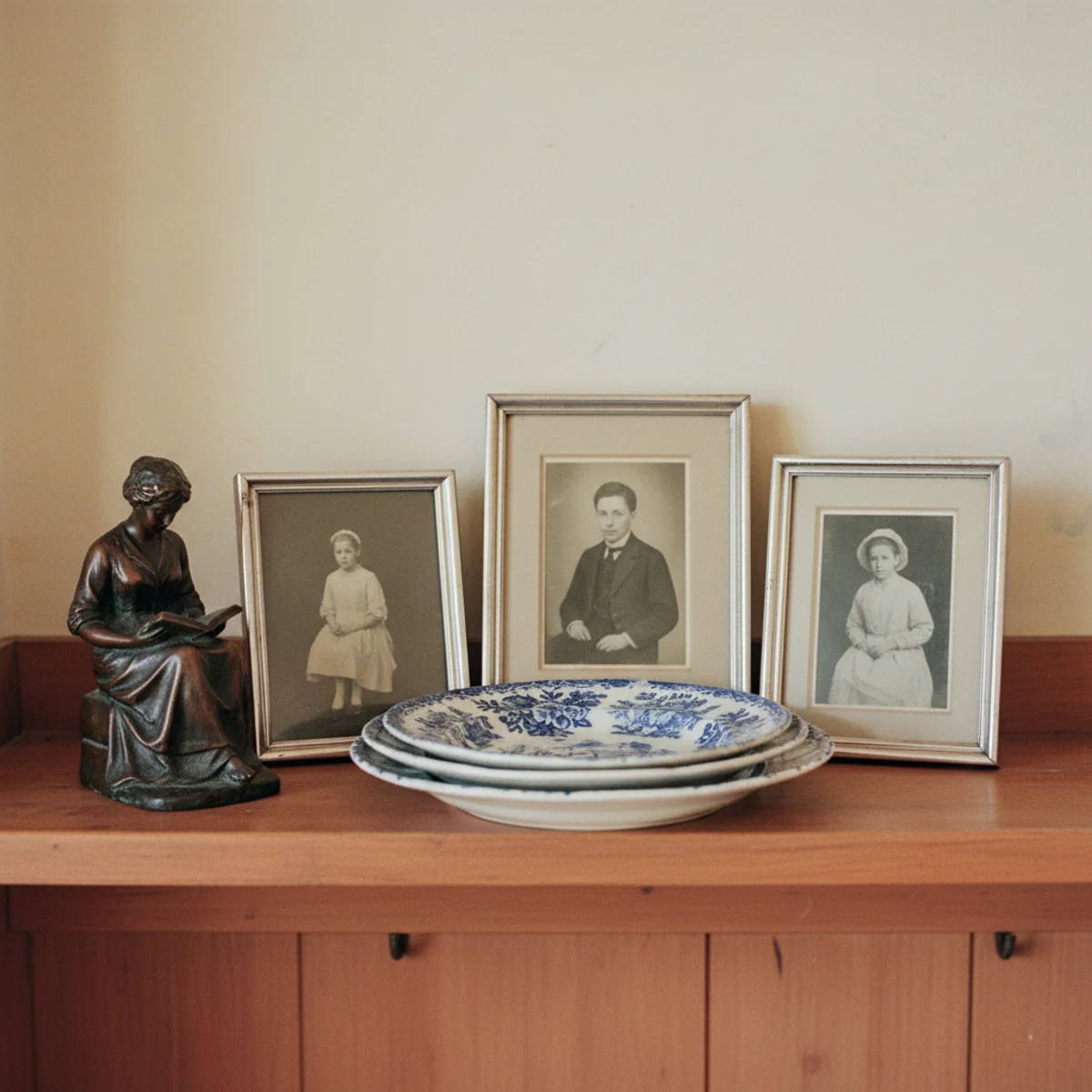
English country rooms display accumulated collections of objects — blue-and-white transfer-ware ceramics on shelves, silver-framed family photographs on piano tops, antique boxes on tables, shell collections on windowsills, small bronzes on side tables, flower frogs in ceramic pitchers. The objects tell the story of the household's history, interests, and travels.
English country collected objects categories: CERAMICS — blue-and-white transferware on open shelves (Willow pattern, flow blue, ironstone at $5-40 per piece from estate sales), majolica in earth tones, Victorian lustre ware, antique porcelain. SILVER-FRAMED PHOTOGRAPHS — small silver-frame family photos on a tabletop or piano. The collection of generations-across-time in silver frames is specifically English country. SMALL BRONZES AND BRASS OBJECTS — antique desk accessories, letter openers, small figures, inkwells, matchstick holders. NATURAL HISTORY OBJECTS — shells, fossils, small stones from significant places, pressed botanicals in glass or frames. TRAVEL OBJECTS — small pieces acquired on travels, particularly pieces from historically British-connected places (Indian brass work, Hong Kong ceramics, Kenyan woven pieces from colonial-era collecting). SEASONAL NATURE — fresh garden flowers, forcing bulbs in winter, seasonal foliage. ARRANGEMENT PRINCIPLE — objects are grouped in collections (all the blue-and-white together, all the silver frames together, all the natural history together) rather than distributed individually. The group-of-like-objects reads as collection; the single distributed object reads as decoration.
AFFILIATE SLOTOBJECTSBlue-and-white ceramics, silver-framed family photos, antique brass objects, natural history pieces, travel acquisitions; grouped in collections not distributed individuallyAdd affiliate URL when configuredWhy it works
Because the objects tell the story of the household — who lived here, where they went, what interested them, what was given to them, what was inherited. A room full of collected objects is a readable autobiography of the household across time. Commercial 'decorative objects' purchased as a matched set for display tell no story; the specific antique school atlas from a grandmother, the set of blue-and-white plates collected over 40 years, the bronze elephant from a father's business trip — these tell everything about the people who lived with them.
Pro tip — Prioritize collections with personal household connection over general antique market collections — the blue-and-white plates from your own family's china cabinet, the silver-framed photos of your own generations, the specific items from meaningful places in your household's history. The objects' personal connection to your household specifically is what makes the display authentic English country rather than just antique collecting.
Grouped blue-and-white ceramics, silver frames, brass objects — readable household autobiography in collected groups. See also: shelf-styling-ideas
09Keep a Fire and Warm Lamplight
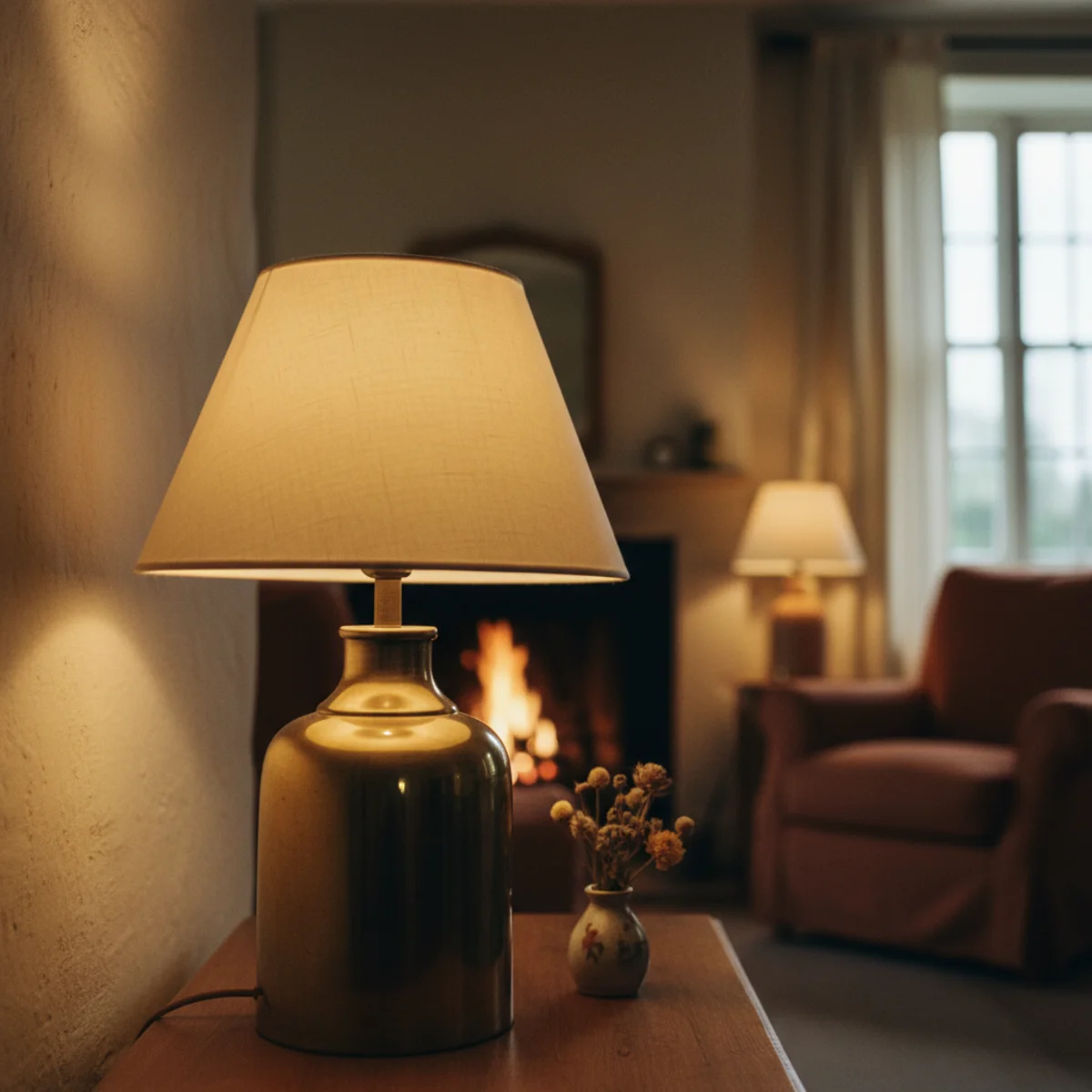
English country is a cold-weather, northern-hemisphere aesthetic built around warmth against the specific cold and grey of British weather. A working fireplace used consistently through winter, supplemented by multiple warm lamps at 2700K throughout every room, is the lighting infrastructure that the whole aesthetic depends on.
English country lighting: WORKING FIREPLACE — the fire should be lit on every cold evening that the household is home. English country specifically does not treat fire-lighting as a special-occasion event but as regular household practice. If working fireplace isn't available, a quality electric insert (per fireplace-nook-ideas item 7) or candle cluster. TABLE LAMPS — multiple warm table lamps throughout every room, 3-5 per room. Victorian or Edwardian lamp bases (converted oil lamps, antique bases with new shades) at $40-200 from estate sales plus warm linen or silk shades. Or modern ceramic bases in warm tones with traditional drum shades. 2700K LED throughout. NO OVERHEAD DURING EVENING — the English country tradition is entirely lamp-lit during evening hours. Overhead lighting was largely absent in pre-electrical English country houses (rush lights, candles, oil lamps) and the multiple-table-lamp approach recreates this distributed warm-light tradition with electric convenience. CANDLES — beeswax candles in silver or brass holders on dining tables, side tables, mantelpieces. Used daily rather than for special occasions. THE LAMPLIGHT QUALITY — multiple warm lamps at table height creates the specific distributed-golden quality that English country photographs capture. The same room under overhead cold light looks like a warehouse; under warm distributed lamplight it looks like what English country is.
AFFILIATE SLOTATMOSPHEREWorking fire every cold evening; 3-5 warm table lamps per room at 2700K; no overhead during evening; beeswax candles on surfacesAdd affiliate URL when configuredWhy it works
Because English country is a specifically cold-weather aesthetic designed around warmth against cold — the warm fire and warm lamps are not decoration but the reason the aesthetic exists. English country houses were the solution to British winters, and their warmth-creating qualities (multiple fires, multiple lamps, warm materials everywhere) are the authentic purpose of the aesthetic rather than stylistic choices. Reproducing the aesthetic without the warmth infrastructure produces the appearance without the experience.
Pro tip — Start the evening lamp routine at 4pm in winter rather than at dusk — English winters have sunset at 3:30-4pm in December, and the transition from insufficient afternoon light to warm evening lamp light is specifically the English country experience. The early-evening lamp lighting is a winter ritual that defines the aesthetic.
Lit fire, multiple warm lamps, beeswax candles — the distributed warm light that is the reason English country exists. See also: fireplace-nook-ideas
10Bring in Fresh Flowers
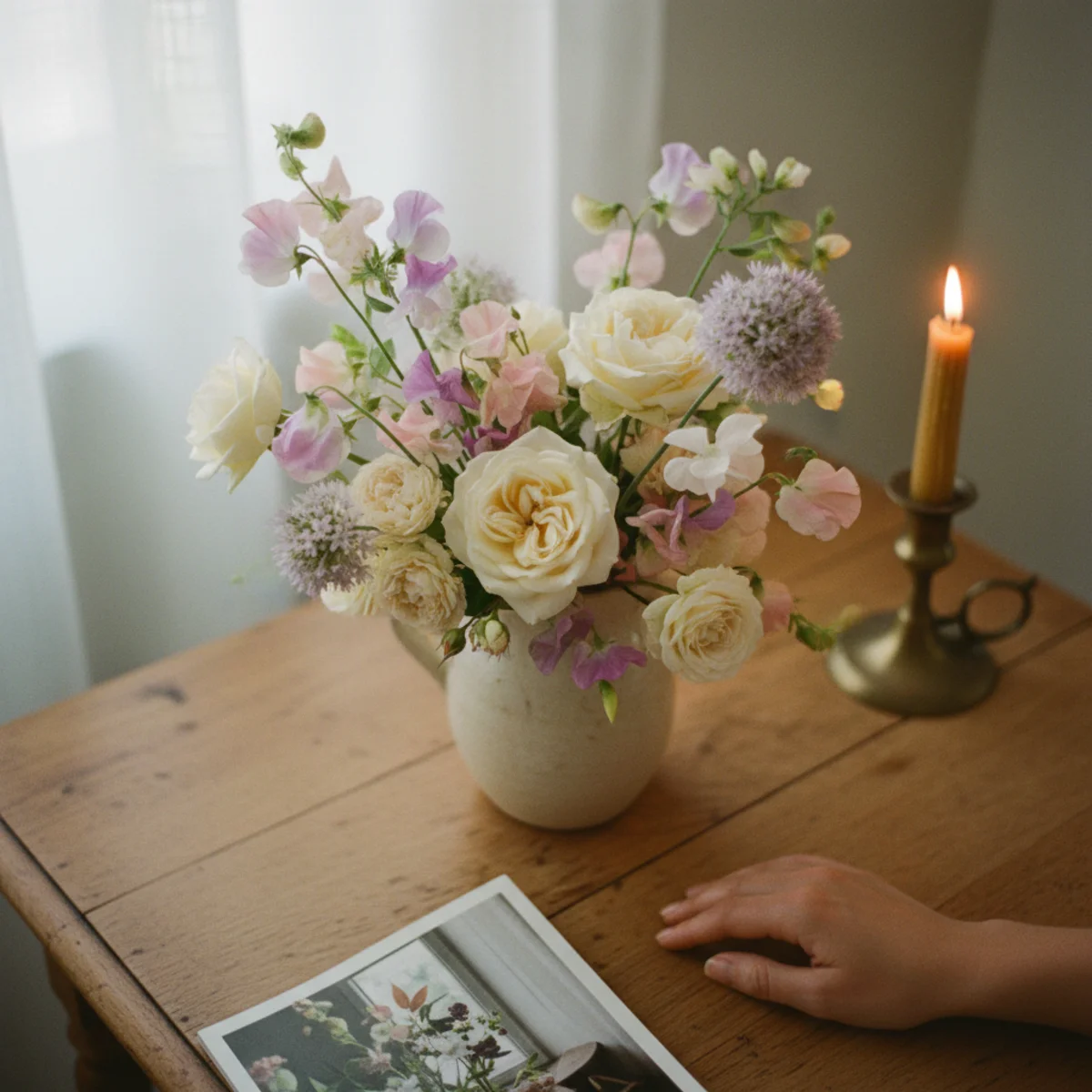
Fresh flowers are continuous in English country houses — not the special-occasion vase but the regular Monday-morning flowers replaced weekly from garden or village florist. A simple arrangement of garden flowers (whatever is in season) in a ceramic pitcher, a silver vase, or a glass jar on every major surface signals that the household tends its garden and its home simultaneously.
English country fresh flower practice: GARDEN AS SOURCE — the English country house's flower arrangement style assumes a garden providing continuous cutting material. If you have a garden, dedicate a cutting bed (sweet peas, foxgloves, cosmos, dahlias, roses, peonies, alliums) for indoor flower production. REGULAR CUTTING — cut and arrange flowers weekly as household routine, not as special-occasion decoration. The flowers should be fresh, not wilting — replace weekly. SIMPLE ARRANGEMENTS — English country flower arrangements are deliberately un-florist: loose bunches, mixed variety (whatever the garden has), irregular height, stems extending beyond the vase top without precise positioning. The 'just gathered from the garden' aesthetic reads as authentic; the carefully-shaped professional arrangement reads as commercial. CONTAINER VARIETY — ceramic pitchers and jugs (with or without chips), silver vases (family silver that gets used rather than stored), old wine bottles, Georgian glass decanters, pottery crocks, Victorian washstand jugs. The container variety is as important as the flower variety. DISTRIBUTION — one arrangement per major surface: dining table, side tables, mantelpiece (in front of or beside the mirror), kitchen windowsill, master bedroom.
AFFILIATE SLOTBOTANICALWeekly fresh flowers from garden cutting bed or local florist in ceramic pitchers, silver vases, pottery crocks; loose garden-gathered style, every major surfaceAdd affiliate URL when configuredWhy it works
Because English country is built around the specific English relationship between the house and its garden — the cottage garden producing for the house, the house opening to the garden, the constant movement of garden material into the interior. The flowers on every surface signal that the garden is actively producing and the household is actively tending. The weekly flower arrangement is not a decorating task but a household practice, like making bread or maintaining the fire. The presence of fresh garden flowers confirms the household's relationship to natural rhythms.
Pro tip — Plant a 4x4 foot cutting bed with sweet peas (plant in March), cosmos (plant in April), and zinnias (plant in May) for a continuous cutting supply from June through October. These three crops produce 2-3 fresh bouquets per week from a single small bed with minimal maintenance, at effectively zero ongoing cost after the initial $15-20 in seeds.
Loose garden flowers in ceramic pitcher — the weekly household practice that signals garden-and-house tended simultaneously. See also: cottagecore-decor
11Add Brass and Aged Metal
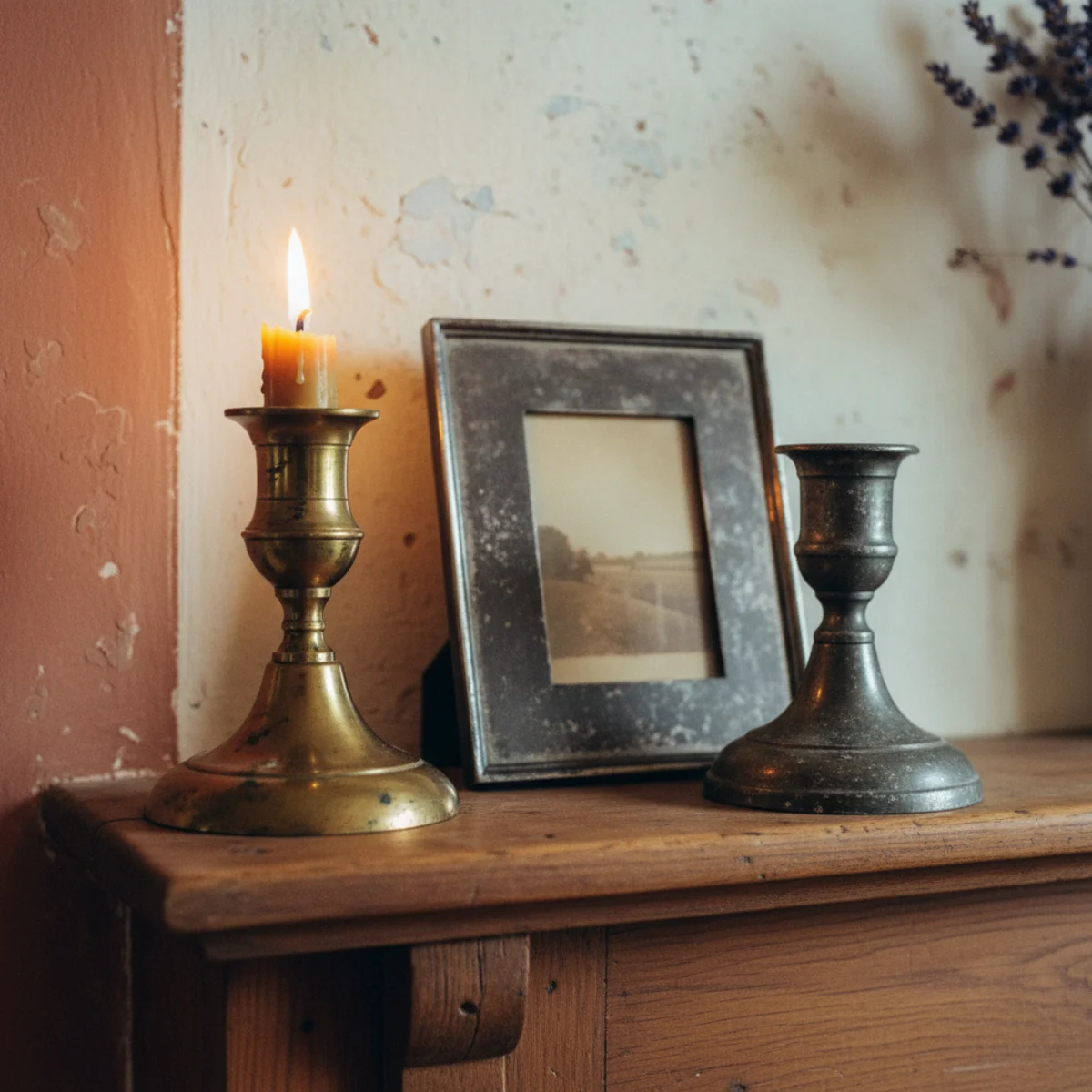
English country uses aged brass, tarnished silver, worn pewter, and dark iron throughout — candlesticks, fire tools, lamp bases, door hardware, picture hooks, letter openers, sugar tongs, silver-plate serving pieces, cast iron trivets and door stops. The aged metal signals the household's relationship to functional objects that were made to last generations.
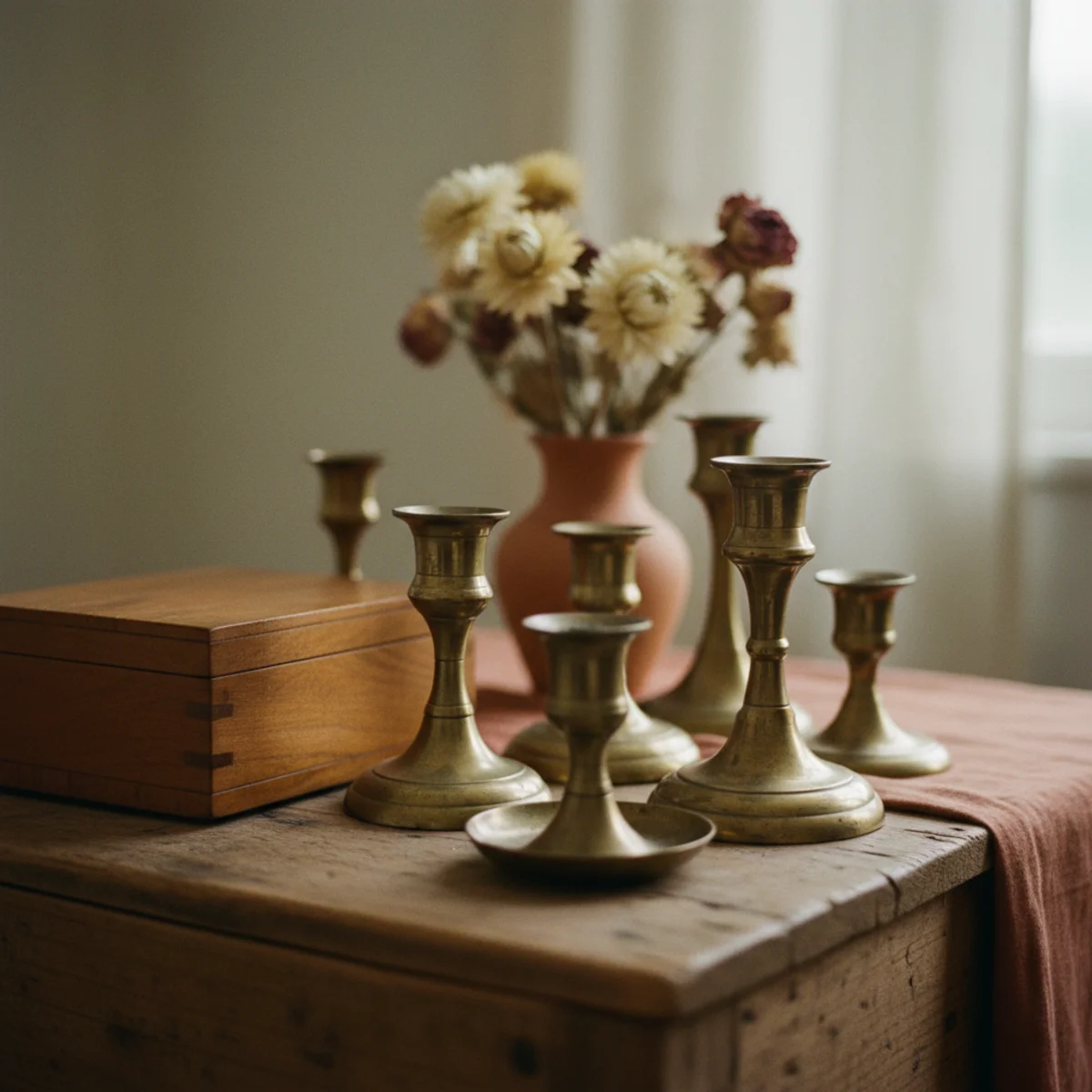
Aged metal in English country: SILVER — family silver used rather than stored: silver-plate serving pieces used for regular dining (not special occasions only), silver frames for family photographs, silver candlesticks with tarnish visible on the ornamental areas. Never over-polished silver. BRASS — aged-brass candlesticks and fire tools, brass letter boxes and door knockers, brass picture hooks and curtain rings, brass-handled drawers and cabinets. Vintage brass is better than new reproduction brass. PEWTER — English country specifically uses pewter (a historically British household metal): pewter tankards, pewter plates and platters, pewter candlesticks at $20-80 each from antique dealers. CAST IRON — doorstops (often in animal forms: dogs, hedgehogs, geese at $20-80 vintage), trivets, kettle stands, fireplace tools. WORN TEXTURE — the key is allowing all metals to develop their natural aging without aggressive polishing. Silver should be used-and-wiped rather than formally polished. Brass should have the aged patina of regular use. SOURCING — estate sales are the best source for all aged metal categories at authentic prices.
AFFILIATE SLOTMETALAged brass candlesticks and fire tools; family silver used regularly not stored; vintage pewter tankards and plates; cast-iron doorstops; estate sale sourcingAdd affiliate URL when configuredWhy it works
Because aged metals carry the visible evidence of use — silver worn smooth at the handles from daily dinner service, brass door knocker with the specific worn spot from years of daily lifting, cast-iron doorstop with the small chips and dents of household life. This evidence of use is the English country signal par excellence: objects used so regularly that they bear the marks of use. Fresh bright metals signal ownership for display; aged metals signal ownership for use across decades.
Pro tip — Use the silver rather than storing it — family silver that comes out only for very special occasions develops a specific kind of tarnish from storage that reads differently from silver tarnished through regular use and wiping. Silver used weekly develops a soft warm patina; silver stored in velvet cases develops dark blotchy tarnish. Use the silver and wipe after each use for the authentic English country silver quality.
Aged brass candlesticks, tarnished silver frames, pewter candlestick — metals bearing the marks of household use across decades. See also: candle-styling
12Let It Look Lived-In
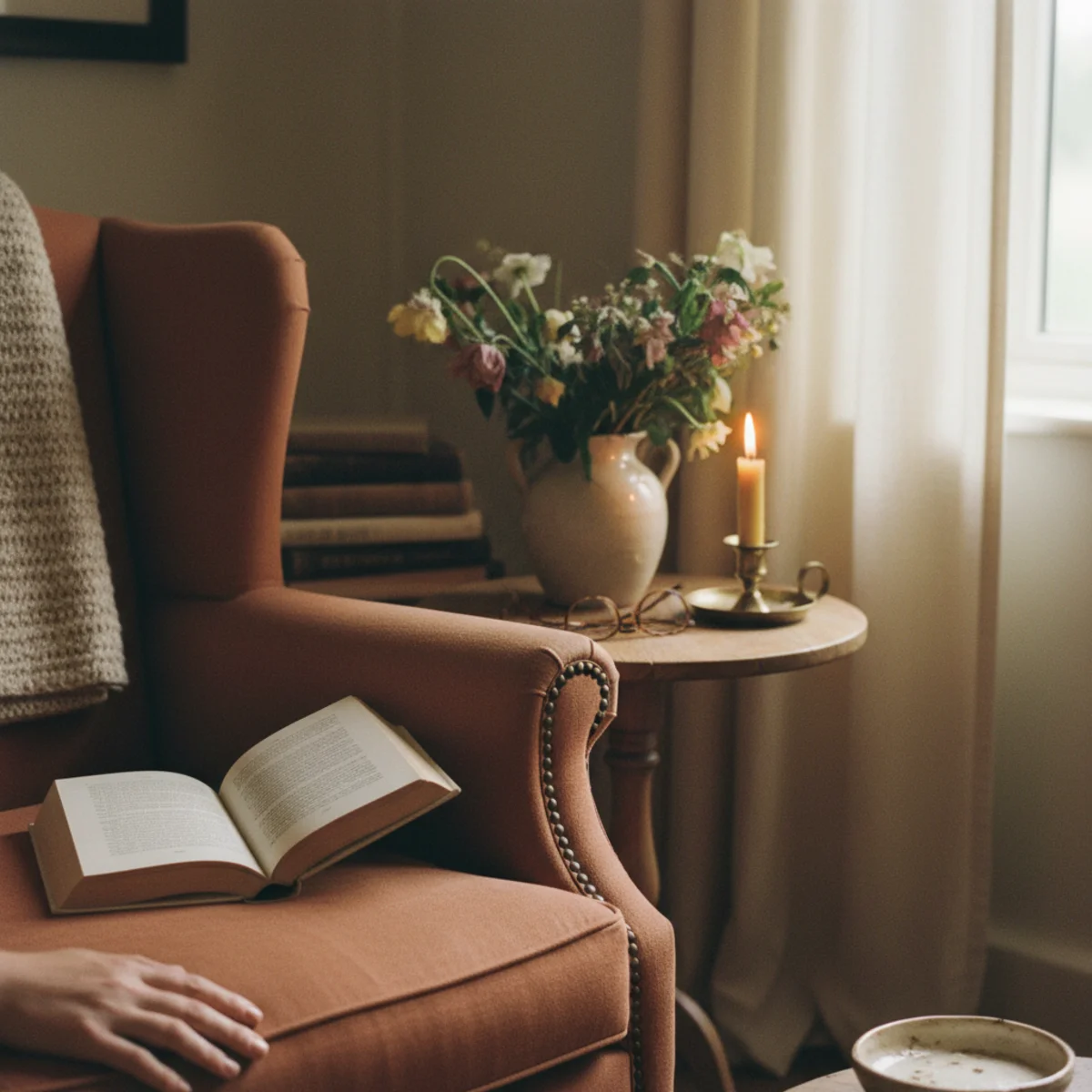
The final and organizing English country principle: let the room look genuinely lived-in. Not styled, not maintained to show-home standards, not cleared before photographs. Books left with bookmarks, reading glasses on a side table, a newspaper not quite folded, a throw that's been wrapped around someone that morning still slightly tousled, flowers slightly past their peak — these are the signs of a house genuinely lived in.
The lived-in standard for English country: WHAT LIVED-IN MEANS — objects in positions of recent use rather than permanently staged: the book left face-down (or bookmark in) rather than squared on a pile, the glasses left where they were set down, the newspaper still open from morning reading, the throw wrapped loosely rather than precisely draped, the flowers in the vase a day past their ideal freshness. WHAT IT DOESN'T MEAN — messy, dirty, or poorly maintained. English country is lived-in but tended — the windows clean, the carpet vacuumed, the silver wipe-cleaned after use, the fire ash cleared. The household is maintained; it just isn't frozen for display. THE ANTI-STYLING PRINCIPLE — when styling for photographs or pre-guest tidying, resist the impulse to square up every book, re-drape every throw, and remove every object that suggests current use. The slightly informal state of a genuinely used room reads more authentically English country than any photographically perfect arrangement. THE GENERATIONAL PATIENCE — English country rooms look lived-in because they have been. The specific patina, the worn rugs, the settled furniture, the accumulated art on walls — these require time. The permission to let things look their age and use is what makes English country possible for households with real objects and real lives.
AFFILIATE SLOTPRINCIPLEBook with bookmark, glasses on table, slightly tousled throw, slightly past-peak flowers — signs of daily use; maintained but not stagedAdd affiliate URL when configuredWhy it works
Because English country is specifically NOT about the beautiful room preserved from use — it's about the beautiful room that is beautiful because it is used daily. The English country tradition romanticizes domestic life in all its comfortable ordinariness: the book being read, the fire being tended, the garden coming inside in vases, the silver being used at dinner. The authenticity is the daily living, not the staged representation of daily living. Letting things look genuinely lived-in IS the aesthetic practice; maintaining perfect staging is the failure.
Pro tip — When the room is freshly tidied for guests, introduce a few lived-in signals: set a book face-down on a side table, leave a pair of reading glasses on a chair arm, place a slightly-tousled throw. The small signals of recent use make the room feel inhabited by specific people rather than designed for general visitors.
Open book, reading glasses, tousled throw, slightly past-peak flowers — the daily life that makes English country authentic. See also: hygge-living-room
How to get the English country look step by step
Layer, collect, and let it fade. Build it like it grew over generations.
- 1Anchor with antiques and rich color
Start with a genuine antique or two and a rich, slightly faded color on the walls or a key piece. This sets the warm, historic base.
- 2Layer the patterns
Add florals, chintz, stripes, and checks together, unified by a shared color rather than matched. This is the signature move.
- 3Layer rugs, fill the walls, collect objects
Add worn mismatched rugs, a full salon-style art wall, and collected objects on the surfaces — abundance, gathered.
- 4Warm it and let it live
Light it with a fire and warm lamps, add fresh garden flowers, and let the room look genuinely lived-in rather than staged.
Quick tips
- Unify clashing patterns with a shared color rather than trying to match them.
- Choose faded, used antiques and textiles over pristine ones — wear is the warmth.
- Layer worn, mismatched rugs as if gathered over generations.
- Fill the walls salon-style rather than leaving them sparse.
- Light it with a fire and several warm lamps, not one bright overhead.
- Let the room look lived-in; pristine English country reads as a museum.
English country by intensity
Layered patterns, antiques, full walls, worn rugs, and rich faded color throughout — the maximalist version.
A few key elements — one chintz, some antiques, warm color — in an otherwise calmer room.
Softer and more floral, leaning toward cottagecore; see our cottagecore decor guide.
A younger, slightly more playful take on the layered, pattern-rich, antique-loving look.
The warmest English country rooms are a little shabby — faded chintz, a worn rug, and the dog on the best chair. The wear is the point.
Frequently asked questions
What is English country decor?+
How is English country different from cottagecore?+
What patterns work for English country?+
Where do I find English country antiques?+
Can I do English country decor in a small apartment?+
What makes English country different from other warm home styles?+
English country is the warmest grand style there is, because the best examples were genuinely layered over generations — faded chintz, scarred antiques, worn rugs, and a room that's clearly been lived in. Layer the patterns with a unifying color, choose the used over the pristine, and let the room look loved rather than staged. We'd hunt one genuine faded antique before buying anything new; the patina is the warmth, and a slightly shabby English country room beats a pristine one every time. Use the room. The wear is the whole point.