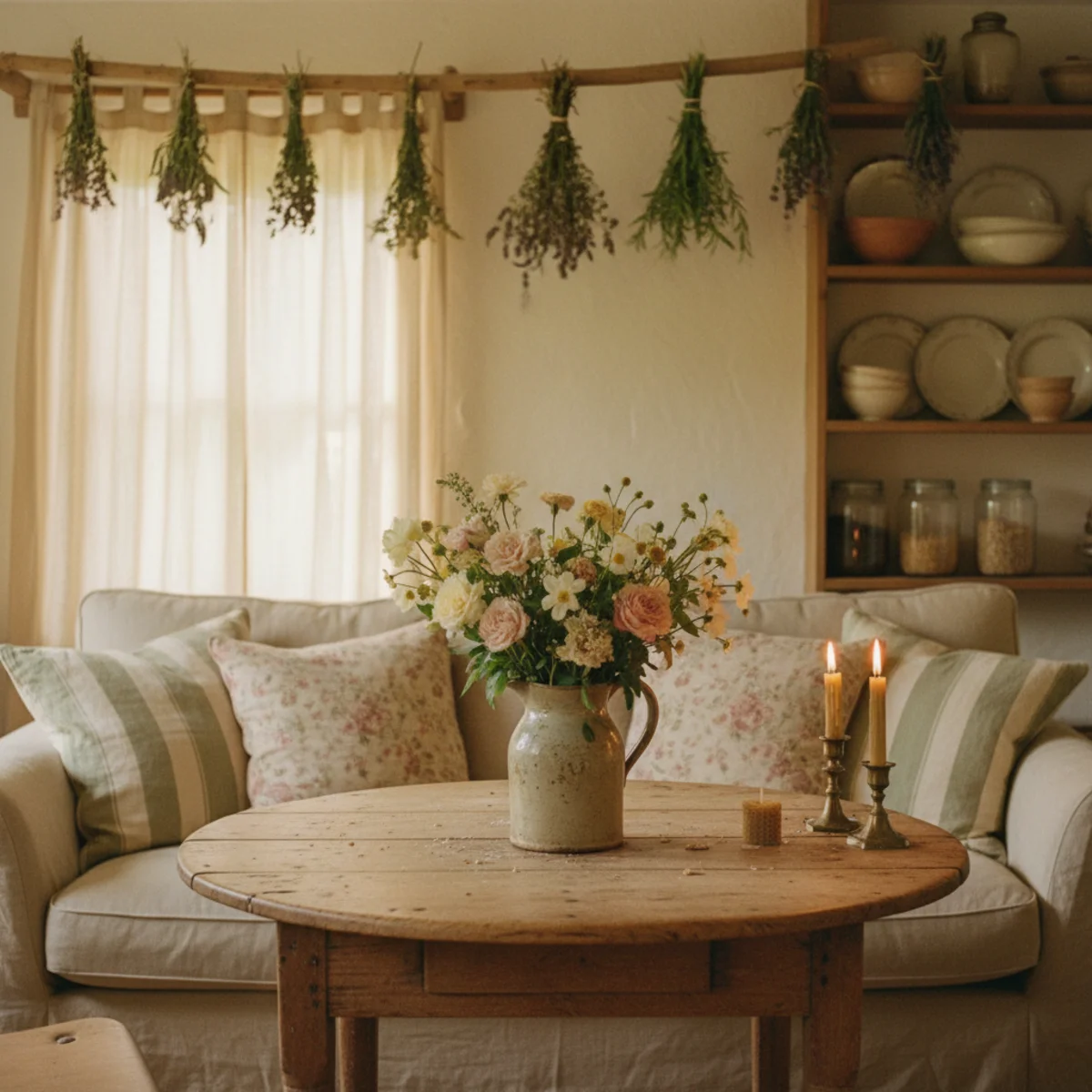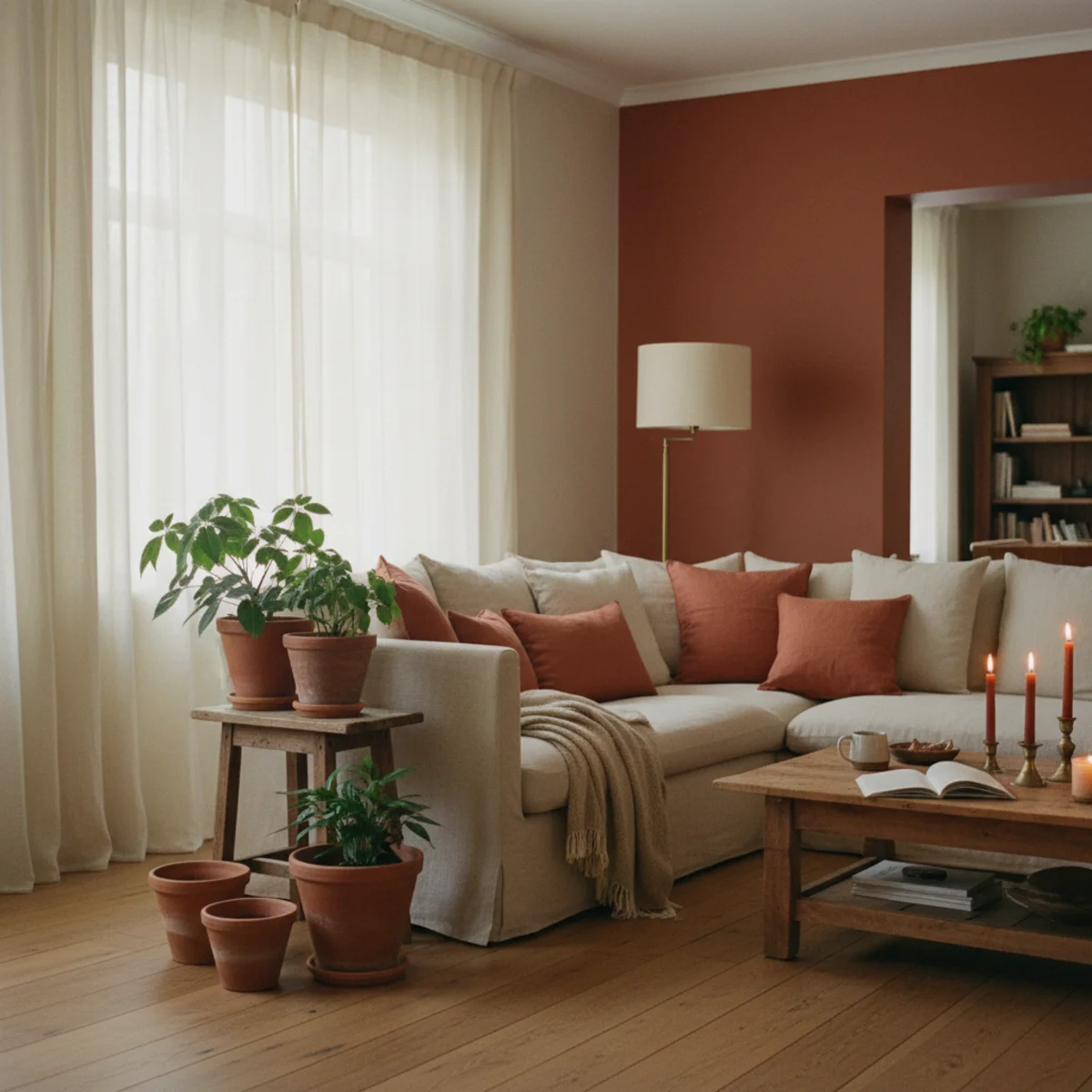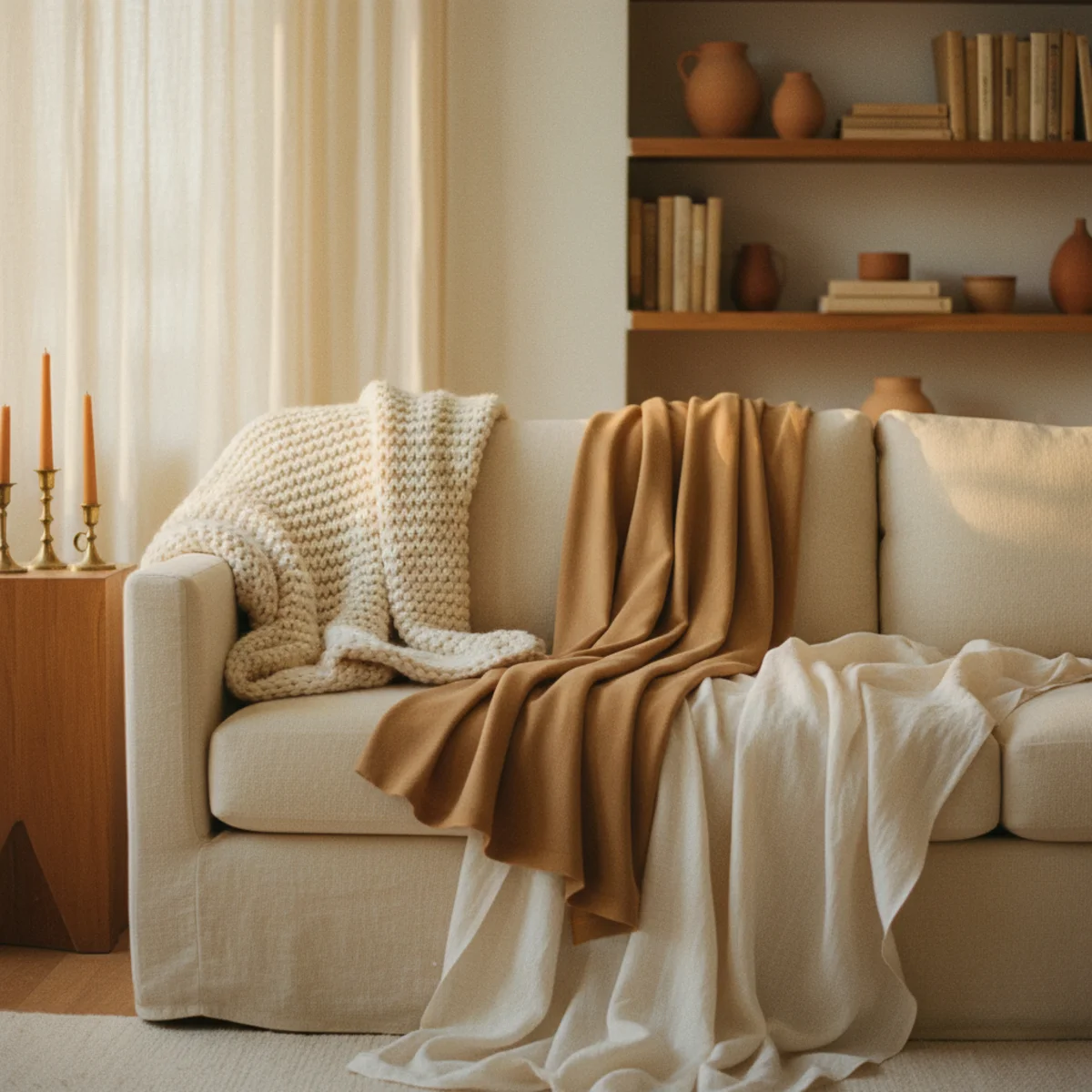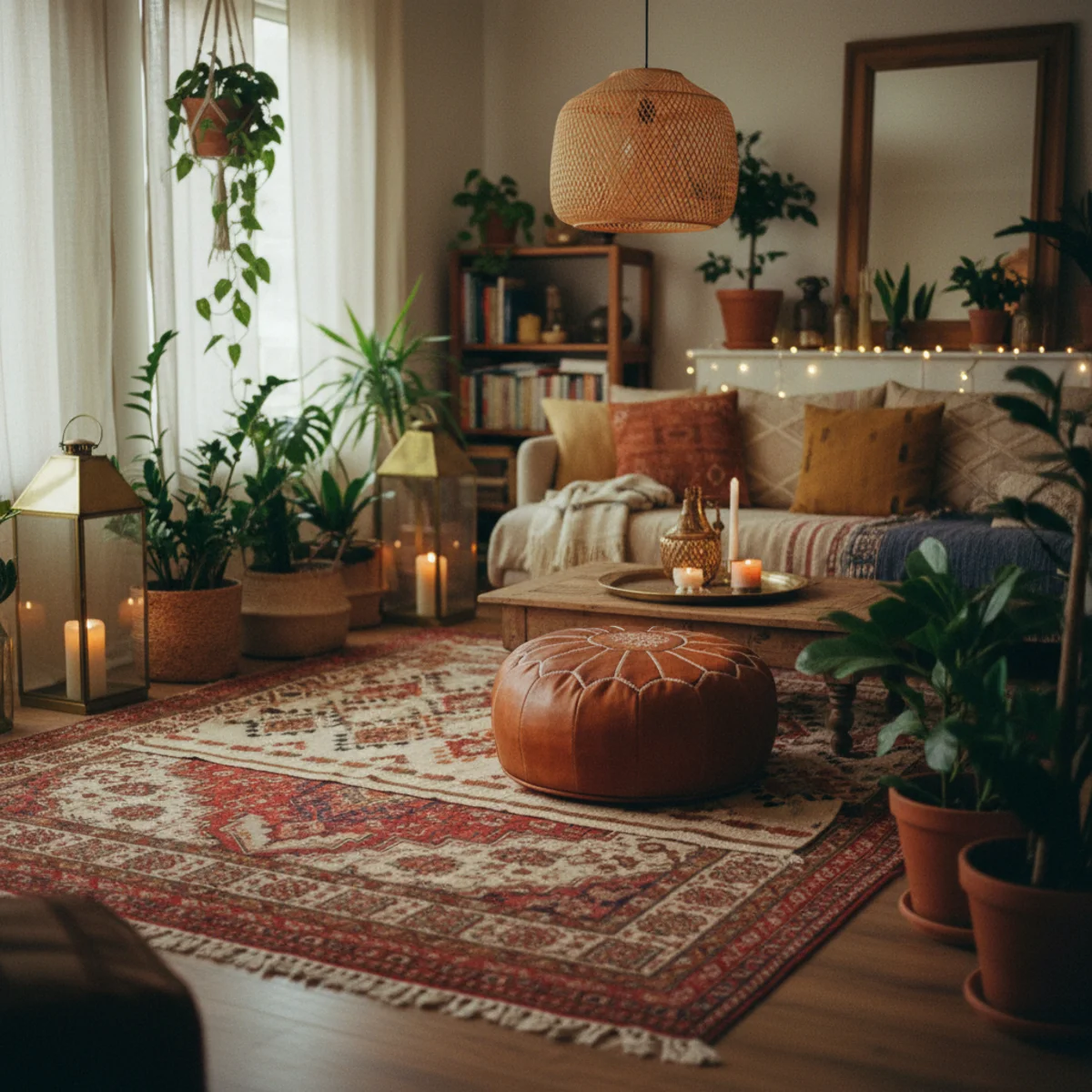
These twelve warm boho principles are grounded in the genuine bohemian tradition — the 19th and early 20th century artist and traveler aesthetic that combined collected global textiles, natural materials, plants, candlelight, and layered pattern from genuine multi-cultural sourcing. Each principle names specific materials (vintage kilims, hand-thrown ceramics, collected global pieces, natural-fiber textiles), specific arrangement approaches (layered mismatched rugs, bold pattern mixing, floor-level seating), and the warm palette (earthy terracotta, rust, deep forest green, cream) that distinguishes warm boho from the cool-bohemian aesthetic that fast-decor retailers sell.
Warm boho's relationship to warm home aesthetic is natural — both prioritize natural materials, collected warmth, genuine aging over manufactured aging, and the specific organic character that mass-produced objects lack. The twelve principles below build the warm boho interior from the floor (layered rugs) through the walls (collected global art) to the ceiling (hanging plants and macramé), maintaining the earthy warm palette that prevents boho from sliding into the cool-grey-and-white commercial version.
By the end of this guide, you'll know exactly which moves produce genuine warm boho — layered mismatched rugs, earthy palette, plants everywhere, rattan and wicker, collected textiles, bold pattern mixing, macramé or woven art, collected global pieces, warm low lighting, natural-fiber everything, one unifying thread to prevent chaos, and a floor cushion or pouf for low-level sitting.
WHAT'S INSIDE
- Why layered mismatched rugs are the foundational warm boho floor statement
- Going earthy not cool — the palette distinction that separates warm boho from commercial boho
- Plants everywhere — the organic abundance principle that's foundational to genuine boho
- The one-unifying-thread principle that keeps bold boho from reading as visual chaos
Boho at its best looks gathered over a lifetime, not bought in one trip. The layering is the point, but so is the restraint.
— House Beautiful [citation needed — verify before publish]
What is boho decor?
Boho — short for bohemian — is a warm, eclectic decorating style built on layered textiles, earthy and jewel-toned color, abundant plants, natural materials like rattan and wicker, and collected, often global, pieces. It's defined by a relaxed, gathered, free-spirited abundance rather than matching sets or rigid rules — a room that looks accumulated over a well-traveled life.
The warm 2026 version leans away from the cool, all-white, macramé-heavy boho of the late 2010s toward earthier tones — terracotta, mustard, rust, and warm greens — and more genuine, collected pieces. The defining skill is layering with restraint: boho embraces more pattern, texture, and abundance than the spare styles, but it still needs an anchoring thread — a warm palette, a repeated material — to read as gathered and intentional rather than cluttered chaos. Plants, layered rugs, and collected textiles do the heavy lifting.
More in Color Stories you may love
See allWhy warm boho is everywhere in 2026
Boho stayed a perennial favorite and matured into a warmer, earthier version — Pinterest's boho and bohemian decor searches climb every year, away from the cool white-and-macramé phase toward terracotta, layered texture, and collected global pieces.
The honest appeal is that boho is the warm, expressive, maximalist counterpoint to spare minimalism — and as people grew tired of cold restraint, its layered abundance, plants, and collected character offered the opposite comfort. It also suits the secondhand-first, anti-matching-set mood perfectly, since boho is built from gathered, mismatched, well-traveled pieces. The 2026 version simply trades the cool palette for an earthy one and the macramé overload for genuine collected warmth.
12 ways to get the warm boho look
01Layer Rugs That Don't Match
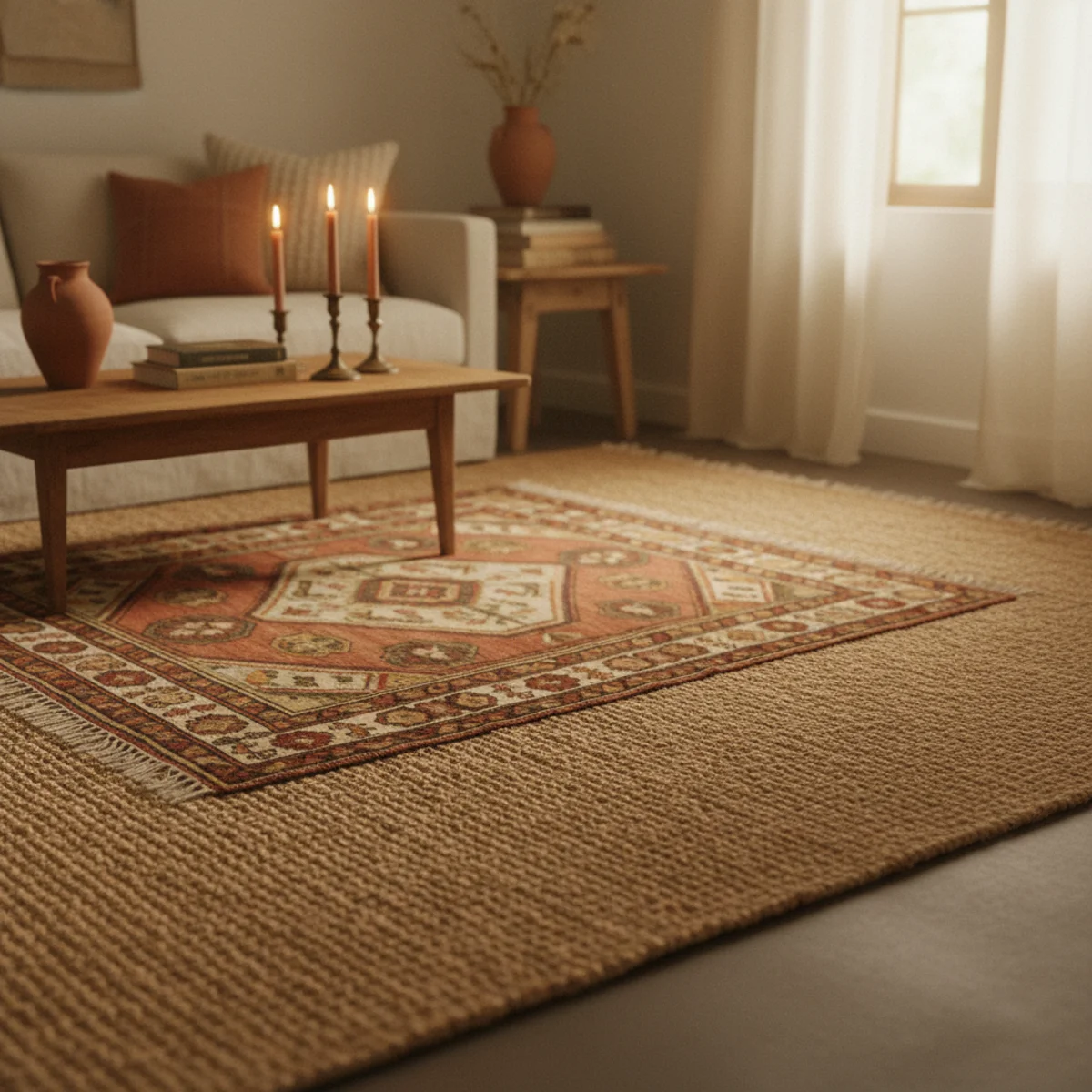
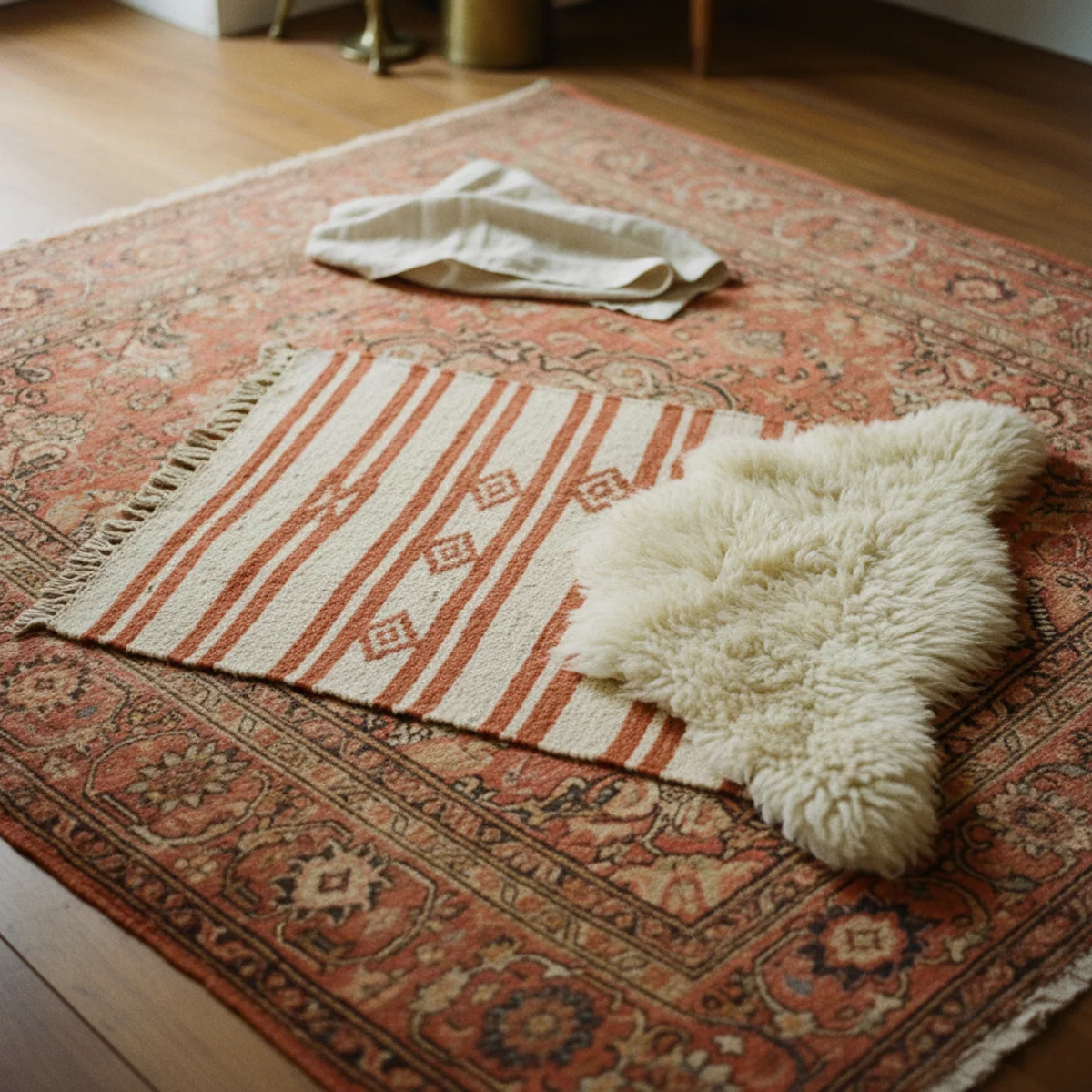
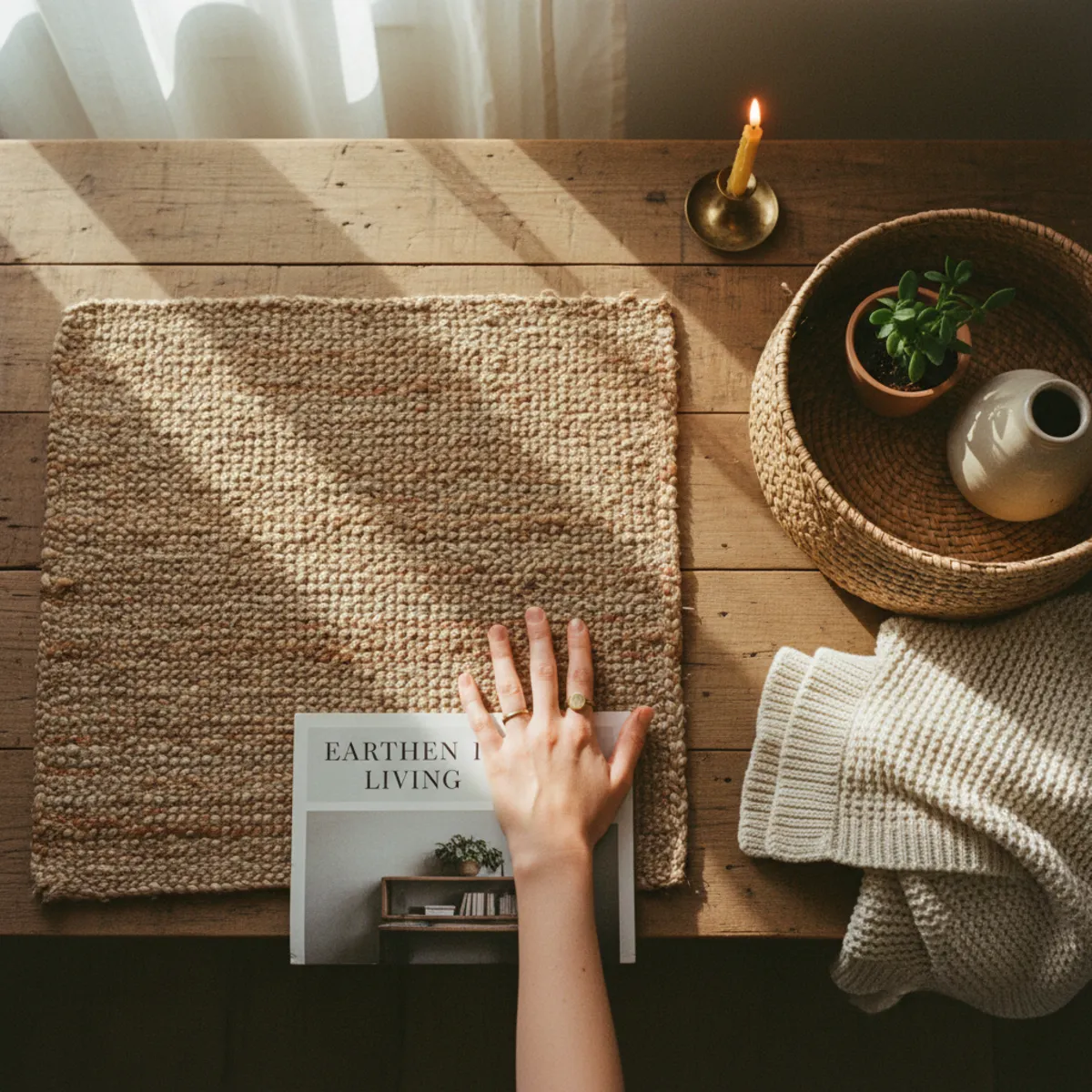
The foundational warm boho floor statement: multiple rugs of different origins, patterns, and scales layered together — a large vintage Persian or Turkish base rug, a smaller Moroccan Beni Ourain over it, a kilim over a jute, a sheepskin over a vintage wool. The layered non-matching rugs express the core boho principle: collected across time and place, not coordinated for a room.
Warm boho rug layering: BASE RUG — large vintage hand-knotted Turkish or Persian rug ($300-800 for 8x10 from estate sales, Rugs USA Vintage, or local rug dealers) in warm earth tones. OR large jute or natural-fiber rug ($100-300 for 8x10) as affordable base. LAYERED RUG — vintage Moroccan Beni Ourain (cream with black geometric pile, $300-800 for 4x6), vintage kilim (flat-weave with bold geometric pattern, $200-600 for 4x6), or vintage Oushak ($300-700 for 4x6). THIRD LAYER OPTION — small sheepskin or cowhide ($60-200) layered over one corner of the layered rug. COLOUR DISCIPLINE — all rugs should share warm tone temperature (terracotta, rust, cream, warm brown, forest green) even while differing in pattern, origin, and pile height. The warm palette family is the thread that prevents rug-chaos. SOURCING — estate sales ($30-200 for vintage rugs), local rug dealers, Etsy vintage rug shops, Chairish. The authentic sourcing (real vintage, not reproduction vintage) is the boho difference.
AFFILIATE SLOTFLOORLarge vintage Persian/Turkish base ($300-800) + smaller Beni Ourain/kilim/Oushak layer ($200-600) + optional sheepskin accent; warm tone family throughoutAdd affiliate URL when configuredWhy it works
Because the rug floor is the largest visual element in most rooms, and layering mismatched rugs from different origins expresses the core boho principle more directly than any other single element: accumulated objects from varied sources across time. A room with one perfectly-matched rug reads as designed; a room with layered mismatched vintage rugs reads as lived in across years of collecting. The floor layers also create the low-visual-center that boho living spaces specifically favor — the eye rests at floor level surrounded by pattern and texture rather than moving immediately upward to wall level.
Pro tip — Collect rug layers gradually across 12-18 months of estate sale and vintage market visits rather than purchasing all layers at once — patient vintage rug accumulation produces the most-authentic warm boho floor and typically costs 40-60% less than single-trip purchasing from specialty vintage retailers.
Vintage Persian base, Moroccan kilim layer, sheepskin accent — rugs from different origins accumulated across collecting time. See also: best-area-rugs
02Go Earthy, Not Cool
Warm boho's defining palette distinction: earthy warm tones (terracotta, deep rust, warm ochre, forest green, warm brown, cream) rather than the cool-grey-and-white palette that commercial 'boho' retailers sell. The earthy palette is authentic to the bohemian tradition — the earth pigments and natural dyes of global textile traditions produce warm colors, not cool grey-white.
Warm boho earthy palette: DOMINANT TONES — warm cream and oat (the light base), terracotta and warm rust (the earth), forest and deep olive green (the foliage), warm brown (the wood and leather), deep warm ochre (the sand and sunlight). SECONDARY TONES — deep indigo (used sparingly as the cool anchor within the warm palette), warm muted burgundy. WHAT TO AVOID — cool grey (commercial 'minimalist boho'), bright pure white (too clinical), bright saturated primary colors (too commercial modern), black-and-white (too graphic and cool). WALL COLORS — warm cream (BM Soft Chamois OC-13), warm plaster pink (F&B Setting Plaster 231), warm taupe (F&B Joa's White 226), warm terracotta (BM Pottery 1297). Not grey, not cool white. TEXTILE PALETTE — all textiles in the warm earthy family: terracotta kilim, cream linen, rust-toned vintage cushion, olive or forest green botanical cushion. The palette discipline is what prevents warm boho from drifting toward the commercial cool version.
AFFILIATE SLOTPALETTEWarm cream + terracotta + rust + forest green + warm brown + ochre; all earthy warm; avoid cool grey, bright white, commercial grey-white 'boho' paletteAdd affiliate URL when configuredWhy it works
Because the bohemian textile tradition that authentic boho references — Moroccan, Turkish, Persian, Central Asian, Indian, African traditional textiles — all use natural dyes that produce warm earth colors (madder red-orange, indigo, safflower yellow, weld yellow-green, plant-based browns and ochres). The cool grey and white 'boho' palette that commercial retailers sell has no basis in these traditions; it was invented for mass-market appeal to minimalist buyers. Warm earthy colors are the actual visual language of the global textile traditions that bohemian aesthetic draws from.
Pro tip — Use your existing terracotta plant pots as the palette reference when assessing whether a proposed boho textile or paint choice reads warm enough — if it looks right beside unglazed terracotta, it's in the right warm earthy register. If it fights the terracotta, it's too cool or too bright for warm boho.
Terracotta, cream linen, forest green, warm ochre — the earthy warm palette of actual textile traditions, not commercial boho. See also: terracotta-color-palette
03Fill the Room With Plants
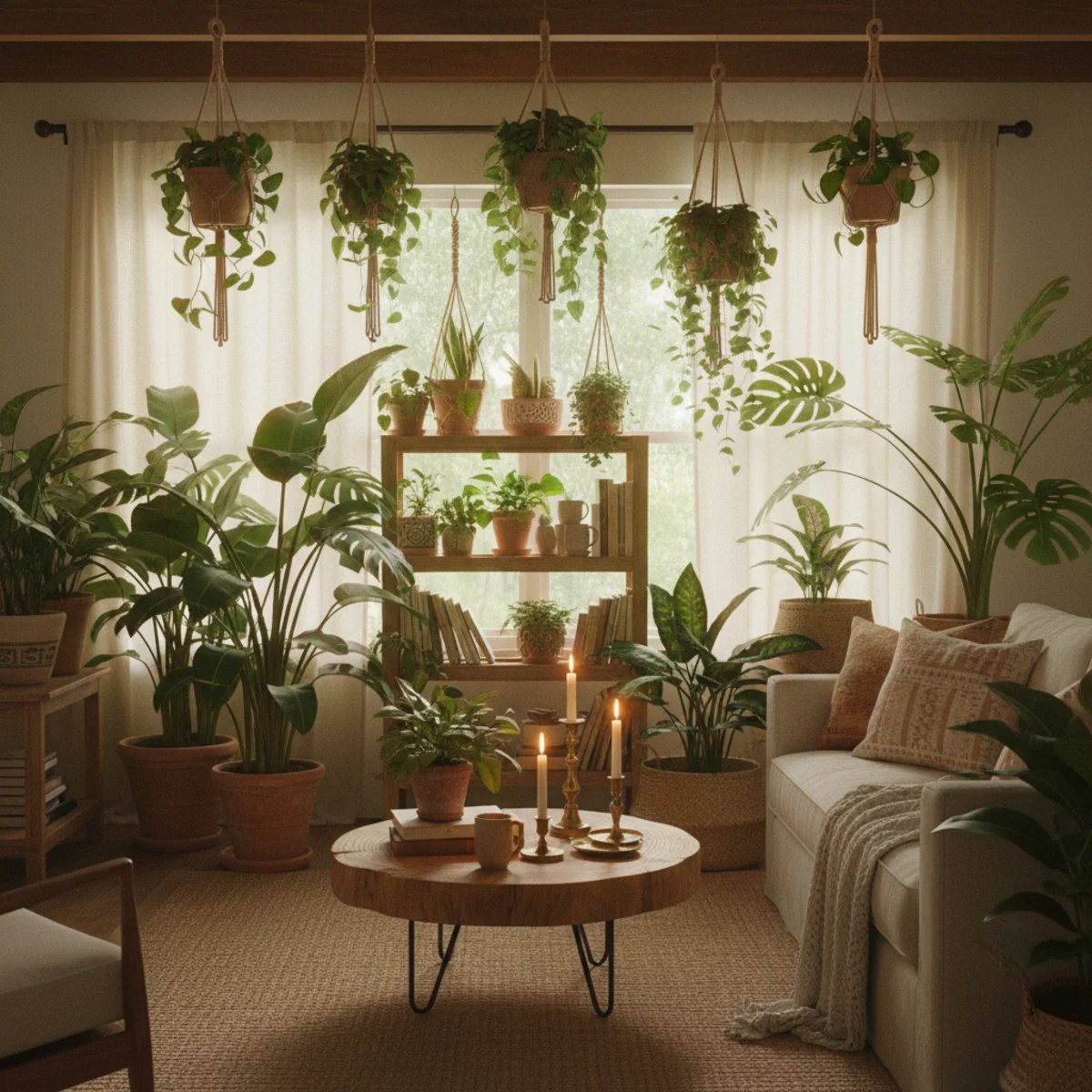
Warm boho rooms have plants everywhere — floor plants, hanging plants, window plants, shelf plants, trailing plants, climbing plants. The plant abundance is one of the most-specific expressions of boho's natural-world connection. No professional interior styling or commercial decor achieves this effect; genuine plant abundance comes from years of collecting and cultivating plants as a household practice.
Warm boho plant abundance: SCALE — significantly more plants than most homes. A 200 sq ft living room might have 15-25 plants in warm boho aesthetic, distributed across floor, shelves, hanging positions, and window sills. The abundance is the point. SPECIES VARIETY — multiple species with varied leaf shapes and textures (per indoor-plant-corner mixing principles): large monstera or rubber plant for floor-level anchor, hanging pothos or philodendron trailing from ceiling hook, shelf cacti and succulents for lower-light positions, ferns for humid zones, prayer plants or calathea for pattern interest. HANGING PLANTS — multiple hanging planters at varied ceiling heights (4-7 feet), trailing pothos and philodendron. Macramé hangers ($15-40 each) or simple rope hangers for warm boho character. WARM-TONED POTS — terracotta (essential for warm boho), hand-thrown ceramic in warm glaze, woven basket covers. NOT white plastic nursery pots left uncovered. CARE CAPACITY — genuine plant abundance requires genuine plant care commitment. Establish the twice-weekly watering routine (per indoor-plant-corner item 10) before scaling to boho-level abundance.
AFFILIATE SLOTPLANTS15-25 plants in 200 sq ft room; floor plants, hanging pothos/philodendron at varied heights, shelf plants, window plants; terracotta pots and macramé hangersAdd affiliate URL when configuredWhy it works
Because the bohemian tradition specifically romanticizes living in harmony with natural growth rather than against it — the artist's studio with plants in every corner, the traveler's collected terrariums, the garden-connected cottage with trailing vines on every sill. Plants signal that the household prioritizes living things and their care over pristine surface maintenance. The warm boho home has plants everywhere because that household genuinely likes plants, tends plants, and has been accumulating plant collection across years. Commercial boho substitutes one or two placed decorative plants; genuine warm boho has 15-25.
Pro tip — Propagate plants from existing specimens to build warm boho plant abundance without major expense — pothos, philodendron, spider plant, and string-of-hearts all propagate easily in water. One $6 pothos can become 8-10 plants within one year through propagation and growth. The propagated collection is more authentically warm boho than purchased plants because it shows household investment in the plants' life across time.
Floor plant, hanging pothos, shelf plants, window plants — genuine plant abundance accumulated across years of collecting. See also: indoor-plant-corner
04Add Rattan and Wicker
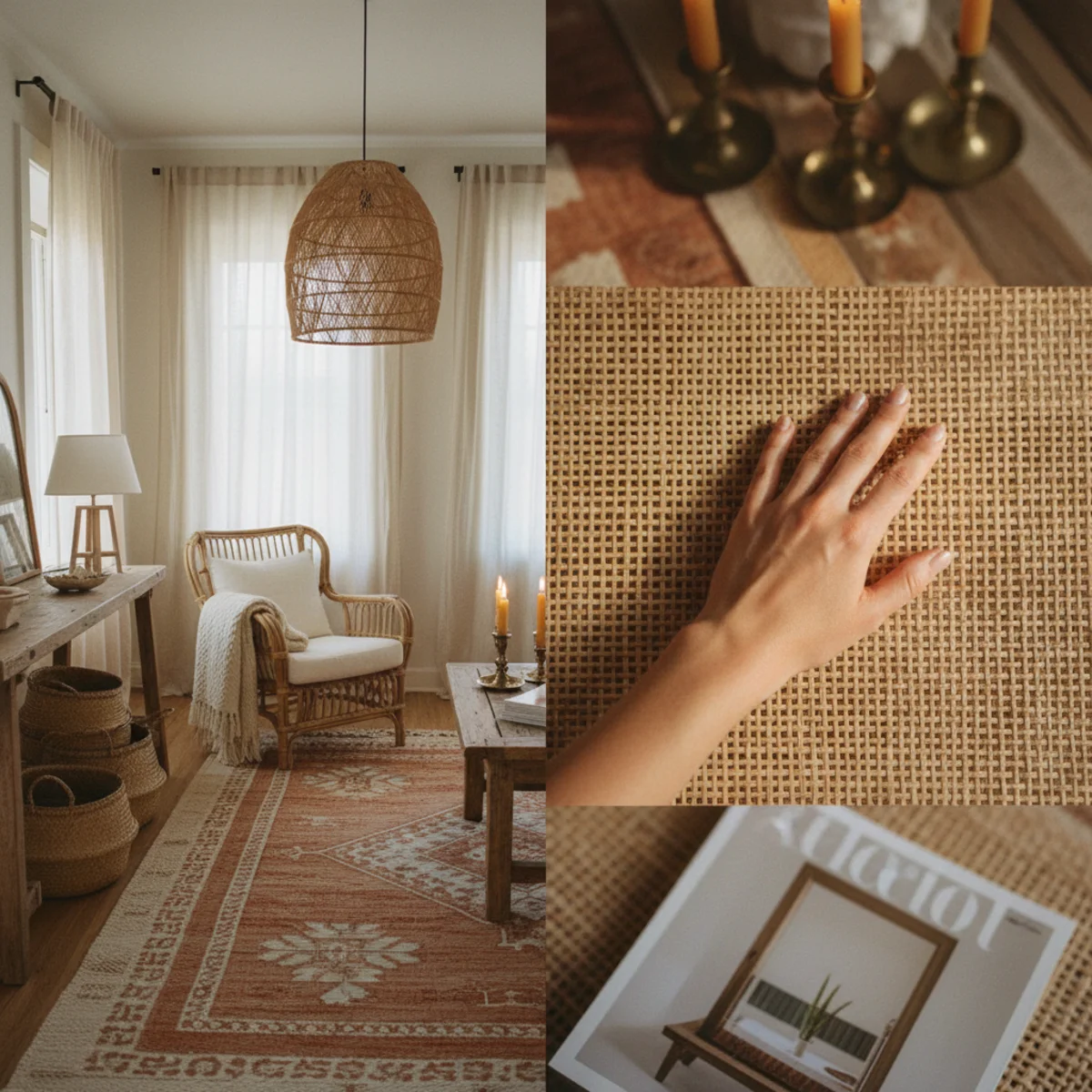
Rattan and wicker furniture and accessories — rattan pendant lights, wicker chairs, rattan shelving, wicker baskets, rattan side tables — add the warm organic material dimension that manufactured furniture specifically lacks. Rattan's natural honey-gold color and woven texture read as warm boho's signature material when combined with vintage rugs, plants, and collected textiles.
Rattan and wicker warm boho applications: RATTAN PENDANT LIGHT — the single most-impactful rattan addition. A large woven rattan pendant (18-30 inches diameter) over the dining table or living room center at $60-200 from West Elm, Serena & Lily, World Market, or import retailers. Warm 2700K bulb essential. WICKER OR RATTAN ACCENT CHAIR — vintage rattan chair from estate sales ($60-200) or new from West Elm or similar ($300-600). With cushion in terracotta or cream fabric. WICKER STORAGE BASKETS — 3-5 wicker or rattan storage baskets throughout the room for blanket storage, book storage, plant pot covers. $15-50 each from HomeGoods, World Market. RATTAN SHELVING — narrow open rattan shelving unit for plant display and collected object storage ($80-250 from IKEA, World Market). VINTAGE RATTAN — 1960s-1970s rattan and bamboo furniture frequently appears at estate sales at $50-300; this genuinely vintage rattan has the most-authentic warm boho character. AVOID — cheap plastic-laminate faux rattan, wicker pieces that read as commercial farmhouse rather than warm boho.
AFFILIATE SLOTMATERIALSRattan pendant ($60-200), wicker accent chair ($60-600), wicker baskets ($15-50 each), rattan shelving ($80-250); vintage 1970s rattan from estate sales at $80-250Add affiliate URL when configuredWhy it works
Because rattan is a tropical plant material with its own specific warmth, color, and cultural associations — it appears in traditional Southeast Asian and South Asian furniture and craft traditions, and entered Western interior use through the colonial-era travel and collecting that the bohemian tradition specifically references. Genuine rattan (not synthetic imitation) has natural color variation, slight irregularity in the weave, and the specific honey-gold aging that makes it distinctly warm boho rather than commercial neutral. The same material that reads as 'coastal' in a cool blue-and-white room reads as warm boho in an earthy terracotta room.
Pro tip — Shop estate sales specifically for vintage 1970s rattan furniture — the peacock chair, barrel chair, and sofa sets from this period are genuine rattan and frequently appear at estate sales in older suburban neighborhoods at $80-250. The genuine 1970s rattan is more authentic and more visually interesting than any contemporary reproduction.
Rattan pendant, wicker baskets, rattan chair — honey-gold woven organic material in warm boho's foundational material. See also: cozy-living-room-ideas
05Layer Collected Textiles
Warm boho textile layering goes beyond the warm minimalism approach — more layers, more varied origins, more pattern mixing, more global variety. Moroccan wedding blankets, Indian kantha quilts, vintage Turkish towels, Guatemalan woven runners, African mud-cloth, vintage American quilts — the global textile collection is the material heart of authentic warm boho.
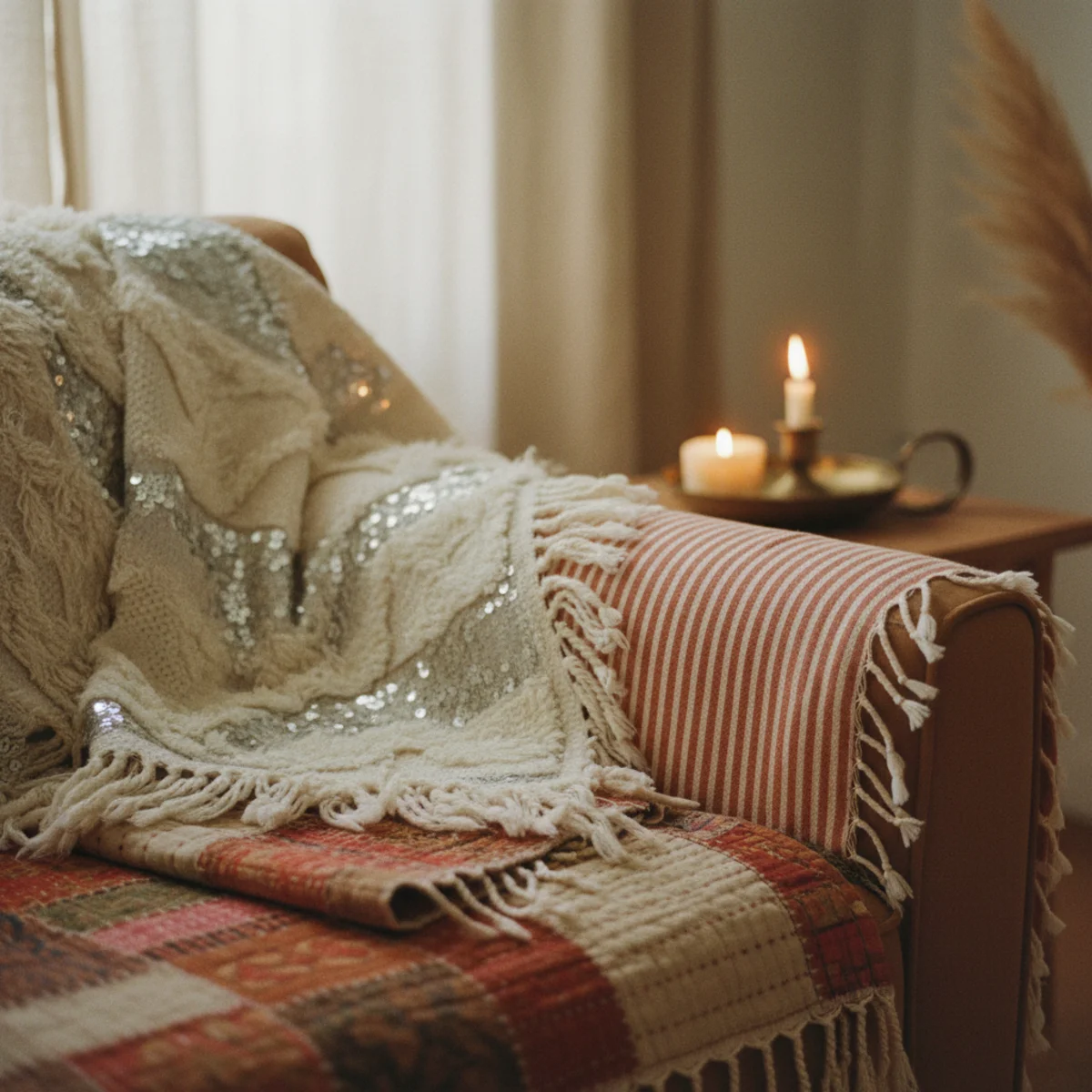
Warm boho textile collection: MOROCCAN WEDDING BLANKET (Handira) — vintage sequined and woven wool blanket in cream with metallic thread, $80-300 from Etsy vintage Moroccan sellers or specialty importers. Drape over sofa back or use as bed throw. INDIAN KANTHA QUILT — hand-stitched cotton quilt from Indian tradition, warm earth-tone pattern, $40-150 from import retailers, World Market, or Etsy Indian textiles. TURKISH HAMMAM TOWELS (Peshtemal) — flat-weave striped cotton towels in warm earth tones, $15-40 each. Use as sofa throw, table runner, wall hanging. GUATEMALAN WOVEN TEXTILES — small hand-woven pieces in warm earth-tone geometric patterns, $15-80 from fair-trade importers. AFRICAN MUD-CLOTH (Bogolan) — hand-painted geometric pattern cotton from Mali, $40-150 from African textile importers. LAYERING APPROACH — multiple textiles stacked, draped, and layered across the room: vintage quilt draped over sofa, Moroccan pillow among cream cushions, kantha quilt folded at bed foot, peshtemal used as table runner. The distribution of global textile collection throughout the room is the warm boho signature.
AFFILIATE SLOTTEXTILESMoroccan wedding blanket ($80-300), Indian kantha quilt ($40-150), Turkish peshtemal ($15-40), Guatemalan woven ($15-80), African mud-cloth ($40-150) layered throughoutAdd affiliate URL when configuredWhy it works
Because the bohemian tradition is specifically built around the traveler's and artist's collection of textiles from multiple cultures encountered through travel, trade, and artistic exchange. The warm boho home expresses genuine curiosity about global material culture through the physical objects that curiosity collects. Globally-sourced textiles carry specific cultural techniques (kantha hand-stitching, mud-cloth wax-resist dyeing, Moroccan weaving traditions) that commercial approximations cannot replicate. The collection reads as genuine accumulation; the commercial alternatives read as aesthetic approximation.
Pro tip — Source global textiles through fair-trade importers and cooperatives rather than mass-market retailers — organizations like Ten Thousand Villages, Global Goods Partners, and Novica ensure that artisan makers receive fair compensation, and the quality of fairly-traded handcrafted textiles is consistently higher than mass-produced equivalents at similar price points.
Moroccan wedding blanket, kantha quilt, peshtemal runner — global textile collection as the material heart of warm boho. See also: throw-blanket-layering
06Mix Patterns Boldly
Warm boho takes the English country pattern-layering principle one step further — not just multiple patterns in a shared color family, but bold pattern mixing across scales, origins, and types that approaches visual overwhelm and stops just before it. The discipline is the same: shared warm earth-tone palette. The ambition is greater: more patterns, more boldness.
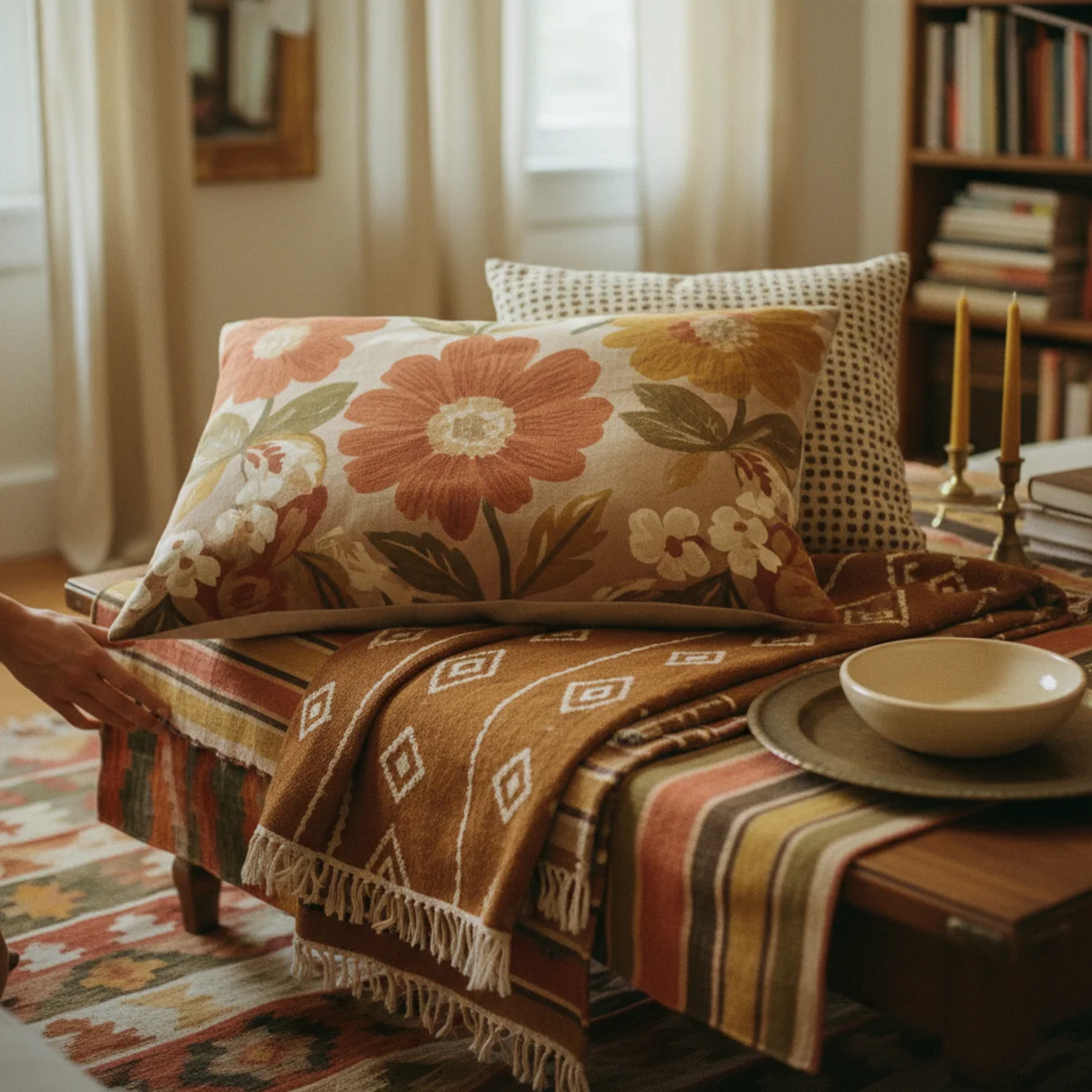
Warm boho pattern mixing: PATTERN TYPES simultaneously — LARGE SCALE FLORAL (a floral print cushion or textile), GEOMETRIC (kilim pattern rug or cushion), TRIBAL ABSTRACT (mud-cloth or Guatemalan textile pattern), STRIPE (Turkish peshtemal or Indian stripe), SMALL-SCALE PRINT (small repeat in a throw or cushion). All five simultaneously is genuine warm boho. COLOR DISCIPLINE maintains the warm earth palette across all patterns: terracotta + cream + forest green + rust + ochre across each pattern, even when scales and types vary wildly. PATTERN MIXING RULES FOR WARM BOHO — at least one pattern is genuine vintage or handmade (not mass-produced reproduction), color palette remains consistently warm earthy, no individual pattern is so large or saturated that it visually overwhelms the others. VISUAL REST — even in maximalist boho, provide 20-30% of surfaces with visual rest (plain cream wall, solid-colored sofa, unadorned wood surface). Without the rest, all patterns become visual noise. THE WALL — boho pattern mixing can extend to walls (patterned wallpaper, gallery of varied art) but the remaining surfaces need the visual rest principle applied even more strictly.
AFFILIATE SLOTPATTERN5+ pattern types simultaneously (floral + geometric + tribal + stripe + small print) in shared warm earth palette; 20-30% plain surfaces as visual restAdd affiliate URL when configuredWhy it works
Because without palette discipline, multiple bold patterns produce chaos rather than richness. The warm earth palette is the single organizing principle that makes 5 simultaneous patterns read as curated abundance rather than as visual overload. Two items can share only the terracotta color and still belong together; without that single shared quality, they fight. The discipline in warm boho is entirely in the palette; the freedom is entirely in the pattern. Trust one and release the other.
Pro tip — Test pattern combinations by laying all proposed textiles on the floor together and standing 6-8 feet back — the full-distance test reveals whether the combination reads as rich warm boho or as visual chaos before any permanent arrangement. Most combinations that seem discordant from close range read as composed and rich from 6-8 feet because the palette harmony becomes dominant over the pattern variety at distance.
Five pattern types — kilim, floral, tribal, stripe, small print — unified by earthy warm palette rather than by pattern coordination. See also: english-country-decor
07Add Macramé or Woven Wall Art
Macramé and woven wall hangings are the warm boho wall art category — texture-based fiber art that adds dimensional depth to walls while maintaining the natural-material language. Genuine handmade macramé (not the mass-produced retail versions) by independent makers carries the craft-investment signal that warm boho values. Cost: $40-200 for quality handmade pieces.
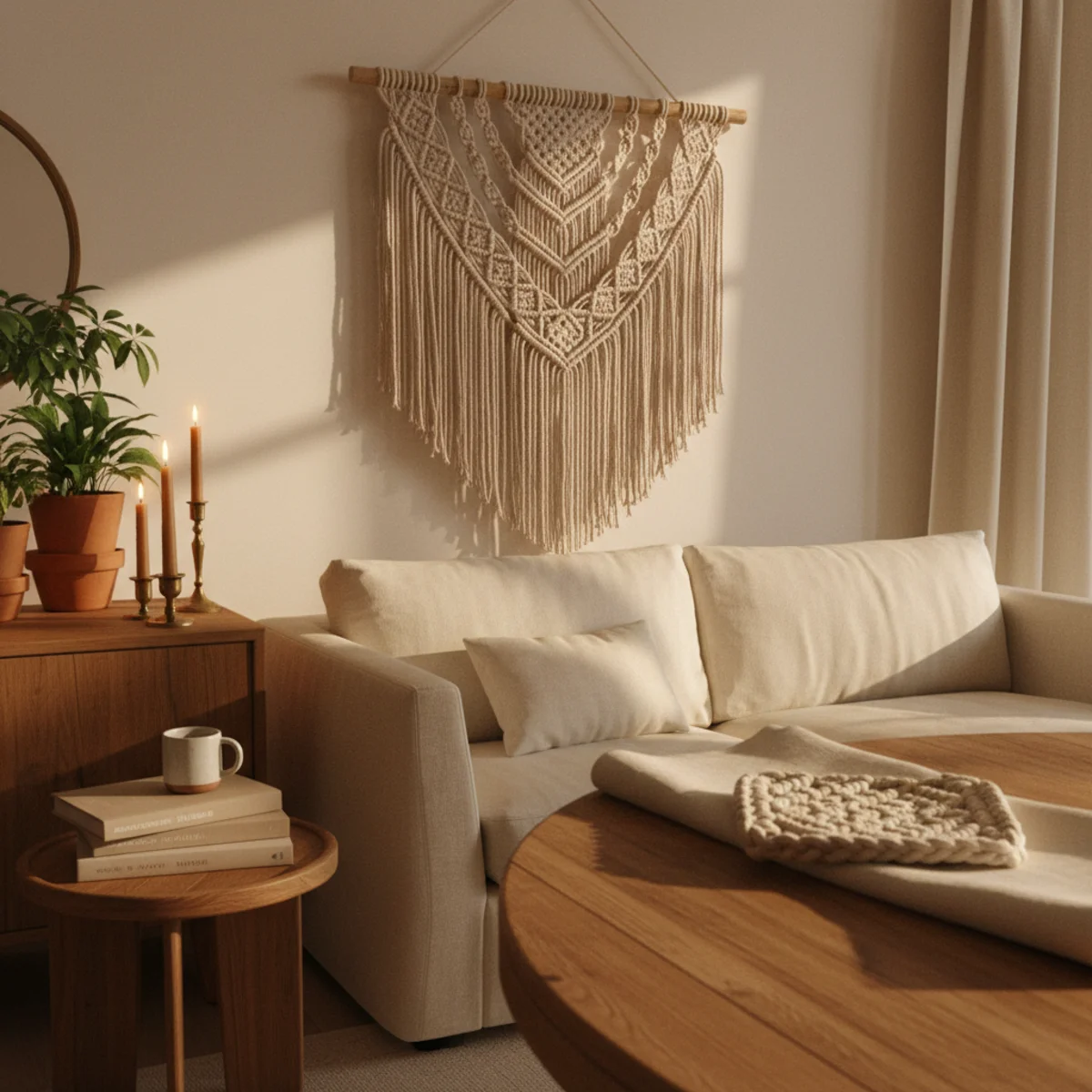
Macramé and woven wall art specifics: NATURAL COTTON MACRAMÉ — single-knot-at-a-time handmade pieces by independent Etsy makers ($40-200 for pieces 18-36 inches wide). Natural cotton rope in unbleached honey-cream reads warmest. JUTE MACRAMÉ — slightly warmer and more earthy than cotton, $30-150 from Etsy artisans. VINTAGE WOVEN WALL HANGINGS — 1960s-1970s woven fiber art from estate sales ($10-60) — genuinely vintage and warmly boho without the reproduction problem. SOUTH AMERICAN WOVEN TEXTILES — small hand-woven Peruvian or Bolivian textile pieces framed or hung on a dowel, $30-100 from fair-trade importers. WALL HANGING SIZE — large-scale (24-48 inches wide) works best as primary wall art; smaller pieces (12-18 inches) work for groupings. PLACEMENT — above a sofa or chair as the room's primary wall art statement, OR in a bedroom above the bed as the headboard alternative. AVOID — mass-produced machine-made 'macramé' from big-box retailers (too uniform, lacks hand-work character). Genuine handmade macramé has slight irregularities in knot spacing, natural variation in the rope tension, and visible craft marks that machine production eliminates.
AFFILIATE SLOTWALL ARTHandmade natural cotton or jute macramé ($40-200) or vintage woven wall hanging ($10-60 from estate sales); 24-48 inches wide; above sofa or bedAdd affiliate URL when configuredWhy it works
Because macramé is three-dimensional textile art — it projects off the wall surface and creates actual shadow from its dimensional structure, which changes throughout the day as light sources move. Additionally, macramé made by hand carries the same craft-investment signal as any other handmade object: someone tied each knot. The visible manual skill, the natural material, and the dimensional quality together produce wall art with warm boho character that flat-surface art cannot match.
Pro tip — Commission a custom macramé piece from an Etsy artisan to your specific wall dimensions rather than buying a pre-made piece — custom sizing typically costs $20-40 more than equivalent pre-made pieces but ensures the piece fits your specific wall correctly. Many Etsy macramé makers offer custom sizing at standard pricing for commissions of $80+.
Large handmade cotton macramé above the sofa — dimensional knotted texture with the craft-investment that mass-produced versions lack. See also: diy-farmhouse-wall-art
08Bring In Collected, Global Pieces
Warm boho rooms contain objects from varied global origins — Moroccan ceramic tagine on an open shelf, Nepalese singing bowl on the coffee table, Indian brass hanging lamp, Turkish evil-eye tile, Indonesian carved wooden panel, Vietnamese lacquerware box. The collected global objects tell the household's story of curiosity and travel, which is what bohemian aesthetic was built to express.
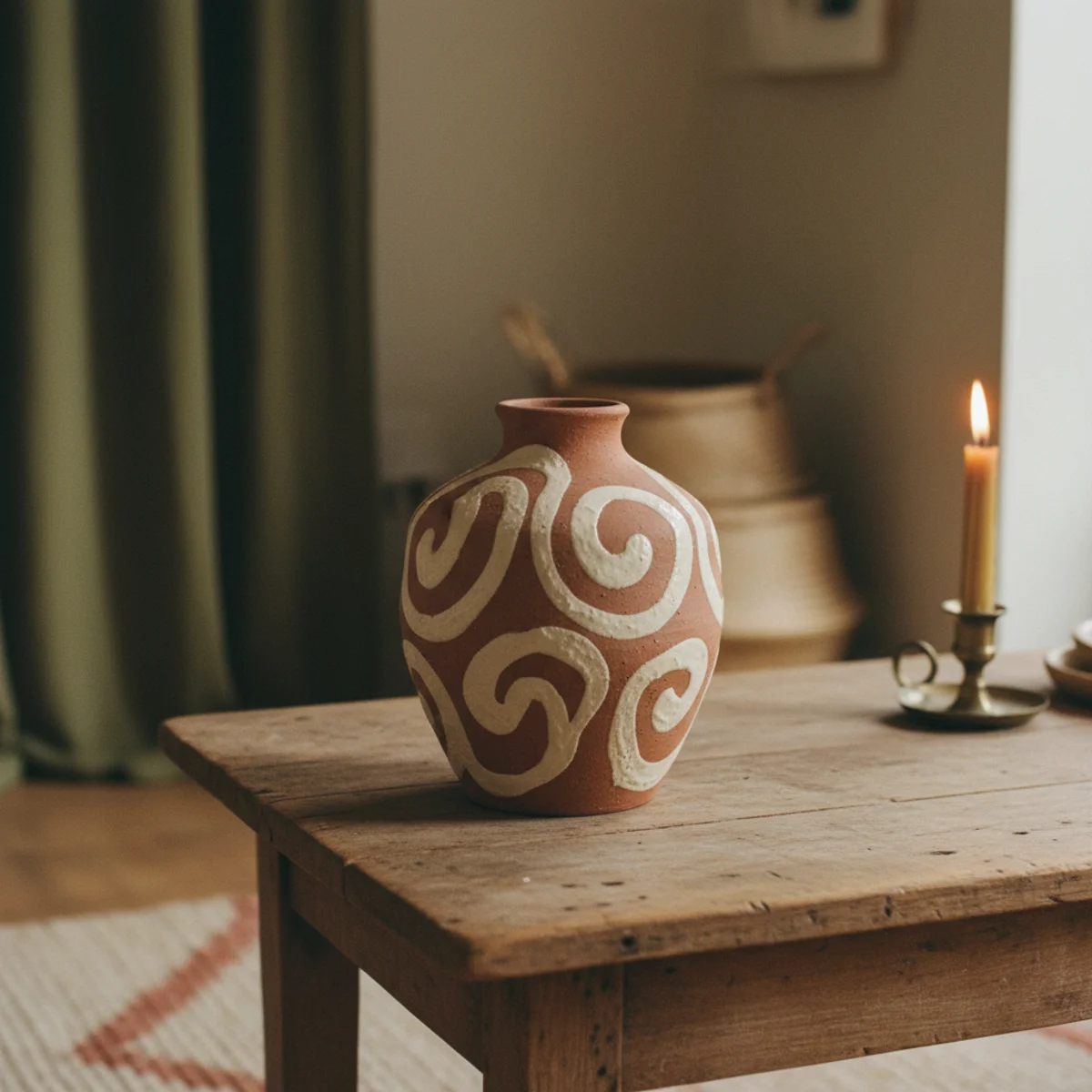
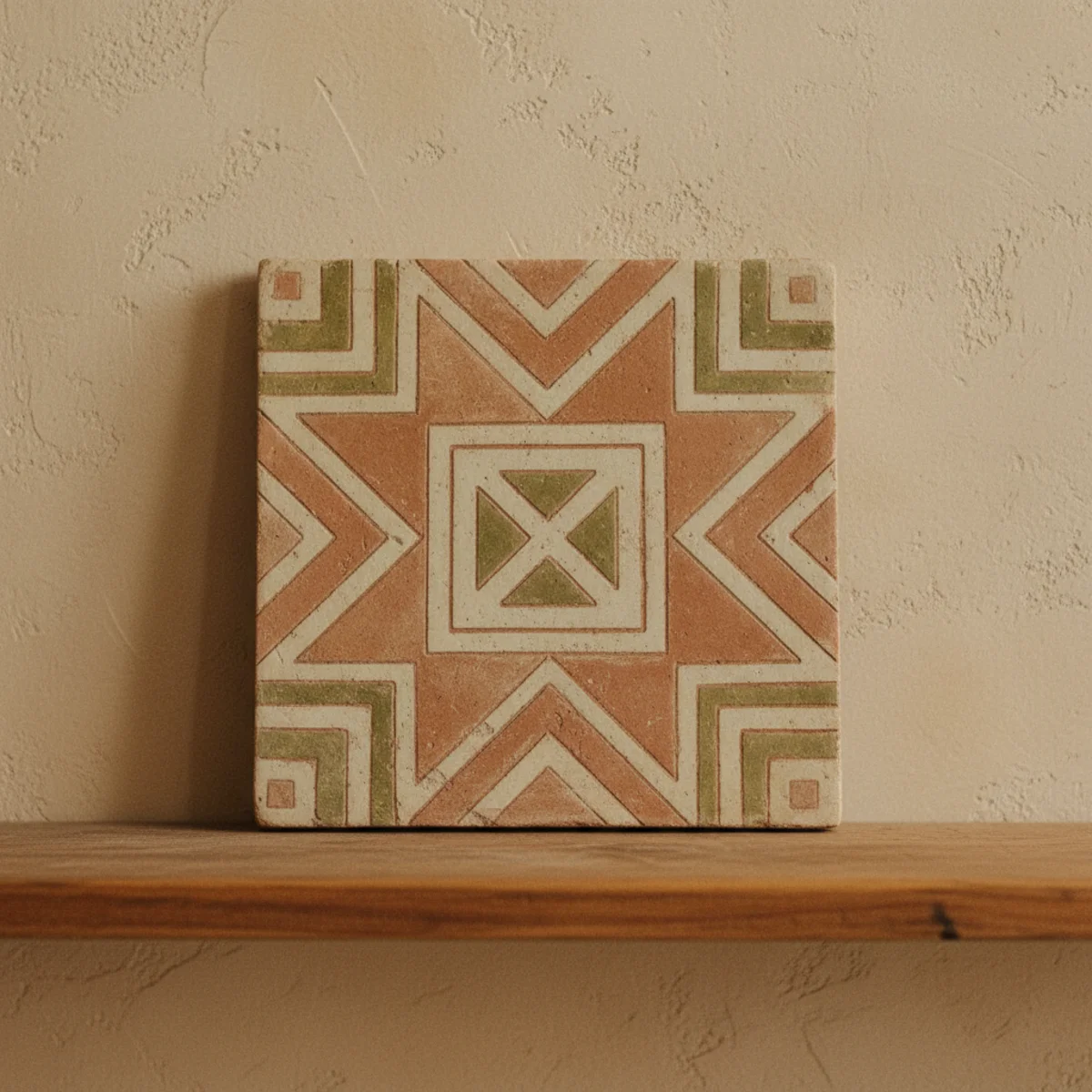
Global collected object categories: MOROCCAN/NORTH AFRICAN — ceramic tagines, geometric zellige tile objects, leather pouf (see item 12), Berber silver jewelry displayed on a ceramic dish. SOUTH ASIAN (Indian, Nepalese) — brass singing bowls, Indian block-print fabric, carved wooden panels from architectural salvage, Indian brasswork. Turkish — ceramic plates and tiles in traditional Iznik-adjacent patterns, evil-eye (Nazar) hanging or dish, copper tea service. SOUTH AMERICAN — Peruvian or Bolivian woven textiles (per item 5), Ecuadorian or Peruvian ceramics. SOUTHEAST ASIAN — Vietnamese or Cambodian lacquerware, Indonesian batik fabric, Philippine woven accessories. THE COLLECTION PRINCIPLE — objects sourced from actual travel or through fair-trade and culturally-appropriate purchasing carry significantly more warmth than objects purchased for their visual similarity to global aesthetics. The boho collection is an autobiography of curiosity; the commercial boho room is an approximation of one. SOURCING ETHICALLY — fair-trade importers, museum gift shops, actual travel, direct-from-maker purchasing. Avoid: appropriated objects sold by retailers who have no connection to the originating culture.
AFFILIATE SLOTOBJECTSMoroccan ceramics, Indian brasswork, Turkish tiles, South American woven, Southeast Asian lacquerware; sourced from actual travel or fair-trade importers; each with origin storyAdd affiliate URL when configuredWhy it works
Because each object carries a specific provenance — where it was made, by whom, in what tradition, acquired by the household through what experience. The Moroccan tagine bought at a Marrakech souk carries specific memory of the market, the negotiation, the seller's craft; the same tagine purchased from a home-decor retailer carries none of these. The warm boho home is an archive of the household's curiosity and experience; the commercial boho home is an aesthetic approximation of that archive. Genuine objects produce genuine character; commercial approximations produce aesthetic imitation.
Pro tip — Connect each collected global object to its origin story through small labels or a household memory journal — the tagine from Marrakech in 2019, the kantha quilt from the Jaipur artisan cooperative, the Peruvian textile from the fair-trade market in Cusco. The stories make the collection a household autobiography rather than just a decoration.
Moroccan ceramic, Indian brass, Turkish tile, Peruvian textile — the global curiosity archive that warm boho is built to express. See also: shelf-styling-ideas
09Add Warm, Low Lighting
Warm boho lighting is low, warm, and distributed from multiple sources — warm 2700K lamps at table height, Moroccan-style lanterns on the floor, candles, fairy lights at warm-white 2700K, and the rattan pendant providing warm dappled overhead light. The boho lighting is the furthest from commercial overhead fluorescent that any warm home aesthetic gets.
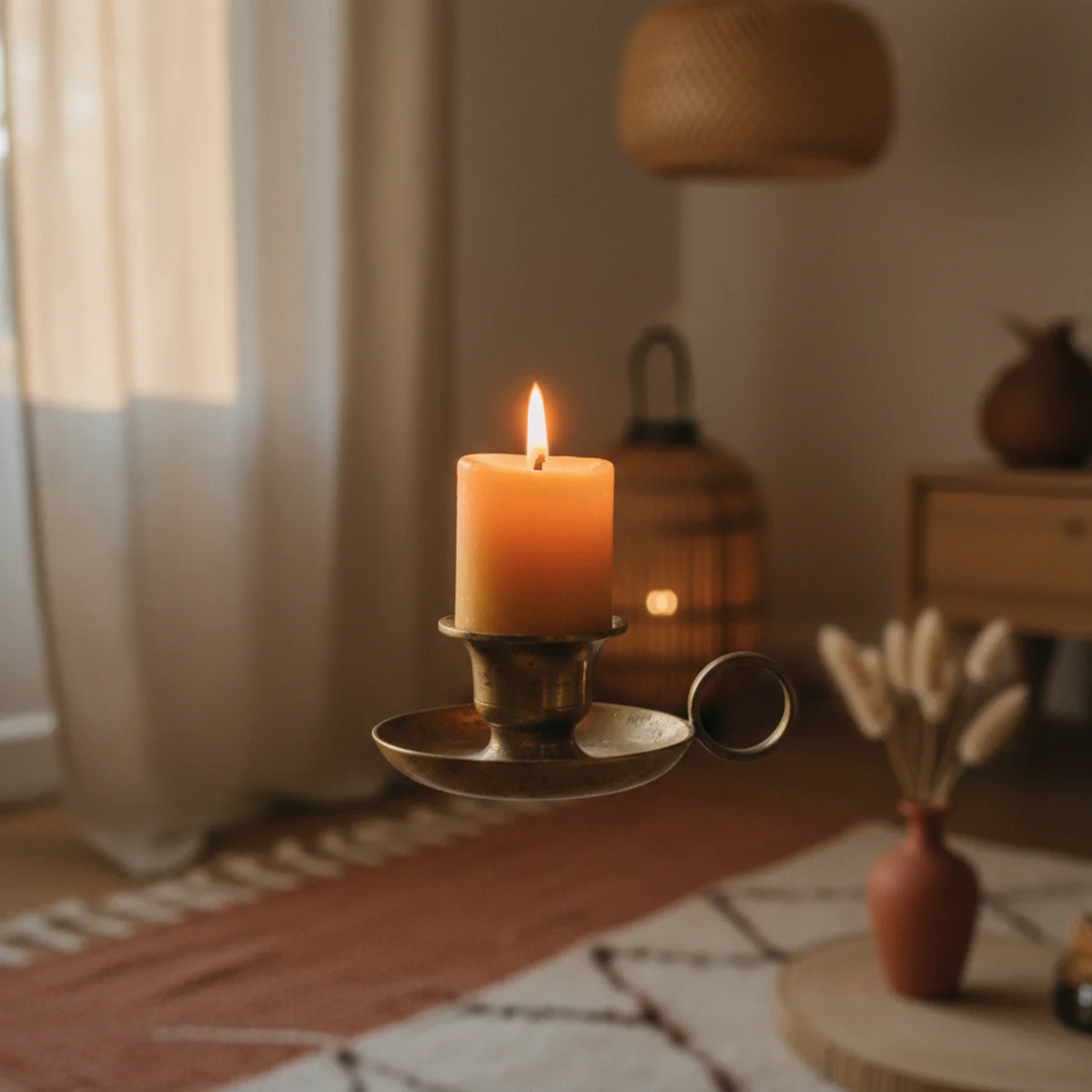
Warm boho lighting setup: RATTAN PENDANT — large woven rattan shade (per item 4) over primary seating area with warm 2700K bulb. The dappled patterned light through woven rattan is warm boho's signature overhead light quality. MOROCCAN LANTERNS — metal-work star or geometric lanterns on the floor or low shelves with LED tealight candles inside. $20-80 each from World Market or import shops. FLOOR LAMPS — 2-3 floor lamps at 50-65 inches with warm ceramic or rattan bases and fabric shades. FAIRY LIGHTS — warm white (2700K) string lights draped over a macramé wall hanging, wrapped around a plant, or strung along a bookcase at $10-30 per set. CANDLES — beeswax candles throughout at warm 2700K flame. VINTAGE BRASS LAMPS — vintage brass table lamps ($20-60 from estate sales) on side tables and shelves. THE LOW LIGHTING PRINCIPLE — as much lighting as possible at floor and table level rather than overhead. The warm boho room is experienced from a low perspective (floor cushions, low-slung sofas, layered rug level); the lighting should match this low perspective.
AFFILIATE SLOTLIGHTINGRattan pendant overhead + Moroccan floor lanterns + vintage brass table lamps + warm fairy lights + beeswax candles; all 2700K; primarily at floor and table levelAdd affiliate URL when configuredWhy it works
Because warm boho living is floor-level living — the layered rugs, the floor cushions, the low coffee tables, the low-slung seating are all expressions of the bohemian practice of living close to the ground rather than at the elevated-table height of Western commercial life. Lighting that comes from floor level and low table height illuminates this low-level life; overhead commercial lighting is designed for work surfaces at table height and above. The warm boho room feels right when experienced at floor cushion level with warm light sources at the same height.
Pro tip — Place Moroccan lanterns specifically on the floor at rug level rather than on elevated surfaces — floor-level lanterns illuminate the layered rugs from below, creating warm patterns in the rug's pile texture from a unique angle that overhead lighting never achieves. The floor-lantern-and-layered-rug combination is one of warm boho's most-specific atmospheric effects.
Rattan pendant, floor lanterns, fairy lights, candles — warm low-level light from multiple sources at the height of the boho living experience. See also: best-lamps-warm-light
10Use Natural-Fiber Everything
Warm boho extends the natural-fiber principle to its maximum expression — every possible surface material should be natural rather than synthetic. Woven jute rugs, rattan furniture, cotton and linen textiles, leather seating, wooden surfaces, ceramic vessels, terracotta pots. The natural-fiber commitment in warm boho is more absolute than in other warm home aesthetics.
Natural-fiber commitment in warm boho: RUGS — all natural fiber (wool, jute, sisal, natural cotton). Zero synthetic-pile rugs regardless of how good they look photographically. FURNITURE — natural materials: solid wood, genuine leather, wicker/rattan, cane. No synthetic upholstery unless cotton or linen over natural fill. TEXTILES — all natural: linen, cotton, wool, silk, hemp, jute for decorative elements. No polyester, microfiber, acrylic. STORAGE — woven baskets in natural fiber (jute, seagrass, rattan). No plastic bins. WALL ART FRAMES — natural wood frames. No plastic or synthetic material frames. VESSELS — terracotta, hand-thrown ceramic, genuine glass, natural wood, genuine leather. CANDLES — natural wax (beeswax, soy, coconut wax). No paraffin. SURFACES — natural wood. No laminate, MDF, or synthetic veneers where possible. THE SENSORY PRINCIPLE — natural fibers create the specific sensory environment of warmth, organic variation, and material authenticity that synthetic materials specifically cannot replicate. In a warm boho room, every surface touched, every fabric handled, every object picked up should feel like natural material.
AFFILIATE SLOTMATERIALSAll rugs, textiles, furniture, storage, frames, and vessels in 100% natural materials; wool, linen, cotton, jute, rattan, ceramic, leather, wood; zero synthetic substitutesAdd affiliate URL when configuredWhy it works
Because the bohemian aesthetic specifically romanticizes natural materials and their organic variation — the imperfect hand-thrown pot, the irregular weave of hand-loomed cotton, the slight texture variation of natural leather across decades of use. These qualities exist because natural materials have inherent imperfection and variation that manufacturing processes specifically eliminate for commercial consistency. The warm boho home is an accumulation of natural imperfections that together produce the warm organic character. Synthetic substitutes cannot achieve this because they have no inherent variation to accumulate.
Pro tip — Audit your existing home for synthetic materials masquerading as natural — polyester 'linen' textiles, plastic-frame mirrors, synthetic-pile rugs, MDF furniture with wood-grain laminate. Replace these items gradually over 12-18 months with genuine natural-material equivalents. Each replacement moves the home toward genuine warm boho character; the process is slow but the direction is clear.
Jute, cotton, rattan, terracotta, wood, ceramic — every surface a natural material; no synthetic substitutes in warm boho. See also: what-is-japandi-style
11Anchor With One Unifying Thread
The most-important warm boho discipline: amid all the pattern mixing, global object collecting, plant abundance, and textile layering, one unifying thread prevents the room from dissolving into visual chaos. The thread can be a consistent color (all warm terracotta tones throughout), a consistent material (rattan and natural fiber appearing in every room zone), or a consistent scale (all large-scale objects at floor level, all small objects at table level). Without the thread, warm boho reads as hoarding; with it, it reads as curated abundance.
Unifying thread options for warm boho: COLOR THREAD — warm terracotta appearing in rug, ceramic, pot, and textile across the full room. Even if everything else varies wildly (pattern, origin, style), the consistent terracotta presence unifies. MATERIAL THREAD — rattan and natural fiber appearing at every horizontal level: rattan pendant above, rattan shelf at mid-height, rattan baskets at floor level. The rattan thread connects ceiling to floor through one material. SCALE THREAD — all large collected objects at floor level (floor plants, floor cushions, layered rugs), all medium objects at shelf and table level, all small objects in specific collected groupings on surfaces. The scale discipline creates visual hierarchy that prevents density from becoming chaos. PLANT THREAD — the plants distributed throughout, at every level, in warm terracotta pots, create a living thread that connects all zones of the room. APPLYING THE THREAD — identify one thread early (preferably color) and maintain it consistently even as every other element varies. The single thread is what makes the room read as collected-with-intention rather than as accumulated-without-direction.
AFFILIATE SLOTDISCIPLINEChoose ONE thread: consistent warm terracotta color, OR consistent natural-fiber material (rattan throughout), OR consistent scale organization; apply to every new additionAdd affiliate URL when configuredWhy it works
Because warm boho operates closer to the visual-overwhelm threshold than any other warm home aesthetic — it has the most patterns, the most objects, the most varied origins, the most plants, the most layers. Without one clear unifying thread, the density crosses from 'richly curated' to 'visually exhausting.' The thread is the discipline that enables everything else's freedom. Japandi requires empty space as its discipline; warm boho requires the single unifying thread. Both are organizing principles that enable the aesthetic's specific qualities without sliding into failure.
Pro tip — Before adding any new element to a warm boho room, ask whether it belongs to the thread — if the thread is terracotta, does the new piece carry any terracotta? If the thread is rattan/natural fiber, is the new piece natural fiber? Applying the thread discipline to every new addition maintains the room's coherence against the natural drift toward accumulation-without-direction.
Terracotta in the rug, pot, cushion, and ceramic — the single thread that lets everything else vary freely without dissolving. See also: warm-minimalism
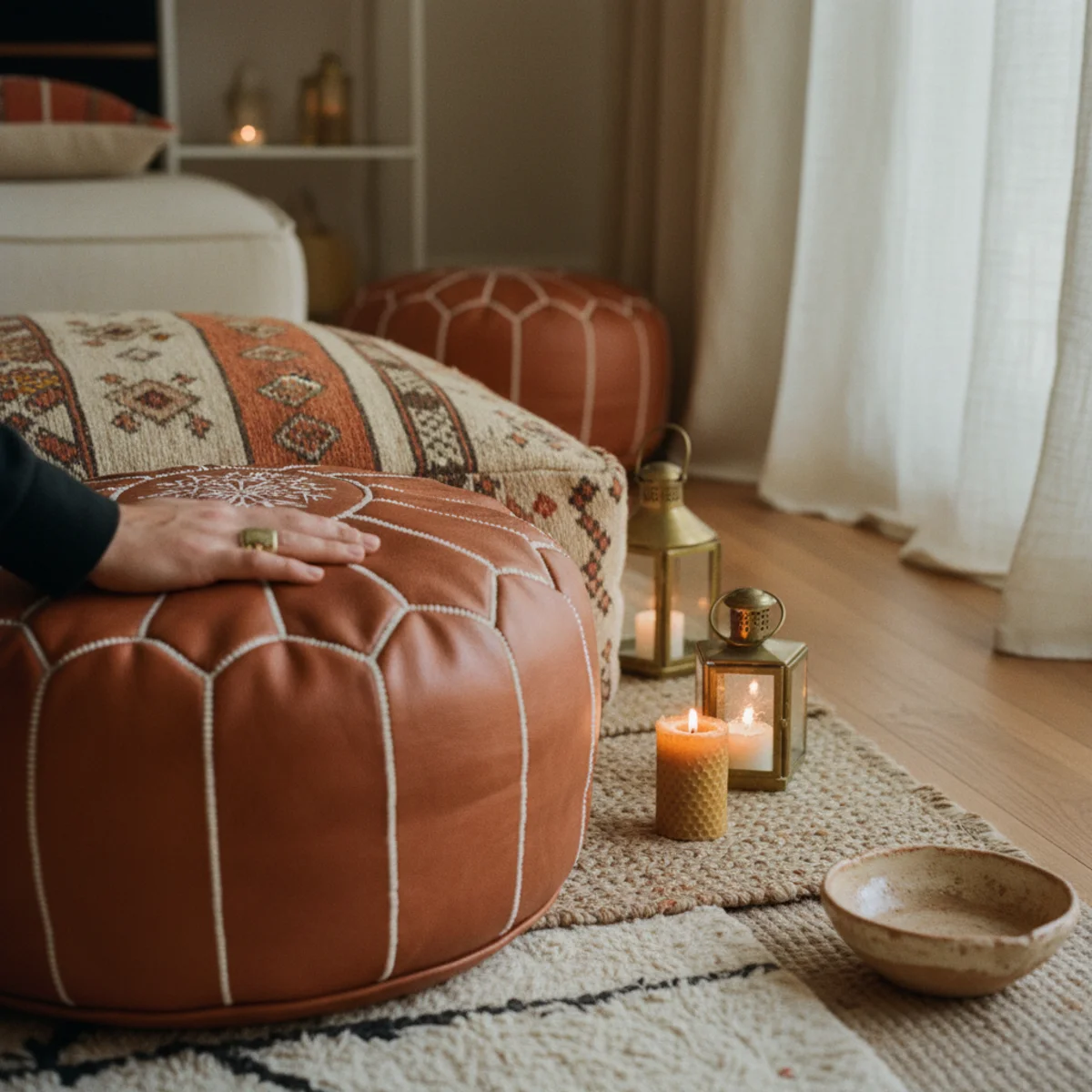
12Add a Floor Cushion or Pouf
Floor cushions and poufs — Moroccan leather poufs, large floor cushions in global textiles, meditation cushions in natural fabric — add the low-level seating that warm boho living specifically favors. The floor cushion invites sitting at ground level with the layered rugs; the leather pouf serves as both additional seating and as a foot rest or low surface.
Floor cushion and pouf options: MOROCCAN LEATHER POUF — genuine hand-stitched leather pouf in terracotta, deep brown, or cream ($60-200 from Moroccan importers or World Market). Stuffed with cotton or recycled filling. The quintessential warm boho accent piece. LARGE FLOOR CUSHION — 24-30 inch square cushion in global textile fabric ($40-120 from Indian textile importers, Etsy, or DIY with purchased global fabric). MEDITATION CUSHION — round zafu meditation cushion in organic cotton or natural fabric ($30-80). VINTAGE KILIM POUF — small kilim fabric-covered floor pouf ($60-150 from Etsy kilim importers). PLACEMENT — alongside the layered rugs at floor level in the primary gathering zone, beside the low coffee table, in the window seat zone, or as a foot rest in front of the sofa. STUFFING — if making a DIY floor cushion, use buckwheat hull ($20-30 per 5 lb bag), natural cotton fill, or wool batting — all natural materials consistent with warm boho natural-fiber principle. PRACTICAL NOTE — floor cushions and poufs add approximately 8-12 inches of seated height above the floor. In warm boho rooms where the sofa seat is 16-17 inches (low-profile seating), the floor cushion sits at 8-12 inches, creating a natural progression from floor level to seated level to sofa level.
AFFILIATE SLOTSEATINGMoroccan leather pouf ($60-200), large floor cushion in global textile ($40-120), or kilim-covered pouf ($60-150) at floor level alongside layered rugsAdd affiliate URL when configuredWhy it works
Because floor-level living is fundamental to the bohemian tradition — the meditation practice, the artist's studio floor-sitting, the Eastern-influenced low-living that the bohemian aesthetic specifically incorporated from global cultures it engaged with. A warm boho room styled with layered rugs, low plants, and floor-level lighting but no floor seating misses the invitation to actually live at that level. The floor cushion is the invitation to sit down with the rugs and the plants and experience the room from its most-specific perspective.
Pro tip — Source Moroccan leather poufs directly from Moroccan artisan sellers through Etsy rather than from Western import retailers — the same pouf costs $60-100 directly from Moroccan makers versus $150-300 from Western importers. Search 'Moroccan leather pouf' on Etsy with free shipping filter; many Moroccan artisans ship directly to customers at competitive prices.
Moroccan leather pouf and global-textile floor cushion on the layered rugs — the invitation to live at the warm boho room's floor level. See also: reading-nook-ideas
How to get the warm boho look step by step
Layer abundantly, but anchor with a warm thread. Work in this order.
- 1Set an earthy palette
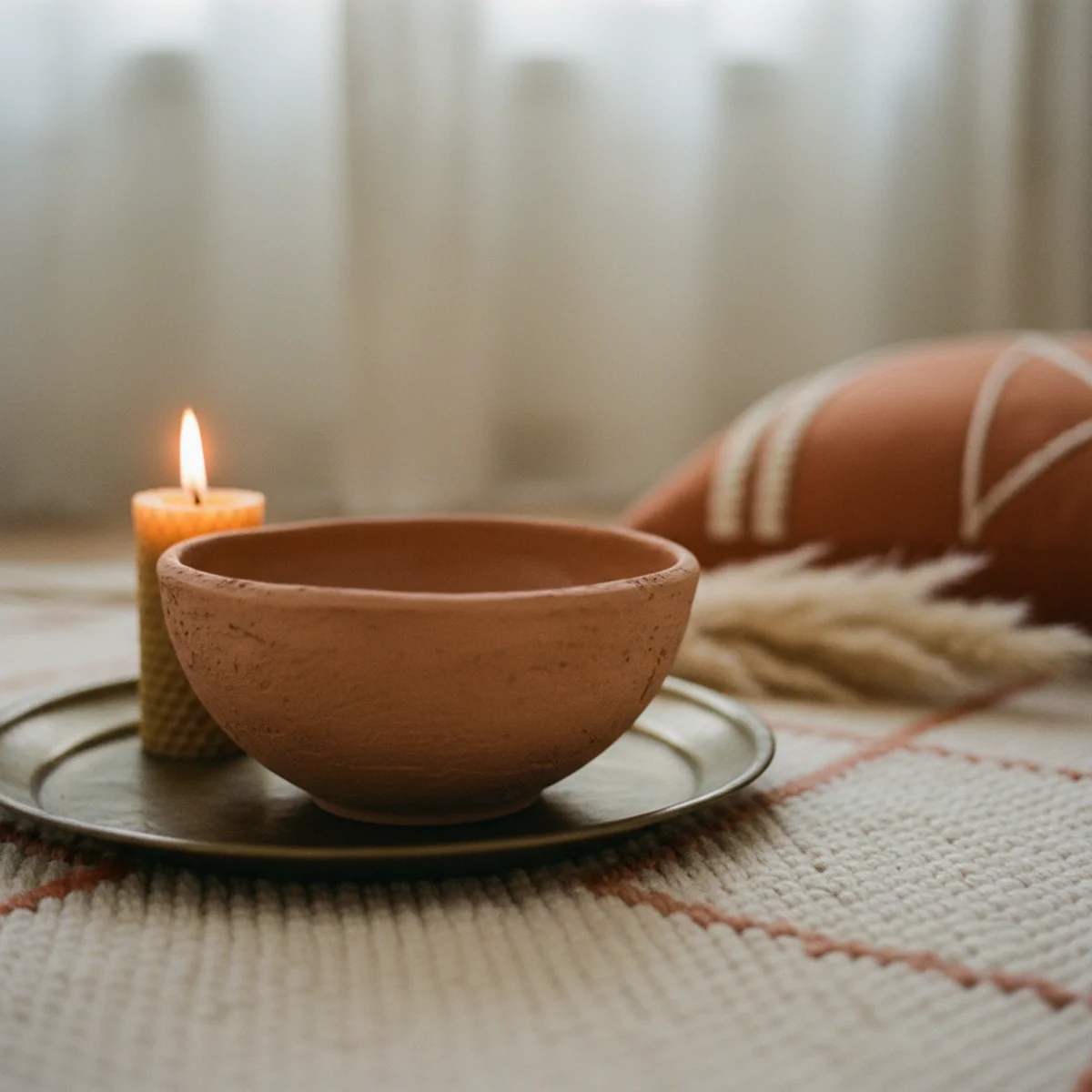
Choose a warm base — terracotta, mustard, rust, warm greens — rather than the cool white-and-macramé look. The palette is the anchoring thread.
- 2Layer rugs and textiles
Overlap a vintage kilim or wool rug over jute, and layer collected cushions and throws, all unified by the warm palette.
- 3Add plants, rattan, and natural fiber
Fill the room with grouped plants, add a rattan chair and wicker baskets, and use natural fibers throughout for grounding warmth.
- 4Mix patterns, add collected pieces, light it warm
Mix patterns boldly within the palette, add genuine collected and global pieces, and finish with warm low light, lanterns, and candles.
Quick tips
- Lean earthy — terracotta, mustard, rust, warm greens — not the cool white-and-macramé look.
- Layer rugs that don't match, like a kilim over jute, for warmth and depth.
- Fill the room with grouped plants; lush greenery is central to boho.
- Mix patterns boldly but unify them with one shared color thread.
- Use macramé sparingly — one piece reads boho, a wall of it reads dated.
- Anchor the abundance with a warm palette or repeated material so it reads gathered, not chaotic.
Boho by intensity
Layered kilims, abundant plants, rattan, mixed patterns, and collected pieces in an earthy palette.
A few boho touches — one kilim, a rattan chair, plants — against a calmer warm-neutral backdrop.
Layered textiles, a macramé piece, plants, and warm low light; see our cozy bedroom inspo.
Thrifted rugs, secondhand collected pieces, and cuttings-grown plants; see our thrifted decor guide.
Real boho is warm and earthy and looks gathered over a lifetime. The layering is the point — but so is the one thread that holds it together.
Frequently asked questions
What is warm boho decor?+
How do I make my home look warm boho?+
What colors are used in warm boho decor?+
What's the difference between warm boho and regular boho?+
Can I do warm boho in a small apartment?+
How do I keep warm boho from looking messy?+
Boho is the warm, gathered, slightly untamed look that feels like a well-traveled life in one room — and the 2026 version is earthier and warmer than the cool white-and-macramé phase that gave it a bad name. Layer rugs and textiles abundantly, fill the room with plants, mix patterns, and add collected pieces, but anchor it all with one warm thread. We'd lean into an earthy palette before anything else; that warm thread is what makes the layered abundance read as gathered over a lifetime rather than chaotic. Layer freely, anchor warmly, and let the collected pieces tell the story.