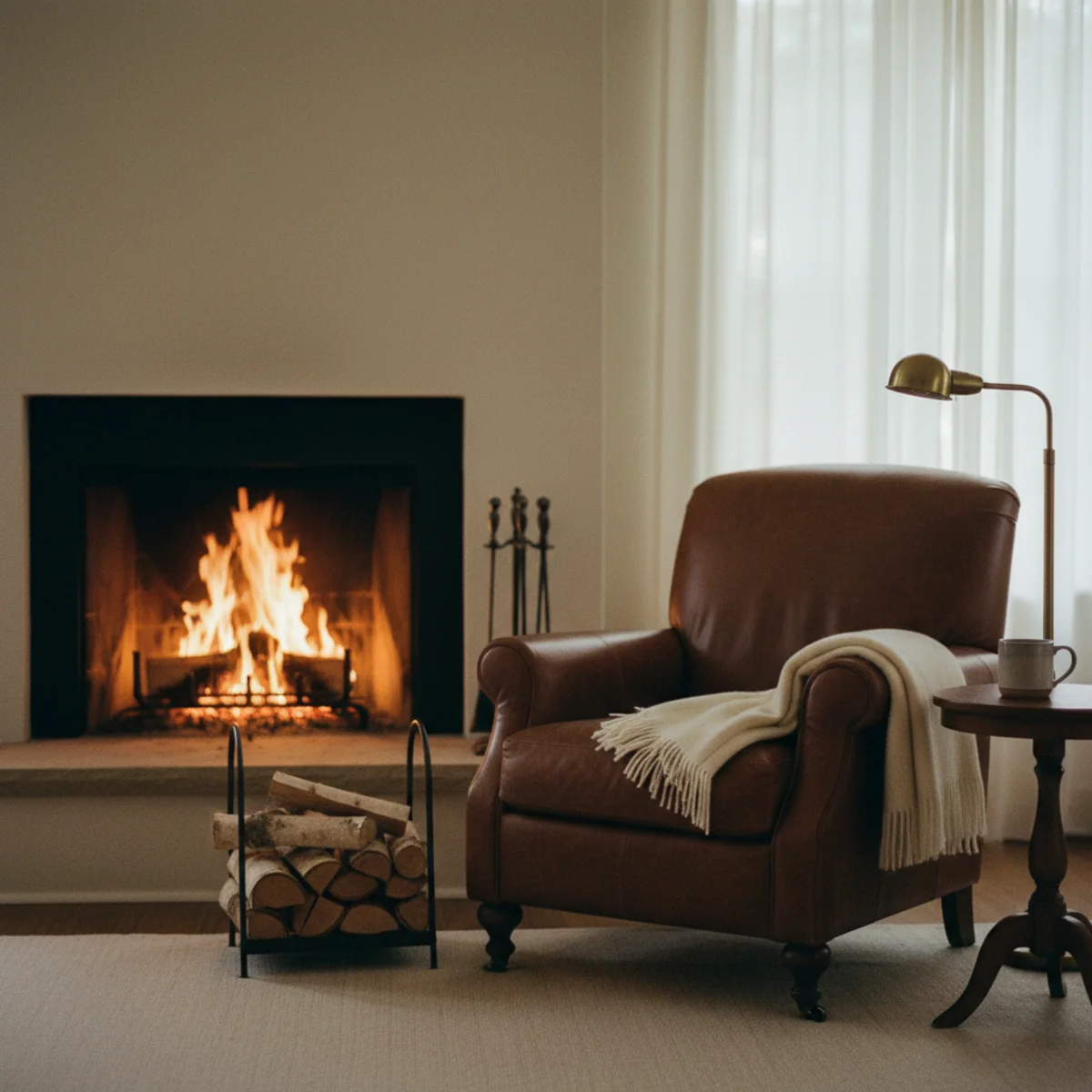
These twelve fireplace nook principles apply across real fireplace situations — working wood-burning fireplaces used daily in winter, gas fireplaces used with a switch, electric fireplace inserts in apartments, faux fireplace surrounds with candles, and every combination of chair, rug, lighting, and styling that determines whether the hearth zone becomes the household's primary cozy destination or a beautiful-but-unused architectural feature.
Most fireplace nooks are under-used because they're under-furnished — the fireplace mantel is styled (per fireplace-mantel-decor principles), but no chair is pulled close, no throw is within reach, no small surface provides a cup placement, and no lamp supplements the fire's light. The hearth itself is architectural; the nook requires furniture and accessories positioned specifically to invite use. The twelve principles below build the nook from the architectural fireplace outward.
By the end of this guide, you'll know exactly how to build a genuinely used fireplace nook — pulling a chair close to the hearth, adding a within-reach throw, styling the hearth with logs or candles, adding sheepskin or soft rug underfoot, providing a small surface for a drink, framing the fire as focal point, using a faux or electric alternative, adding two chairs for conversation, stacking nearby books and firewood, keeping the ambient light low, adding a mirror above the mantel, and making the nook a reading spot.
WHAT'S INSIDE
- Why pulling a chair close to the actual hearth (within 3-5 feet) transforms the nook's use frequency
- The within-reach throw that signals the nook is for use rather than display
- Keeping the ambient room light low so the fire becomes the primary visual source
- Making the fireplace nook a reading spot — the specific combination that produces daily use
The fire is the original cozy corner. Pull a chair up to it, add a throw, and you've made the warmest spot in any house.
— House Beautiful [citation needed — verify before publish]
What makes a good fireplace nook?
A good fireplace nook combines comfortable seating drawn close to the hearth, soft warm layers, and styling that frames the fire as the room's focal point. The fireplace — real or faux — provides the gravitational warmth; the nook adds a chair or two, a throw within reach, a spot for a drink, and the textures that make you want to settle in.
The seating is the defining move. A chair or a corner of the sofa pulled genuinely close to the hearth, angled toward the fire, turns a fireplace from a thing you look at into a place you sit. Add a wool throw, a sheepskin, a stack of logs or candles as styling, and a small surface for a mug, and the hearth corner becomes the spot the whole house gravitates to on a cold night. No working fireplace? A faux hearth, an electric insert, or a cluster of candles in the firebox creates the same focal-point warmth.
More in Cozy Corners you may love
See allWhy fireplace nooks are everywhere in 2026
The hearth remained the emotional center of the cozy home, and styling the area around it as a dedicated nook — rather than just facing a sofa at it from across the room — became a saved-pin favorite. Pinterest's fireplace nook and hearth searches climb every cold season.
The honest appeal is that the fire is the original cozy corner, and drawing seating close to it taps something primal. As the warm-home and slow-living movements grew, people moved beyond the standard sofa-across-the-room layout toward intimate hearth seating — a chair pulled close, a throw, firelight. And as faux and electric fireplaces made the look achievable without a chimney, the fireplace nook became reachable in any home, even a rental.
20 fireplace nook ideas
01Pull a Chair Close to the Hearth
The most-important fireplace nook decision: pull one comfortable chair within 3 to 5 feet of the hearth — close enough to feel the fire's warmth, see the flames clearly, and have the fire as the primary visual focus from the seated position. Most living rooms position chairs 8 to 12 feet from the fireplace for social symmetry; the cozy nook chair breaks this pattern to create an intimate hearth zone.
Chair positioning and selection: DISTANCE — 3 to 5 feet from the fireplace opening (front of chair to fireplace opening). Close enough for warmth from a working fire, visual focus on flames, and atmospheric intimacy. CHAIR TYPE — comfortable enough for 1-2 hour sitting (same principle as coffee corner and window seat chairs). BEST OPTIONS: vintage worn leather club chair ($200-600 from Marketplace/estate sales), linen-upholstered wingback ($400-1,200 new), boucle armchair ($300-1,000), IKEA POÄNG ($129 budget). Avoid: dining chairs, accent chairs without adequate seat depth, chairs with tall backs that block the fire's visual access from the room. CHAIR ORIENTATION — angled 10-20 degrees toward the hearth rather than perfectly parallel to the fireplace wall. The slight angle acknowledges the fireplace as focal point while allowing the seated person to also see the rest of the room. SAFETY DISTANCE — for wood-burning fireplaces, ensure upholstered chair is at least 3 feet from the hearth opening (NFPA standard). For gas and electric fireplaces, follow manufacturer minimum clearance requirements. SMALL SIDE TABLE — positioned at chair arm height within the nook, for drink placement (per item 5).
AFFILIATE SLOTFURNITUREComfortable chair 3-5 feet from hearth, angled 10-20 degrees toward fire; vintage leather, linen-upholstered wingback, or boucle armchairAdd affiliate URL when configuredWhy it works
Because the fire's warmth, visual focus, and acoustic qualities (crackling, settling, ambient heat sound) are only fully experienced within 3-5 feet. A chair 10 feet from the fireplace is in the same room as the fire but not in the fireplace experience; a chair at 4 feet is genuinely IN the fireplace experience. The household member who sits in the distant chair for warmth is warm; the one who sits in the close nook chair is sitting by the fire. The second is qualitatively different. No amount of styling compensates for a chair positioned too far from the hearth.
Pro tip — Sit in the proposed chair position during a fire and assess the experience for 20 minutes before permanently positioning — the warmth level, the view angle on the flames, the acoustic quality, and the relationship to the rest of the room all reveal themselves during actual use. Most households find the right position is 6-12 inches closer to the hearth than initial aesthetic instinct suggested.
Vintage leather chair 4 feet from hearth, angled toward fire — close enough to be genuinely IN the fireplace experience. See also: reading-nook-ideas
02Add a Throw Within Reach
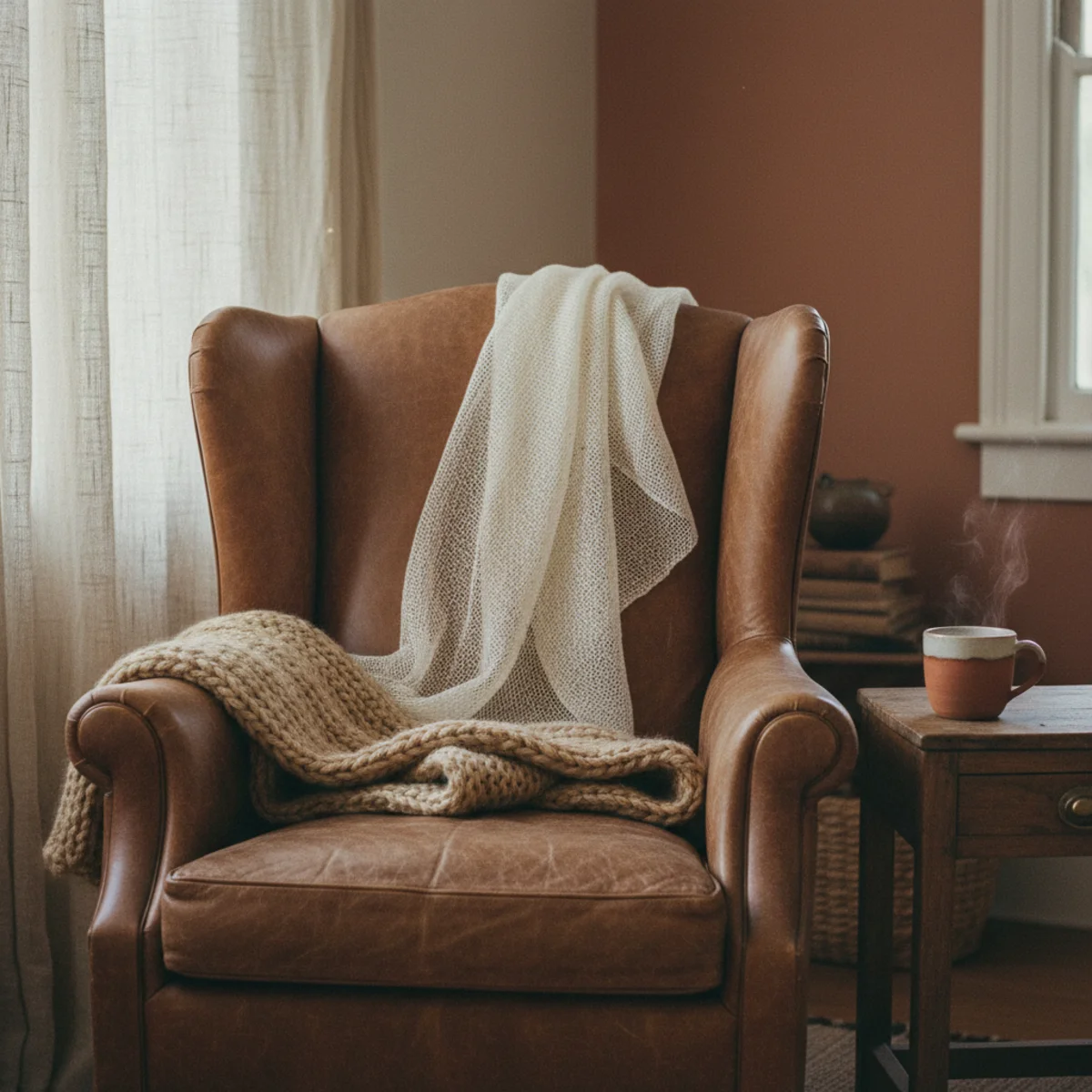
A throw draped over the nook chair's back or arm — within seated arm's reach — signals that the fireplace nook is for active cozy use rather than architectural display. The fire provides warmth, but on mild evenings or during early-season fires, wrapping in a throw completes the sensory cozy experience. Cost: $60-150 for a quality wool throw.
Fireplace nook throw specifications: MATERIAL — chunky knit wool or heavy merino for autumn-winter nook use ($80-150 from Pendleton, West Elm, or Etsy artisans), heavyweight alpaca for the warmest version ($100-300). POSITION — draped over the chair back (50% hanging behind, 50% over seat) OR draped over one arm of the chair (easily reachable while seated). NOT folded into a storage basket beside the chair — storage baskets read as display; draped throws read as active-use invitation. PALETTE — within the room's warm tone family. Deep rust, terracotta, warm cream, soft sage — whatever is already the room's textile palette. FIRE PROXIMITY NOTE — the throw should not hang forward enough to contact the fireplace screen or surround. Keep the drape on the chair, away from the open hearth. SEASONAL ADJUSTMENT — in autumn (light fire season), a medium-weight merino is appropriate. By January, the nook calls for the heaviest wool or alpaca throw available. SECONDARY USE — the throw is also for use when the fire is out but the nook chair is used for reading in the morning or afternoon. The throw's utility extends beyond fire-only use.
AFFILIATE SLOTTEXTILEHeavy merino or chunky wool throw draped over nook chair back or arm, within seated reach; $80-150; not in storage basketAdd affiliate URL when configuredWhy it works
Because the micro-comfort of wrapping in a throw while sitting by the fire is one of the nook's defining physical pleasures — and it requires the throw to be immediately available rather than in another room. The household member who thinks 'I'll sit by the fire if I get a throw from the bedroom' often doesn't make the trip; the household member who sees the throw draped over the nook chair simply sits and wraps in one motion. The accessibility eliminates the friction that prevents spontaneous nook use.
Pro tip — Keep a second throw in a nearby basket for when two household members use the fireplace nook simultaneously (two chairs, per item 8) — the two-throw fireplace zone supports the two-person use case that makes the nook a social space rather than a solitary one.
Chunky wool throw draped over chair back beside lit fire — the within-reach warmth completing the nook experience. See also: best-wool-throws
03Style the Hearth With Logs or Candles
The hearth itself (the firebox interior and the hearth surround) should be styled whether or not the fire is currently burning. An unlit fireplace with no styling reads as a hole in the wall; one with a neatly stacked log arrangement, candle cluster, or seasonal botanical display reads as an intentional design element even when unlit.
Hearth styling options: WOOD-BURNING FIREPLACES (when unlit) — stack seasoned firewood in an attractive arrangement: a neat log stack with kindling visible at the front, or use a decorative log holder ($40-200 in brass, iron, or wood). Add a bundle of birch logs ($20-40 from garden centers or holiday stores) for their white bark visual appeal. CANDLE ALTERNATIVE FOR UNUSED FIREPLACES — a cluster of 5-9 pillar candles of varied heights in the firebox, on a non-flammable base (slate slab, stone, metal tray). The candles are lit when fire ambiance is desired without a full wood fire. DRIED BOTANICAL DISPLAY — a large bunch of dried pampas, dried grasses, or dried eucalyptus in a tall vase positioned inside the firebox (only when the fireplace is not being used). Dried botanicals in an unused fireplace read as intentional display. FIREPLACE SCREEN — a decorative fire screen ($80-400 in brass, iron, or decorative panels) frames the firebox attractively whether the fire is lit or unlit. THE HEARTH TOOLS — a fireplace tool set in aged brass or matte iron ($50-200) positioned beside the hearth as both functional and decorative. The poker, brush, tongs, and ash shovel in a coordinated set signal that the fireplace is genuinely used.
AFFILIATE SLOTHEARTHNeat log stack or decorative log holder + birch logs; OR candle cluster on stone base for unlit ambiance; OR dried botanical in tall vase; brass tool set besideAdd affiliate URL when configuredWhy it works
Because the fireplace is the living room's architectural focal point year-round — in rooms with fireplaces, the fireplace is the first thing the eye registers upon entering. An unstyled empty firebox reads as gap or void; a styled hearth reads as composed architectural element. The nook's cozy reading depends on the hearth being visually active even in summer or on fire-free evenings.
Pro tip — Keep a ready-laid fire in the firebox during fire season — a fire laid and ready to light (kindling and newspaper under split logs, fire starter cube at the base) reads as prepared-and-ready rather than empty-and-waiting, and removes the barrier of fire-building from spontaneous fire-lighting. The 5-minute fire-laying task becomes a daily reset habit rather than a pre-fire labor.
Birch log arrangement and pillar candles on slate — styled hearth reading beautiful with or without a fire. See also: fireplace-mantel-decor
04Add a Sheepskin or Soft Rug
A real sheepskin or small soft area rug directly in front of the fireplace (and under the nook chair's foot zone) completes the cozy sensory environment at the nook floor level. The warm underfoot texture adds the tactile dimension to the fire's visual and thermal experience. Cost: $60-200 for a real sheepskin; $80-300 for a small soft area rug.
Fireplace nook floor options: REAL SHEEPSKIN — single genuine shearling at $60-200 (IKEA RENS at $40-50 for synthetic alternative). Placed at chair front, feet landing on the fleece. The sheepskin is the most-direct sensory expression of 'fireside comfort.' SMALL WOOL PILE RUG — 3x4 or 3x5 foot wool pile rug in front of the fireplace and under the nook chair. $80-300 from Rugs USA or thrifted vintage. NATURAL FIBER RUG — small jute or sisal rug for slightly firmer underfoot texture. $60-150. LAYERED RUGS — a small flat-weave rug under a sheepskin, creating two layers of warmth and visual texture. FIRE SAFETY — any rug or sheepskin placed in front of a working wood-burning fireplace should be at least 3 feet from the firebox opening and positioned so no edges or pile extends toward the hearth. A good fireplace screen is essential when rugs are present. GAS AND ELECTRIC FIREPLACES — follow manufacturer clearance guidelines, typically 18-36 inches from the firebox front. PLACEMENT — centered in front of the fireplace with the nook chair positioned so the chair legs and the seated person's feet are on the rug.
AFFILIATE SLOTFLOORReal sheepskin ($60-200) or small wool area rug (3x4-3x5 feet, $80-300) positioned at chair front; 3+ feet from firebox openingAdd affiliate URL when configuredWhy it works
Because fireside sitting has an ancient association with floor-level warmth — hearth-side seating evolved from sitting directly on the floor (or on animal skins) beside the fire. The sheepskin references this ancestral posture while adapting it to modern chair-height seating. Feet on warm sheepskin with back warmed by fire and hands wrapped in wool throw creates the full-body warm sensory environment that the fireplace nook specifically enables. Remove the sheepskin and the nook's sensory completeness loses a significant dimension.
Pro tip — Position the sheepskin fleece-side up and tuck slightly under the chair's front legs — the tucked-under placement prevents the sheepskin from sliding when the chair is moved and keeps the fleece visually integrated with the chair rather than looking like a separate object placed on the floor.
Real sheepskin under chair feet facing lit fire — warm underfoot completing the sensory fireplace nook environment. See also: bedroom-cozy-ideas
05Include a Spot for a Drink
A small side table (or any surface) within seated arm's reach of the nook chair provides the one additional functional requirement for extended nook sitting — somewhere to put a coffee cup, tea glass, or wine glass. Without this surface, the nook chair becomes a two-handed sitting position (one hand always holding the drink); with it, the nook becomes fully hands-free.
Fireplace nook side surface options: SMALL SIDE TABLE at chair arm height (26-28 inches from floor), 12-16 inches square or 14 inches diameter. IKEA KNARREVIK at $10 (small, minimal, functional), vintage wooden side table at $15-50 from estate sales, small vintage tripod table at $30-80. POSITIONING — at the chair's outer arm side, not between the chair and the fireplace (which would create obstacle). ADDITIONAL SMALL TABLE ITEMS — a small unscented beeswax candle in glass holder adds intimate candlelight beside the nook ($5-10 per tealight box), a small book within reach, a small ceramic or glass for the drink. WINDOW INTO THE ROOM — the side table is also where a small lamp goes if the nook needs supplemental light beyond the fireplace (per item 10 below). INTEGRATED ARM OPTION — some wingback chairs and leather club chairs have wide flat arms that function as the side table — no additional furniture needed if your nook chair already has this feature.
AFFILIATE SLOTFUNCTIONALSmall side table 12-16 inch at chair arm height (26-28 inches from floor); at outer arm side of nook chair; IKEA KNARREVIK $10 works wellAdd affiliate URL when configuredWhy it works
Because the absence of a surface for the drink creates a physical limitation on nook use — the household member who brings tea to the nook must either hold it (limiting posture and activity options) or return to the coffee table for a surface (breaking the nook's self-contained character). The small side table removes this constraint and enables the 2-hour reading session with tea that the nook is capable of supporting. It's the same principle as the coffee corner's side surface: the cup surface unlocks comfortable long-duration positions.
Pro tip — A small round table (14-16 inch diameter) works better than a rectangular side table for fireplace nooks because the round edge doesn't create corner hazards in the tight space between chair and fireplace. The round profile also feels less space-occupying in the nook zone.
Small round table at chair arm height holding the tea — the surface that enables hands-free extended nook sitting. See also: cozy-coffee-corner
06Frame the Fire as the Focal Point
The fireplace should be unambiguously the room's focal point — all other furniture oriented toward it rather than toward a TV, artwork, or other competing focal. When the fire is lit, the room's visual and physical center should be the hearth. Furniture arrangement, rug placement, and lighting distribution all support or undermine this framing.
Framing the fire as focal point: FURNITURE ORIENTATION — all seating should face the fireplace rather than at 90 degrees to it or parallel to an adjacent wall. The sofa across the room from the fireplace faces it; the nook chair is angled toward it; secondary chairs are positioned to have the fire within view. TV COMPROMISE — if the TV is mounted above or near the fireplace, this creates competing focal points. The nook chair should position toward the fireplace without the TV being the primary view. If possible, avoid mounting the TV above the fireplace. RUG ANCHORING — the primary area rug in the room should be centered on the fireplace axis (the rug center aligns with the fireplace center) to anchor the furniture arrangement to the hearth. MANTEL AS EXTENSION — the styled mantel (per fireplace-mantel-decor principles) extends the fire's visual influence upward even when the fire is unlit. The mantel and hearth together constitute the focal wall rather than just the firebox. LIGHTING DIRECTION — table lamps and floor lamps positioned so their warmth supplements the fire's light rather than competing with it.
AFFILIATE SLOTARRANGEMENTAll seating faces fireplace; area rug centered on fireplace axis; styled mantel extending fire's visual reach; lamps supplementing not competingAdd affiliate URL when configuredWhy it works
Because rooms arranged with the fireplace as focal point unconsciously organize social behavior around the hearth — people naturally face and gather toward the focal point. When the furniture is arranged toward the TV instead, the fire becomes background; when arranged toward the fire, the fire becomes the room's social center. The cozy nook specifically depends on the nook chair, the fireplace, and the room's gathering zone being colocated rather than in competition. The arrangement decision is foundational to the nook's function.
Pro tip — Try pulling all living room furniture into a fireplace-facing arrangement for one weekend and live with it before deciding — most households that try the fireplace-centric arrangement find they prefer it significantly to the TV-centric arrangement they assumed was necessary. The fire commands the room's attention much more effectively than they expected.
All seating facing the hearth — the arrangement that makes the fire the room's social center. See also: cozy-living-room-ideas
07Use a Faux or Electric Fireplace
Households without working fireplaces can create most of the fireplace nook experience with an electric fireplace insert (realistic flame simulation, genuine heat output) or a candle cluster in a fireplace surround or mantel frame. Both produce authentic warm-nook atmosphere at fraction of real-fireplace cost and with no structural requirements.
Faux and electric fireplace options: ELECTRIC FIREPLACE INSERTS — wall-mounted or freestanding units that produce realistic LED flame simulation plus genuine resistance heat. Best options: Dimplex (the industry leader for realistic flame, $300-2,000 depending on size), Napoleon Allure ($500-1,500), Touchstone Sideline ($400-1,200). ELECTRIC INSERT IN EXISTING SURROUND — if you have a non-working decorative fireplace surround, an electric insert sized to fit the opening ($200-800) produces working fireplace effect without gas or wood burning. CANDLE CLUSTER FIREPLACE — in an unused fireplace surround or faux surround, a cluster of 7-12 pillar candles on a slate or stone slab within the firebox creates genuine candlelit fire ambiance without any flame simulation electronics. FAUX FIREPLACE SURROUND — a DIY or purchased faux mantel and surround installed against a flat wall ($200-800 for premade units, or DIY from trim lumber) creates the architectural fireplace nook without any heating element. Style with candle cluster or electric insert. THE NOOK PRINCIPLE — all nook principles (close chair, throw, side surface, sheepskin, dim lighting) apply identically regardless of whether the fireplace is real wood-burning, gas, electric, or candle-only.
AFFILIATE SLOTOPTIONDimplex or Napoleon electric insert ($300-2,000) OR candle cluster on slate base in unused surround; all nook principles apply equallyAdd affiliate URL when configuredWhy it works
Because modern electric fireplaces with LED flame simulation produce visual warmth (the flickering flame reads as real from comfortable viewing distances), physical warmth (resistance heating produces genuine temperature rise in the nook zone), and acoustic warmth (many models include crackling sound). The combination covers 3 of the 4 sensory dimensions that real wood fires provide (the fourth — wood smoke scent — is only available from real fires). The nook experience is 75-80% available from an electric fireplace; the remaining 20-25% is the specific sensory quality of actual burning wood.
Pro tip — Choose an electric fireplace with independent flame and heat controls — the ability to run the flame visual without the heat (for warm evenings when fire ambiance is wanted but the room doesn't need additional warmth) significantly extends the useful season of an electric fireplace nook.
Electric insert in faux surround — 75-80% of the wood-fire nook experience available in any apartment or home. See also: cozy-living-room-ideas
08Add Two Chairs for Conversation
The fireplace nook becomes a social zone rather than a solitary one when two chairs are positioned facing the fire — at roughly a 45 to 90 degree angle to each other, both at 3 to 5 feet from the hearth. Two chairs in the nook enable the specific cozy experience of talking beside the fire with a companion, which is the social setting most associated with warmth and intimacy across cultures.
Two-chair nook arrangement: CHAIR POSITIONS — both chairs within the 3 to 5-foot hearth zone. ANGLE BETWEEN CHAIRS: 45 to 90 degrees from each other (not parallel side-by-side — parallel is watching-together, angled is talking-together). CHAIR TYPES — matched pair for formal symmetry, or two complementary but different chairs for collected character (leather club chair + wingback, armchair + reading chair). SPACE BETWEEN CHAIRS — 18 to 24 inches between the chairs' inner arms for the fire view and sufficient personal space without feeling cramped. SHARED SIDE TABLE — a single small side table positioned between the two chairs, within reach of both, holding two drinks simultaneously. VISUAL EFFECT — two chairs angled toward each other with the fire between them creates the visual impression of invitation — the arrangement communicates 'come sit, there's a spot.' This two-chair fireplace arrangement is among the most-photographed cozy interior images because it so clearly signals warmth and intimacy. THROW PLACEMENT — one throw per chair, each draped over the respective chair's arm for symmetry.
AFFILIATE SLOTARRANGEMENTTwo chairs at 3-5 feet from hearth, angled 45-90 degrees toward each other; single shared side table between; throw per chairAdd affiliate URL when configuredWhy it works
Because the second chair transforms the nook from a personal retreat into a shared invitation. The solitary nook chair communicates 'I'm sitting here alone'; the two-chair arrangement communicates 'sit here with me.' The paired chairs facing the fire create the perfect conversation configuration — both people have a warm view, can see the fire, and face slightly toward each other without full face-to-face confrontation (which is more intimate than most social conversations require). The angled-chairs-toward-fire arrangement is the physical expression of relaxed close conversation.
Pro tip — If the fireplace zone has limited space for two full armchairs, use one armchair and one smaller accent chair or low-profile side chair as the second seat — the visual effect of two chairs at the hearth reads as complete even if one chair is smaller than the primary one. The second chair's presence matters more than its size.
Two chairs angled toward each other and the fire — the conversation arrangement that transforms nook into social invitation. See also: hygge-living-room
09Stack Books and Firewood Nearby
Books and firewood stacked near the fireplace nook complete the nook's self-contained character — everything needed for an extended evening by the fire within reach without leaving the nook. A small log store beside the fireplace, a stack of books on the side table or floor, and the nook becomes genuinely habitable for 2 to 3 hours.
Books and firewood near the nook: FIREWOOD STORAGE — for working wood-burning fireplaces: a decorative log holder or firewood rack ($40-200 in brass, iron, or wood) positioned beside the fireplace holding 5-10 pieces of seasoned firewood. A full evening by the fire typically burns 4-6 logs; having 6-10 within reach removes the mid-fire trip to the garage woodpile. Brass or iron log holders contribute warm aesthetic. BOOK SELECTION — 3-6 books on the side table or in a small basket within the nook. Select books appropriate to fireside reading: novels, essays, poetry, short stories. Not work documents or reference material. BASKET AS BOOK/THROW STORAGE — a small woven basket beside the nook chair holding 2-3 books + a second throw creates self-contained nook storage that reads as warm-collected rather than as organized. THE SELF-CONTAINED PRINCIPLE — the nook should be ready for spontaneous 2-hour use without requiring anything from outside the nook zone. The fire, the chair, the throw, the sheepskin, the side surface, the drink, the books, and the firewood are all present. The spontaneous nook-use rate is determined by how completely self-contained the nook is.
AFFILIATE SLOTSETUPDecorative log holder ($40-200) with 6-10 pieces beside fireplace + 3-6 books on side table or basket; nook self-contained for 2-3 hour eveningAdd affiliate URL when configuredWhy it works
Because the interruption of leaving the nook to fetch firewood is one of the main reasons real fireside sitting remains shorter than it could be. The household member who sees the fire burning low and knows they'll need to go to the garage for more wood often lets the fire die rather than leaving the warm nook. Having 6-10 logs within arm's reach of the nook chair means adding to the fire is a 30-second seated-reach-and-place action rather than a multi-minute interruption. The uninterrupted evening by the fire is the nook's primary experiential offering.
Pro tip — Fill the log holder as part of the afternoon preparation for a fire evening — carry in 10-12 pieces of seasoned firewood in the late afternoon when the weather is still comfortable, so the evening can begin with a full log holder and no cold-weather trips to the woodpile. The afternoon prep habit transforms fire evenings from spontaneous-but-logistically-interrupted to planned and uninterrupted.
Brass log holder with firewood and book basket beside the chair — everything for an evening by the fire within reach. See also: reading-nook-ideas
10Keep the Light Low Around It
The ambient room lighting around the fireplace nook should be low — the fire and a single small lamp provide the nook's light, with the rest of the room at 20-30% or below. The contrast between the bright warm nook and the dim surrounding room is what creates the intimate fireplace zone atmosphere.
Fireplace nook lighting protocol: OVERHEAD ROOM LIGHTING — dimmed to 15-25% or off during fire evenings. ADJACENT TABLE LAMPS — the living room's table lamps at 50-60% warm 2700K, providing ambient warmth outside the nook zone without competing with it. NOOK-SPECIFIC LAMP — a small table lamp on the nook side table or a small floor lamp behind the nook chair, at 2700K, for book reading light that supplements the fire without competing with it. This lamp should be dimmable and positioned so the light falls on reading material rather than on the fire (reading at the fire works by directing the lamp onto the book, keeping the fire as visual focus). SMART PLUG SCHEDULING — program the nook lamp and main room lamps to a 'fire evening' scene: overhead off, room lamps at 50%, nook lamp at 70%. THE VISUAL EFFECT — from any position in the room, the fireplace nook should appear as the warmest, brightest zone, drawing the eye naturally toward the hearth. The dim surrounding room amplifies the nook's relative brightness and warmth.
AFFILIATE SLOTLIGHTINGOverhead 15-25% or off; room lamps at 50-60% 2700K; small nook lamp for reading supplement; fire as primary light sourceAdd affiliate URL when configuredWhy it works
Because the fire's light and warmth are most dramatically experienced in relative contrast to the surrounding dark — a fire in a fully-lit room is a warm visual element; a fire in a dim room is the primary experiential reality. The room's dimness amplifies everything the fire does: the warmth feels more significant against cooler surrounding air, the light feels more intimate against dimmer background, the sound (crackling, settling) carries more clearly in a quieter room where overhead lighting systems aren't buzzing. Dim the room and the nook becomes transformative; light the room fully and the nook becomes merely decorative.
Pro tip — Test your fireplace nook's lighting balance on an ordinary evening before a gathering — sit in the nook chair with a fire going and the room at your proposed lighting levels for 20-30 minutes, then walk to the room's entrance and view the scene. The entrance-view of a warm glowing nook in a dim room is the experience guests first encounter; the test ensures it reads correctly before anyone sees it.
Fire as primary light in a dim room — the contrast that makes the nook the room's unmistakable warm heart. See also: best-lamps-warm-light
11Add a Mirror Above the Mantel
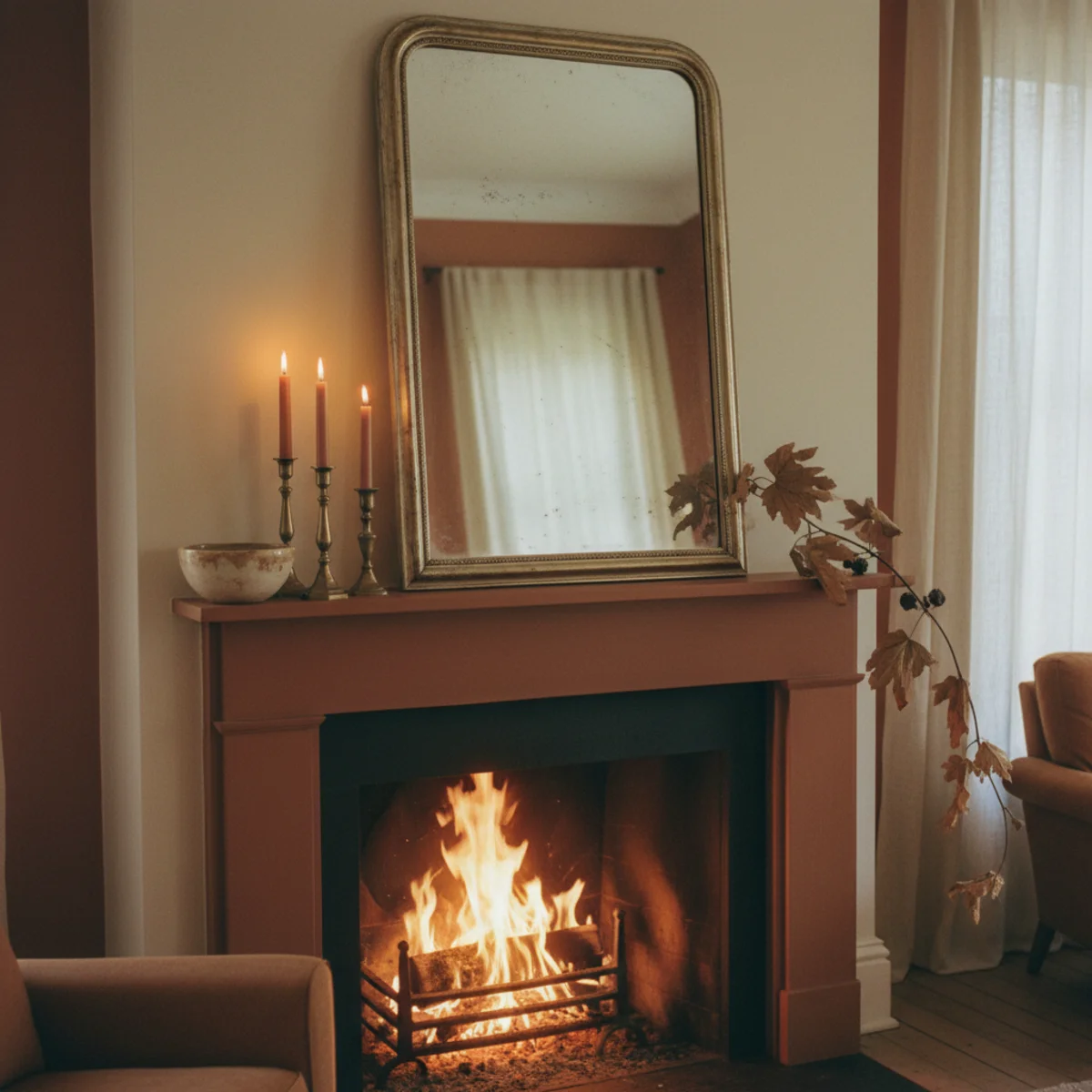
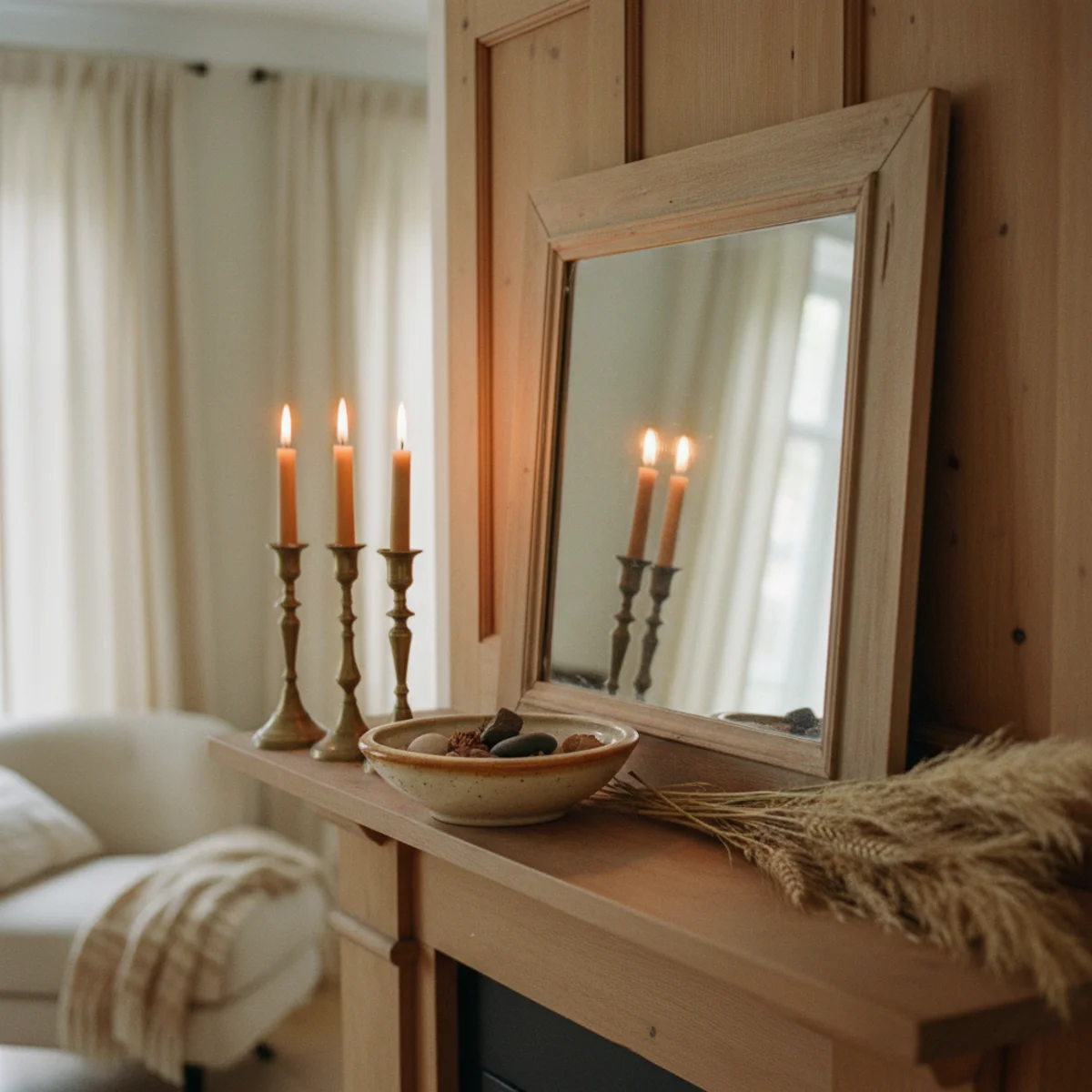
A large mirror above the mantel reflects the fire's light back into the room and visually extends the fireplace zone's warm influence. The reflected flames in the mirror double the fire's visual presence in the room; the mirror also reflects the candlelight from the mantel cluster, producing compound warm-light effect in the nook zone.
Fireplace nook mirror specifications: SIZE — 60-80% of mantel width (same as fireplace-mantel-decor anchor principle: for 60-inch mantel, mirror 36-48 inches wide). STYLE — round or arched mirror in vintage gilded brass, warm wood, or aged-bronze frame. POSITION — leaned against wall above mantel (the leaning approach per fireplace-mantel-decor) with bottom edge resting on mantel surface, OR hung above the mantel at appropriate height (mantel top to mirror center = 6-10 inches). MIRROR ANGLE — if leaned, the slight backward tilt angles the reflection upward, capturing the fire's flames at slightly above-horizontal angle. The reflected flames appear in the upper portion of the mirror. FIREPLACE SAFETY — ensure the mirror is positioned so it cannot fall into the firebox. Leaned mirrors should be slightly back-tilted away from the fire; hung mirrors should use appropriate hanging hardware rated for the mirror's weight. NO COOL-FRAME MIRRORS — the same warm-frame rule applies as with general mantel mirrors. Gilded brass or warm wood only; silver or chrome frames fight the warm nook aesthetic.
AFFILIATE SLOTMIRRORRound or arched mirror 60-80% mantel width in vintage gilded brass or warm wood frame; leaned or hung above mantel; reflects fire and candlelightAdd affiliate URL when configuredWhy it works
Because the reflected fire creates the impression that the fire is larger and that warm light fills more of the room — the reflection doubles the visible fire without doubling the wood consumption. The reflected candlelight from the mantel cluster also compounds: the lit tapers appear twice (real candles and reflected candles) in the combined visual field of mantel and mirror. For the nook sitter, the mirrored fire above the real fire creates a deeply atmospheric visual environment that a mirror-less mantel cannot achieve.
Pro tip — Place one or two of the mantel's brass candlesticks in positions specifically chosen to appear in the mirror reflection — the reflected taper flames in the mirror above the actual taper flames create a vertical stack of warm light that reads as the room's most atmospheric visual element during the fire evening.
Gilded mirror reflecting fire and candles — the compound warm-light effect that doubles the nook's atmospheric presence. See also: fireplace-mantel-decor
12Make It a Reading Spot
The fireplace nook reaches its full potential when designated as the household's primary reading spot — the specific combination of firelight, warm chair, throw, and small lamp provides the ideal reading environment that no other corner of the house matches. Stock 3-5 current reads on the side table or basket. Establish the fire + reading ritual as a regular household practice.
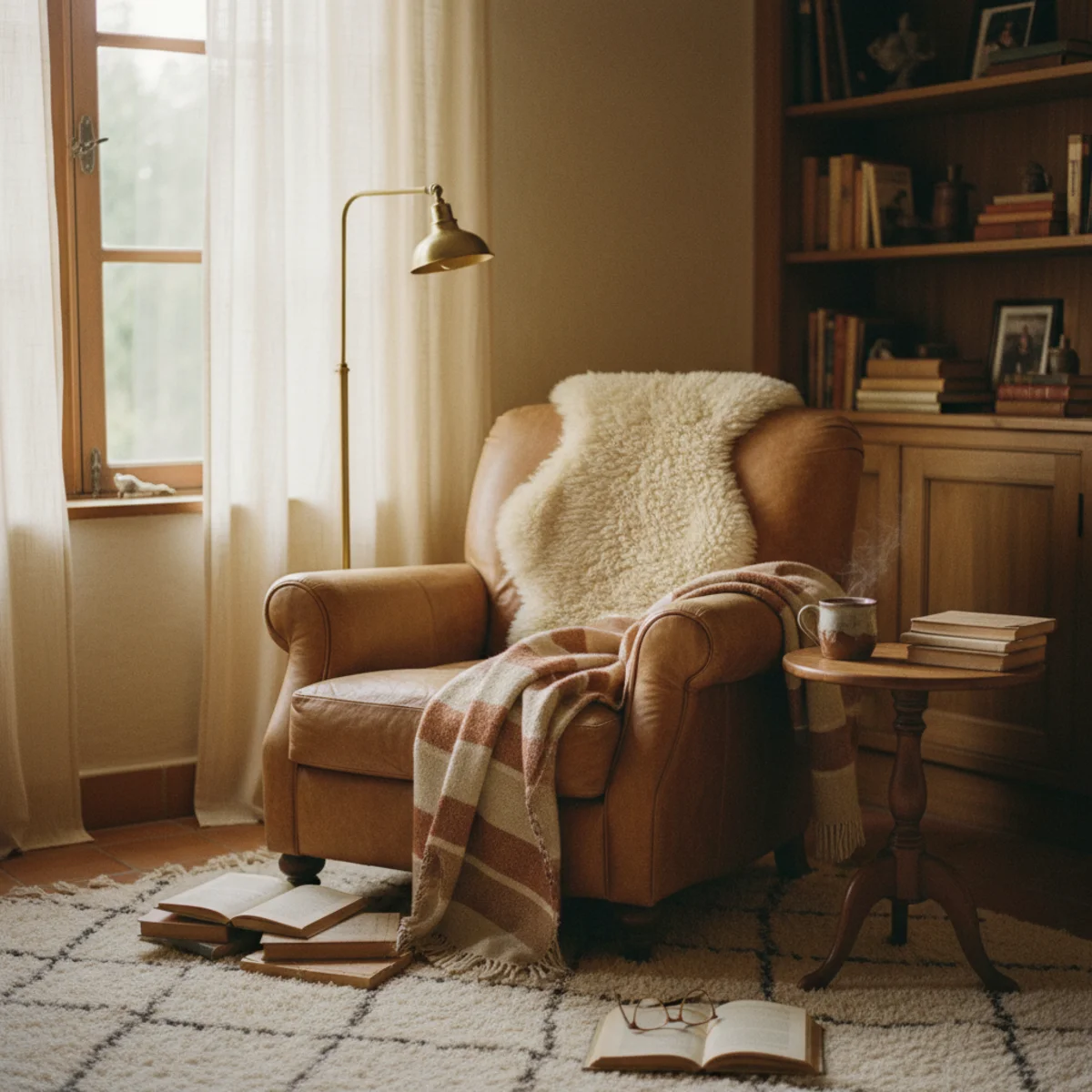
Fireplace reading nook setup: READING LIGHT — a small table lamp on the nook side table or a small adjustable floor lamp behind the chair, positioned to illuminate the page without the light falling on the fire (per item 10). 2700K at 40-60W equivalent; adjustable intensity if possible. CURRENT READS ON THE SIDE TABLE — 3-4 books currently in progress at the top of the stack, easy to pick up without rearranging. Not coffee table books for display, but books actually being read. TIMING THE READING RITUAL — establish a regular reading-by-fire time: Sunday evening from 7pm, or the first quiet weeknight evening each week, or every evening that the fire is lit. The scheduled ritual creates the practice that transforms the nook from 'intended reading spot' to 'actual reading place.' READING NOOK ADDITIONS — a small carafe of water or herbal tea on the side table, a reading lamp with adjustable arm for precise positioning, a notepad or bookmarks beside the chair for notes during reading. THE COMPOUNDING BENEFIT — the reading-by-fire ritual produces the experience that cozy home aesthetic aims toward: the household reading by firelight on winter evenings is the specific image that warm home design is built around. The nook is the room's infrastructure for that experience.
AFFILIATE SLOTPURPOSEAdjustable reading lamp + 3-4 current reads on side table; scheduled regular fire+reading time; water or herbal tea beside chairAdd affiliate URL when configuredWhy it works
Because designation creates purpose and habit — 'the reading chair by the fire' has a specific function that makes sitting in it intentional and rewarding. A chair that could be used for anything gets used for nothing specific; a chair designated for reading-by-fire gets used exactly for that. The designation also concentrates the reading habit in the home's warmest and most-atmospheric spot, reinforcing the reading practice with the most-pleasant possible reading environment. Both the reading and the nook benefit from the pairing.
Pro tip — Set the nook reading lamp on a smart plug ($10-25) with a scheduled auto-on time matching your intended reading ritual — the warm lamp waiting in the nook at 7pm on winter evenings is an invitation that gradually becomes a habit, then a tradition. The automated warm light reduces the friction of starting the ritual.
Leather chair, reading lamp, book stack, lit fire — the reading-by-fire setup that warm home design is built to enable. See also: reading-nook-ideas
How to create a fireplace nook step by step
Draw seating close, add warmth, frame the fire. Work in this order.
- 1Draw the seating close
Pull a chair or two genuinely close to the hearth, angled toward the fire — closer than feels normal. The intimacy is what makes it a nook.
- 2Add the soft layers
Drape a wool throw within reach and a sheepskin over the chair, and add a soft rug at the hearth for warmth underfoot.
- 3Frame the fire
Style the hearth and mantel so the fire is the clear focal point — logs or candles in the firebox, a styled mantel above.
- 4Add a surface and low light
Set a small table for a drink within reach, keep the surrounding light low and warm, and add a reading lamp if it's a reading spot.
Quick tips
- Draw the seating genuinely close to the hearth — closer than feels normal.
- Keep a throw on the chair so it's always there on a cold night.
- Style the firebox with logs or candles so the hearth warms the corner even unlit.
- Use a faux or electric fireplace for the look without a chimney, even in a rental.
- Keep the surrounding light low so the firelight leads.
- Add a mirror above the mantel to double the glow at night.
Fireplace nooks by setup
A chair drawn close, a log basket, a sheepskin, and a styled mantel framing the fire.
An electric insert or candle-filled firebox with the same close seating and soft layers — works in any home.
A pair of chairs flanking the hearth, angled toward each other and the fire.
A chair by the hearth with a reading lamp and books; see our reading nook ideas.
The fire is the original cozy corner. Pull a chair genuinely close, add a throw, and you've made the warmest spot in the house.
Frequently asked questions
How do I create a cozy fireplace nook?+
What furniture should I put near a fireplace?+
What should I put in front of a fireplace?+
How do I make a fireplace cozy without a real fire?+
Is it safe to put a rug in front of a fireplace?+
What's the best chair for a fireplace?+
The fire is the original cozy corner, and a fireplace nook taps that primal pull by drawing seating genuinely close to the hearth rather than facing it from across the room. Pull a chair up closer than feels normal, add a throw and a sheepskin, frame the fire as the focal point, and keep the surrounding light low. We'd draw the chair right up to the hearth before anything else; a chair across the room from a fire isn't a fire nook, but a chair pulled close with a throw over your knees is the warmest seat in the house. And with a faux or electric hearth, you can build it anywhere.