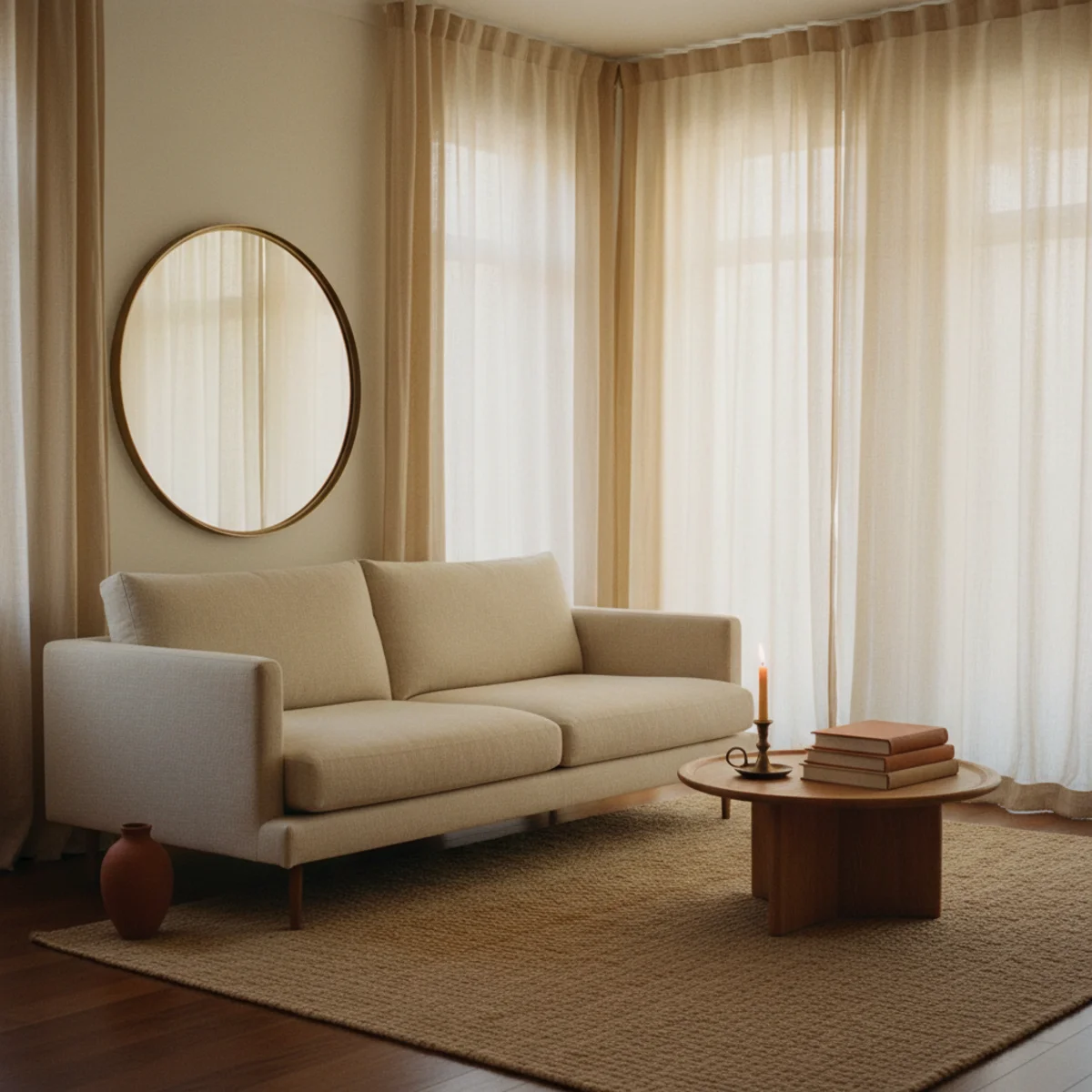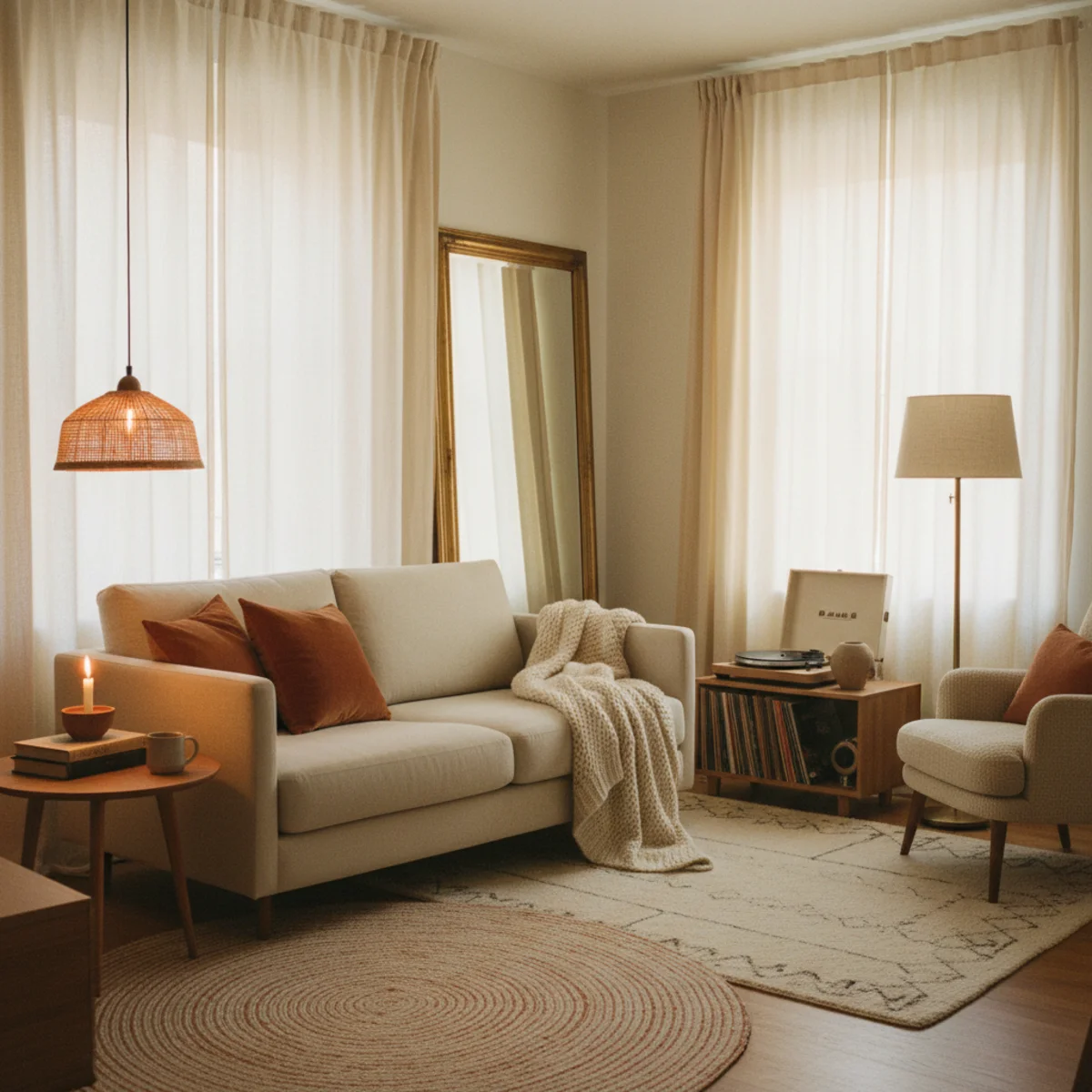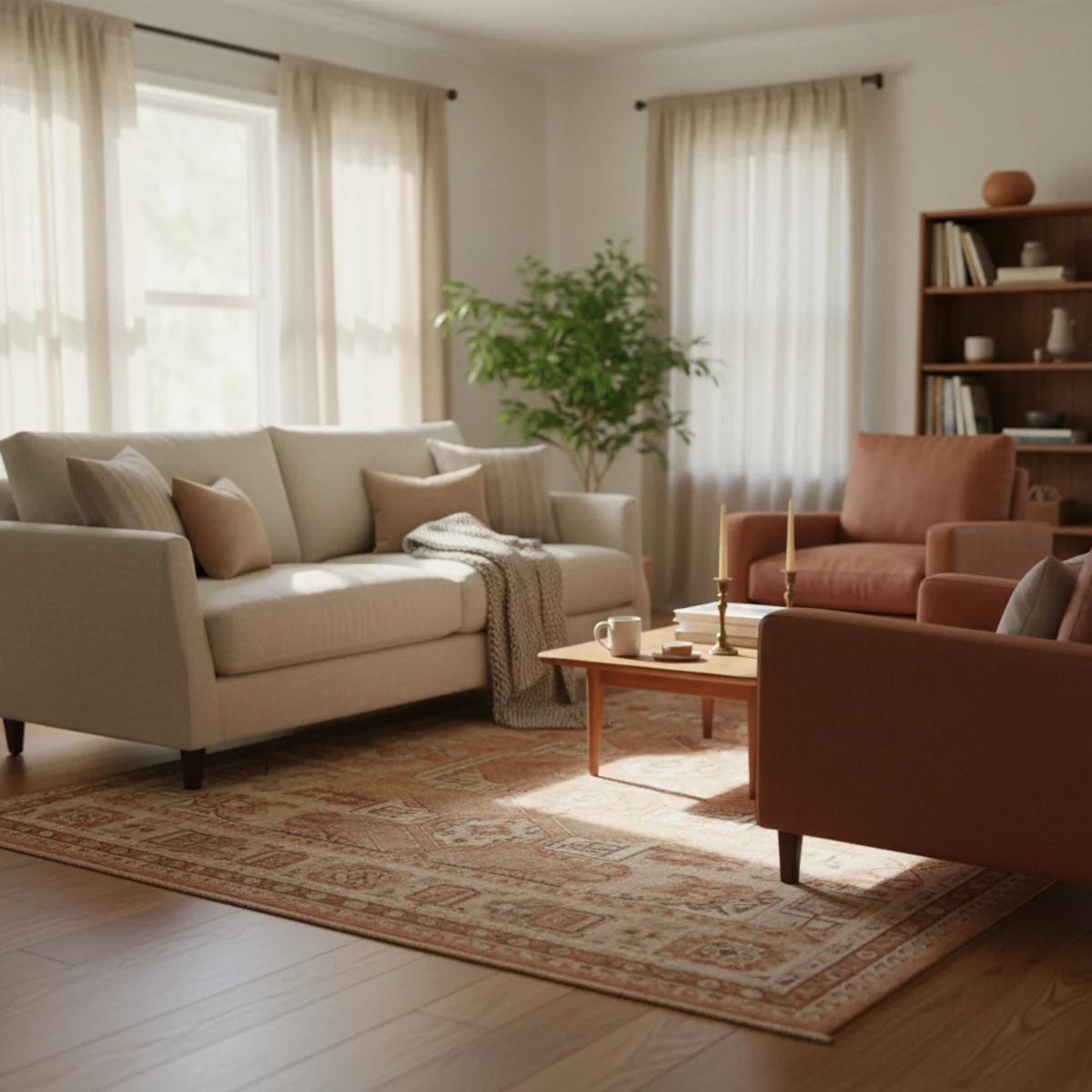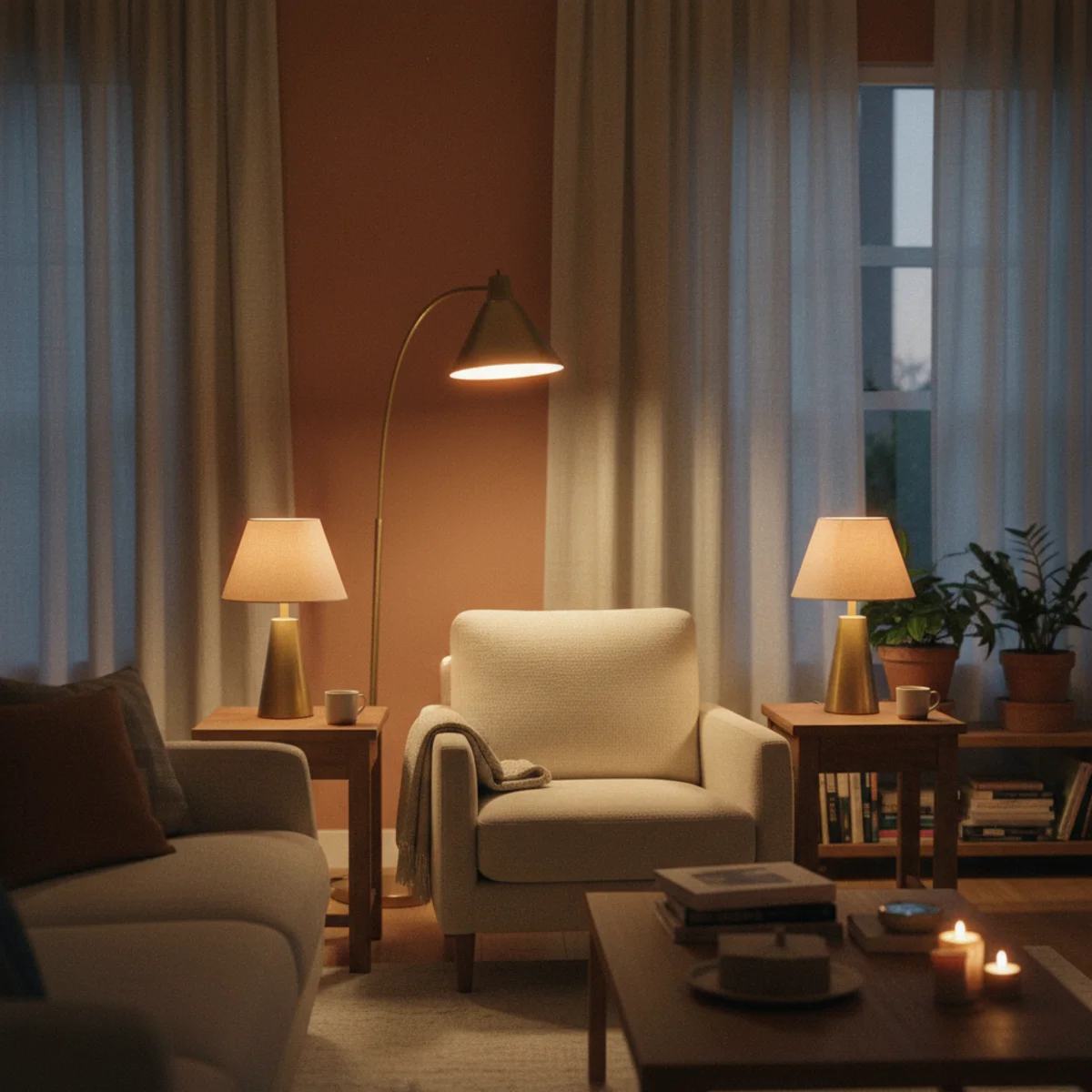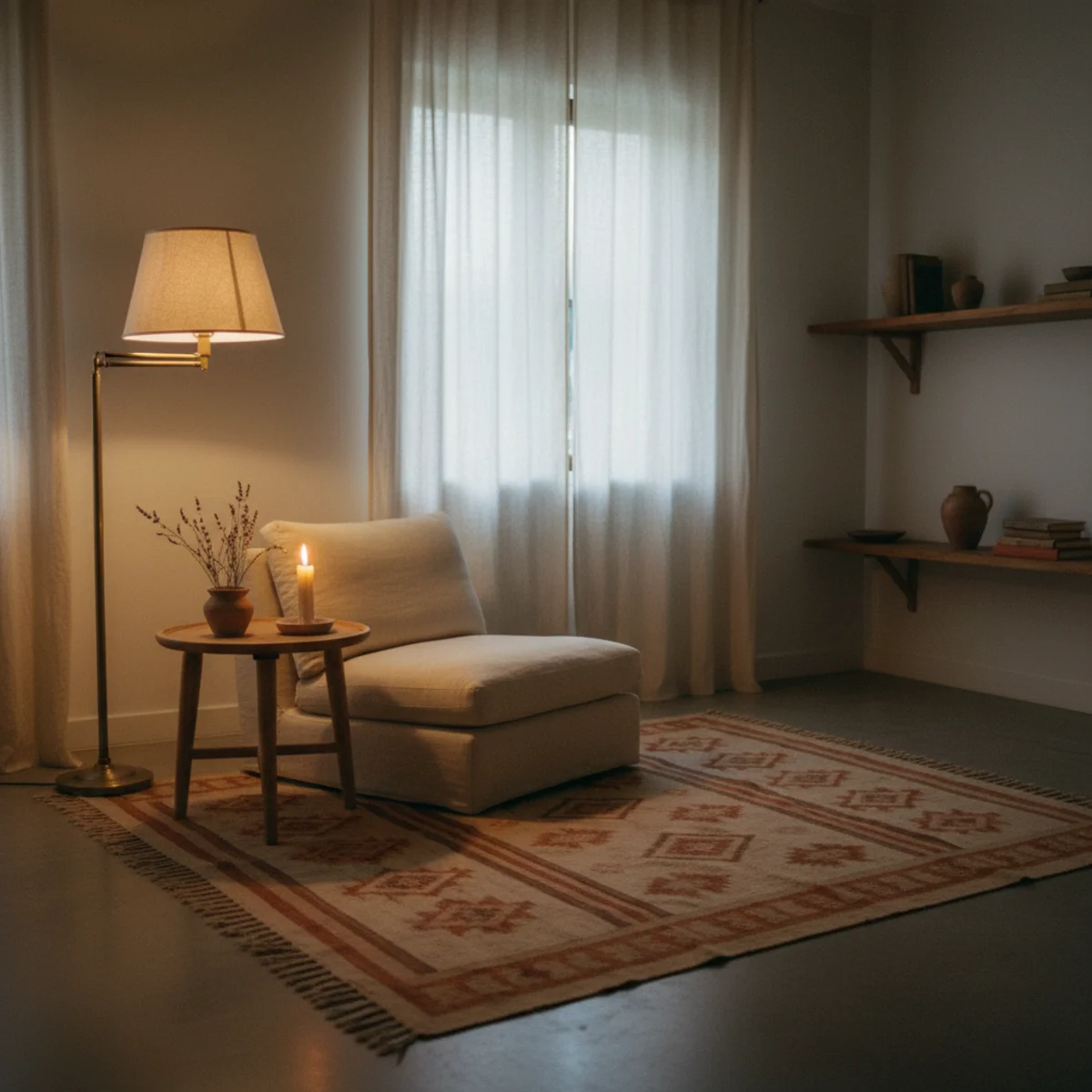
These eight small-room cozy principles apply across the smallest warm-home spaces — studio apartments, single bedrooms, small reading rooms, home offices, and any room under 150 square feet where the goal is warmth and intimacy rather than apparent size. Each principle names the exact move, the cost, and the specific reason that principle improves cozy quality rather than spatial appearance.
The small room's cozy challenge is different from the large room's: large rooms need more warmth added; small rooms need the existing coldness removed. Cold overhead light, cleared-and-sparse surfaces, cold floor tone, no scent, no candles — these create cold rooms regardless of size. The eight moves below are primarily corrections of the cold defaults that rooms inherit from construction and commercial standard practice.
By the end of this guide, you'll know exactly how to make a small room cozy — warming the light first, anchoring with one rug, layering just a few textures, keeping surfaces mostly clear, hanging curtains high, going deep with color not busy, adding one soft thing underfoot, and lighting a candle or two.
WHAT'S INSIDE
- Why light temperature matters more than any object change for small-room cozy
- One rug as anchor — the single floor decision that transforms small rooms
- Going deep with color not busy — the small room's specific color principle
- One candle as the starting point for daily cozy habit
Small rooms get cozy through warmth and restraint, not through more stuff. The clutter is what makes a tight space feel tight.
— Apartment Therapy [citation needed — verify before publish]
What actually makes a small room feel cozy?
A small room feels cozy when it has warm low light, layered natural texture, and enough clear space that the eye can rest. The instinct to fill a small room with decor backfires — clutter is exactly what makes a tight space feel cramped rather than warm. Coziness comes from atmosphere, not quantity.
The single highest-impact change is the light. Swap the cold overhead for two or three lamps with 2700K bulbs at table and floor height, and a small room transforms before you've added a single object. After that, one anchoring rug and a couple of soft textures — a wool throw, a linen cushion — do the rest. The clear surfaces in between are not a gap to fill; they're what let the warmth breathe.
More in By Room you may love
See allWhy the small-cozy question matters in 2026
More people are living in smaller homes for longer, and the question of how to make a tight room feel warm rather than cramped is one of the most-searched in home decor. Pinterest's small space and cozy small room searches climb every year, and the answers have shifted toward warm minimalism — restraint plus warmth — rather than maximalist filling.
The honest answer cuts against instinct, which is why people keep asking. The reflex in a small cold room is to add: more cushions, more decor, more furniture against the walls. The fix is almost always to warm the light, anchor with one rug, layer a little texture, and then stop. A small room done this way can be the coziest in the house.
8 ways to make a small room cozy without clutter
01Warm the Light First
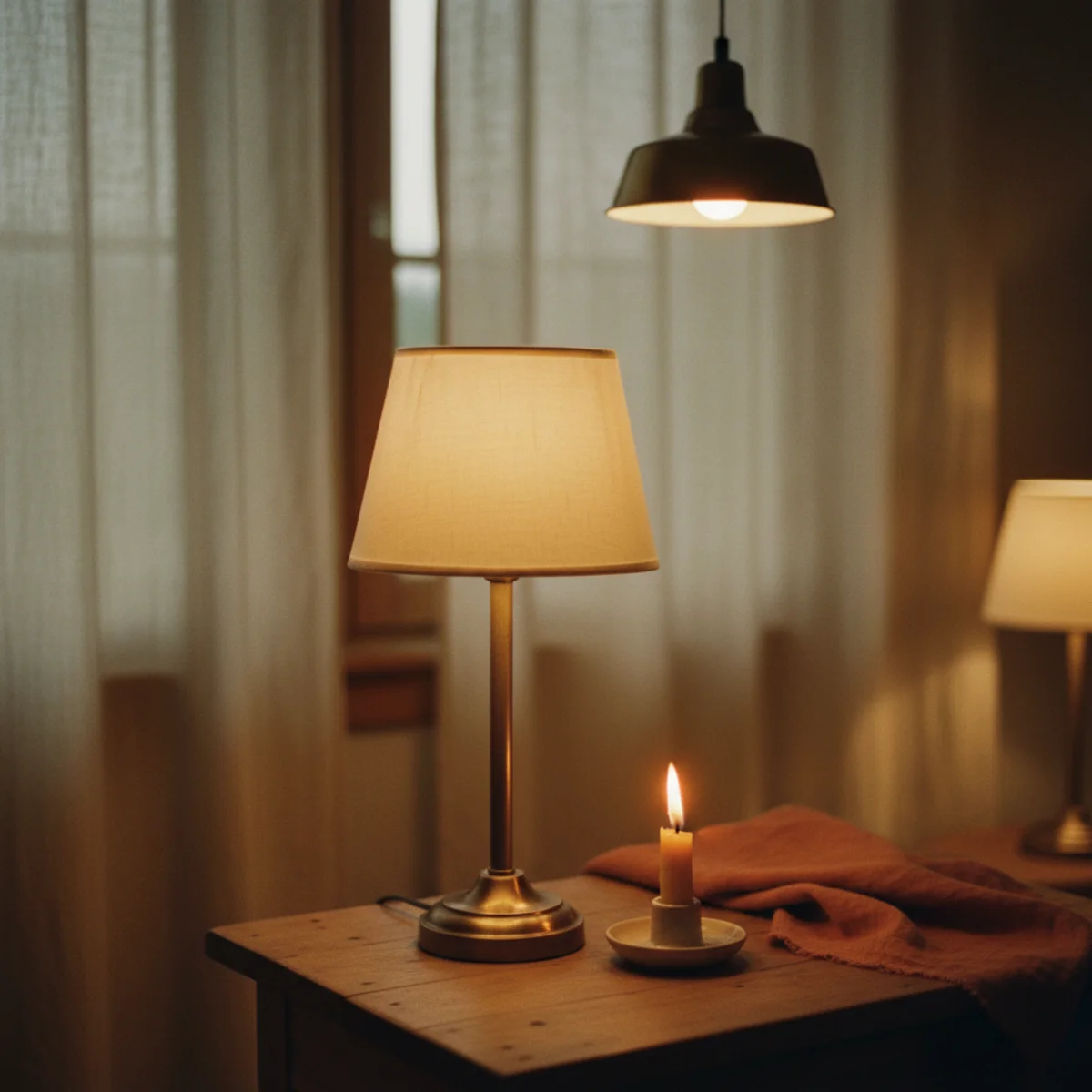
The single highest-impact cozy move in any small room: replace any cool or bright white light sources (overhead fixtures, desk lamps, bedside lamps) with warm 2700K bulbs. The light temperature change alone — from cool white to warm 2700K — transforms the same room from office-adjacent to evening-warm. Cost: $8-20 for new bulbs.
Light temperature change for small rooms: BULB REPLACEMENT — replace every light bulb in the room with warm 2700K LED. Typical small room: 1-2 overhead fixtures + 1-2 table or floor lamps = 3-5 bulbs at $2-4 each. Philips Warm Glow ($4-8 each) dims to an even warmer 2200K as they dim, producing the warmest possible atmosphere at low intensity. OVERHEAD DIMMER — if the overhead fixture is not on a dimmer, replace the wall switch with a dimmer switch ($15-25, 30 minutes to install). The overhead on full blast is the most-common cozy destroyer in small rooms; the overhead at 20-30% with table lamps providing the primary light converts the same room to warm. LAMP POSITIONING — table lamps and floor lamps should be at 18-30 inch height from the floor surface, not on high shelves or mounted high. Low lamp positioning reads as intimate in small rooms; high-mounted fixtures read as overhead-commercial regardless of warm bulb color. RESULT — the same small room with 2700K at 30% overhead + 2 warm table lamps reads as genuinely cozy in the evening. The same room with 4000K overhead at 100% reads as a well-lit workspace. The bulb change costs $10; it produces most of the room's cozy transformation.
AFFILIATE SLOTLIGHTAll bulbs 2700K (Philips Warm Glow $4-8 each warms to 2200K when dimmed); overhead dimmer switch ($15-25); primary light from table lamps not overheadAdd affiliate URL when configuredWhy it works
Because every object in the room is seen through the ambient light — warm light makes all surfaces (walls, textiles, wood, ceramics) read warmer; cool light makes all surfaces read colder regardless of their actual color. A terracotta cushion under cool overhead light reads as slightly orange-grey; the same cushion under 2700K warm light reads as warm earth. The light is the lens through which every other cozy element is perceived; getting the lens warm first makes everything else automatically warmer.
Pro tip — Change bulbs in the evening rather than during the day — the daytime switch makes it hard to assess whether 2700K is warm enough (daylight competes with the artificial warmth). Changing bulbs at dusk and immediately experiencing the warm room against the darkening outside sky reveals the full atmospheric potential of the warm light.
2700K table lamps with dimmed overhead — the light temperature change that costs $15 and produces more cozy than any object addition. See also: best-lamps-warm-light
02Anchor With One Rug
One well-chosen area rug anchors a small room by defining the seating or sleeping zone, warming the floor, and providing the soft visual base that makes furniture feel placed rather than scattered. In a small room, one good rug does the same compositional work as two or three in a larger space. Cost: $80-400 for a quality natural-fiber or vintage wool rug at appropriate small room size.
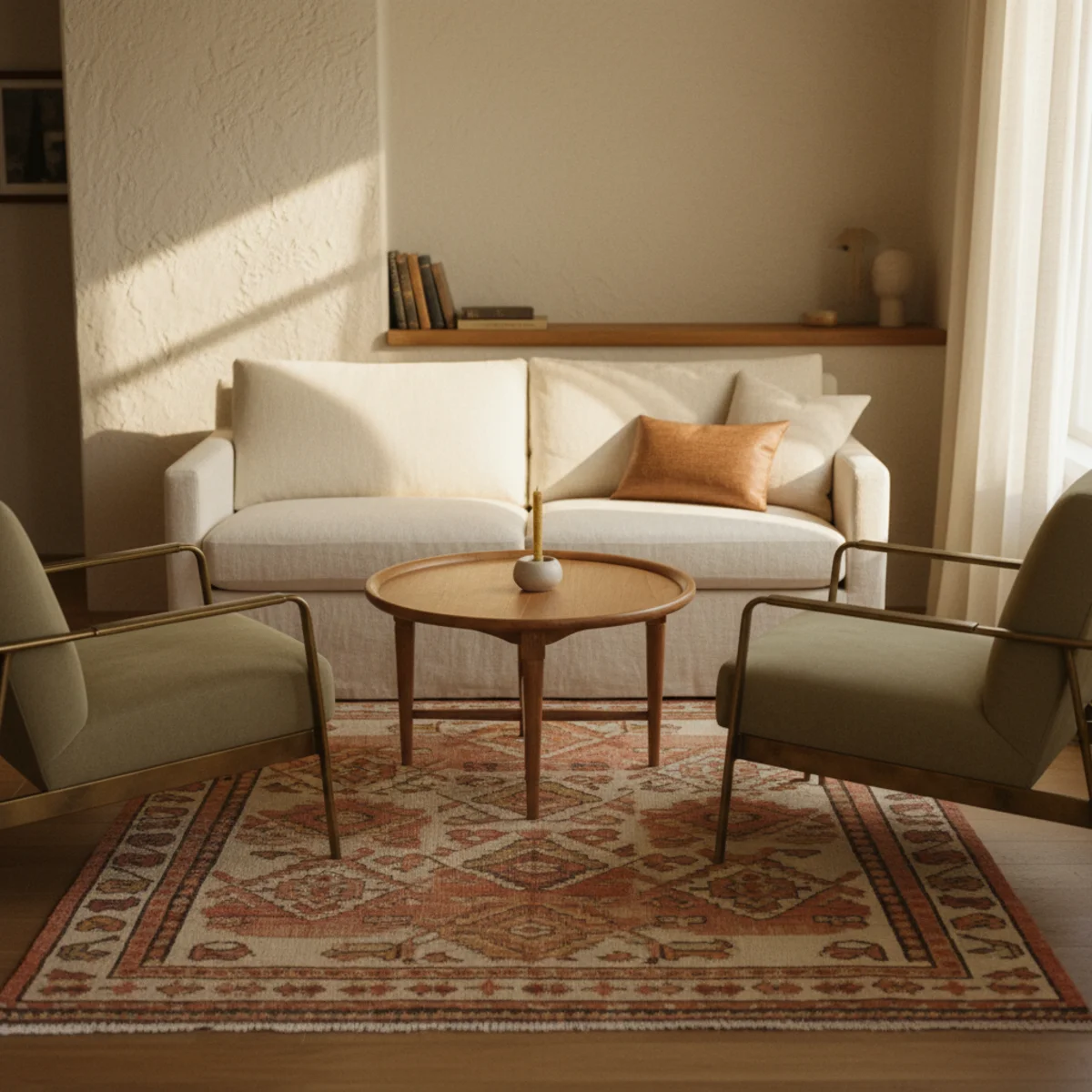
Small room rug specifics: SIZE — in small rooms, size the rug to fit under the front legs of all primary furniture (sofa front legs, both bedside tables and the foot of bed). A too-small rug reads as a mat; the right-size rug reads as a defined zone. For a small bedroom (10x12 feet): 5x8 rug. For a small living room (12x14 feet): 6x9 or 8x10 rug. MATERIAL — vintage Turkish or Persian wool (warmest, best aging character at $200-600 from estate sales), jute or sisal (most affordable natural at $80-250), or quality wool from Rugs USA ($150-400). COLOUR — warm earth tones that relate to the room's other warm elements. The rug should feel like it belongs in the room's palette rather than like a new introduction. NO MORE THAN ONE RUG in a small room — multiple layered rugs work in large open boho rooms; they make small rooms feel cluttered and visually busy. PATTERN — a patterned rug (Persian, geometric) can be the small room's primary visual interest; a solid rug lets other elements carry the visual interest. Choose based on what the room's other elements require.
AFFILIATE SLOTFLOOROne warm-toned rug sized to fit under primary furniture legs; vintage wool ($200-600 estate sales), jute ($80-250), or quality wool ($150-400); no layering in small roomsAdd affiliate URL when configuredWhy it works
Because small rooms have limited visual budget — the number of distinct visual elements that can be present before the room reads as busy is lower than in large rooms. One rug uses that visual budget efficiently: it provides floor warmth, zone definition, color/pattern introduction, and visual base all in one element. Two rugs in a small room use twice the visual budget for the same functional result, leaving less budget for other warmth elements.
Pro tip — Place the rug before finalizing furniture positions — try the furniture arrangement with the rug in place before anchoring anything with wall hardware or heavy-item placement. The rug often suggests the optimal furniture arrangement; furniture arranged without the rug often doesn't work as well with the rug once added.
One vintage Turkish rug anchoring the seating zone — single rug using the small room's visual budget efficiently. See also: best-area-rugs
03Layer Just a Few Textures
Small rooms cozy up through a few well-chosen textures rather than through maximalist layering. Two or three textural elements — a linen cushion, a wool throw, a ceramic pot — provide the warmth that dozens of mixed textures produce in larger spaces. The discipline is restraint: each texture earns its place specifically.
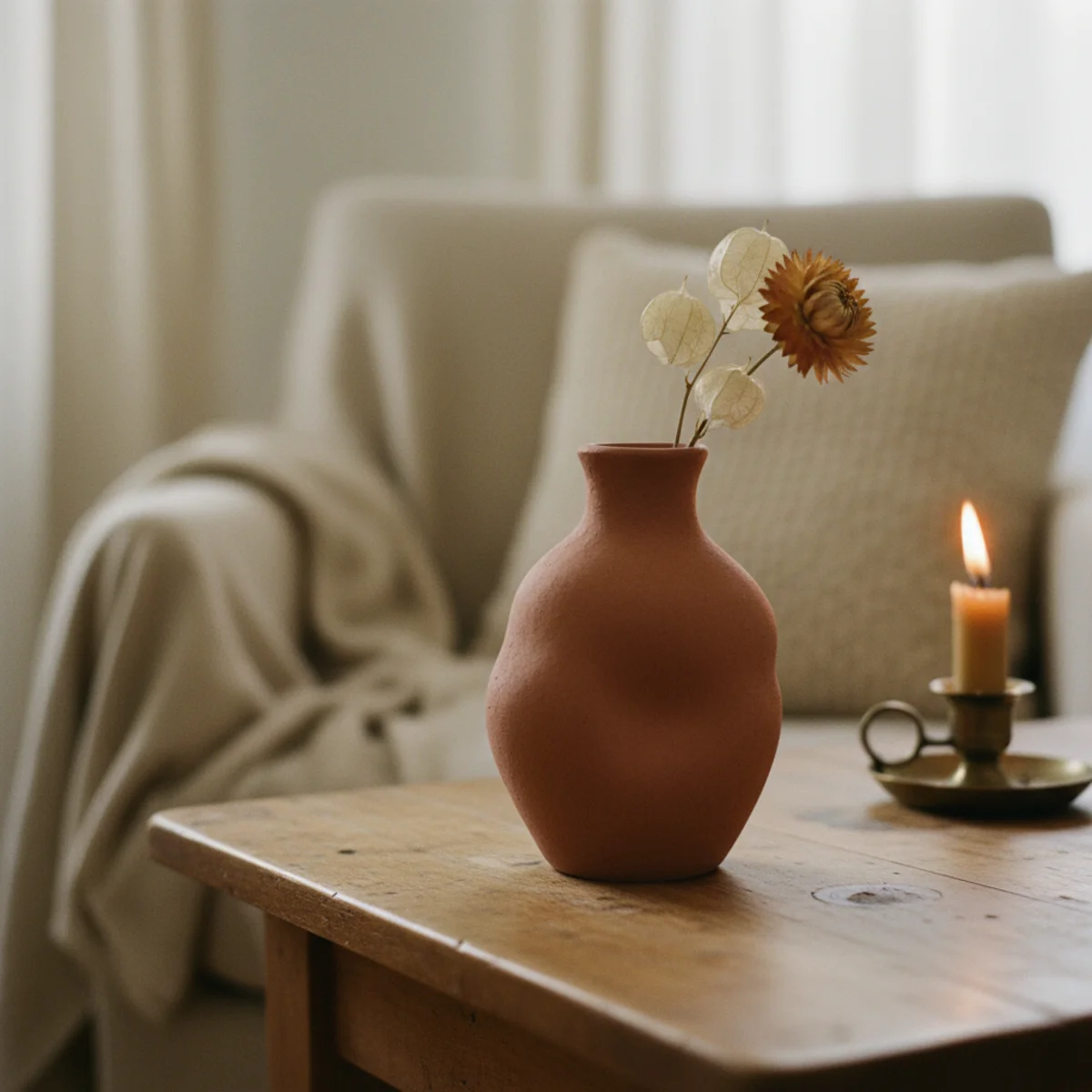
Small room texture layering: THE APPROPRIATE COUNT — 3-5 distinct textures in a small room (under 150 sq ft). More than 5 reads as busy in limited visual field. EFFECTIVE TEXTURES for small rooms — LINEN (cushion covers, throw, or curtain): natural warmth, breathable quality, reads warm at any scale. WOOL OR MERINO (one throw): chunky texture visible from across even a small room. ONE HAND-THROWN CERAMIC (plant pot or small vase): organic glaze variation adds warm material character. ONE NATURAL MATERIAL PIECE (rattan tray, wooden bowl, or small wicker basket): adds material variety without another textile layer. WARM WOOD (furniture surface or small object): the baseline warm material that doesn't count against the texture budget. WHAT TO AVOID in small rooms — too many cushion types (mixed sizes and fabrics on a small sofa creates visual chaos), layered rugs, multiple competing throws, overlapping textile patterns in a small space. PLACEMENT PRINCIPLE — distribute the 3-5 textures across different surface planes (floor level, sofa level, table level) rather than clustering on one surface.
AFFILIATE SLOTTEXTURE3-5 distinct textures maximum: one linen cushion, one wool throw, one hand-thrown ceramic, one natural material accent; distribute across floor/sofa/table levelsAdd affiliate URL when configuredWhy it works
Because visual field is smaller in small rooms — the same density of objects that reads as 'richly layered' in a large room reads as 'crowded' in a small room at the closer viewing distances. The cozy quality in small rooms comes from warmth of each individual element rather than from cumulative abundance. Three beautiful textures in a small room produce more warmth than eight mediocre ones, because each of the three can be fully appreciated at the room's close viewing distances.
Pro tip — Test the texture count by photographing the small room at its present state and counting the distinct textures visible in the photo. If the count exceeds 5-6 and the room feels busy, remove 2-3 elements before adding any more. The editing step is always more effective than the adding step in small rooms.
Linen pillow, wool throw, terracotta pot — three textures in a small room, each appreciated at close viewing distance. See also: how-to-layer-textiles-without-clutter
04Keep Surfaces Mostly Clear
In small rooms, surface clearing is paradoxically more important for coziness than object adding. A small room with 3-4 objects on its visible surfaces reads as intentional and peaceful; the same room with 10-12 objects reads as cluttered regardless of object quality. The cozy small room has breathing space around each element.
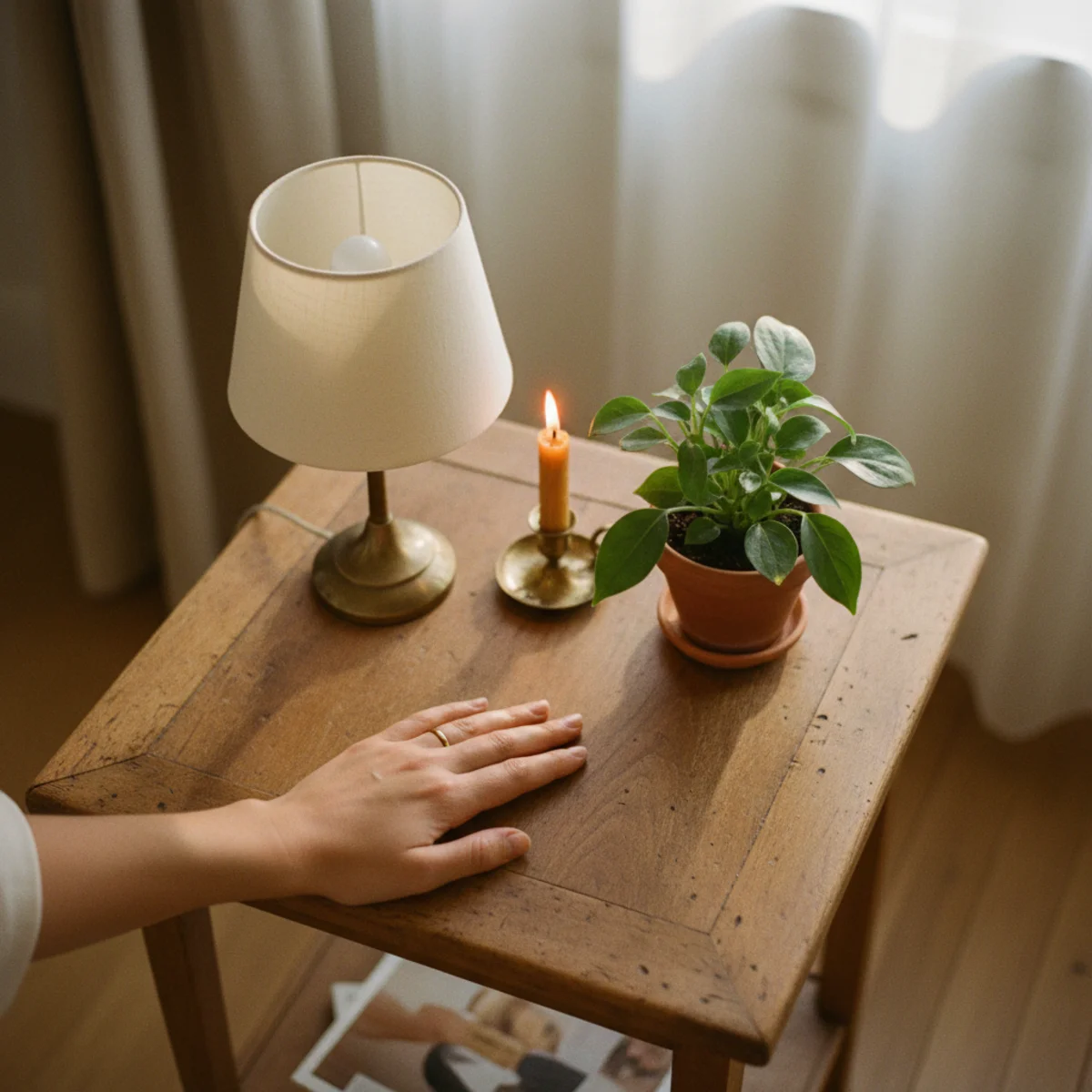
Small room surface discipline: THE MAXIMUM COUNT — 2-3 objects per surface in a small room. BEDSIDE TABLE maximum: 1 lamp + 1 small plant + 1 book. DESK maximum: 1 lamp + 2 functional objects. WINDOWSILL maximum: 1-2 plants. SMALL SHELF maximum: 3-4 objects with visible gap between groups. EDITING TRIGGER — if you can't name the function or reason for each object on a surface, that object is decoration that may be thinning the room's visual budget. The edit-to-intentional principle: every visible object should earn its place through function, beauty, or personal meaning. NOT ALL THREE required; ONE of the three is sufficient. SEASONAL ROTATION — in small rooms, rotating objects seasonally (swap autumn items for spring items) prevents the accumulation that makes surfaces perpetually feel over-full. THE COUNTERINTUITIVE PRINCIPLE — adding warm objects to a small cluttered room makes it feel more cluttered and less cozy; removing existing objects to create space between the remaining warm ones makes the room feel warmer. Subtract before adding.
AFFILIATE SLOTEDITMaximum 2-3 objects per surface; full-reset approach (everything off, selectively return); seasonal rotation prevents accumulation; subtract before adding warm elementsAdd affiliate URL when configuredWhy it works
Because at close viewing distances (which small rooms force), every object demands some visual attention — each one requires the eye to process its form, color, and relationship to adjacent objects. In a large room, you can stand 12 feet away and let many objects blur into a composition; in a small room, you're always 4-6 feet from the surfaces, and each object is individually visible. The cognitive demand of processing many close-range objects reads as 'busy' rather than as 'warm.' Fewer objects with more space between them reads as 'intentional' and 'warm' at close range.
Pro tip — Take everything off all surfaces in the small room, then put back only the items you specifically want to see every day. This full-reset approach is more effective than removing individual items because it forces you to consciously choose each returning object rather than accepting the accumulated default.
Two objects per surface with visible space between — the intentional clarity that reads as warm at small-room close range. See also: warm-minimalism
05Hang Curtains High
Hanging curtains 4-6 inches below the ceiling (as opposed to just above the window frame) makes any small room feel taller and the windows feel larger without changing the room's actual dimensions. The curtain that runs from near-ceiling to floor uses the full vertical height of the room, making 8-foot ceilings read as higher and small windows read as more generous.
High curtain hanging in small rooms: HEIGHT — mount rod 4-6 inches below ceiling. For 8-foot ceiling with 7-foot window-top: rod at approximately 90-92 inches. PANELS STACK OFF GLASS — extend the rod 6-8 inches beyond the window frame on each side so panels fully stack off the glass when open. Maximum daylight when open, full visual width when closed. PANEL LENGTH — floor-grazing (1/2 inch above floor) or slight puddle (1 inch on floor). Never sill-length in small rooms — the truncated panels read as cost-cutting in small rooms specifically. FABRIC — lightweight natural linen or sheer linen for small rooms that need maximum light. Heavier thermal linen for rooms needing acoustic softening. COLOUR — warm cream or natural linen for small rooms that need maximum light reflection. Deep tones in a small room can work but require exceptionally warm artificial lighting to prevent feeling compressed. THE CEILING-HEIGHT ILLUSION — the eye reads the room's height by following vertical lines from floor to ceiling. Curtains that run full vertical height create the floor-to-ceiling vertical line that reads as full-height room; curtains that start at the window frame cut the room's apparent height at the window-top line.
AFFILIATE SLOTCURTAINSRod 4-6 inches below ceiling, 6-8 inches beyond window frame each side; floor-grazing length; warm cream or natural linen; full vertical height creates ceiling-height illusionAdd affiliate URL when configuredWhy it works
Because the perception of room size is strongly influenced by ceiling height, and the perception of ceiling height is influenced by vertical lines that approach the ceiling. Curtains hanging from near-ceiling height create these vertical reference lines and train the eye to read the room as full-height. Window-top-mounted curtains interrupt the vertical line at the window-top, reading the room as the height between the floor and the curtain top rather than the floor and the ceiling. The curtain's hanging height is one of the few elements that directly affects the room's perceived spatial dimensions.
Pro tip — Use a tension rod inside the window frame for a second sheer inner layer if privacy requires it while using the high-mounted rod for the outer linen panel — the two-layer approach (sheer inner on tension rod, linen outer on high-mounted rod) provides both privacy and the full-height architectural effect.
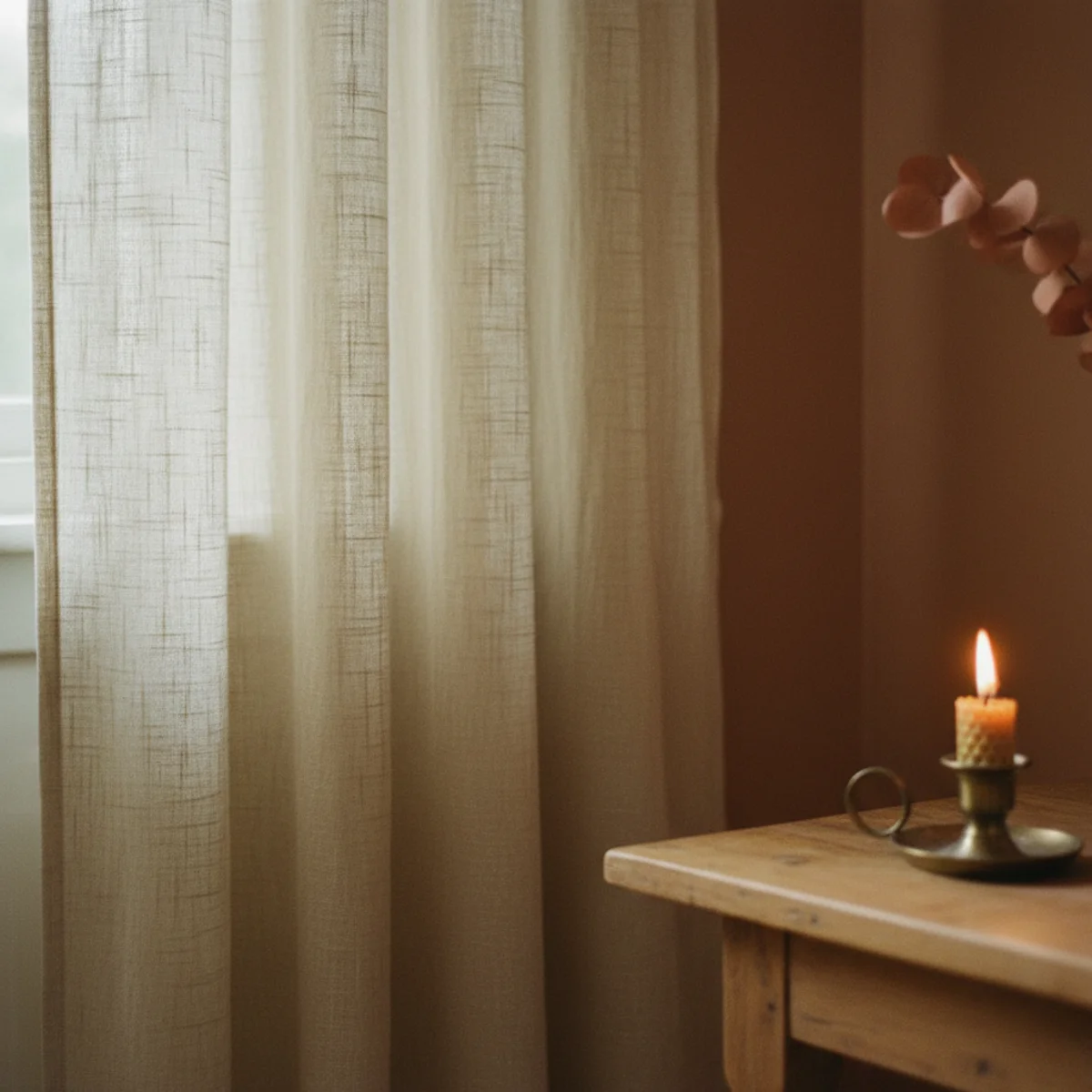
Rod 5 inches below ceiling, floor-grazing panels — the vertical line that makes 8-foot ceilings read as generous. See also: diy-no-sew-curtains
06Go Deep With Color, Not Busy
Small rooms benefit from one deep, rich color rather than from many varied accent colors. A single deep warm wall — one terracotta accent wall, one deep sage corner, one warm charcoal feature — produces more cozy depth than four walls of varied decorative accents. The depth of color creates the enclosed warmth that many-color approaches dissipate.
Deep color for small rooms: ONE DEEP WALL — paint one wall in a rich warm tone: BM Pottery 1297 terracotta, F&B Green Smoke 47, F&B Hague Blue 30, or BM Kendall Charcoal HC-166. A single deep accent wall in a small room reads as a cocoon-creating design choice; multiple deep walls in a small room can feel heavy without sufficient light. WHOLE-ROOM DEEP COLOR — possible and sometimes very effective in small rooms with good warm lighting (bedrooms, reading nooks, powder rooms). Small rooms with one deep-colored wall used as study or reading room: the enclosure is specifically appropriate to the function. AVOID — too many different accent colors in a small room. A small room with terracotta wall, sage green cushion, navy throw, and yellow ceramics reads as chaotic at the close viewing distances small rooms enforce. WARM NEUTRAL AS PRIMARY — if committing to a single deep accent wall is too much, warm white (BM White Dove OC-17 or F&B Pointing 2003) on all four walls is the correct non-commitment approach for small rooms. The warm neutral maximizes reflected light and allows the textile elements to carry the warmth without wall color competition.
AFFILIATE SLOTCOLOROne deep warm accent wall (BM Pottery 1297, F&B Green Smoke 47, or F&B Hague Blue 30); avoid multiple competing accent colors; warm neutral on remaining wallsAdd affiliate URL when configuredWhy it works
Because cozy warmth in small spaces comes from enclosure — the feeling of being held by the room — and one deep warm wall specifically creates one enclosed face that the room faces toward. Multiple varied colors in a small space create the opposite sensation: visual restlessness that prevents the eye from settling. The same pattern that makes variety interesting in large rooms (the eye moves from element to element across a large visual field) makes variety uncomfortable in small rooms (the eye can't help but see all elements simultaneously from close range).
Pro tip — Test the deep accent wall color on the longest wall in the small room — the longest wall benefits most from the depth because it provides the most surface area for the color to establish its warmth. The end wall of a narrow room painted in deep terracotta creates a warm focal point that draws the room toward it, making the room feel deeper and more purposeful.
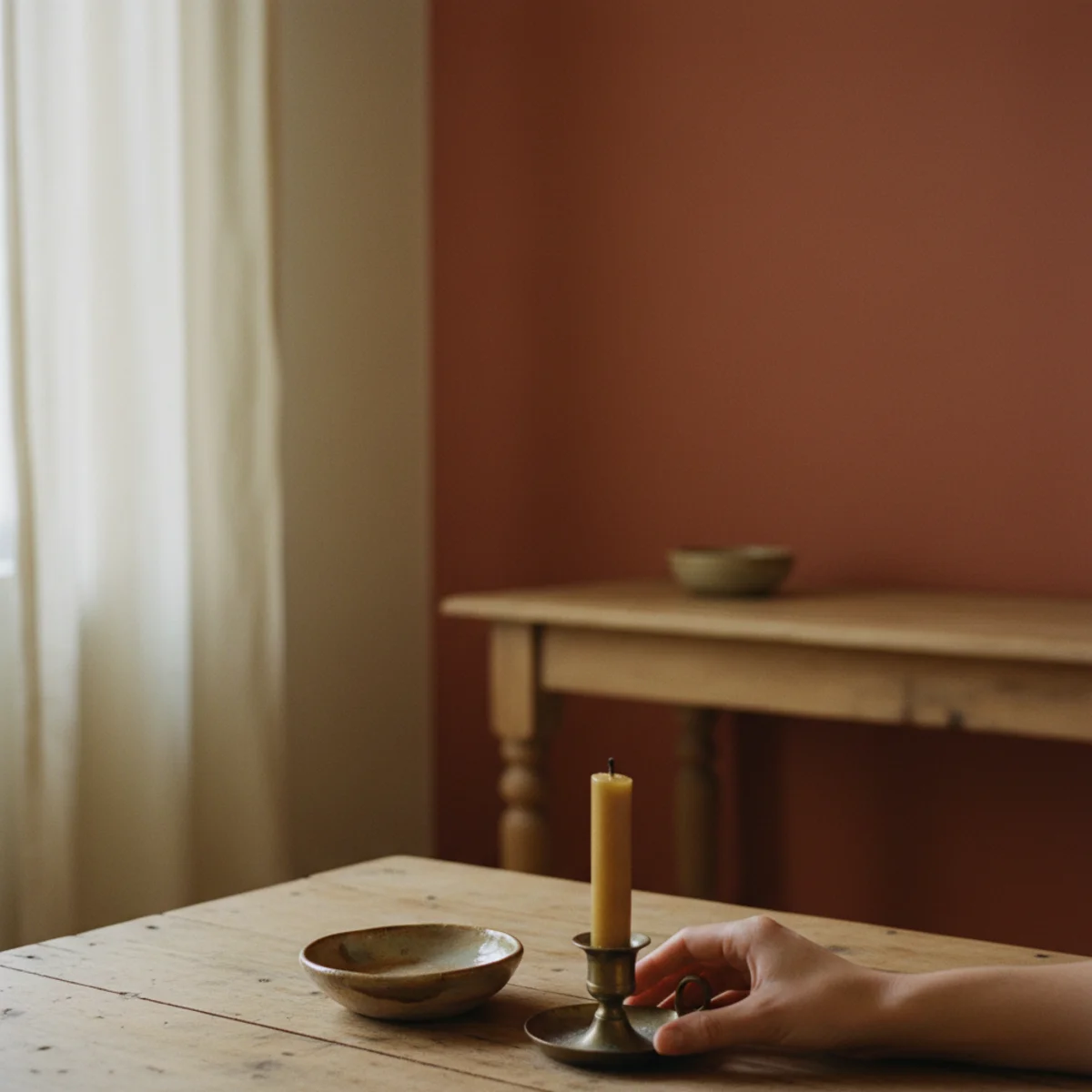
One deep terracotta wall behind the bed — warm enclosure from depth, not variety. See also: warm-paint-colors
07Add One Soft Thing Underfoot
Beyond the area rug (item 2), one additional soft element underfoot — a sheepskin beside the bed, a small wool rug at the desk chair, a cozy bath mat in a small bathroom — adds the specific sensory pleasure of warm softness at foot level. In small rooms where every element is at close sensory range, underfoot texture registers more directly than in large rooms.
Additional underfoot softness options: SHEEPSKIN BESIDE BED — a genuine or quality synthetic sheepskin at the bedside (where feet land first in the morning) at $40-150 for genuine from IKEA or estate sales. The soft landing at the beginning and end of each day is one of the small room's most-appreciated daily touches. SMALL WOOL RUG AT DESK CHAIR — a 2x3 or 3x4 foot wool rug under the desk chair in a small home office. Adds warmth to the specific floor zone where hours of work happen. BATHROOM BATH MAT — a real wool or cotton bathmat rather than the standard synthetic rectangle. Turkish towel-material mats ($20-60) or woven cotton mats ($15-40). NOT synthetic microfiber or polyester bath mats. THE SENSORY PRINCIPLE — small rooms are experienced at close physical range; the texture your feet touch morning and night registers as significant in a small room where you're always proximate to all surfaces. The sheepskin morning landing, the warm rug underfoot at the desk, the natural cotton bath mat — these are sensory pleasures specific to small-room life where proximity makes every surface directly experiential.
AFFILIATE SLOTSENSORYReal sheepskin at bedside ($40-150 from IKEA or estate sales), small wool rug at desk chair (2x3 feet, $60-150), or natural cotton bath mat ($15-60)Add affiliate URL when configuredWhy it works
Because small rooms are lived in at a more tactile scale — you're always within arm's reach of most surfaces, and your feet are always on or near the floor. In large rooms, you traverse significant floor distance between furniture zones and the floor is more of a visual element than a tactile one. In small rooms, the floor is always underfoot, and its texture registers directly with every movement. A warm sheepskin or wool rug in a small room is noticed and appreciated at every use; the same element in a large room might go days without direct contact.
Pro tip — Position the sheepskin specifically where feet naturally land — beside the bed aligned with the pillow end (not the foot), at the desk chair's natural foot resting position, and at the bathroom sink (where you stand during the morning routine). Placement at natural-use positions maximizes the daily sensory return on the sheepskin investment.
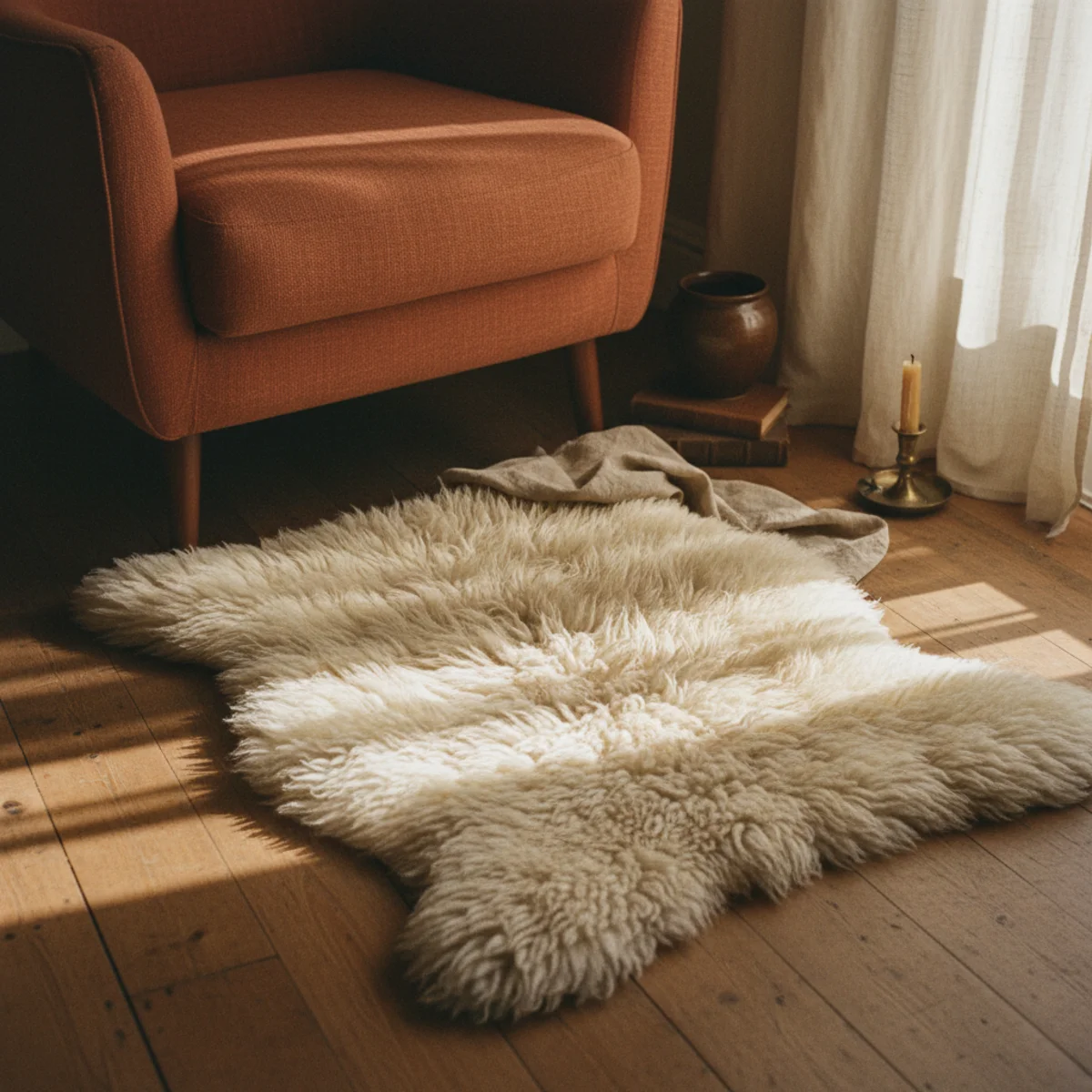
Real sheepskin at bedside foot-landing — the daily sensory pleasure that small-room proximity makes directly experiential. See also: bedroom-cozy-ideas
08Light a Candle or Two
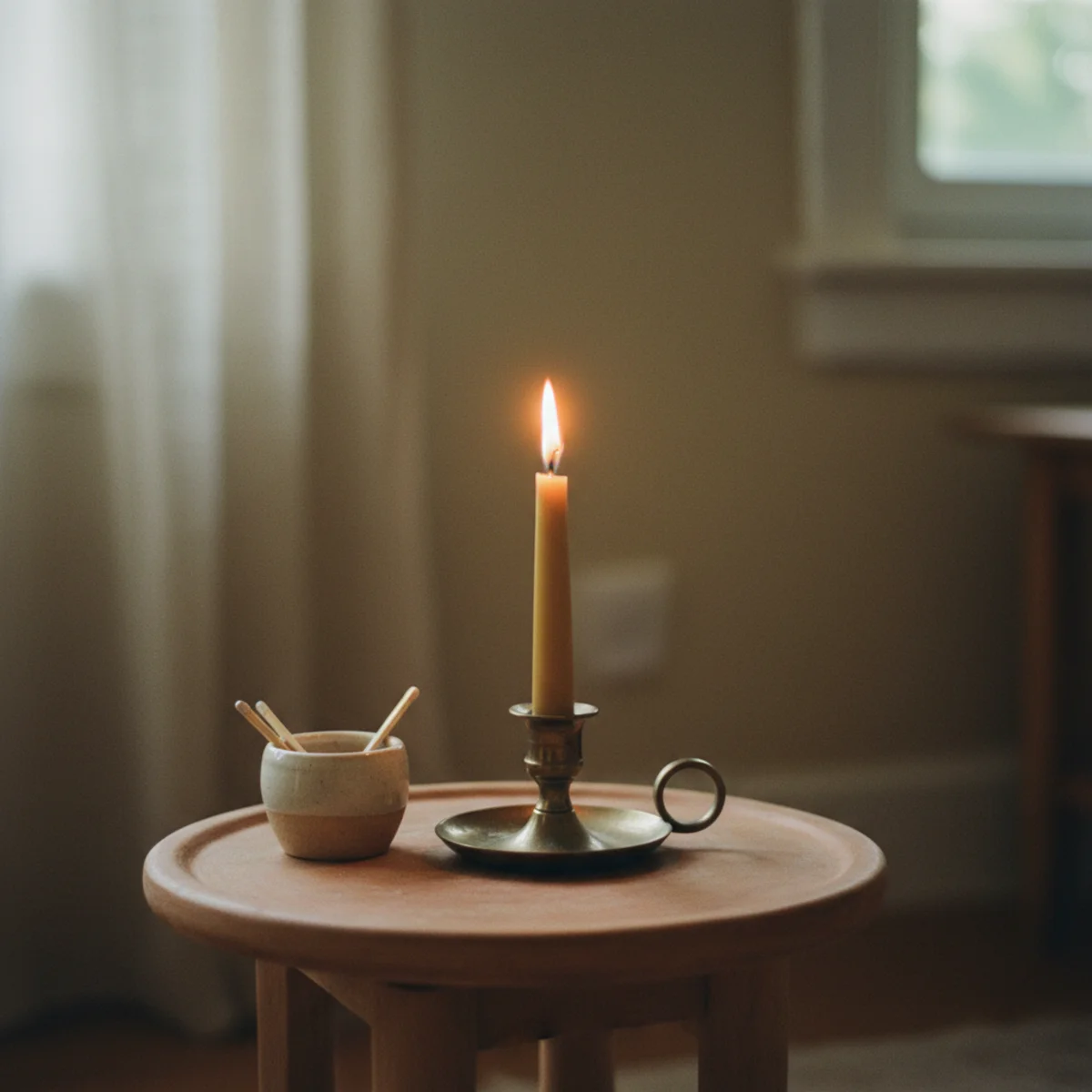
One or two beeswax candles, lit in the small room each evening, establish the daily cozy ritual that all other improvements support. The candle's warm moving flame at close range (small rooms keep you near the candle) is the most-specific cozy sensory experience available. Cost: $5-15 per candle. Time: 30 seconds to light each evening.
Small room candle practice: CANDLE TYPE — beeswax taper candles ($4-8 each) in a small brass or ceramic holder, or a 6-8 hour beeswax pillar candle ($10-20). The beeswax has the warm honey-amber flame and slight natural beeswax scent that paraffin candles lack. POSITION — on a stable surface (NOT near curtains, bedding, or other flammable materials), in a appropriate holder that catches drips. SCALE — one or two candles for a small room. In large rooms, candle clusters of 5-7 are needed for visual presence; in small rooms, one candle is close enough to be fully experienced. THE DAILY RITUAL — the act of lighting a candle signals the transition from work-time to rest-time, from day-mode to evening-mode. In small rooms particularly, where work and living may share the same space, this ritual transition has functional value beyond aesthetics. FIRE SAFETY — never leave burning candles unattended; position away from drafts (windows, fans); extinguish before sleeping. Use flameless LED candles for spaces where an open flame is impractical.
AFFILIATE SLOTRITUALOne beeswax taper ($4-8) or pillar ($10-20) in brass or ceramic holder; lit every evening; matches kept beside the candle; start the evening cozy-transition ritualAdd affiliate URL when configuredWhy it works
Because in a small room, you're always within 6-8 feet of the candle — close enough to see the flame's movement, feel the slight heat on nearby skin, and fully register the honey-amber quality of the light. In a large room, one candle is a visual element across 15 feet of distance; in a small room, it's a present warmth at personal range. The small room amplifies the candle's effects simply through physical proximity.
Pro tip — Keep a small box of matches or a lighter specifically beside the candle — the habit friction of having to find lighting when you want to light the candle is the most-common reason the candle-lighting ritual gets skipped. Matches beside the candle means the evening ritual takes 10 seconds and no searching.
One beeswax candle in brass holder — close-range warm flame that small rooms experience more fully than large ones. See also: candle-styling
How to make a small room cozy step by step
Warm the atmosphere first, then add only what earns its place.
- 1Fix the light
Turn off the overhead, add two or three warm 2700K lamps at different heights, and put one on a timer. This alone changes the room.
- 2Anchor with one rug
Lay a single wool rug large enough to sit the front legs of your seating on it. Skip the scattered small rugs.
- 3Layer three textures
Add a wool throw, a linen cushion, and one woven or wooden element. Stop at three; more reads as clutter in a small room.
- 4Clear and edit
Remove two objects for every one you add until the surfaces breathe. The empty space is what makes the warmth read.
Quick tips
- Warm the light before buying anything — it's the biggest cozy lever and adds zero clutter.
- Use one anchoring rug, not several small ones, in a tight space.
- Keep surfaces mostly clear; empty space is what lets a small room feel calm.
- Hang curtains high to lift the eye without using floor space.
- Choose a deep, warm wall color over more objects to warm the room.
- Remove two things for every one you add until the room breathes.
Cozy small rooms by type
A floated low sofa, one anchoring rug, warm lamps, and a single throw; see our small living room ideas.
Slim paired lamps, a low headboard, one bedside rug, and a tight warm palette.
A chair, a shoulder-height lamp, a throw, and a small rug — a whole cozy room in a corner.
Lean on portable warmth — lamps, a rug, a throw, leaning art — and skip the paint.
A small room doesn't want more. It wants warm light, one rug, a little texture, and permission to breathe.
Frequently asked questions
How do I make a small room feel cozy?+
What makes a room feel cozy?+
What colors make a small room feel cozy?+
Does a small room need more or less furniture for cozy?+
How do I add cozy lighting to a small room?+
Making a small room cozy is mostly about subtraction and warm light, not addition. Switch off the overhead, add two warm lamps, anchor with one rug, layer a single throw, and then clear the surfaces. We'd warm the light before buying a single thing — it's the biggest lever, it costs almost nothing, and it adds zero clutter. A small room done this way isn't a compromise; it's often the warmest room in the house.