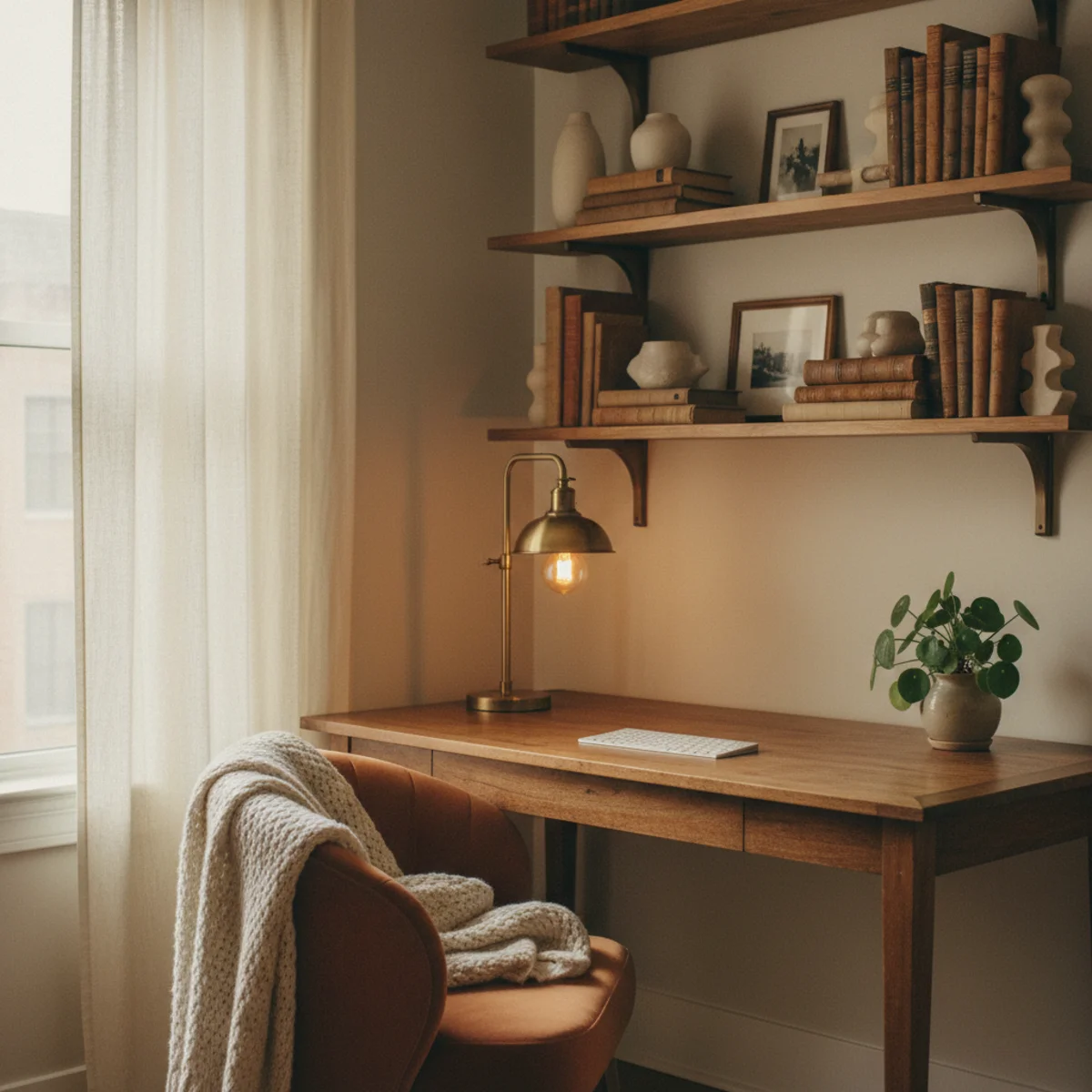
These twelve home office ideas are tested across actual remote-work setups — spare bedrooms converted to offices, dedicated office rooms, kitchen-nook desks, alcoves in living rooms. None requires expensive ergonomic furniture; almost all are renter-friendly. Every move below balances function (you have to actually work here) with warmth (you have to want to come back every morning).
Home offices fail when they read as commercial — bright overhead, glossy desk, ergonomic-but-ugly chair, cool gray walls. The fix isn't sacrificing function for aesthetic, it's choosing functional pieces that also happen to be warm. A solid oak desk works just as well as a glass-and-chrome one but reads home; a 2700K task lamp lights the keyboard just as well as a 5000K LED bulb but reads cozy. The home office is where these choices compound most.
By the end of this guide, you'll know exactly how to position your desk relative to natural light, the task-lamp spec that prevents eye strain and reads warm, the wood desk choice that anchors any office aesthetically, and the cozy-break-corner that prevents the room from becoming a productivity prison.
WHAT'S INSIDE
- The desk-to-window orientation (perpendicular, not facing) that prevents glare and warms the room
- Why a 2700K task lamp at 18 to 22 inches beats every fancy ergonomic desk light
- The solid oak or walnut desk choice (often thrifted at $80-200) that anchors any office
- The break corner that prevents 8-hour workdays from feeling like sentences
A workspace that feels like the rest of your home is one you'll actually use. Sterile is the enemy of focus, not the friend.
— Apartment Therapy [citation needed — verify before publish]
What makes a home office work?
A good home office balances focus with warmth — it needs enough order and light to get work done, but enough texture and personality that it doesn't feel like a sterile satellite of a corporate floor. The functional bones are a desk at the right height, a supportive chair, and layered lighting; the warmth comes from natural materials, a personal object or two, and a view if you can get one.
The single biggest improvement is placing the desk well and lighting it warmly. A desk facing or beside a window gives you daylight and a reason to look up, and a warm task lamp at 2700K keeps the evening hours from feeling clinical. After that, a wool throw on the chair, a plant, and a piece of art turn a workstation into a workspace — somewhere focus comes more easily because the room isn't fighting you.
More in By Room you may love
See allWhy home offices are everywhere in 2026
Remote and hybrid work became permanent for millions, and the home office stopped being a spare-room afterthought and became a room people genuinely invest in. Pinterest's home office searches climb every year, and the look has shifted from the sterile white-desk setup toward warm, lived-in workspaces with wood, texture, and personality.
The driver is that people now spend serious hours in these rooms and have learned that environment affects focus and mood. House Beautiful and similar publications track the move toward 'cozy productivity' — workspaces that look like part of the home rather than a transplanted cubicle — because a room you want to be in is a room you work better in.
26 home office ideas worth stealing
01Face the Desk Perpendicular to the Window
The single most-important home-office choice is where the desk sits relative to natural light. Facing directly into a window creates glare on screens; backing into a window backlights your face on every video call. The fix is positioning the desk perpendicular to the window — light falls across the desk from the side, with no glare on the screen and even facial lighting for calls. The perpendicular position works in nearly every office layout.
Position the desk so the window is at a 90-degree angle to your sightline — the screen faces parallel to the window wall, with natural light entering from the side. Best position is window to your dominant-hand side if you're right-handed (light falls over your left shoulder onto the keyboard, matching how reading-light should fall). For laptops with built-in webcams, the perpendicular orientation also gives the best video-call lighting — natural light from the side flatters the face better than backlit or front-lit positions. Avoid: desk directly facing a window (glare on screen, hard to read), desk directly backing a window (backlight on video calls, sun heat on back).
AFFILIATE SLOTARRANGEMENTDesk perpendicular to window, window on dominant-hand side for right-handersAdd affiliate URL when configuredWhy it works
Because you work at the desk 30 to 50 hours per week, and the lighting direction determines whether those hours strain your eyes or feel comfortable. A $200 desk in the right position outperforms a $2,000 desk in the wrong position — and the orientation is free to change. The perpendicular-to-window position also means natural light supports your work during the day without competing with task lamps, which means the room transitions naturally from daylight productivity to evening warm-lamp work without a harsh shift.
Pro tip — If your office layout forces the desk to face away from the window, install a long horizontal mirror behind the screen (mounted to the wall in front of the desk) — the mirror catches and bounces the window light back over your shoulder, simulating the perpendicular-to-window lighting effect without moving the desk. A 36-inch mirror reflecting natural light beats blackout shades or fluorescent compensation every time.
Window perpendicular to the desk, light from the side — the orientation that prevents glare and warms the room. See also: natural light
02Add a Warm Task Lamp at Keyboard Height
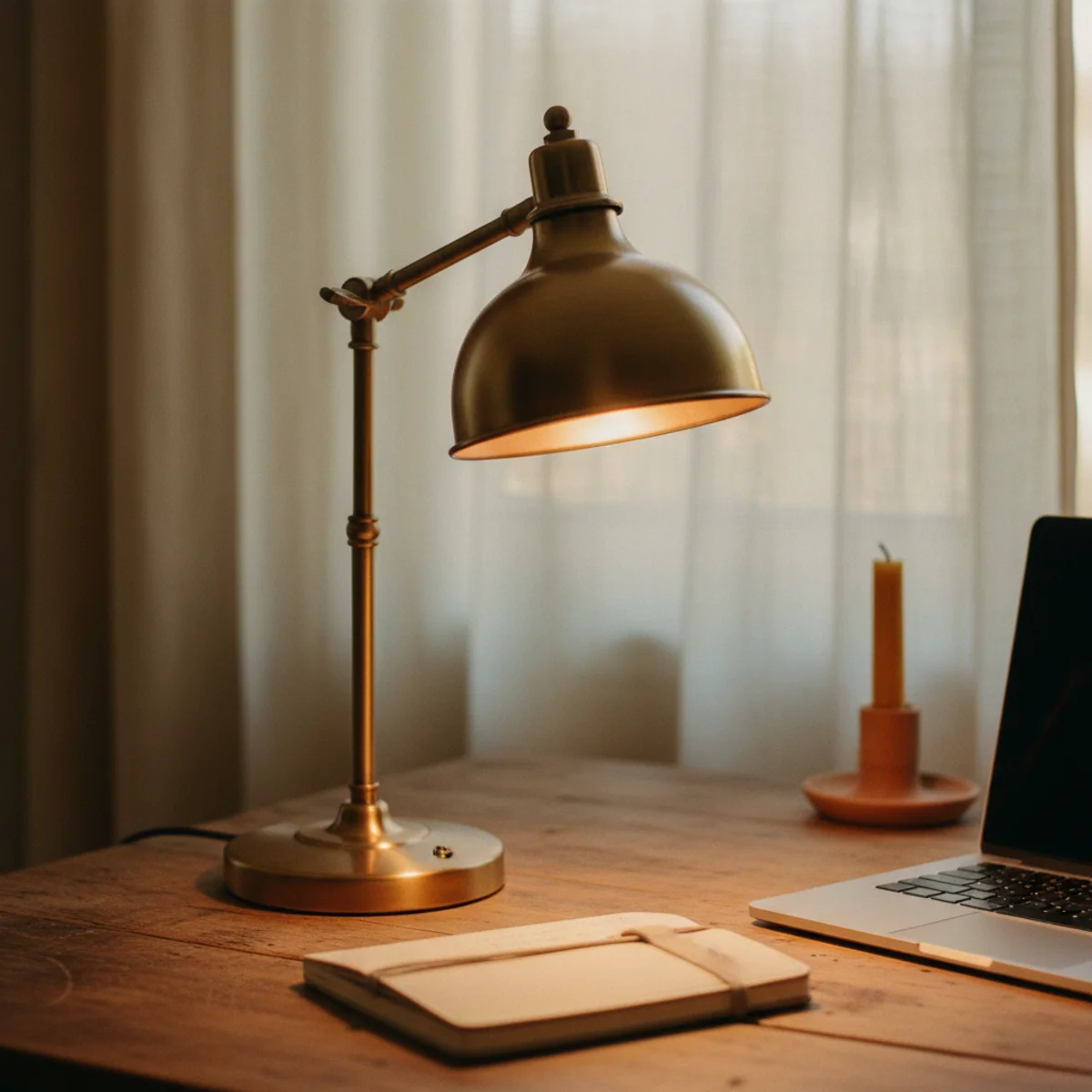
The desk task lamp is the most-overlooked home-office upgrade — most offices rely on the harsh overhead alone, which floods the room with cool light and creates screen glare. A small 2700K task lamp positioned beside the keyboard transforms the working zone into warm focused light, with the overhead off most of the time. The screen reads clearer; the room reads cozier.
Choose a desk task lamp 18 to 22 inches tall with an articulating arm (allows positioning), shade 6 to 10 inches across, 2700K LED bulb at 600 to 900 lumens (slightly brighter than living-room lamps because it's lighting a working surface). Best options: BenQ ScreenBar at $109 (clips to monitor, illuminates desk without screen glare), IKEA TERTIAL articulating at $30, Anglepoise 1228 at $300, vintage brass lamps with adjustable arms thrifted at $40 to $100. Position the lamp 18 to 24 inches from the keyboard, with the shade-bottom roughly at screen-top height. Avoid: lamps with fixed positions (you'll need to move the light angle), cool-white LEDs (cancel warmth), bright direct fluorescents.
AFFILIATE SLOTLIGHTINGArticulating desk task lamp 18-22 inches with 2700K bulb at 600-900 lumens, plus optional BenQ ScreenBarAdd affiliate URL when configuredWhy it works
Because focused task light at 2700K illuminates only the working zone, leaving the rest of the room in atmospheric ambient. The brain reads this as 'focused workspace' rather than 'flooded with cool light room.' The screen also reads clearer when the ambient room is dimmer than the screen — high ambient cool light competes with screen content and increases eye strain. Task lamp plus screen-only light is the workspace setup that compounds across 30 to 50 hours per week of working.
Pro tip — Add a clip-on monitor light (BenQ ScreenBar at $109 is the most-loved) for screen-focused tasks — the light angles down onto the keyboard without shining into your eyes or onto the screen. The single addition is the most-noticed eye-strain reducer available, and it stays out of the way unlike traditional desk lamps that take real estate.
Articulating task lamp at the keyboard, 2700K bulb — focused warmth that compounds across 30+ hours per week. See also: BenQ ScreenBar
03Choose a Solid Oak or Walnut Desk
The desk is the largest visual element in a home office, and the material choice determines whether the room reads warm or commercial. Solid oak, walnut, or teak desk reads warm and substantial; glass, chrome, or laminated MDF reads cold and corporate. The good news: vintage solid wood desks at $80 to $300 from Marketplace consistently outperform $800 retail laminate ones for both aesthetic and durability.
Look for desks 48 to 72 inches wide, 24 to 30 inches deep, 28 to 30 inches tall (standard ergonomic desk height). Solid oak, walnut, teak, or oiled pine — never veneer-on-particleboard or laminate. Sources: vintage mid-century at $80 to $300 from Marketplace and estate sales (often Heywood-Wakefield, Knoll, or Danish-modern brands), unfinished wood from solid-wood furniture stores at $200 to $500, West Elm Mid-Century desk at $700, Article Madera at $900. Test by weight (heavier than expected is good), test by joint stability (no wobbles when leaning). Refinish vintage finds with Danish oil ($12) and aged brass drawer pulls ($4 to $20 per pull) for $40 to $60 upgrade.
AFFILIATE SLOTFURNITURESolid oak, walnut, teak, or oiled pine desk 48-72 inches wide x 24-30 deep x 28-30 tallAdd affiliate URL when configuredWhy it works
Because the desk occupies the room's primary focal area — what your eyes see when you look at the room from any angle. A glass-and-chrome desk pulls the room toward commercial-office aesthetic regardless of all other warm decisions; a solid-walnut desk pulls the room toward warm-home aesthetic regardless of other commercial elements. The desk is what sets the room's category, and changing it is the highest-leverage office aesthetic decision.
Pro tip — Add a wooden monitor riser ($30 to $80 from Amazon or Etsy) on top of the desk surface — the wood-on-wood layering reads more layered and finished, and the riser doubles as keyboard storage underneath while raising the screen to ergonomic eye level. The combination of wooden desk plus wooden monitor riser is the warm-office signature setup.
Vintage solid oak desk, refinished, brass pulls — the desk that pulls the entire office toward warm aesthetic. See also: Danish oil
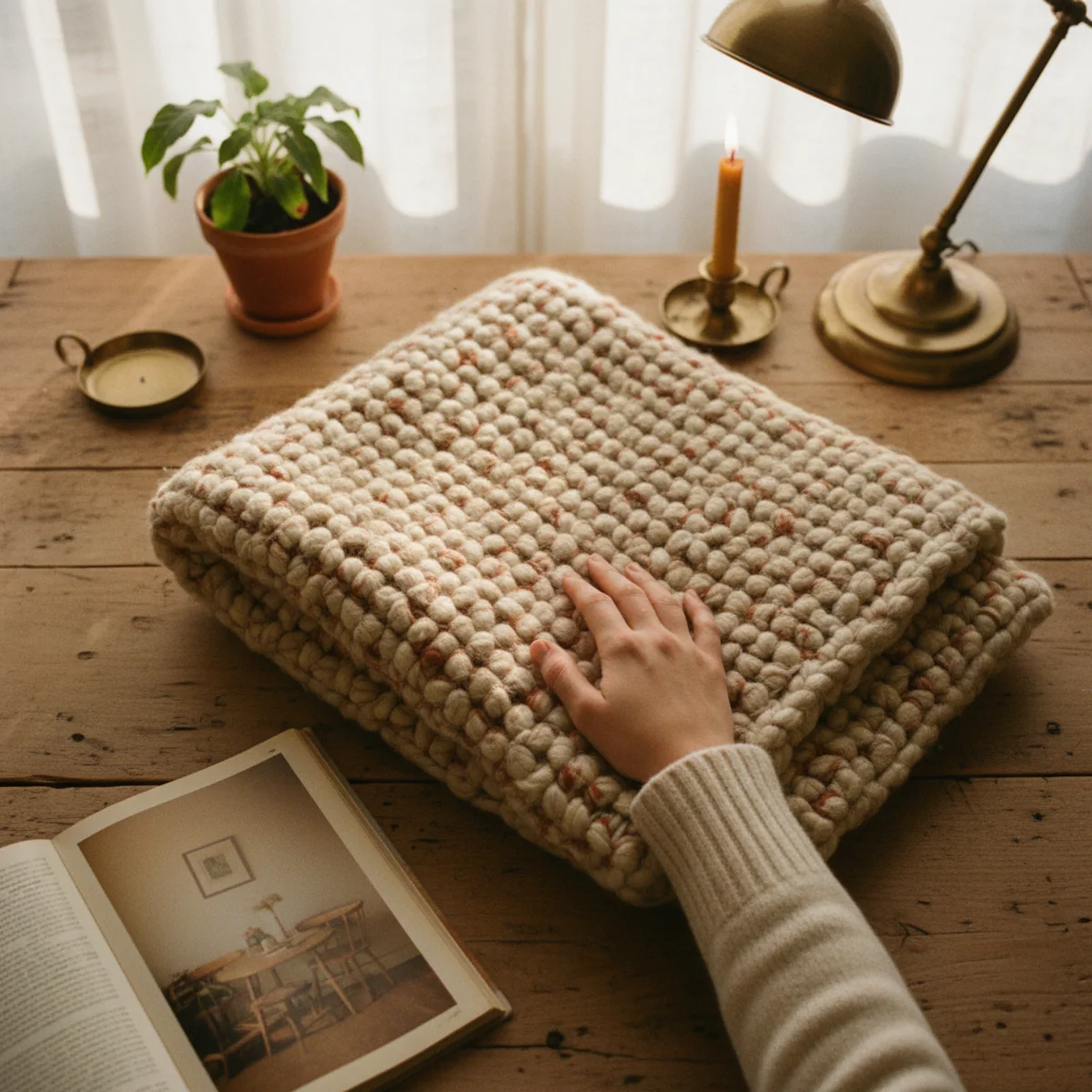
04Drape a Wool Throw Over the Office Chair
Office chairs are usually ergonomic but visually cold — black mesh, gray fabric, plastic frames. Draping a wool throw over the chair back transforms how the chair reads without sacrificing any function — you sit on the same chair, but the room reads warmer because the chair has been visually softened by the throw. Cost: $40 to $80 for the throw.
Choose a wool throw 50x60 inches in oat, cream, terracotta, or sage tones — undyed natural fibers read warmest. Sources: Pendleton secondhand at $40, West Elm boucle at $79, Lands' End wool at $80, IKEA INGABRITTA at $30. Drape diagonally over the chair back with one corner falling toward the seat (per the throw-blanket-layering rules). The wool reads as a soft layer over the ergonomic structure; the structure still functions ergonomically; the visual register shifts from commercial to home. Skip synthetic fleece throws — they shine under task lighting and read cheap; real wool reads matte and warm.
AFFILIATE SLOTTEXTILESWool throw 50x60 inches in undyed earth tones draped diagonally over chair backAdd affiliate URL when configuredWhy it works
Because office chairs are designed to be ergonomically perfect, not visually warm — they look like office equipment because that's what they are. A wool throw breaks the equipment-look by adding a textile layer the chair would never have at retail. The chair functions identically; only the visual register shifts. The throw is also useful in winter when sitting at the desk for hours requires extra warmth — the throw pulls across the lap for cold afternoons.
Pro tip — Use a throw in a slightly contrasting tone to the rest of the office palette — if your room is mostly oat-and-cream, choose a terracotta or rust throw for the chair. The contrast makes the throw read as deliberate styling choice rather than just leftover blanket draped on the chair.
Wool throw over the office chair — the soft layer that pulls ergonomic equipment toward warm aesthetic. See also: throw-blanket-layering rules
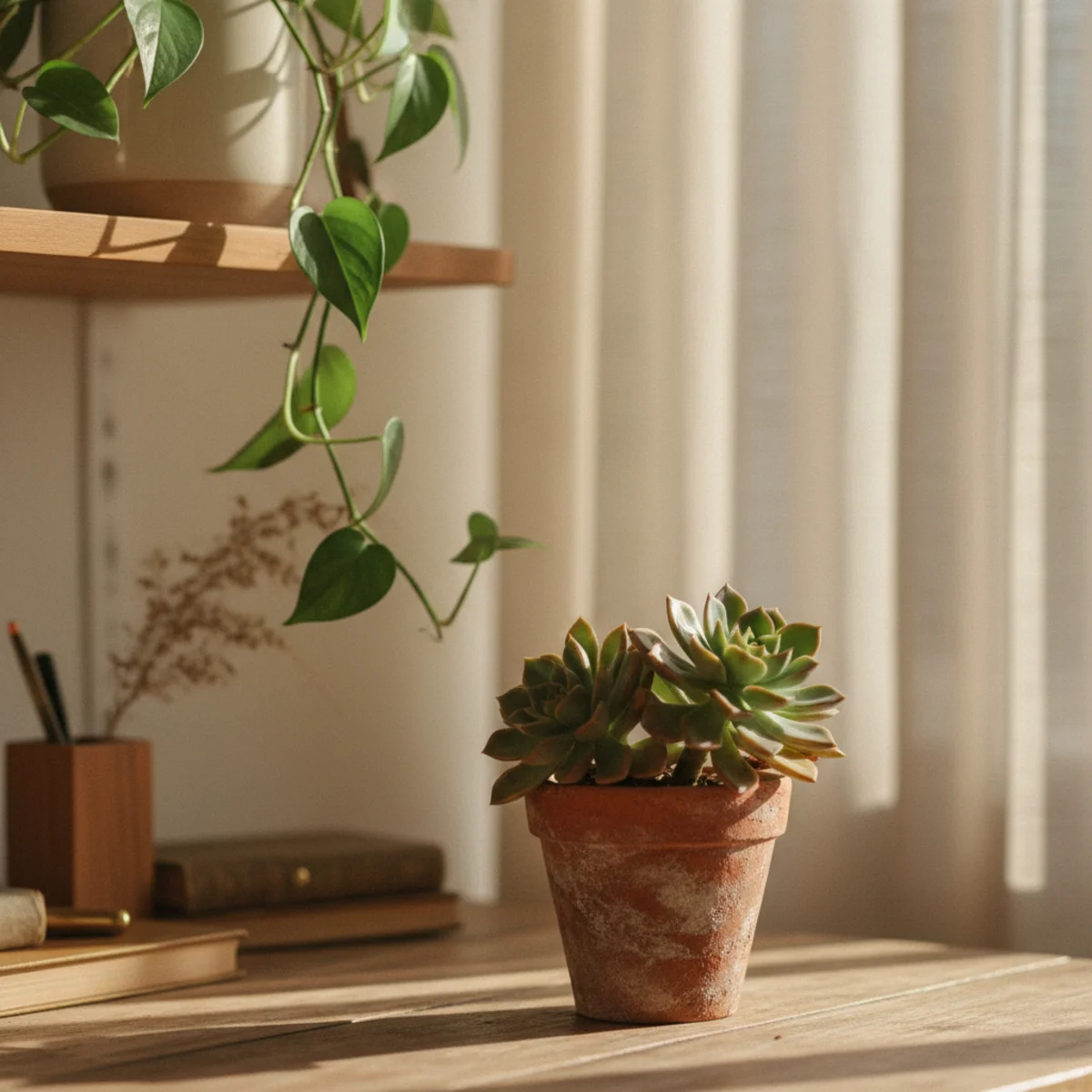
05Add One or Two Plants Nearby
Plants in a home office aren't decoration — they're the simplest mental-health upgrade available. One or two plants positioned within sight from the desk add organic shape, natural color, and the subtle motion of growth amid otherwise static work-surface. Research consistently shows plants in workspaces improve focus and reduce stress; even one is meaningfully better than zero.
Best home-office plants: snake plant (3 to 4 feet tall, near-indestructible, low light tolerant, $20 to $40), pothos (trailing vines on shelves, easy, $15 to $30), ZZ plant (low light, low water, near-impossible to kill, $20 to $40), small fiddle leaf fig (4 to 5 feet, demands light, $40 to $80 for medium size). One large floor plant (3 to 5 feet tall, beside the desk) plus one small desk plant (trailing pothos on shelf or small succulent on desk) is the standard arrangement. Place in warm-toned ceramic, terracotta, or rattan planters — never plastic. Position within sight from your normal seated working position.
AFFILIATE SLOTPLANTS1 large floor plant (snake, ZZ, fiddle) + 1 small desk plant (pothos, succulent)Add affiliate URL when configuredWhy it works
Because home offices have the highest hours-per-week-spent-staring-at-screens of any room in a typical home, and the screen-focus mode is physically constraining for the eyes. Plants positioned in peripheral vision give the eye something to refocus on between tasks, which reduces eye strain. The mental effect compounds: plants signal life amid otherwise static work, which helps the office feel like a room rather than a productivity prison. The single highest-ROI mental-health office upgrade.
Pro tip — Choose one plant you can almost ignore (snake plant or ZZ plant — water every 2 to 3 weeks) and one plant you'll attend to (small trailing pothos or fiddle leaf — water weekly). The combination gives you the visual benefit of two plants with manageable maintenance — one survives neglect, the other rewards small attention.
One large snake plant beside the desk, one small pothos on the shelf — the simplest mental-health office upgrade. See also: warm-toned ceramic
06Hide Every Cord and Cable
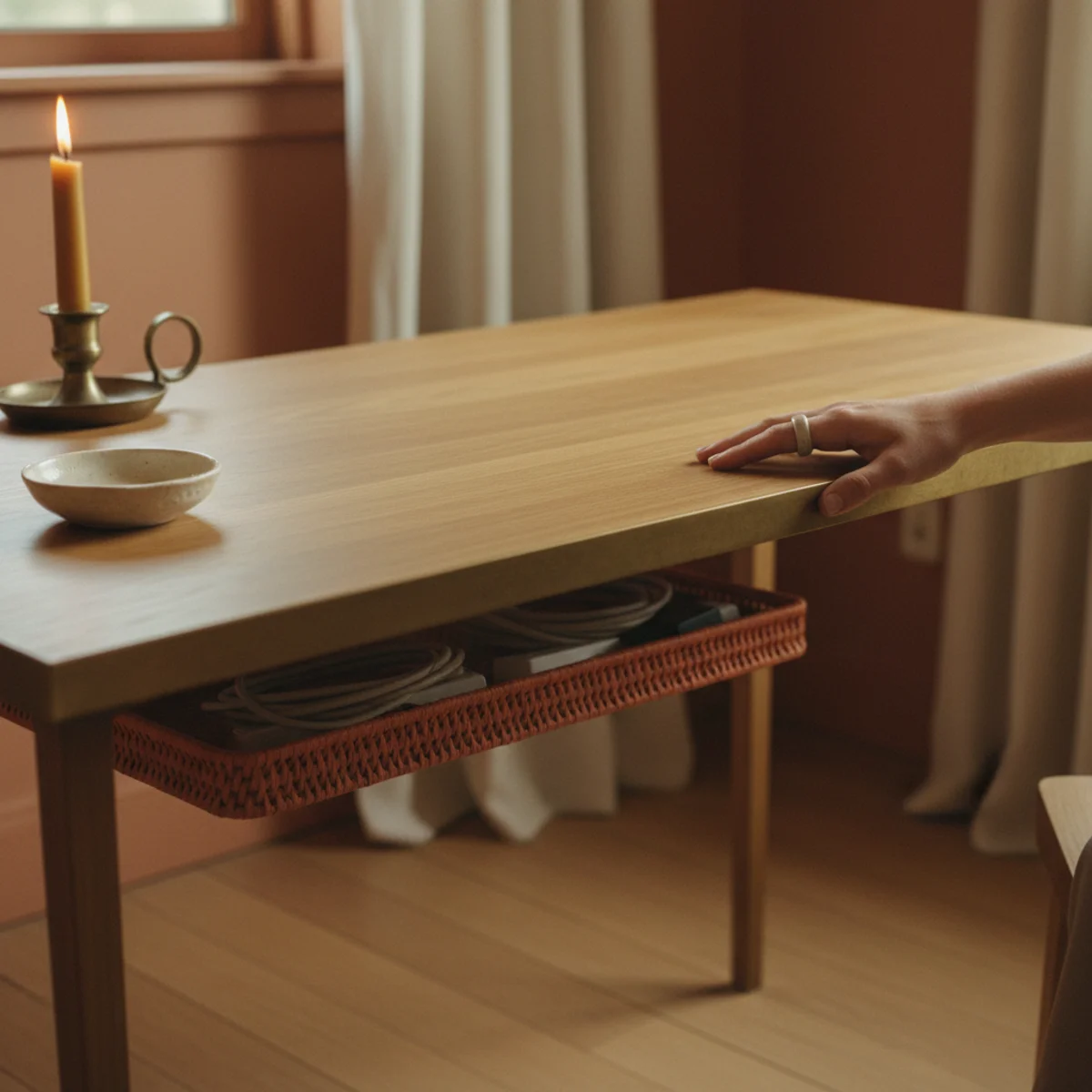
The fastest way to ruin a warm home office is visible cords — laptop charger, monitor cable, phone cable, lamp cord, headset cable, USB hub. Each visible cable reads as commercial chaos and breaks the warm aesthetic. The fix is systematic hiding: cable tray under the desk, cord raceways along baseboards, wireless where possible, and one charging station in a closed drawer.
Three-tier cord management: (1) UNDER-DESK CABLE TRAY at $20 to $40 from Amazon — mounts under the desktop, holds power strip, multi-port USB hub, and excess cable length so nothing dangles. (2) CORD RACEWAYS at $8 to $15 per 4-foot section, painted to match walls, hide cables running from desk to wall outlets along baseboards. (3) DRAWER CHARGING STATION — modify one desk drawer to hold a power strip, drill a small cord hole in the back of the drawer, charge phone and small devices inside the closed drawer. The complete cord-hiding setup costs $50 to $100 total and transforms how the office reads.
AFFILIATE SLOTORGANIZATIONUnder-desk cable tray + cord raceways + drawer charging station for complete tech invisibilityAdd affiliate URL when configuredWhy it works
Because cords introduce hard plastic, sharp lines, glossy black surfaces, and chromatic interruption all at once — the most disruptive elements possible in a warm-home aesthetic. A single visible black charging cable across an otherwise warm office is the visual equivalent of a single dissonant chord in an otherwise melodic song. Home offices have more cables per square foot than any other room, so the cord-hiding discipline matters most here.
Pro tip — Audit your office once a month specifically for new visible cords — they accumulate quickly as you add devices, and you'll lose track of how many small interruptions have appeared. A monthly 10-minute cord audit (consolidate, hide, re-route) keeps the warm office from slowly degrading over time without you noticing.
Under-desk tray, raceways, drawer charging — no visible cords means the warm office actually reads warm. See also: warm-home aesthetic
07Use Open Shelving for Warmth
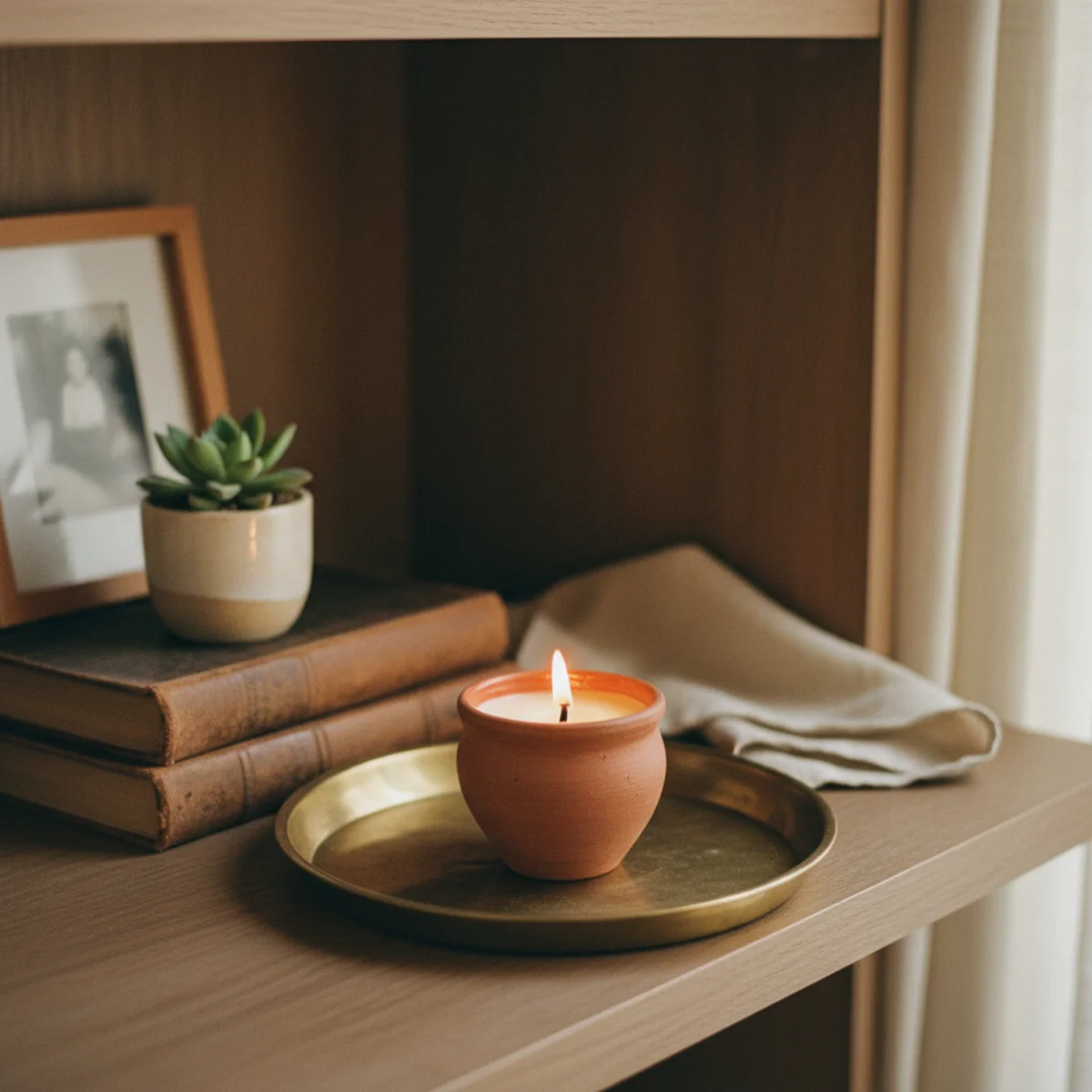
Closed filing cabinets and tall storage units fight warm-office aesthetic — they read as commercial office equipment. The fix is open shelving (the floating oak shelf from the diy-home-decor-ideas guide, or a small bookshelf) above or beside the desk, styled with books, ceramics, plants, and a few personal objects. The visible shelf adds the warm-home layer that office storage furniture entirely lacks.
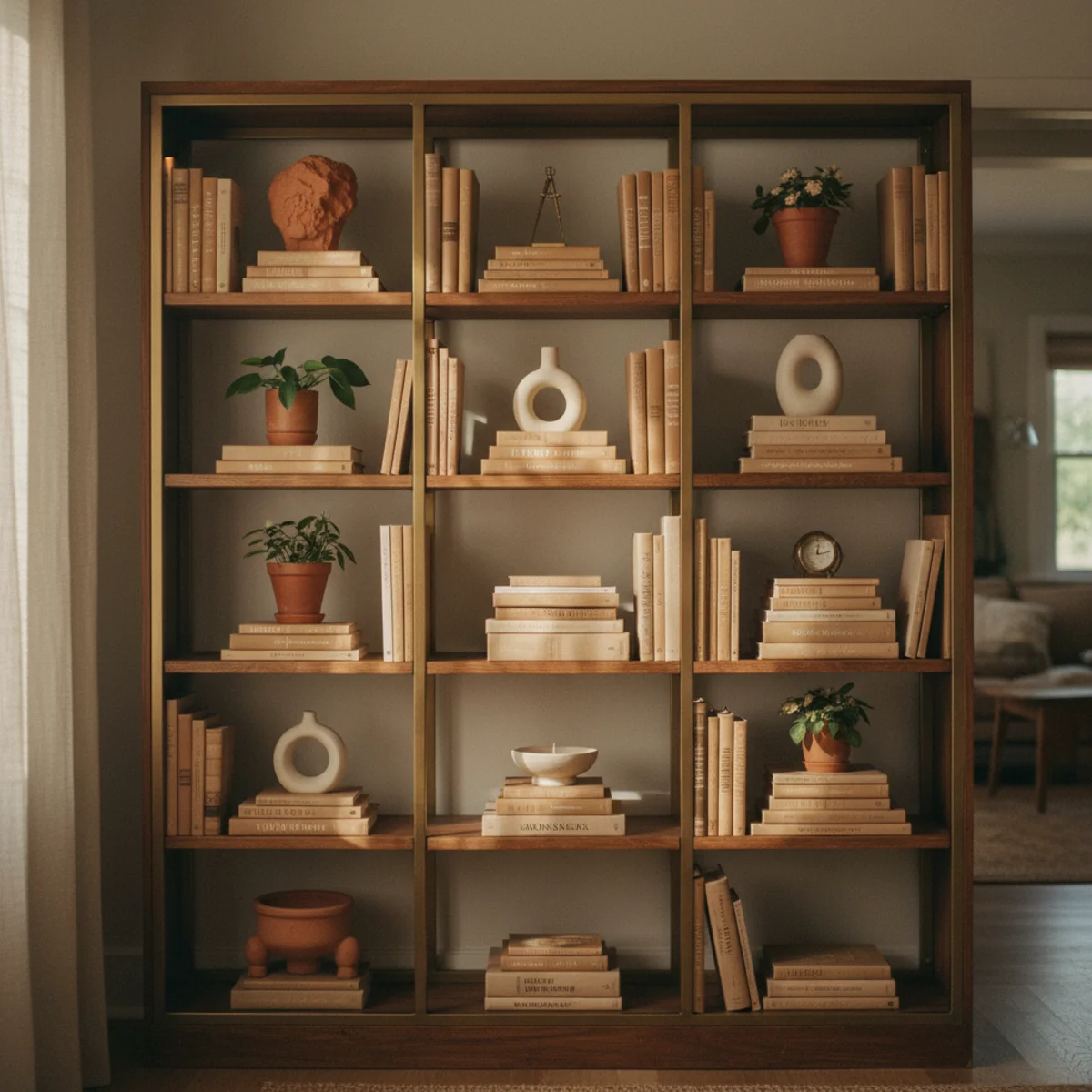
Two approaches: SINGLE FLOATING SHELF — install one 36 to 48-inch solid oak or walnut floating shelf above the desk at 18 to 24 inches above the desktop ($35 to $60 in materials per the diy-home-decor-ideas guide, or $80 to $150 retail). SMALL BOOKSHELF BESIDE THE DESK — a 24 to 36-inch wide, 60 to 72-inch tall bookshelf in solid wood ($80 to $300 thrifted, $400 to $800 retail). Style with reference books you actually use, 2 to 3 ceramics or small sculptural objects, one small framed personal piece, one small plant or branch in a vase. Follow the shelf-styling-ideas rules: 30 to 40% empty, odd numbers per vignette, depth layering, repeated material across shelves.
AFFILIATE SLOTSTORAGESingle floating oak shelf above desk OR small solid-wood bookshelf beside deskAdd affiliate URL when configuredWhy it works
Because closed cabinets hide everything (including personality), while open shelves display the small warm-home objects that signal this is a home rather than a corporate office. Reference books visible on a shelf read more competent and warm than the same books hidden in a filing cabinet. The shelves also become functional storage that doubles as styling, which is the universal warm-home principle.
Pro tip — Strip dust jackets from any hardcover reference books on the office shelves — the cloth bindings underneath read more sophisticated than printed jackets and fit the warm-home palette better. The trick costs nothing and transforms how the shelves read; reference books with cloth bindings look like a personal library, where the same books with bright printed jackets look like a school bookshelf.
Floating oak shelf above the desk, books with cloth bindings — open shelving that turns commercial storage into warm-home library. See also: diy-home-decor-ideas guide
08Add a Wool or Jute Rug Underfoot
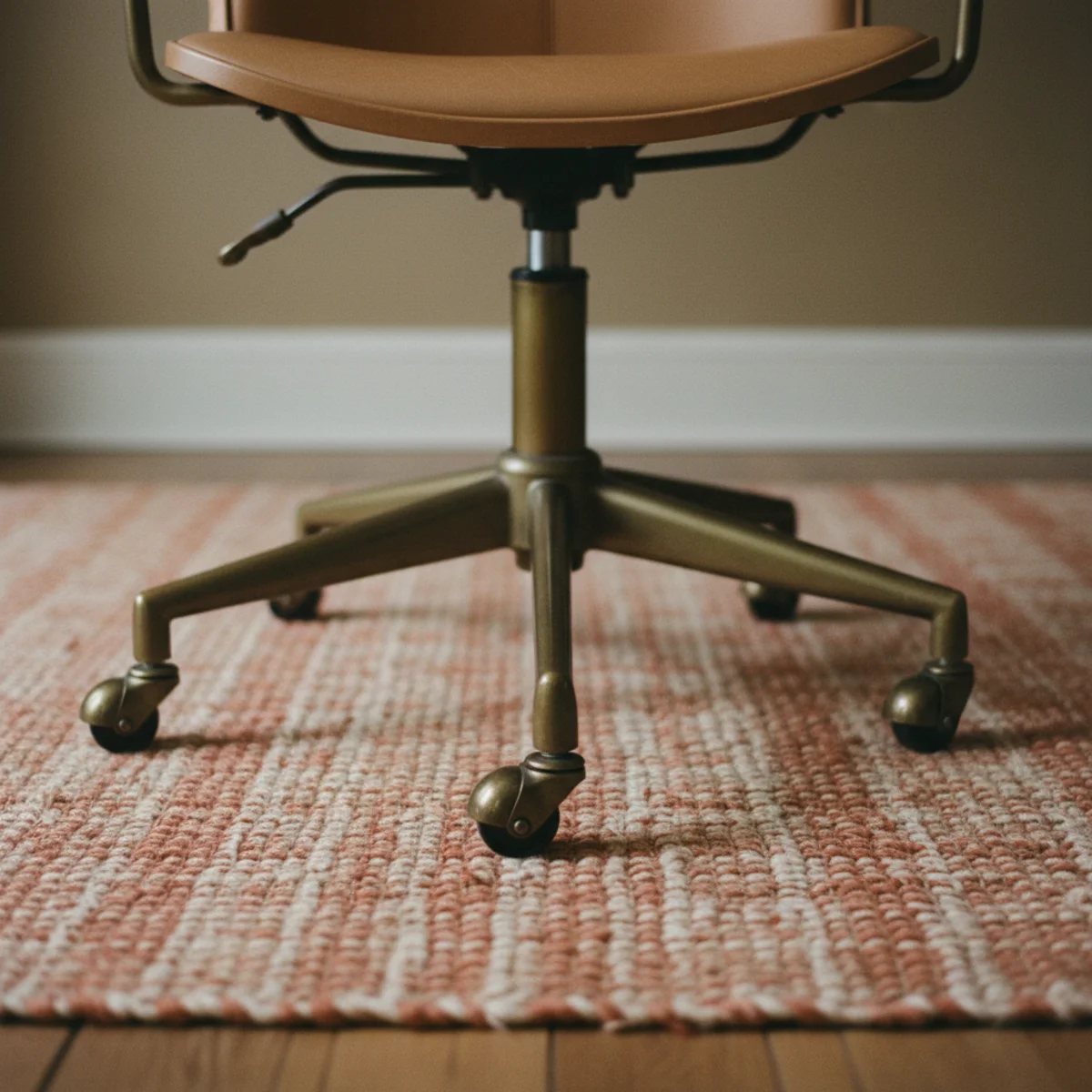
Hard floors under office chairs read commercial — the same hard surfaces that work in entries and kitchens fight warm-home aesthetic in the room where you spend the most hours. A wool or jute rug under the desk (or under the whole working zone) softens the floor visually and acoustically, and adds the textile layer that hard-surfaced offices entirely lack. The rug also protects the floor from chair-roller wear.
Choose a rug 5x7 or 6x9 feet for desk-only coverage, or 8x10 / 9x12 for whole-office coverage. Best types: wool (Annie Selke, Rugs USA, vintage Persian at $200 to $500), jute or sisal ($80 to $250, surprisingly durable), wool-jute blends ($150 to $400). The desk and chair should both sit on the rug. Add a clear plastic chair mat ($25 to $60 from Amazon) on top of the rug under the chair if you use a rolling chair — protects the rug from roller wear while preserving the warm-rug aesthetic. Or use a non-rolling chair (worn leather armchair, wooden chair with cushion) to eliminate the chair-mat issue entirely.
AFFILIATE SLOTFLOORWool or jute rug 5x7 to 9x12 under desk and chair zoneAdd affiliate URL when configuredWhy it works
Because home offices have the longest single-position viewing time of any room — you sit in roughly the same place for hours, looking at the same floor and walls. A bare hard floor in this fixed view becomes the day's primary visual element, and the lack of textile reads as office or hospital. Adding a wool or jute rug under the desk and chair adds the soft texture the eye registers across all those hours, which compounds significantly across 30 to 50 hours per week of looking.
Pro tip — Use a 6x9 jute rug as the budget warm-office choice — at $80 to $150 it covers the desk-and-chair zone, adds significant warmth, and works under chair rollers with a clear chair mat on top. The combination delivers most of the visual warmth of vintage Persian at one-fifth the cost.
Jute rug under desk and chair — the textile layer that pulls home offices toward warm rather than commercial. See also: vintage Persian
09Style One Personal Object on the Desk
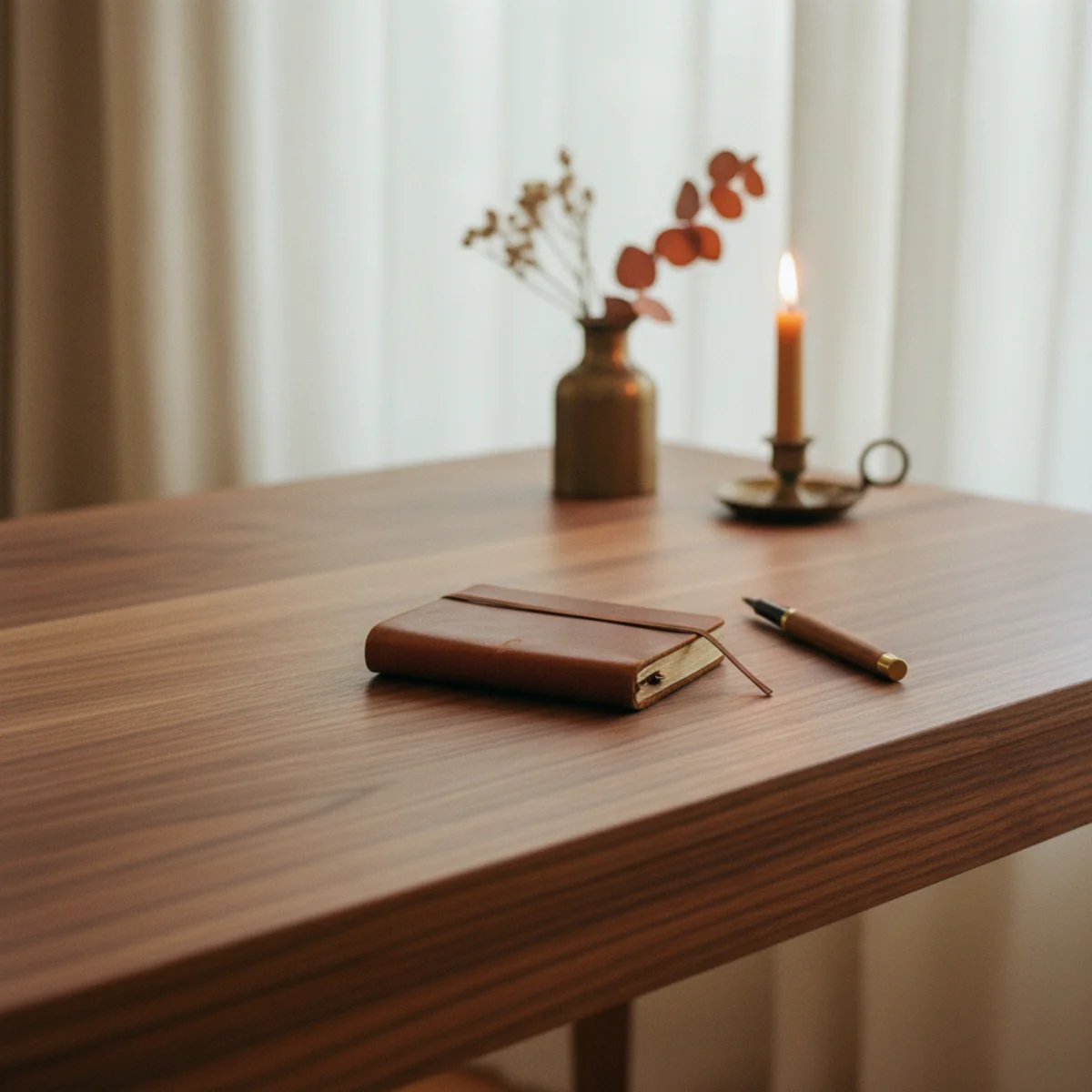
The desk surface needs one styled personal object beyond functional work items — a small framed photograph, a small ceramic from a meaningful trip, an heirloom letter opener, a small sculptural piece. The single personal object signals that this is a specific person's workspace, not a generic desk. It's the smallest possible signal of identity and the one that makes the office feel inhabited rather than functional.
Choose one small object (3 to 8 inches in any dimension) that has specific personal meaning: a framed 4x6 photograph in warm wood or brass frame, a small ceramic vessel from a craft fair, an inherited small object (letter opener, paperweight, small sculpture), a single small piece of art on a leaning easel. Position on the desk in a spot that's visible when working but not in your primary work zone — typically the back-corner of the desk farthest from your dominant hand. The object becomes something to notice during break moments and signals 'this is my space' to anyone entering the room.
AFFILIATE SLOTSTYLINGOne small personally meaningful object 3-8 inches on the desk's back-cornerAdd affiliate URL when configuredWhy it works
Because the rest of the desk is functional infrastructure — keyboard, monitor, mouse, papers, lamp, plant, perhaps a notebook. None of those communicates personality. The single personal object is what signals 'a specific person works here.' Without it, the most beautifully styled desk still reads as a generic workspace; with it, the same desk reads as your particular workspace. The compound effect across 30 to 50 hours per week of looking at the desk surface is significant.
Pro tip — Rotate the personal object every 3 to 6 months — pull a different framed photograph from a drawer, swap in a different inherited piece, change the small artwork. The rotation keeps the object from becoming visual background and gives you something quietly different to notice each season. The rotation is the small ritual that protects against habituation.
One framed photograph in the back corner — the personal signal that turns generic desk into specific workspace. See also: small piece of art
10Hang Art at Eye Level Above the Desk
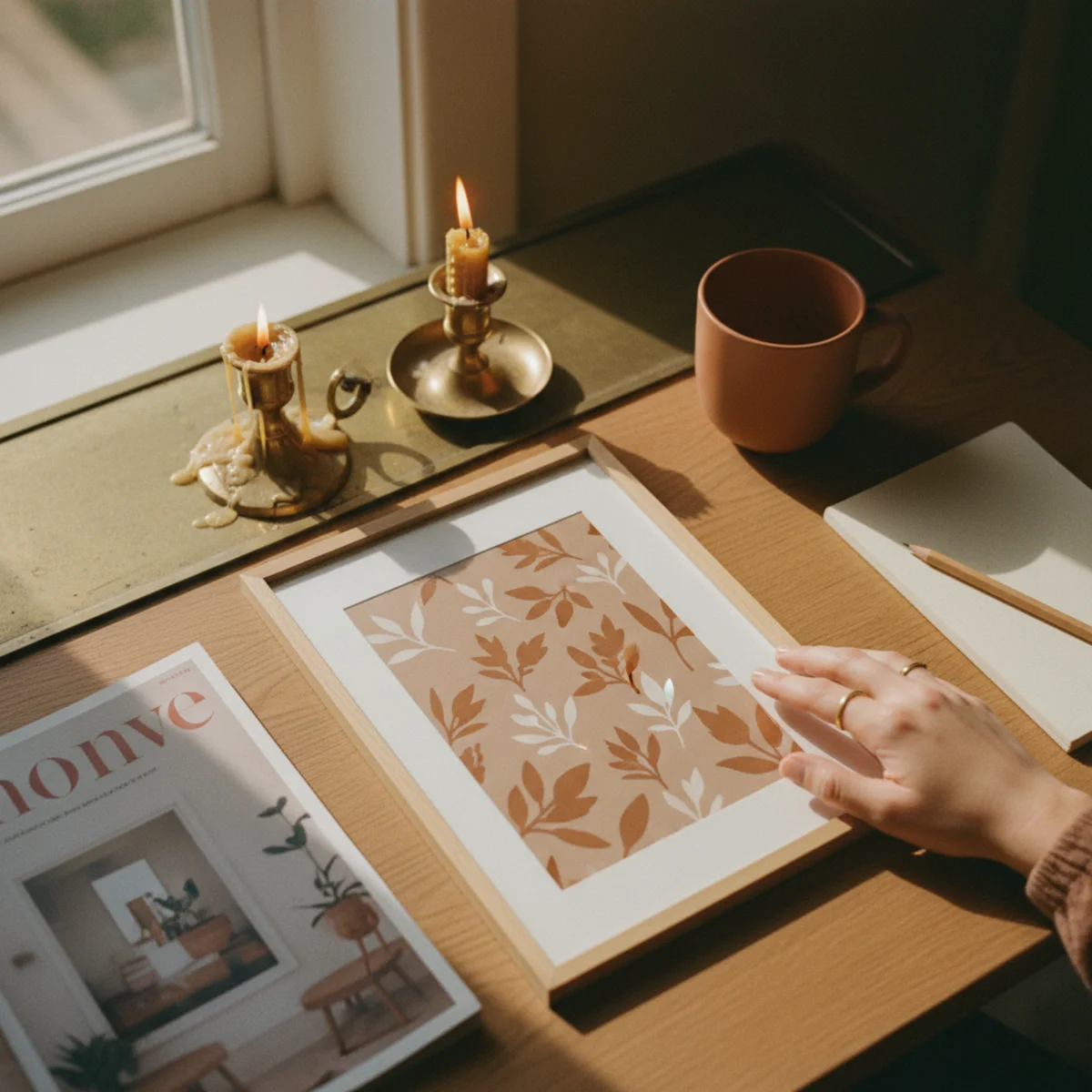
The wall above the desk is the most-viewed surface in any home office — you look at it every time you lift your eyes from the screen. Hanging one piece of art (or a small grouping) at eye level above the desk gives the eye somewhere to rest and breaks the screen-only focus that defines most office hours. The art should be calming, not energizing — landscapes, abstracts, soft botanicals, single-color photography.
Choose one larger piece (16x20 to 24x36 inches) or a small grouping of 2 to 3 medium pieces (8x10 to 14x18 each). Position with the art's center at 51 to 55 inches above the floor — this is seated eye level when working at the desk, slightly lower than the standard 57-inch gallery height because you'll view it seated, not standing. The art should be calming subject matter (landscapes, abstracts, soft botanicals, single-color photography) in warm earth tones; avoid bright primary colors and graphic patterns that compete with screen focus. Frame in warm wood (oak, walnut) or aged brass.
AFFILIATE SLOTART1 large piece or 2-3 medium pieces at eye level (center 51-55 inches above floor) above deskAdd affiliate URL when configuredWhy it works
Because the brain needs visual rest points throughout long work sessions — and looking at the screen continuously without other visual stimuli creates eye strain and mental fatigue. Art above the desk provides a fixed visual rest point that the eye can refocus on between tasks. The 20-20-20 rule (every 20 minutes, look at something 20 feet away for 20 seconds) works best when there's something specific to look at — the art above the desk is the answer.
Pro tip — Hang the art slightly closer than feels natural — for desks against a wall, hang at 12 to 18 inches above the back of the desk rather than the standard 24 to 30 inches. The closer position creates a tighter visual relationship between desk and art, which reads more deliberate and gives you something to look at without lifting your head significantly.
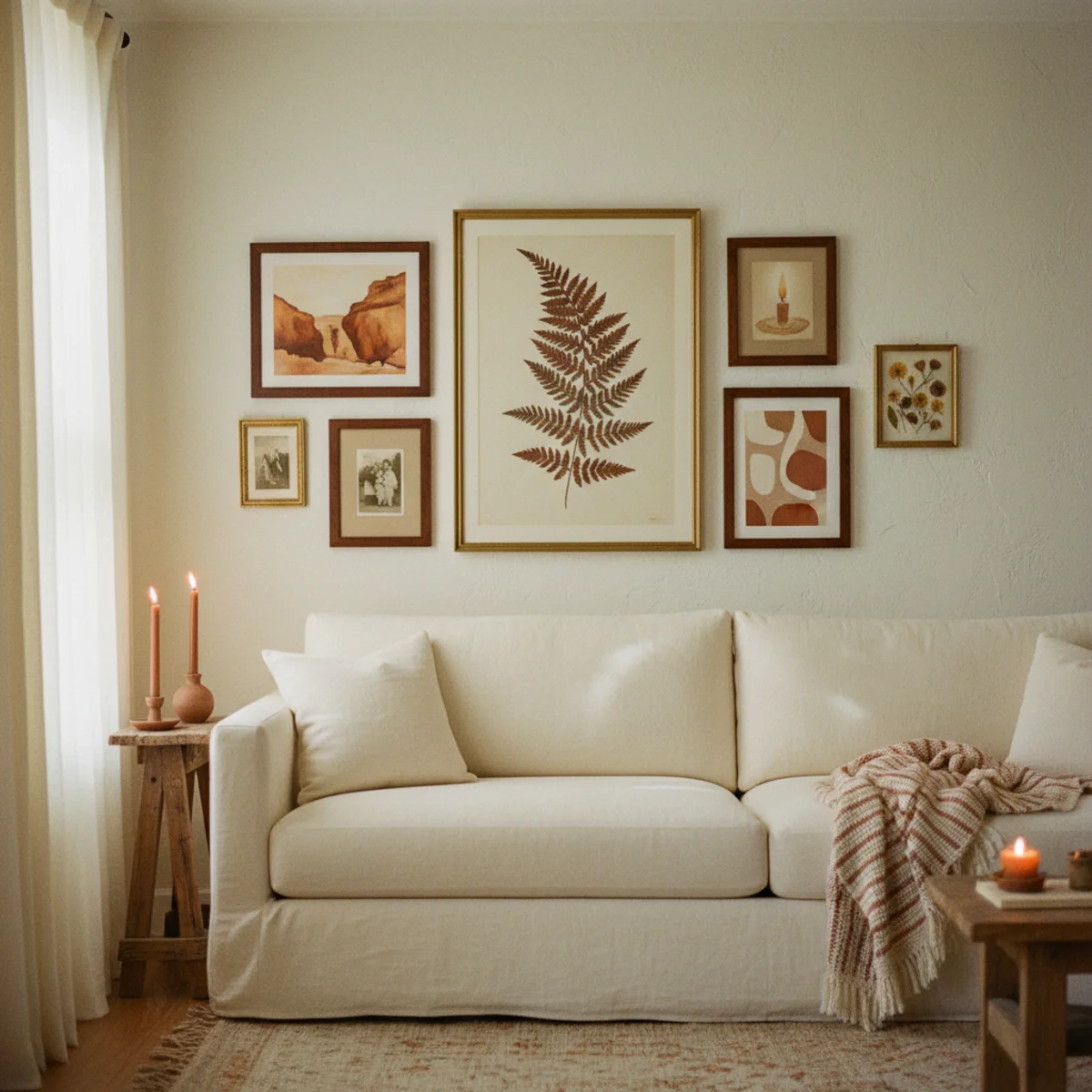
Large landscape, warm oak frame, at seated eye level — the visual rest point that prevents screen-only fatigue. See also: warm earth tones
11Carve a Small Cozy Corner for Breaks
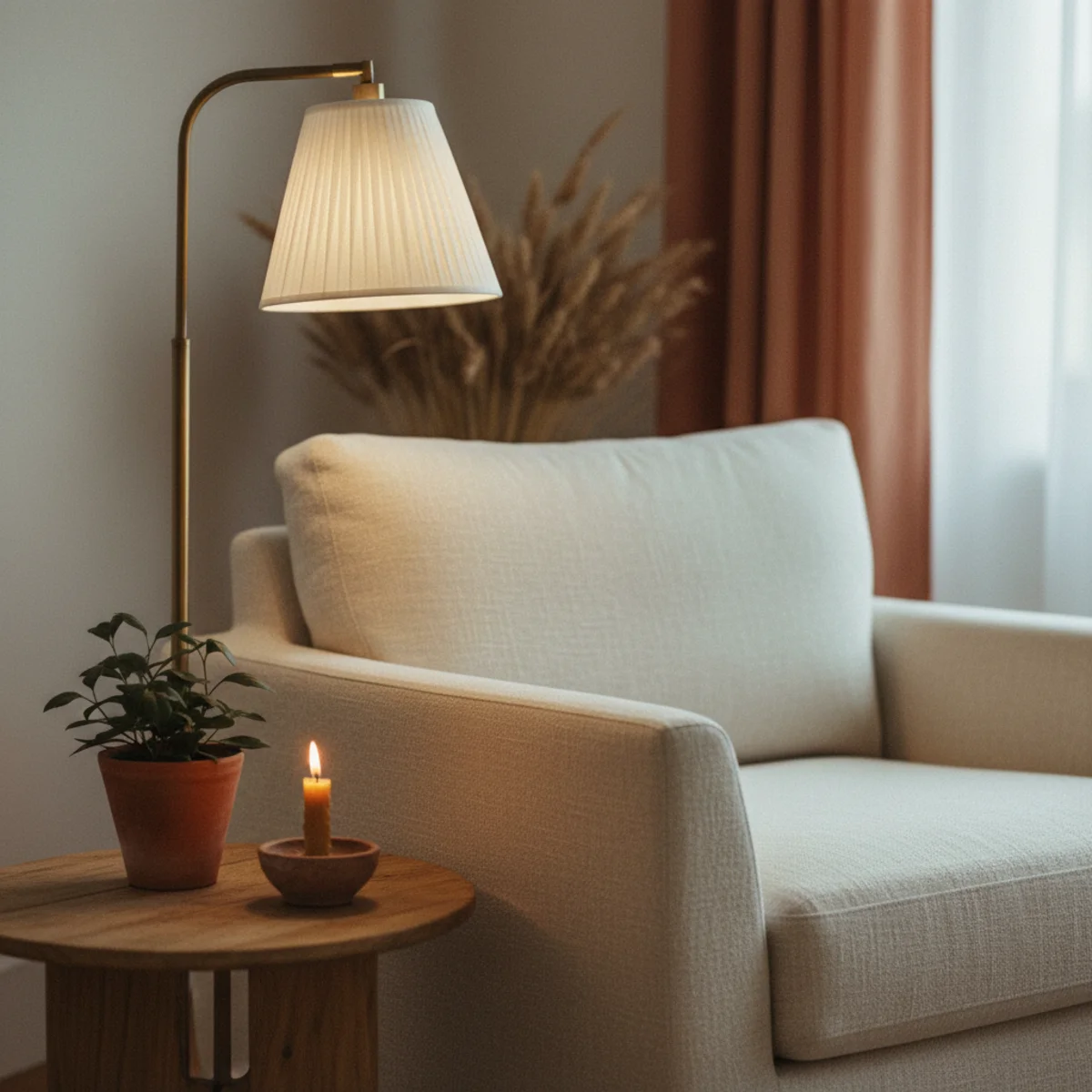
The most-skipped home-office element: a small break corner. A reading chair, a side table, a small lamp positioned 6 to 10 feet from the desk creates a dedicated zone for the breaks that long work sessions require. Without the break corner, the breaks happen at the desk (still looking at screens) or in other rooms (full context switch). The corner is the middle path — same room, different physical position, real mental break.
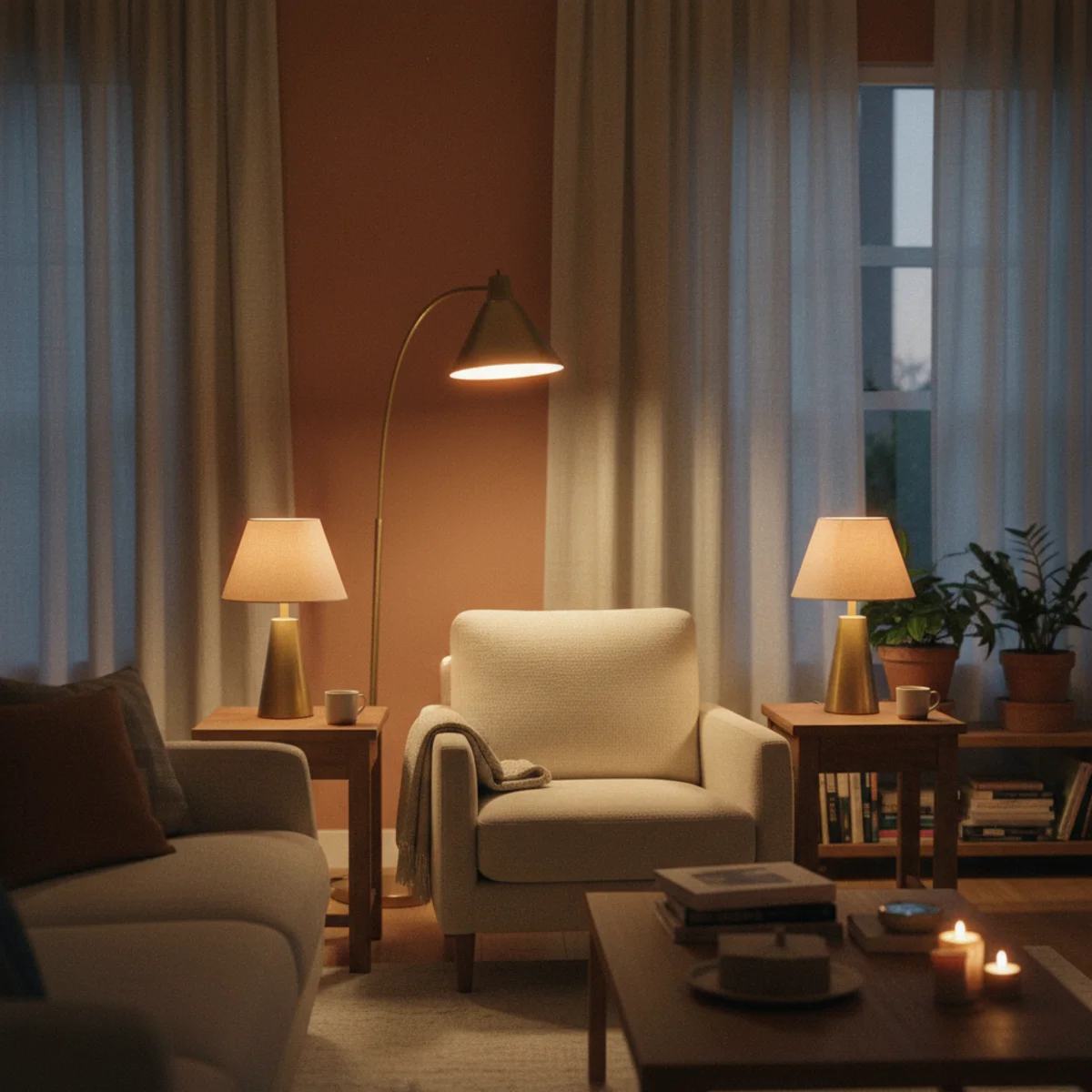
Minimum components: one armchair (worn leather, linen, or boucle at 17 to 19 inch seat height — see reading-nook-ideas), one small side table 22 to 28 inches tall for a mug, one floor lamp at 58 to 64 inches tall with 2700K bulb. Position the chair angled away from the desk so the visual direction changes during breaks. Add a wool throw, one linen lumbar cushion, optional sheepskin. The corner becomes the spot for the 10-minute coffee break, the 30-minute lunch break, the occasional phone call you don't need to take at the desk. Total cost: $250 to $500 if thrifted; up to $1,000 retail.
AFFILIATE SLOTZONEArmchair + side table + floor lamp at 2700K in 3x4 foot break corner separate from deskAdd affiliate URL when configuredWhy it works
Because home offices are physically constraining (sitting in the same position for hours), and the brain needs physical-position changes throughout the day to reset. Without a break corner, breaks happen in other rooms (high friction, often skipped) or at the desk (no real break). A separate chair in the same room is the middle path — accessible enough that breaks actually happen, separate enough that the body and brain actually reset. The five-minute corner break compounds across 50 work-weeks per year into significant burnout prevention.
Pro tip — Take coffee or tea breaks specifically in the corner, never at the desk — the mug-in-corner ritual is what reinforces the corner as a break zone rather than just another seat. After a few weeks the brain associates the corner with rest; before then, you'll have to consciously move there during breaks until the habit forms.
Break corner six feet from the desk — separate enough for real breaks, accessible enough that they actually happen. See also: reading-nook-ideas
12Paint the Office a Warm Focused Color
Home office walls deserve a more saturated color than living rooms — the focused color creates a defined work zone visually, and the slightly-stronger-than-average paint matches the focused nature of the work itself. Deep olive, warm clay, dark navy, or muted charcoal all work better in offices than warm whites. The bolder color also makes the office feel like a deliberate room rather than leftover space.
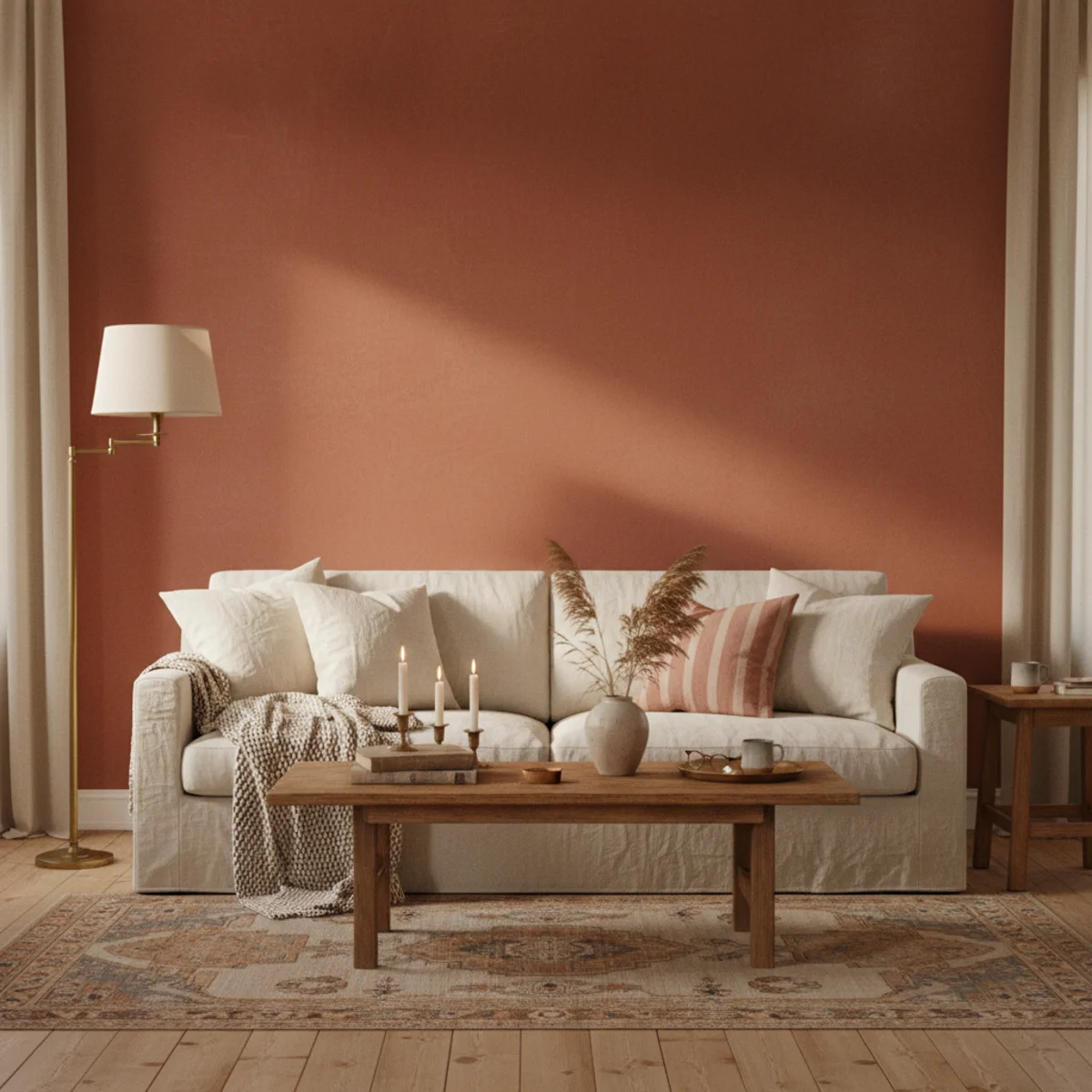
Best home-office paint colors: Farrow & Ball Bancha 298 (deep olive — the canonical study color), Benjamin Moore Tate Olive HC-112 (lighter olive), F&B Hague Blue 30 (deep saturated navy), BM Cinnamon Slate AF-575 (terracotta-brown), F&B Setting Plaster 231 (soft plaster pink for less intense effect). Apply to all four walls plus ceiling for the full cocoon effect. The deep color creates psychological enclosure that focused work benefits from — the brain reads dark walls as protective shell. Pair with warm-cream trim (BM White Dove) and 2700K task lighting at multiple low heights.
AFFILIATE SLOTPAINTF&B Bancha, BM Tate Olive, F&B Hague Blue, or BM Cinnamon Slate on all walls + ceilingAdd affiliate URL when configuredWhy it works
Because focused work requires reduced peripheral visual stimuli — bright white walls reflect light and demand cognitive processing, while deep saturated walls absorb light and recede into the background. The brain has more cognitive bandwidth for actual work when the room's color does less visual work. The 18th-century English study with deep green walls and warm task lighting is the historical version of this principle, and it works for the same reason now as then.
Pro tip — Add one piece of warm-toned art (a landscape with golds and reds, a vintage map, a large botanical) on the deep-painted wall — the contrast against the deep background reads as deliberate focal point and prevents the office from feeling like a uniform dark cave. One bright piece of art on a dark wall is the move; multiple compete with each other.
Bancha olive on every surface, warm task lamp at the desk — the focused color that absorbs peripheral stimuli. See also: Farrow & Ball Bancha 298
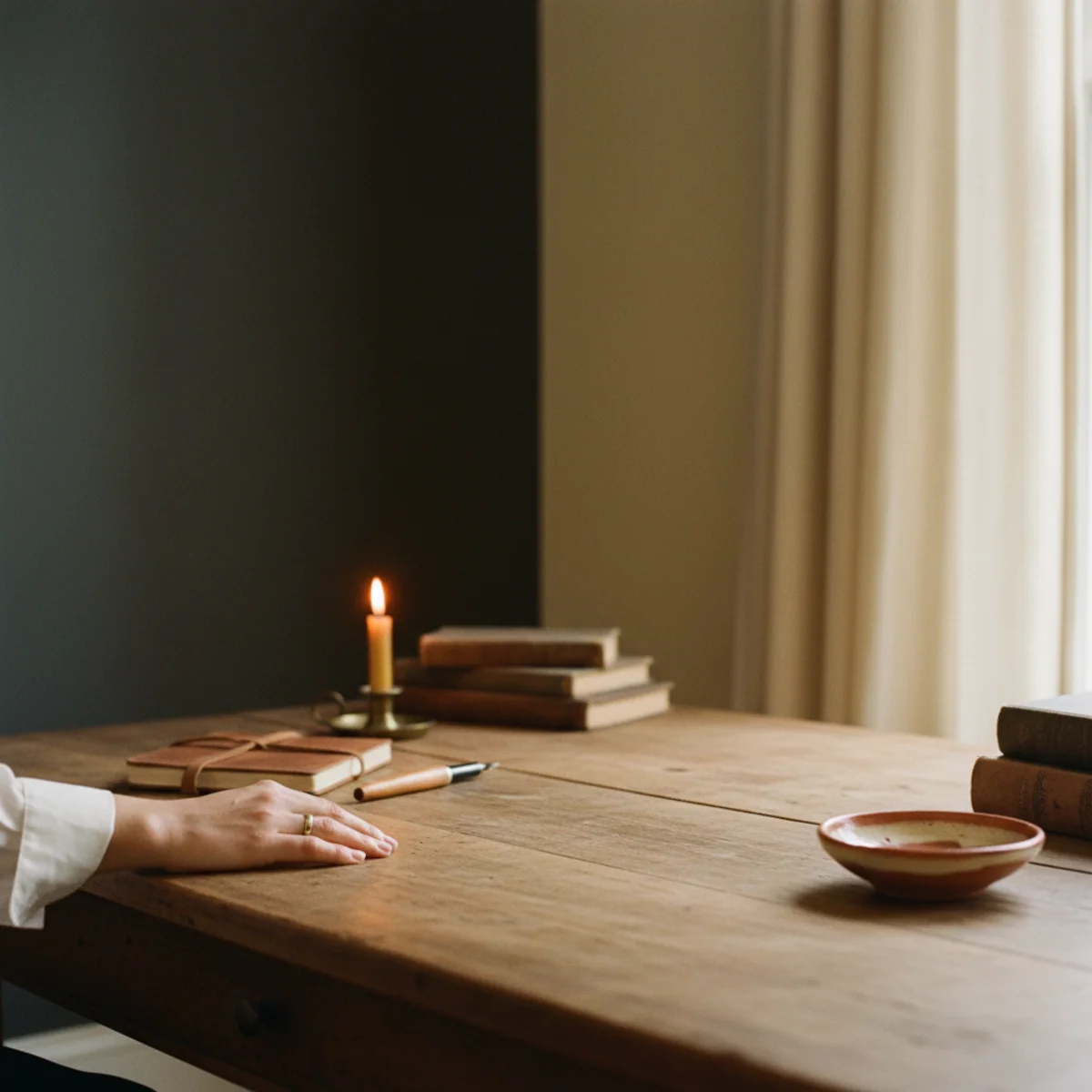
How to set up a cozy home office step by step
Get the bones right first, then warm it up. Work in this order.
- 1Place the desk for light and view
Position the desk facing or beside a window. If glare's a problem, set it perpendicular so the daylight comes from the side.
- 2Sort the function
Add a supportive chair at the right height, a warm task lamp, and hidden cord management. This is the focus layer.
- 3Warm the materials
Choose or refinish a wood desk, add a rug underfoot, and drape a throw over the chair. Natural texture does the cozy work.
- 4Add personality
Style a shelf, add a plant and a personal object, and hang one calm piece of art at eye level. Now it's a room, not a station.
Quick tips
- Face or sit beside a window for daylight, but go perpendicular if glare hits the screen.
- Layer a warm 2700K task lamp with the daylight; skip the cold overhead for evening work.
- Hide the cords with a tray or channel — visible tangle makes an office feel chaotic.
- Add a wool throw and a rug for the warmth a work chair and hard floor lack.
- Keep one personal object in eyeline so the desk feels like yours.
- Paint a small office a deep, warm color to make it feel like a focused cocoon.
Home offices for different spaces
A wood desk by the window, open shelving, a rug, and a break-time reading chair in the corner.
A slim desk and a single warm lamp tucked into a corner, styled to blend with the room.
A wall-mounted or fold-down desk, a stool, and one shelf above; warm light and a plant carry the rest.
A secondhand desk, a plug-in task lamp, a rug, and leaning art — fully portable, no holes.
A home office you want to sit in is one you'll work better in. Warm the room and the focus follows.
Frequently asked questions
How should I position my desk in a home office?+
What's the best task lamp for a home office?+
What color should I paint a home office?+
Do I need a separate break corner in my home office?+
What plants work best in a home office?+
How do I hide cords in a home office?+
A home office works best when it feels like part of your home rather than a cubicle that wandered in. Face the desk to the window, light it warm, choose wood over laminate, and add one personal object you'll see when you sit down. We'd move the desk to the window and add a warm lamp before buying anything new — the same desk in a better spot, lit warmly, is a different room. A workspace you want to be in is one you'll actually work in.