These twelve bar cart styling principles apply across cart types — brass rolling carts, vintage bar cabinets, small sideboards repurposed as bar surfaces, and simple open shelves dedicated to drink service. Each principle names specific arrangement decisions, specific object categories, and the editing discipline that keeps the bar cart looking intentional rather than accumulated. The goal is a bar cart that works for actual drink preparation, reads as warm-collected from across the room, and improves rather than complicates the living or dining space it occupies.
Most bar cart failures come from either under-filling (too sparse, reads as unused) or over-filling (every bottle acquired on every trip, every cocktail implement, every souvenir glass — the cart becomes a catch-all). The twelve principles establish the composition middle: visually abundant enough to read as a proper bar, edited enough that every object earns its place.
By the end of this guide, you'll know exactly how to style a bar cart — bottle grouping by height, glassware within reach, trailing plant, working top tier, brass and wood tools, book stack, tray organization, fresh garnish, mixed vintage glasses, one personal object, a warm-toned cart, and the editing rule that keeps the whole composition intentional.
WHAT'S INSIDE
- Why grouping bottles by height creates visual composition rather than accumulated supply
- The working-surface designation that separates the bar cart's function from its display
- The trailing plant addition that adds organic life to an otherwise all-hard-surface composition
- The editing-to-what-you-use rule — the single most-important discipline for long-term cart quality
A bar cart should be ready to pour, not just to photograph. The best ones are styled with what you actually use.
— Apartment Therapy [citation needed — verify before publish]
What makes a well-styled bar cart?
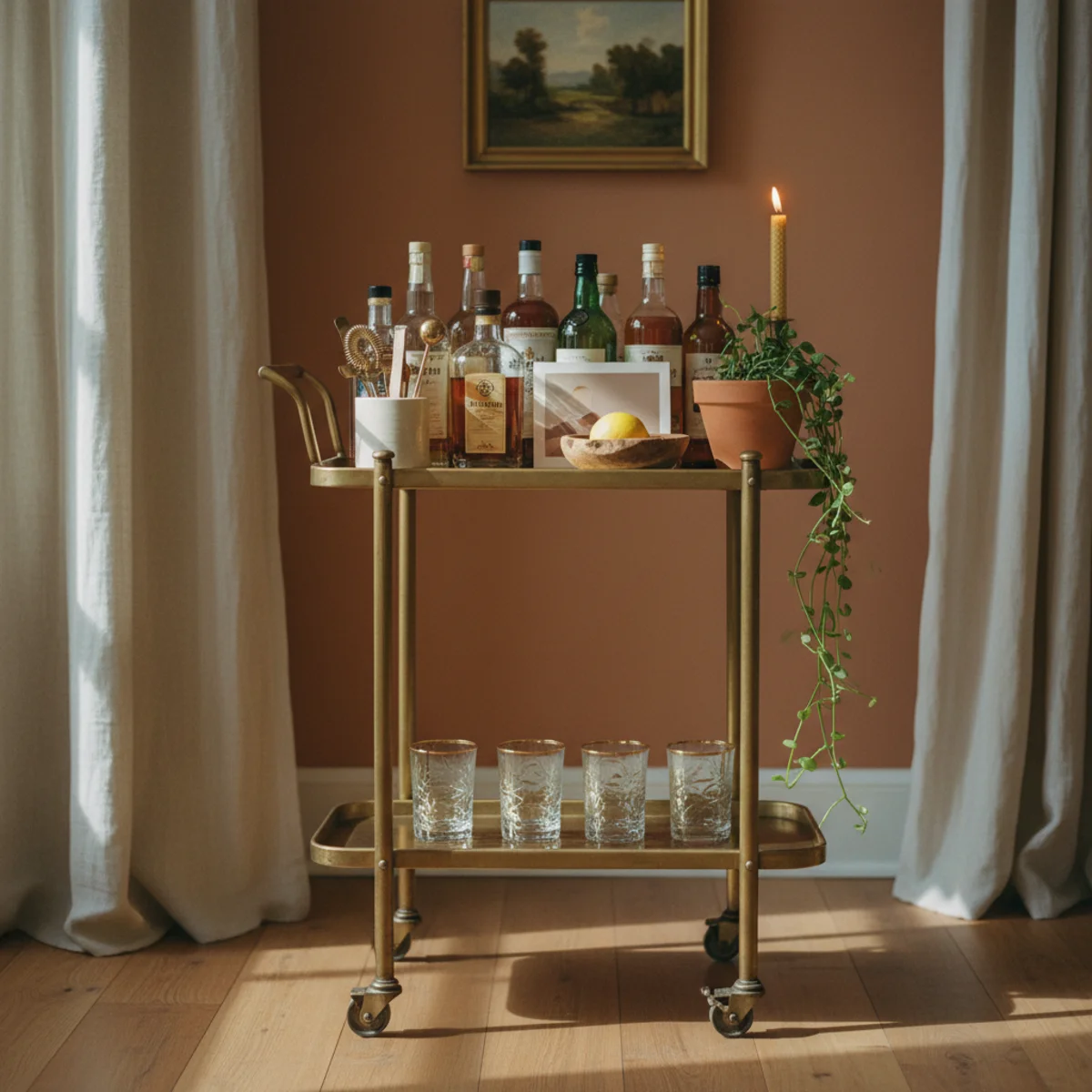
A well-styled bar cart balances function and looks across its tiers: the bottles and tools you actually use, glassware within reach, and a few warm styling touches — a plant, a stack of books, a tray — that make it a considered corner rather than a utility shelf. The reliable approach treats the top tier as the working surface and the lower tier as storage and styling.
The defining principle is that the working parts are the styling. Bottles grouped by height, glasses you'll actually drink from, and tools you'll actually use look better than props that have to be moved to make a drink. A bar cart styled purely for display — full bottles never opened, glassware you can't reach — reads as staged. The cozy version works first and photographs second, warmed by a plant, books, and a personal object.
More in Entertaining you may love
See allWhy bar carts are everywhere in 2026
The bar cart became a fixture of casual home entertaining — a compact, moveable, styleable home bar that suits the relaxed way people host now. Pinterest's bar cart and bar cart styling searches climb steadily, toward warm, functional, plant-and-vintage styling over cold chrome display.
The honest appeal is that it's a high-impact, low-effort corner. A cart, a few bottles, some glassware, and a plant turn dead space into a functional, good-looking spot for almost nothing — and because it's compact and moveable, it suits rentals and small spaces. As home entertaining went casual and warm, the bar cart styled with vintage glassware, brass tools, and a trailing plant fit right in.
20 bar cart styling ideas
01Group Bottles by Height
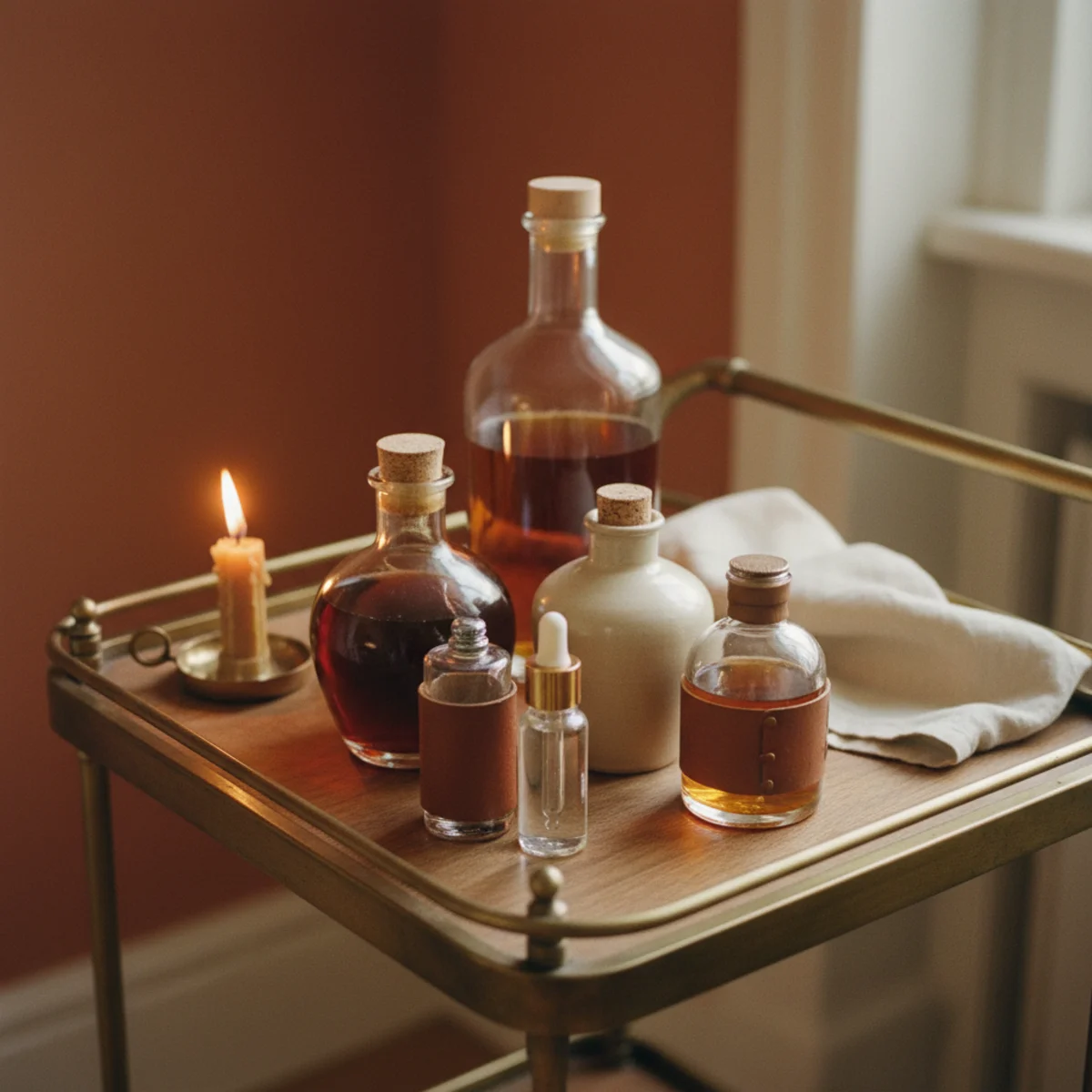
The foundation of bar cart composition: arrange bottles by height, tallest at the back, shorter bottles in front, with all bottles visible from the primary viewing angle. The graduated height grouping creates visual depth and reads as composed arrangement rather than as restocked supply closet. Limit to 6 to 10 bottles total on a standard two-tier cart.
Bottle grouping specifications: BACK ROW (tallest) — tall spirit bottles (bourbon, vodka, gin, rum at 750ml to 1L height: 11-14 inches). Group 3-5 tall bottles together. MIDDLE ROW — medium bottles (aperitifs, vermouth, liqueurs at 375ml to 750ml: 8-11 inches). Group 2-4 medium bottles. FRONT ROW or OFFSET — short bottles (bitters, small cordials, miniature bottles for decoration at 3-6 inches). 1-3 small bottles or decanters. TOTAL COUNT — 6 to 10 bottles maximum on a standard 24-30 inch wide two-tier cart. More than 10 reads as inventory rather than as curated bar. BOTTLE SELECTION — keep only bottles you actually use or plan to use. The visual-only bottle of interesting-shaped liqueur you never drink clutters the cart without function. DECANTING — spirits used regularly can be transferred to a glass decanter ($20-80) that reads more beautiful than the original bottle and allows mixing labels off the primary display. ARRANGEMENT ANGLE — angle bottles slightly (15-20 degrees from parallel) rather than all perfectly aligned. The slight angle variation reads more collected.
AFFILIATE SLOTCOMPOSITIONTall spirits (back) + medium bottles (middle) + short cordials/bitters (front); 6-10 bottles total; slight angle variation not parallel rowsAdd affiliate URL when configuredWhy it works
Because height variation creates the three-dimensional depth that flat arrangements miss — tall bottles in back create background, shorter bottles in front create foreground, and the eye reads the progression as composed stage rather than as shelf of objects. The same bottles arranged in a flat single-height line or randomly by access frequency reads as storage; height-arranged reads as display. The discipline takes 5 minutes to apply and produces most of the cart's visual quality.
Pro tip — Remove bottles whose labels you find visually disruptive — even a single brightly-labeled commercial bottle among warm-toned decanters and older-label bottles can break the warm palette. Either decant into glass decanters or hide the disruptive bottle in a cabinet and bring it out only when serving.
Tall, medium, short bottles graduated by height — three-dimensional depth that flat arrangement misses. See also: cozy-dinner-party-ideas
02Keep Glassware Within Reach
The primary bar cart function is drink service — and glassware should be on the cart or immediately adjacent, not in a cabinet across the room. Hang stemless wine glasses by their bases on a hanging rack above the cart, stack rocks glasses on the lower tier, or display cocktail glasses on a small tray on the top tier. Function determines placement.
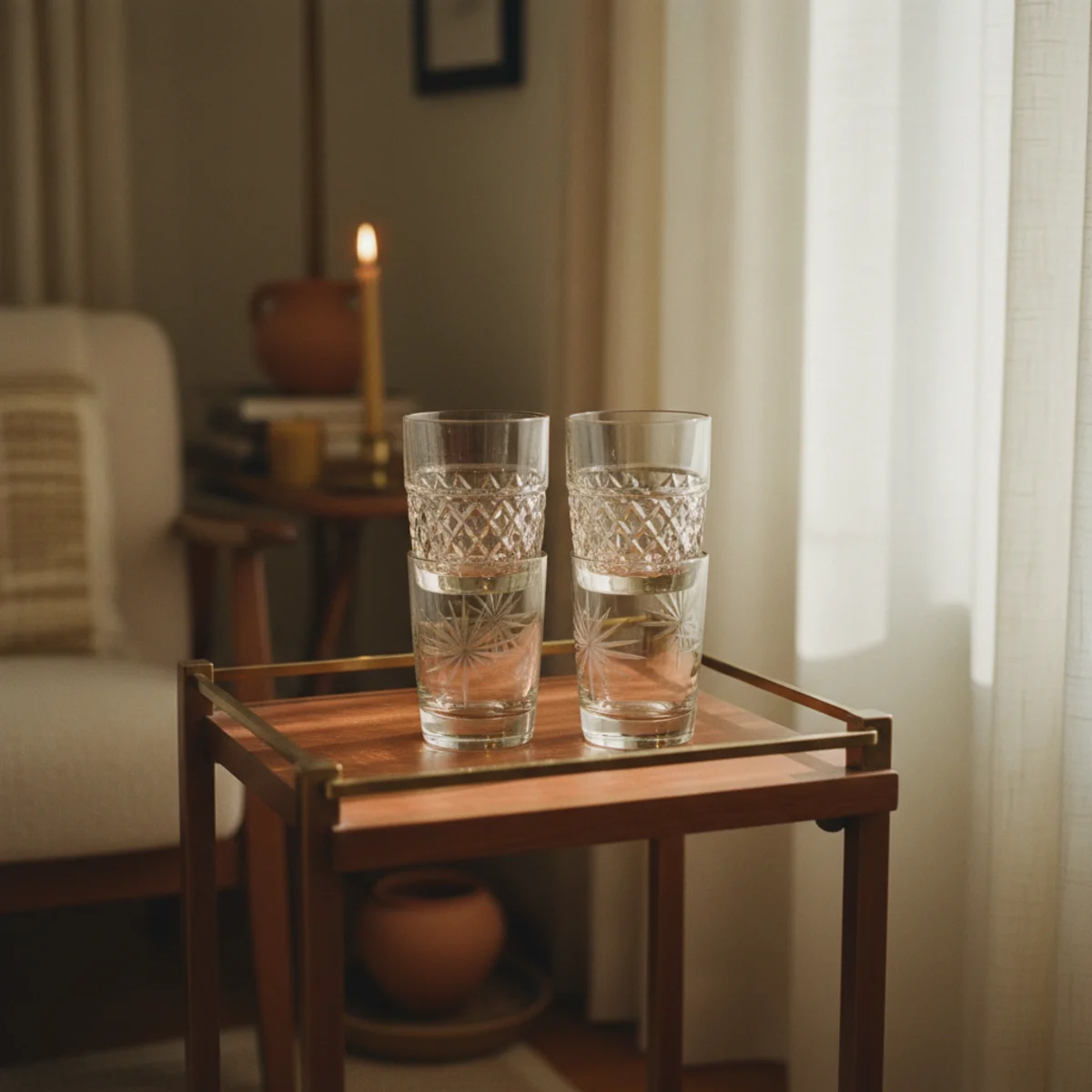
Bar cart glassware setup: HANGING RACK ABOVE CART — a small over-the-cart hanging rack ($20-50 from bar supply stores or Amazon) suspends wine or stemmed glasses by their bases above the top tier, keeping them accessible without occupying the working surface. STACKED ON LOWER TIER — 4-6 rocks glasses or Collins glasses stacked in pairs or grouped on the lower tier. Accessible but not in the working zone. SMALL TRAY DISPLAY — 4-6 glasses displayed on a small tray on the working surface (use while entertaining, move to cabinet when cart is in daily display mode). GLASS TYPES to include — rocks glasses for spirits and cocktails (most versatile, $3-15 per glass from estate sales or Crate & Barrel), wine glasses if the cart serves wine (2-4 glasses hanging or on lower tier), coupe glasses for cocktails ($8-20 per glass). VINTAGE MIXED GLASSWARE — thrifted vintage glasses of related-but-not-matching style at $2-8 per glass from estate sales (per item 9 below). MINIMUM — 4 glasses of the primary type per 4-person household. More glasses live in the cabinet; the cart holds the ready-to-use set. THE FUNCTION PRINCIPLE — the glassware's position should require no searching during drink service. Hang it, stack it, or tray it — the key is immediate accessibility.
AFFILIATE SLOTGLASSWAREHanging rack above cart for stemmed glasses, OR stacked rocks glasses on lower tier, OR small tray for cocktail glasses; 4-6 glasses of primary typeAdd affiliate URL when configuredWhy it works
Because the bar cart's purpose is functional drink service rather than merely decorative display — and the glassware's immediate accessibility is what makes the cart actually function as a bar rather than as a drinks shelf. When glasses are in a separate cabinet, the bar cart service requires two steps (cart for bottles, cabinet for glasses); when glasses are on or above the cart, service requires one step. The single-step service makes the cart genuinely convenient, which determines how often it's actually used for its intended purpose.
Pro tip — Invest in one set of quality rocks glasses for the bar cart display — 4-6 matching or coordinated rocks glasses at $6-15 each from Crate & Barrel, CB2, or Amazon's Libbey selection read significantly better than mismatched everyday glasses. The glasses are the most-handled element on the cart; their quality registers tactilely with every guest who picks one up.
Rocks glasses on lower tier, wine glasses hanging above — glassware accessible without searching during service. See also: cozy-dinner-party-ideas
03Add a Trailing Plant
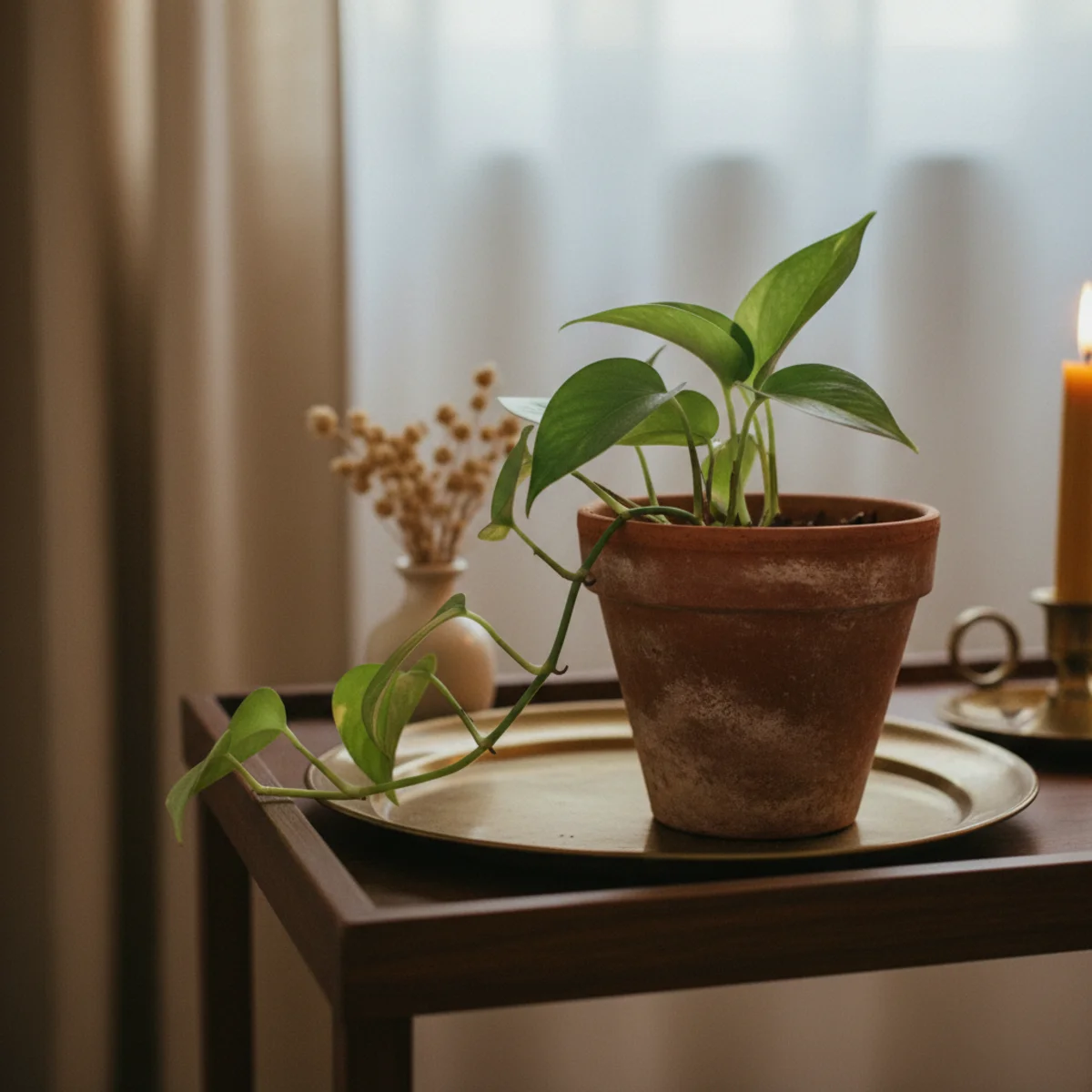
One trailing plant — a small pothos in a warm-toned pot, a small trailing plant on the top tier with stems draping off the side, or a small succulent or herb — adds organic life to the bar cart's otherwise all-hard-surface composition. The plant softens the bottles-and-glass rigidity and adds the warm-collected signal that purely-functional objects cannot provide.
Bar cart plant specifications: TRAILING POTHOS — single small pothos in a 4-inch terracotta or ceramic pot on the cart's top tier, with trailing vines beginning to drape off the side after 4-6 weeks of growth. $6-15 from grocery store or nursery. SMALL ROSEMARY PLANT — fresh rosemary in a small terracotta pot ($5-10). The herb is both decorative and functional (rosemary garnish for cocktails and nonalcoholic drinks). SMALL SUCCULENT — small succulent in a warm-toned ceramic pot ($5-20) for a cart in a well-lit area. SMALL AIR PLANT — tillandsia in a small holder ($5-15). POT CHOICE — small terracotta ($3-8) or small hand-thrown ceramic ($15-30). POSITION on the top tier, near one side (not centered), with the plant's trailing or ascending form creating organic vertical interest against the bottles. PRACTICAL CONSIDERATION — the bar cart plant lives in low-light conditions typically (interior position away from windows). Choose low-light tolerant plants (pothos, ZZ plant, snake plant small version) rather than light-demanding species.
AFFILIATE SLOTORGANICSmall pothos or rosemary in 4-inch terracotta or ceramic pot on top tier; low-light tolerant plants for typical interior cart positionAdd affiliate URL when configuredWhy it works
Because bars carts are entirely composed of manufactured objects (bottles, glasses, metal tools) — every element has a hard surface, a defined geometric form, and no organic variation. The single plant introduces everything the rest of the cart lacks: irregular organic shape, living material, something that changes (grows) over time, something requiring care. This single living element registers as disproportionately significant against the all-manufactured context, signaling 'a household that cares for living things' in a way that no additional decorative object could.
Pro tip — Replace the plant whenever it starts looking unhealthy rather than nursing a struggling plant on the cart — a thriving small pothos at $6 reads far better than a barely-surviving expensive plant. The low cost of the replacement means you should have no hesitation replacing when needed.
Small pothos in terracotta pot trailing off the tier edge — the single living element in an all-manufactured context. See also: indoor-plant-corner
04Use the Top Tier as the Working Surface
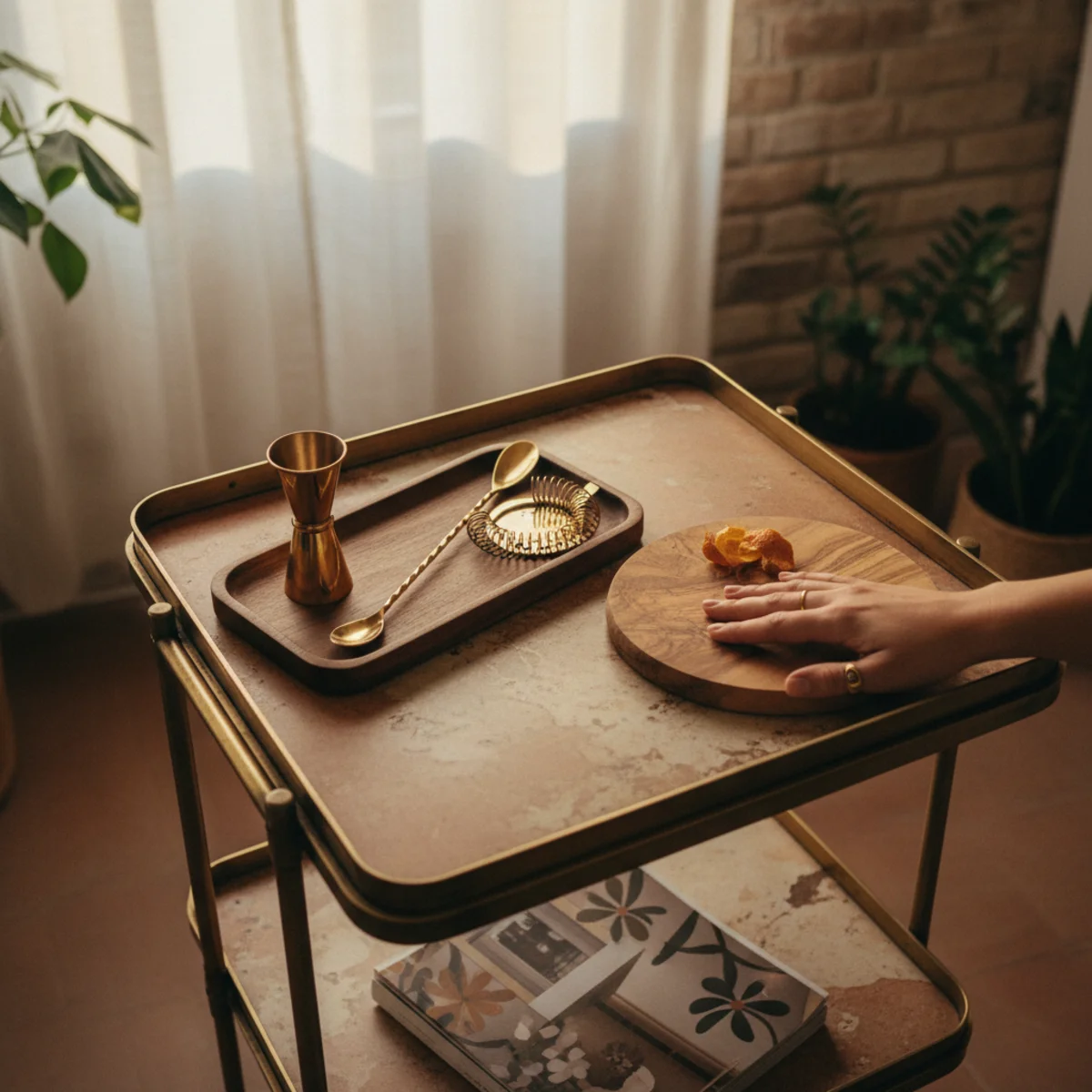
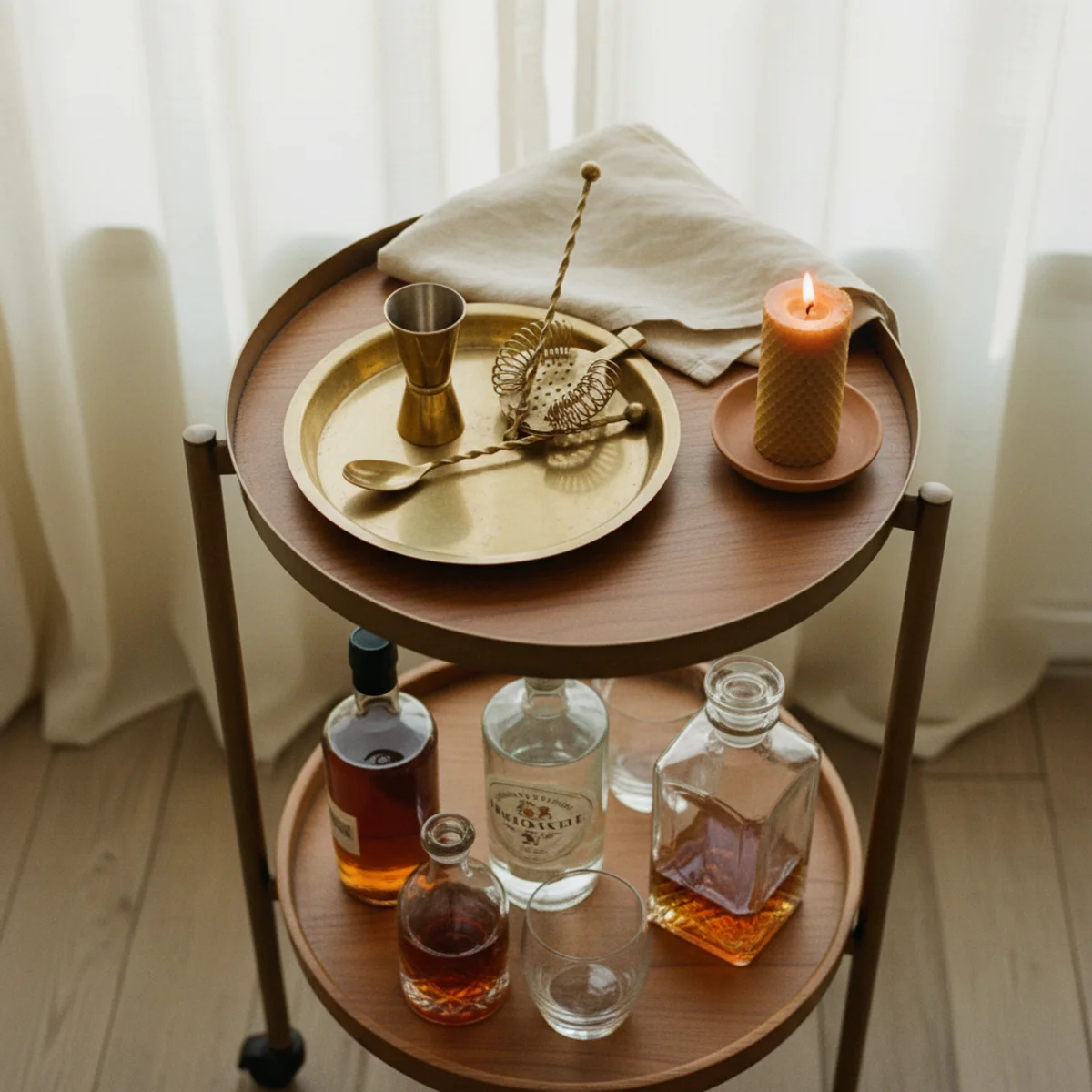
The top tier of a two-tier bar cart should be designated as the primary working surface — where drink preparation happens. This means a small tray or cutting board for garnish, the cocktail tools (jigger, strainer, muddler), and the currently-in-use bottle. The bottom tier holds additional bottles, glassware, and less-frequently-used items. The function hierarchy makes the cart both beautiful and genuinely useful.
Top-tier working surface setup: SMALL TRAY — 6x10 to 8x12 inch tray in warm brass, warm wood, or aged silver on the top tier. The tray defines the working zone and contains preparation mess. COCKTAIL TOOLS ON THE TRAY — jigger ($10-25), cocktail strainer ($15-30), bar spoon ($8-20), muddler ($10-20). All in aged brass or warm metal rather than stainless steel. CUTTING BOARD — a small wooden cutting board (6x8 or 8x10 inch) on the tray for citrus cutting and garnish preparation ($15-40 from small kitchen boards or a piece of hardwood cut to size). CURRENTLY-IN-USE BOTTLE — the bottle being actively served sits on or near the tray during service, then returns to the bottle grouping when not in use. DECANTER — if decanting the primary spirit, the decanter lives on the top tier nearest the tray as the most-accessible pourable. BOTTOM TIER — reserve for additional bottles (overflow from top tier), stacked glasses, wine or champagne (which are served but less often mixed), and the book stack.
AFFILIATE SLOTFUNCTIONSmall brass/wood tray + jigger + strainer + bar spoon + small cutting board on top tier as designated working zone; bottom tier for bottles and glasswareAdd affiliate URL when configuredWhy it works
Because without zone designation, bar carts drift toward all-display-all-the-time — bottles everywhere, tools scattered, glasses mixed among bottles, no clear preparation area. The designated working zone creates both visual hierarchy (the organized top tier reads as intentional composition) and functional clarity (during service, the host knows where everything is and doesn't have to clear space to work). The tray's visual containment of the working zone also means the preparation mess stays within the tray boundary rather than spreading across the whole cart top.
Pro tip — Clear the tray completely between gatherings — remove used tools, wash and replace the cutting board, return the active bottle to the bottle grouping. The 10-minute post-gathering cart reset maintains the cart's daily display quality and means it's ready for the next service without any pre-gathering prep.
Brass tray with cocktail tools and cutting board on top tier — the working zone designation making the cart genuinely functional. See also: cozy-dinner-party-ideas
05Add Brass or Wood Tools
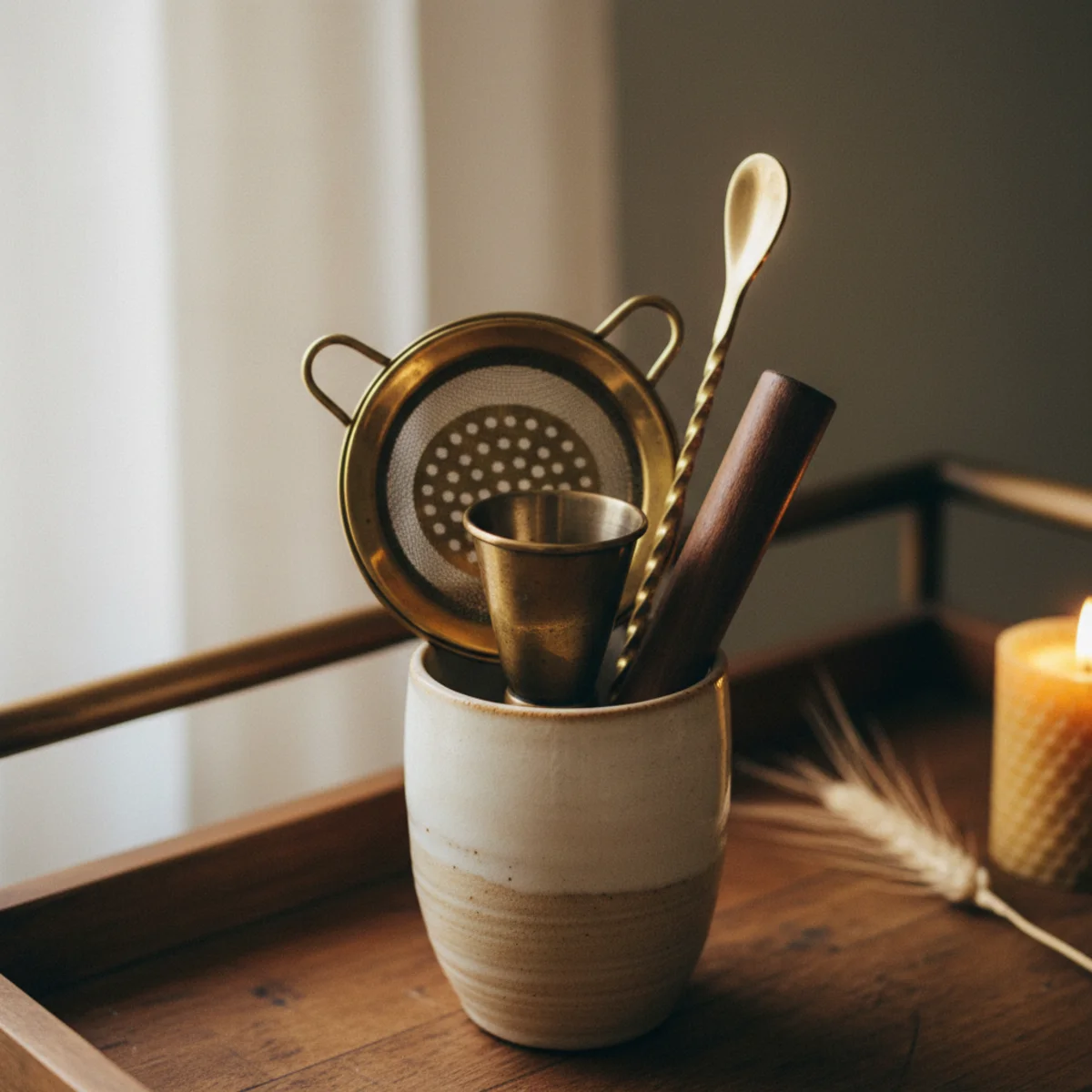
The bar tools (jigger, cocktail strainer, bar spoon, muddler, ice tongs, bottle opener) should be in aged brass or warm wood handles — not stainless steel. The metal choice applies the same warm-material language that the rest of the bar cart's aesthetic requires. A stainless steel cocktail set fights the warm composition; brass or dark metal tools complete it.
Warm bar tool specifications: JIGGER — double jigger in aged brass at $15-30 from Cocktail Kingdom, Amazon, or specialty bar supply. COCKTAIL STRAINER — Hawthorne strainer in aged brass at $15-25. MIXING SPOON — long bar spoon in aged brass at $10-20. MUDDLER — wooden muddler ($10-20) or brass-cap muddler ($15-30). ICE TONGS — small brass ice tongs ($10-25). BOTTLE OPENER — brass wall-mount or countertop bottle opener ($15-40). STORAGE — all tools grouped in a small cylinder vessel (a metal tin, a tall ceramic cup, a small brass vessel) on the working tray, rather than scattered loosely. The cylinder keeps tools upright, organized, and visually composed. AVOID — stainless steel 'cocktail set' marketed to home bartenders (the clinical silver reads as commercial rather than warm), plastic-handled tools (no visual character), mixing glass sets that occupy significant space without daily use. BUDGET APPROACH — brass bar tools are available from Amazon at $10-30 for individual pieces. Cocktail Kingdom, Barfly, and Sur La Table offer higher-quality options at $25-60 per piece.
AFFILIATE SLOTTOOLSJigger + strainer + bar spoon + muddler + ice tongs in aged brass or wood handles; stored upright in ceramic/tin/brass cylinder on working trayAdd affiliate URL when configuredWhy it works
Because bar tools are the most-handled objects on the cart — every drink made involves touching the jigger, the spoon, the strainer. The material registers tactilely with every use, and visually they occupy the working zone's center. Stainless steel tools read as professional bar equipment; brass tools read as warm-collected home bar. The same drink tastes different when made with warm brass tools versus clinical stainless in the same way that food tastes different from beautiful plates versus institutional ones — the material context affects the experience.
Pro tip — Buy bar tools as individual pieces rather than as sets — individual brass pieces from various makers produce the mixed-but-related aesthetic that a matching stainless set lacks. One Cocktail Kingdom jigger, one Amazon bar spoon, one vintage bottle opener from an estate sale creates a more interesting tool collection than any coordinated retail set.
Brass jigger, strainer, and bar spoon in ceramic holder — warm tools completing the working zone's material language. See also: cozy-dinner-party-ideas
06Stack a Few Books
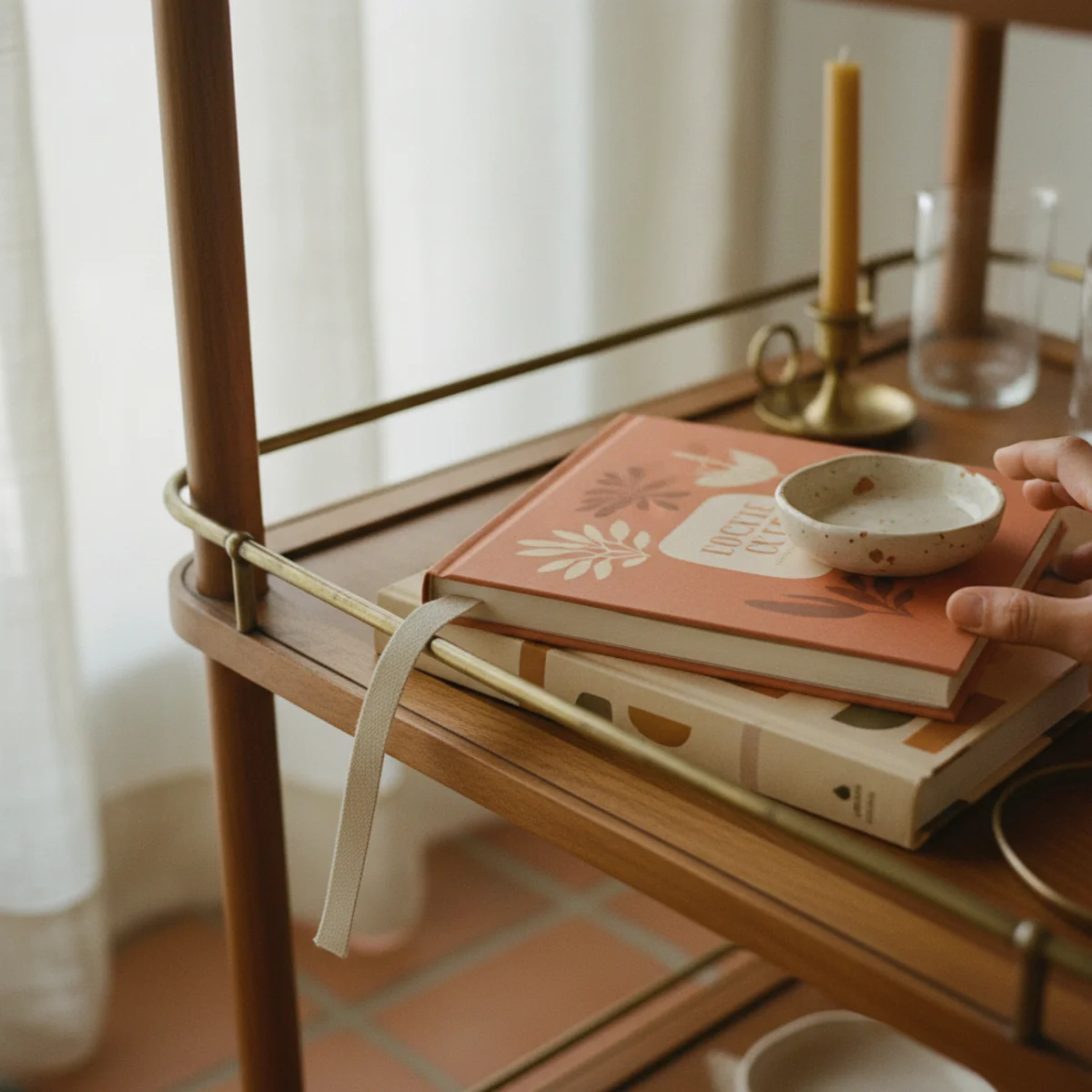
A small stack of 2 to 4 books on the bar cart's lower tier adds warm-collected character — cocktail books with beautiful covers, a wine reference, a host's guidebook, or simply books with warm-toned spines that relate to the bar cart's function. The books signal that the household takes drink culture seriously enough to have read about it, not just purchased the equipment.
Bar cart book stack specifications: RELEVANT BOOK TYPES — cocktail recipe books (Death & Co, Liquid Intelligence, The Bar Book, PDT Cocktail Book), wine reference books (Wine Folly, Jancis Robinson's Wine Guide), hosting guides (Smitten Kitchen, vintage entertaining guides). STACK SIZE — 2 to 4 books, horizontal stack on the lower tier (spine-up, titles readable). VISUAL CRITERIA — choose books with beautiful covers or spines (warm tones, vintage design, interesting typography) since they become visual elements. Remove books with bright commercial covers that fight the warm aesthetic. VINTAGE BARTENDING BOOKS — 1950s-1970s cocktail guides from estate sales at $3-15 each often have beautiful mid-century cover design that reads as warm and collected. POSITION — one end of the lower tier, not centered (off-center positioning per the asymmetric-weighting principle). Books can also serve as risers: stack 2 books with a small object (vintage bottle opener, small ceramic) on top. PRACTICAL USE — these books should actually be referenced occasionally, not just displayed. A bar cart with genuinely used cocktail books reads more authentic than one with display-only books.
AFFILIATE SLOTCHARACTER2-4 cocktail books, wine references, or hosting guides with beautiful covers on lower tier; vintage bartending books from estate sales at $3-15Add affiliate URL when configuredWhy it works
Because books signal intellectual engagement with the bar's function — the household doesn't just have bottles, they've read about the craft. The physical presence of cocktail books or wine references suggests that the drinks being served here have been researched and considered rather than simply poured. Books also add the warm-residential character that purely functional objects lack — a home bar with books reads as part of the household's life; a bar without books reads as furniture.
Pro tip — Place the most-used cocktail book with a bookmark at a favorite recipe — the used book with a bookmark reads as actively consulted reference rather than as decorative prop. The simple detail of a visible bookmark communicates that this bar cart is for actual drink-making, not just for display.
Three cocktail books with bookmark — the actively-consulted reference that signals genuine drink craft. See also: shelf-styling-ideas
07Style With a Tray
A small tray on the bar cart's top tier (per item 4) organizes the working zone, but a second slightly-larger tray on the lower tier can also organize the bottle grouping — containing the bottles within a defined zone and providing a visual base that unifies the arrangement. Trays are the organizing tool that prevent bar carts from reading as chaotic.
Bar cart tray application: TOP TIER WORKING TRAY — 6x10 to 8x12 inches, brass or wood, containing cocktail tools and cutting board (per item 4). LOWER TIER ORGANIZATIONAL TRAY — 10x16 to 12x18 inches, warm brass, walnut, or aged silver. Groups 4-6 bottles together within defined zone. The tray visually contains the bottle grouping so it reads as composed arrangement rather than as scattered supply. TRAY STYLES — vintage brass serving trays from estate sales and thrift stores at $10-40 (best warm aesthetic), wooden rectangular trays at $20-60 (farmhouse warmth), velvet-lined small trays ($20-50) for a more polished effect. SINGLE-TRAY APPROACH — if the cart is compact, one tray on the top tier (working zone) is sufficient; the lower tier uses open shelving for bottles and glasses. DOUBLE-TRAY APPROACH — for larger carts (30+ inches wide), two trays (top working, bottom organizational) create visual hierarchy without cluttering either tier. TRAY MATERIAL RULE — choose trays in the same warm-material family as the cart's frame and tools: brass trays with brass cart, wood trays with wood-shelf cart, aged silver tray as accent on either.
AFFILIATE SLOTORGANIZATIONSmall 6x10-8x12 inch brass/wood tray for tools on top tier; 10x16-12x18 inch tray for bottle grouping on lower tierAdd affiliate URL when configuredWhy it works
Because trays create visual boundaries that the eye reads as intentional grouping — objects within a tray read as belonging together, objects outside the tray read as separate. Without trays, the bar cart's objects float without visual relationship; with trays, the objects are composed into zones. The same bottles arranged randomly and arranged within a tray read as different levels of intentionality to any viewer. Trays are the compositional tool that converts random collection into organized display.
Pro tip — Line wooden trays with a piece of cork sheet ($5-10 for a sheet) — the cork prevents bottles from sliding or tipping on the tray and produces a satisfying material base against the warm wood. Cork also absorbs minor drips from bottle bases, protecting the tray surface.
Brass working tray on top, wood organizational tray below — trays creating intentional visual zones. See also: cozy-tablescape-ideas
08Add Fresh Garnish or Citrus
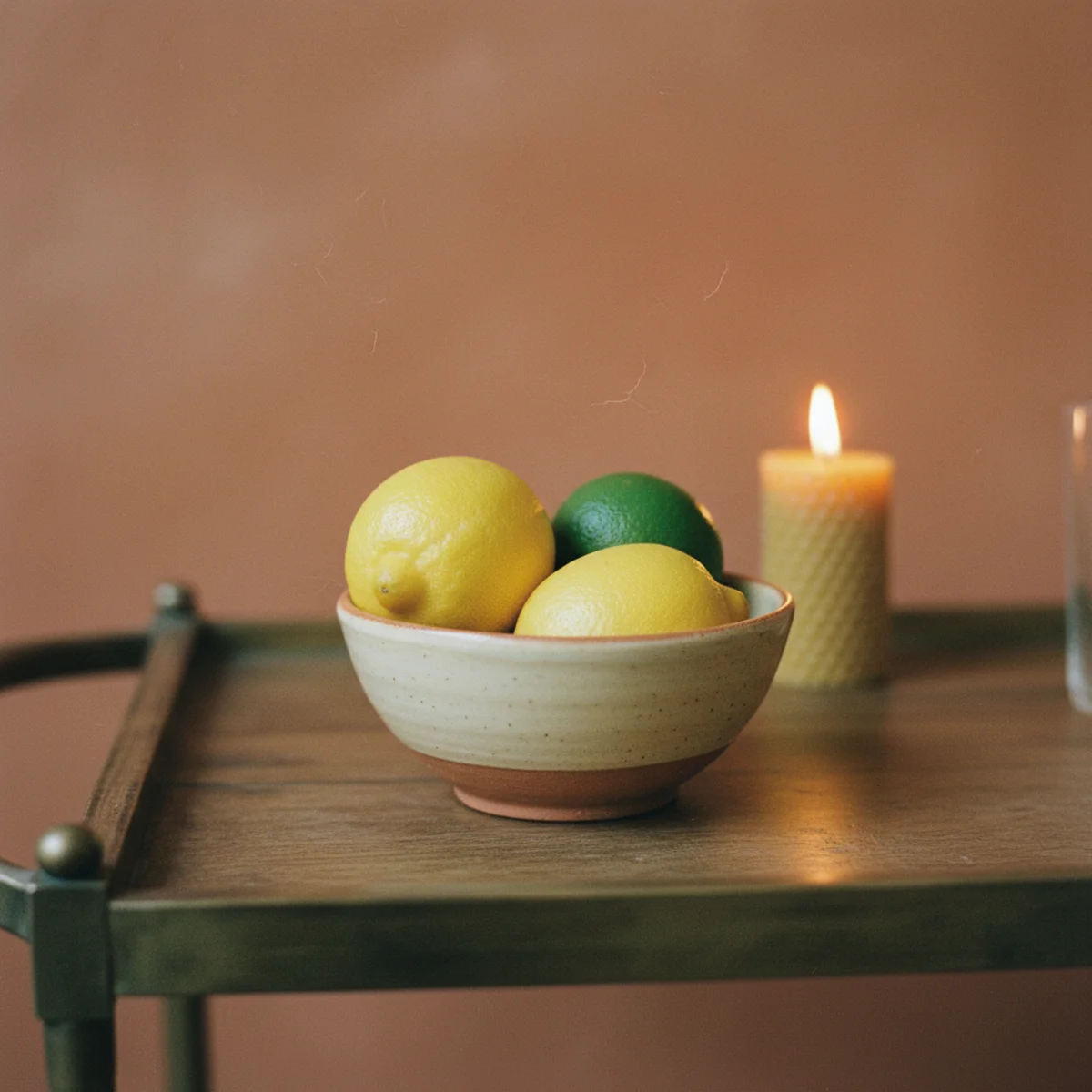
Fresh garnish on or near the bar cart — a small bowl of citrus (lemons, limes, oranges), fresh herbs (rosemary, mint, thyme) in a small ceramic, or a bowl of olives — adds the fresh-household signal that purely-static bar carts miss. The fresh elements also mark the bar cart as actively-used rather than as styled display.
Fresh garnish specifications: CITRUS BOWL — small ceramic or brass bowl on the working tray or adjacent surface, filled with 3-5 lemons, limes, or small oranges. Refresh weekly. $3-8 per refresh. The citrus signals that cocktails are actually being made with fresh juice. HERB POT — small rosemary, mint, or thyme plant in a 4-inch terracotta pot on the cart top tier (combining the plant addition of item 3 with functional garnish use). Snip fresh herbs directly from the pot for cocktail garnish. OLIVE BOWL — small ceramic or brass bowl with 8-12 olives for serving martinis or alongside spirits. Refreshed before each gathering. LIME WEDGE TRAY — small wooden cutting board with pre-cut lime wedges in a small ceramic cup for casual self-service during gatherings. SEASONAL ROTATION — citrus in autumn-winter (blood oranges, clementines add visual warmth), fresh herbs in spring-summer (basil, mint, rosemary more available), fresh pomegranate seeds or dried cranberries in winter holiday season. THE FRESHNESS SIGNAL — any fresh element (something that will change, that needs tending, that has a short use life) signals active household use rather than decorative arrangement. The freshness signal is one of the most-effective warm-home signals at low cost.
AFFILIATE SLOTFRESHSmall ceramic/brass bowl with 3-5 citrus lemons/limes/oranges on working tray; OR herb pot (rosemary, mint) on cart top; refresh weeklyAdd affiliate URL when configuredWhy it works
Because fresh elements are the primary signal distinguishing a household that actually uses the bar from one that styled it for the room's aesthetic. A citrus bowl refreshed weekly tells anyone who sees it that drinks are made here — the fruit bruises and shrinks if not used, which means its presence indicates real use. Static decorative objects (a vintage bottle of spirits never opened, display-only garnish) read as props; fresh garnish reads as working bar. The bar cart's credibility as a functional rather than decorative object is enhanced by every fresh element.
Pro tip — Keep a small lemon and lime in a bowl on the cart at all times even when not hosting — the two lemons and two limes cost $2 and visually signal active bar rather than display piece throughout the week. When hosting, replace with fuller bowl before guests arrive.
Small ceramic bowl with lemons and limes — the fresh element that signals working bar rather than styled display. See also: cozy-dinner-party-ideas
09Mix Vintage Glassware
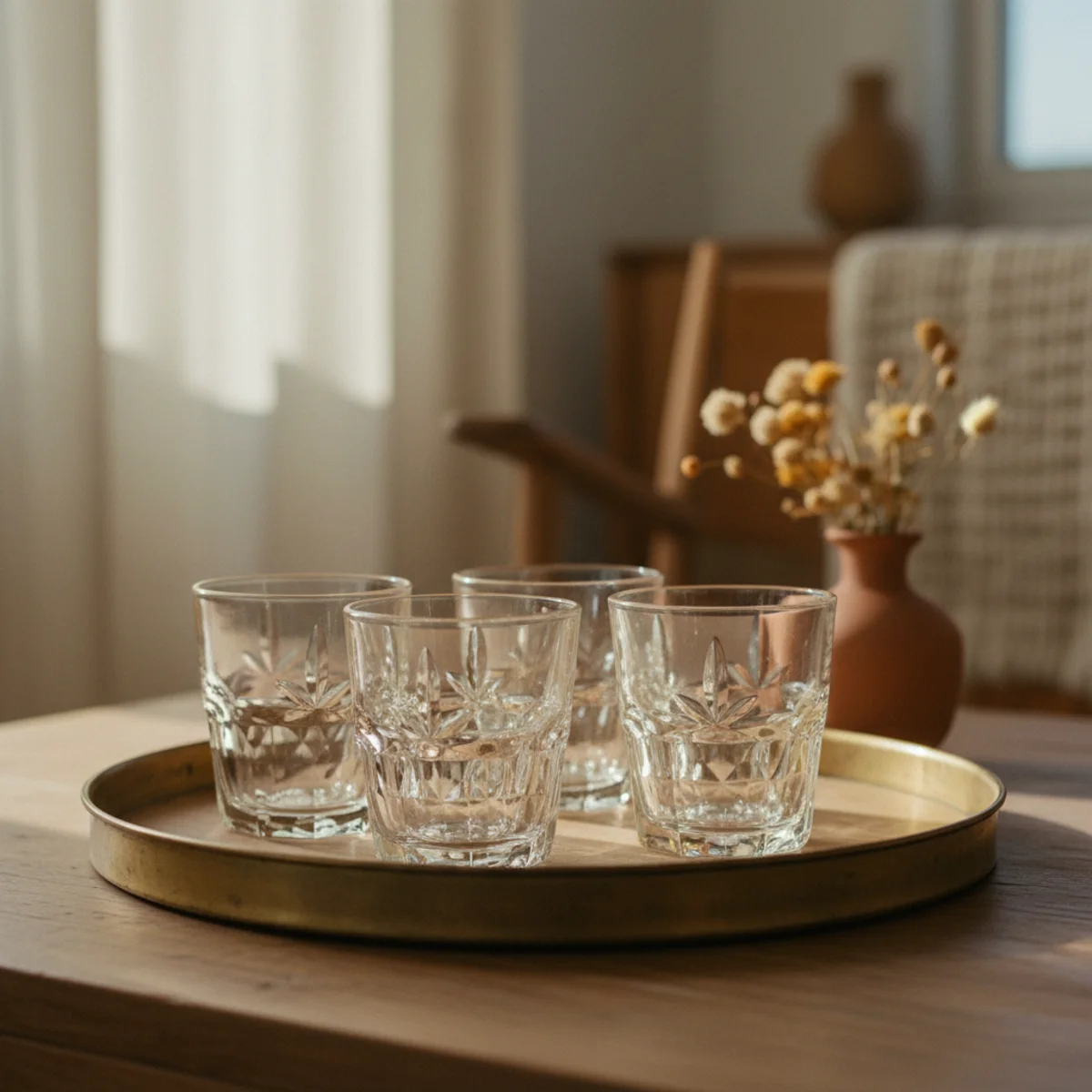
Mixed vintage glassware — related but not matching glasses from various estate sales and thrift stores — reads as warm-collected home bar where matched commercial glassware sets read as retail purchase. The best bar cart glassware is 4 to 6 rocks glasses of related style (same era, same rough proportions, slight design variations) assembled over several thrift store visits.
Vintage mixed glassware approach: ESTATE SALES AND THRIFT STORES — the best source. Look for glass sets that share one quality (all mid-century pressed glass, all etched crystal of the same era, all cut crystal with similar patterns) while varying in specific design. Price: $2-8 per glass. COCKTAIL GLASSES — coupes ($4-15 per glass vintage), champagne flutes ($3-8 per glass vintage), vintage highball glasses ($3-8 per glass). MIXING PRINCIPLE — collect glasses from the same 20-30 year period (all 1950s-1970s pressed glass, or all 1960s-1980s cut crystal) for sufficient visual coherence. Mixing glasses from 1920s crystal and 1990s tumbler clashes; mixing four variations of 1960s mid-century pressed glass coheres. PRESSED GLASS SPECIFICALLY — mid-century American pressed glass (Anchor Hocking, Indiana Glass, Hazel Atlas) at estate sales at $2-5 per glass is both beautiful and extremely durable, making it ideal for actual bar use. BUILDING THE COLLECTION — buy 2-3 related glasses at each estate sale visit over 4-6 visits; the patient accumulation produces a collected set that reads as accumulated rather than purchased. THE VISUAL BENEFIT — mixed glasses create visual texture within the glassware display where matched sets create uniformity. The slight variation keeps the eye moving across the cart.
AFFILIATE SLOTGLASSWARE4-6 related vintage rocks glasses or cocktail glasses from same era (1950s-1970s pressed glass or etched crystal); collected over multiple estate sale visitsAdd affiliate URL when configuredWhy it works
Because the bar cart's aesthetic goal is warm-collected rather than retail-purchased — and mixed vintage glasses are the glassware equivalent of thrifted frames and inherited pottery. The slight variations in the vintage glass collection signal 'accumulated across time' where matched sets signal 'purchased from a catalog.' Both hold drinks equally; only one reads as warm-home character.
Pro tip — Research vintage glass patterns before estate sale shopping — 'Anchor Hocking' and 'Indiana Glass' are the two main mid-century American pressed glass makers, and many of their patterns are identifiable from photos online. Recognizing patterns lets you identify and intentionally collect related pieces rather than randomly selecting pretty-looking glasses.
Four vintage pressed-glass rocks glasses with slight variations — the accumulated collection rather than the purchased set. See also: thrifted-decor-ideas
10Add One Personal Object
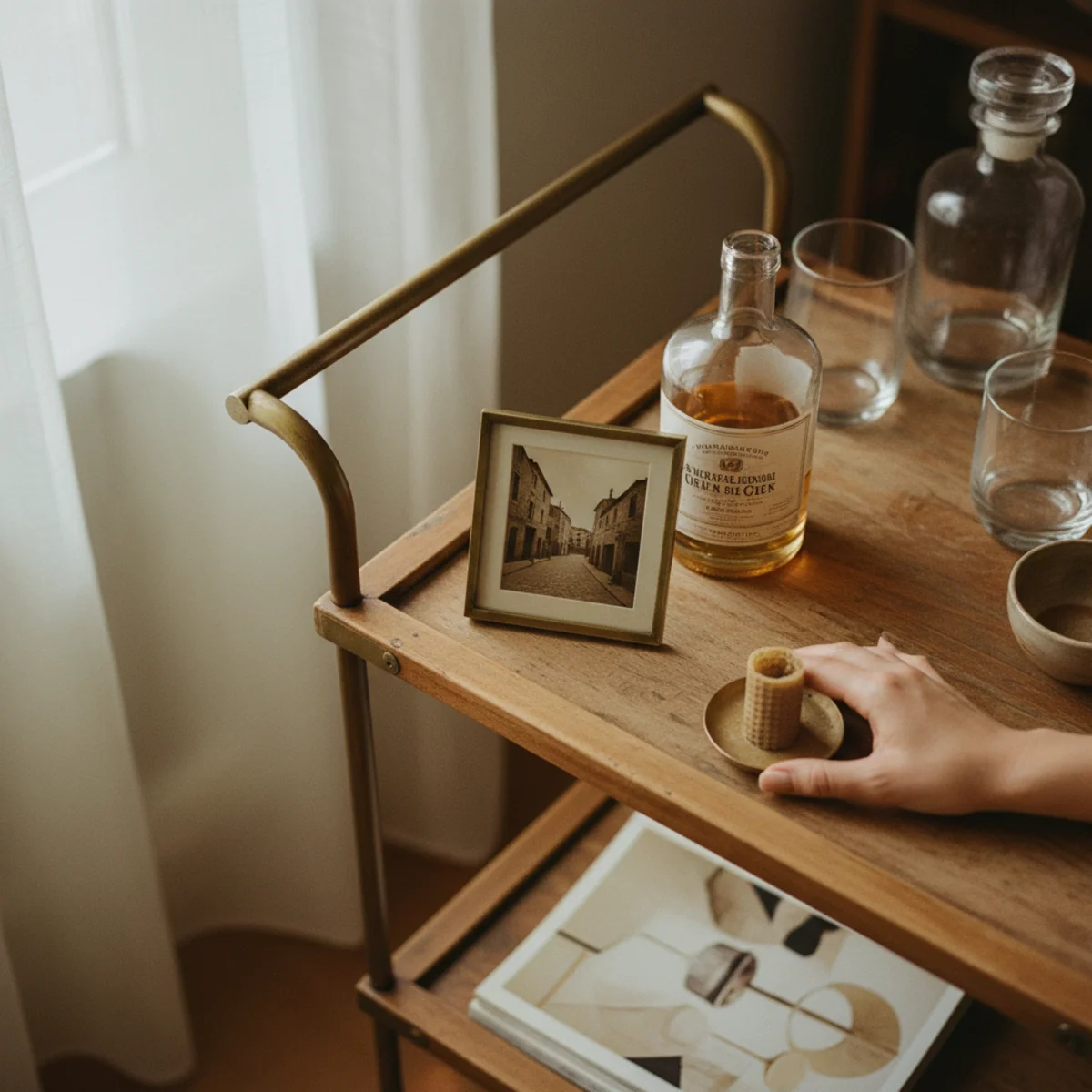
One personal object on the bar cart — a small framed photo from a significant travel, a vintage bottle opener with family history, a small collected object from a meaningful place — distinguishes a warm-home bar cart from a hotel lobby bar. The single personal object signals that a specific household lives here, not that a designer styled here.
Personal object options for bar carts: SMALL FRAMED PHOTO — a 3x4 or 4x6 inch framed photo of a significant place, person, or moment. The small frame reads as intimate personal display on a working cart. VINTAGE OBJECT WITH HISTORY — an antique bottle opener from a grandparent's collection, a small vintage object from a significant trip, a small brass piece with family connection. TRAVEL MEMENTO — a small ceramic or glass piece from a significant travel (small handmade bottle from Provence, small ceramic from Morocco, small etched glass from Prague). Small enough to fit without dominating, specific enough to be clearly personal. A SINGLE INTERESTING BOTTLE — one bottle of particular personal significance (a spirits gift from a friend, a specific label with meaning, a bottle brought back from travel) given featured position on the cart tells its own story. SCALE — the personal object should be small (under 8 inches in major dimension) and positioned so it's visible but not dominant. The human-scale intimacy of the small personal object is its entire point.
AFFILIATE SLOTCHARACTEROne small personal object under 8 inches: travel memento, framed photo, vintage object with family history, or significant spirits bottleAdd affiliate URL when configuredWhy it works
Because it answers the question 'does a specific person live here?' — which is the fundamental question that distinguishes warm-home from warm-aesthetic. Perfectly-styled bar carts without personal objects read as produced; one genuine personal object makes the whole cart read as belonging to a specific person with specific history. The single object changes the cart's register from 'curated for effect' to 'collected by someone.' The effect is disproportionate to the object's size.
Pro tip — Choose a personal object that also tells a drink-culture story if possible — a vintage cocktail shaker from your grandparent, a small bottle from a vineyard you visited, an interesting spirit brought back from travel. The drink-relevance makes the personal object feel compositionally appropriate rather than arbitrarily placed.
Small travel photo among the bottles — the single personal object answering 'does a specific person live here?' See also: shelf-styling-ideas
11Choose a Warm-Toned Cart
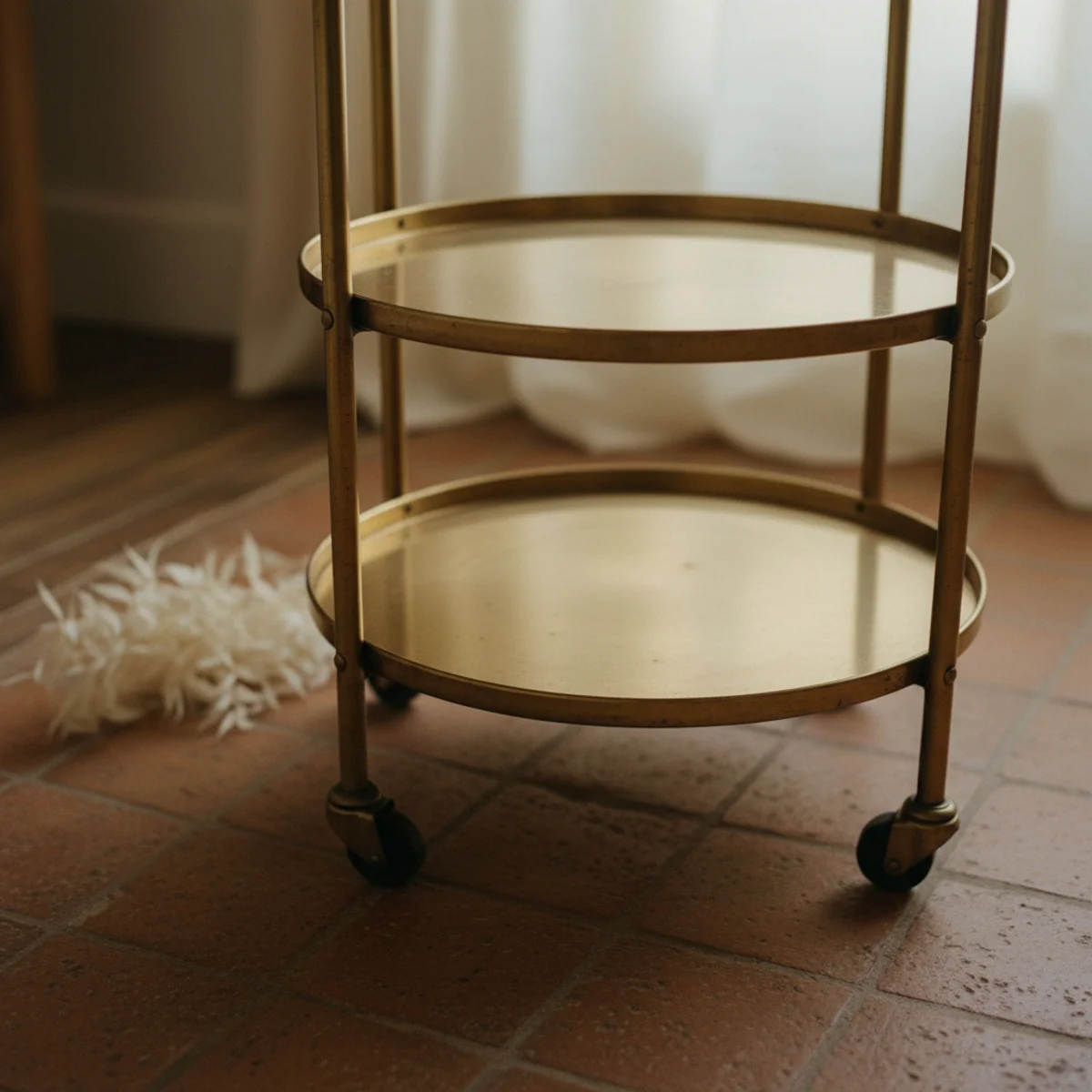
The bar cart's frame color and material determines the entire composition's warm register. Warm-toned carts (brass, aged gold, warm bronze, warm wood, raw brass with age developing) work immediately and improve over time. Cool-toned carts (chrome, polished stainless, matte black) require significantly more work to read warm. Budget: $100-600 for the right cart.
Warm-toned bar cart options: BRASS OR AGED GOLD ROLLING CART — the signature warm bar cart material. Arteriors, World Market ($100-300), Overstock, and Wayfair offer brass or gold-tone carts at $150-400. Vintage brass bar carts from Marketplace at $80-300. NATURAL WOOD SHELF UNIT — a narrow solid-wood open shelf repurposed as a bar (24-36 inches wide, 2-3 tiers, warm wood tone). IKEA FLYSTA ($50) for budget, solid oak alternatives at $200-600. WARM RATTAN OR BAMBOO CART — vintage rattan rolling cart at $80-250 from estate sales or Marketplace, or new rattan from West Elm or similar at $200-400. ANTIQUE OR VINTAGE CABINET REPURPOSED AS BAR — vintage hutch, sideboard, or small armoire with the interior repurposed for bar storage. AVOID for warm bar carts: matte black carts (dramatic but fights warm aesthetic), chrome or polished stainless (cool commercial), pure white carts (hospital aesthetic), grey carts (too cool). BUY VINTAGE WHEN POSSIBLE — vintage brass or gold bar carts from the 1960s-1980s are among the most-available and best-priced vintage furniture items at estate sales ($80-200) because they've been out of fashion but are now sought-after again.
AFFILIATE SLOTCARTBrass/aged gold rolling cart ($150-400 new, $80-200 vintage), OR narrow warm wood shelf ($50-600), OR warm rattan cart ($80-400)Add affiliate URL when configuredWhy it works
Because the cart's frame is visible in every view of the cart — it's the background and structure against which every object is seen. A warm brass cart makes every bottle, tool, and glass on it read warmer; a cool chrome cart makes the same objects read cooler regardless of how warm the individual pieces are. The frame sets the baseline temperature for the entire composition, and objects can only deviate from that baseline within limits.
Pro tip — Buy vintage brass bar carts from estate sales during summer (July-August) when estate sales have lower competition and more inventory — vintage brass carts were extremely common in homes from the 1960s through 1980s and appear frequently at estate sales in older neighborhoods. Saturday morning early-arrival shopping during summer months often yields the best vintage cart finds at $80-200.
Vintage 1970s brass rolling cart with aged patina — the warm foundation that every object reads warmer against. See also: cozy-living-room-ideas
12Edit to What You Use
The most-important long-term bar cart principle: edit regularly to only what you actually use. The bottle of exotic liqueur from 3 years ago that nobody drinks, the cocktail shaker set used twice, the extra glasses that came with a set but don't fit the style — all of these accumulate into the visual clutter that turns curated bar carts into cluttered drink shelves.
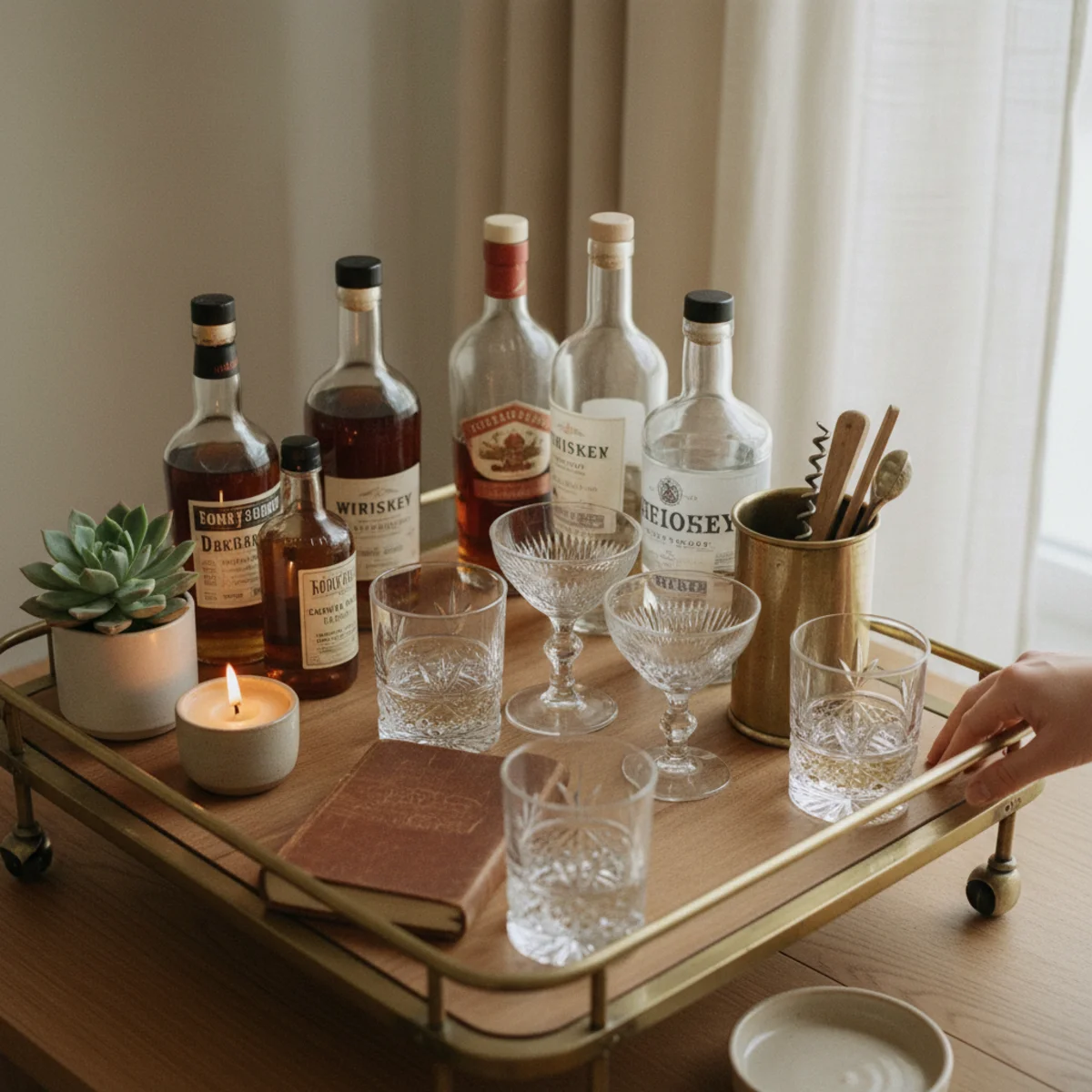
Bar cart editing principles: QUARTERLY EDITING ROUND — every 3 months, remove everything from the cart. Assess each item: is it actually used? Is it the right material? Is it earning its visual place? Return only items that pass. BOTTLE EDITING — keep only spirits consumed within the past 3 months. Bottles that sit untouched for 6+ months aren't being used; they're occupying space and probably going stale. Store in a cabinet or donate to a gathering. TOOL EDITING — keep only tools used in the past month. The cocktail shaker set used twice in a year occupies significant visual and physical space for minimal functional return. GLASS EDITING — keep only enough glasses for a typical gathering (4-6 per type). Extra glasses belong in the cabinet; the cart holds the ready-to-serve set. THE VISUAL TEST — after editing, stand 8-10 feet from the cart and assess. If it still reads busy, remove another 2-3 items. The right bar cart looks abundant (enough bottles to signal a real bar) but not cluttered (every object has space around it). THE RULE OF ENOUGH — a bar cart with 7 bottles, 4 glasses, 4 tools, 2 books, one plant, and one personal object is complete. Adding more after that point diminishes rather than enhances.
AFFILIATE SLOTDISCIPLINEQuarterly edit: remove everything, return only actively-used items; keep only spirits consumed in past 3 months; 7 bottles + 4 glasses + tools is completeAdd affiliate URL when configuredWhy it works
Because bar carts accumulate by default — every hosted gathering produces a new bottle, every holiday gifts another cocktail accessory, every travel brings a spirits souvenir. Without active editing, the cart drifts from curated to cluttered over 12-18 months regardless of the initial styling quality. The quarterly editing round is the maintenance practice that sustains the initial curation across years of real household use. Editing is not a reduction of the bar; it's the ongoing act of keeping it excellent.
Pro tip — Photograph the bar cart after each quarterly edit — the photo documents the edited state and makes it easier to identify what has accumulated since the last round when the next edit comes. Comparing before-edit to after-edit photos also builds the editing instinct over time.
Seven bottles, four glasses, tools, plant, personal object — the edited cart with breathing room around each element. See also: warm-minimalism
How to style a bar cart step by step
Function first, then the warm touches. Build by tier.
- 1Edit to what you use
Pare back to the bottles, tools, and glassware you actually reach for, and store the rest. A curated cart beats a crowded one.
- 2Set the working top tier
Group bottles by height at the back, keep glassware accessible, and leave a clear working zone the size of a shaker.
- 3Style the lower tier
Add stacked cocktail books, backup glassware, and a tray for storage and styling on the lower shelf.
- 4Warm it up
Add a trailing plant, brass or wood tools, a small bowl of citrus, and one personal object. Now it works and looks the part.
Quick tips
- Style with the bottles, tools, and glasses you actually use — not impressive props.
- Group bottles by height and leave a clear working zone for making a drink.
- Add a trailing plant to soften the metal and break up the bottle lines.
- Choose brass or wood tools and a warm-toned cart over cold chrome.
- Mix vintage glassware from estate sales for a collected, warm look.
- Edit hard and store the overflow; a curated cart beats a crowded one.
Bar carts for different spaces
A warm brass cart with grouped bottles, vintage glassware, a plant, and cocktail books.
A compact moveable cart that tucks into a corner — high impact, no installation, fully portable.
A cart that does coffee by day and cocktails by night; see our coffee bar ideas.
The same styling with quality sodas, syrups, and mocktail ingredients.
A bar cart should be ready to pour, not just to photograph. Style it with what you actually reach for.
Frequently asked questions
How do I style a bar cart?+
What should I put on a bar cart?+
What kind of bar cart should I buy?+
How many bottles should be on a bar cart?+
Where should I put a bar cart in my home?+
How do I keep a bar cart looking nice long-term?+
A bar cart is one of the easiest good-looking corners in the house, as long as you style it to work rather than just to photograph. Edit it down to the bottles, glasses, and tools you actually reach for, group the bottles by height, and warm it with a plant and brass tools. We'd pare it back to what you use before adding a single prop; a curated, working cart is both prettier and used far more than an overstuffed display. Style it to pour, and it earns its corner.